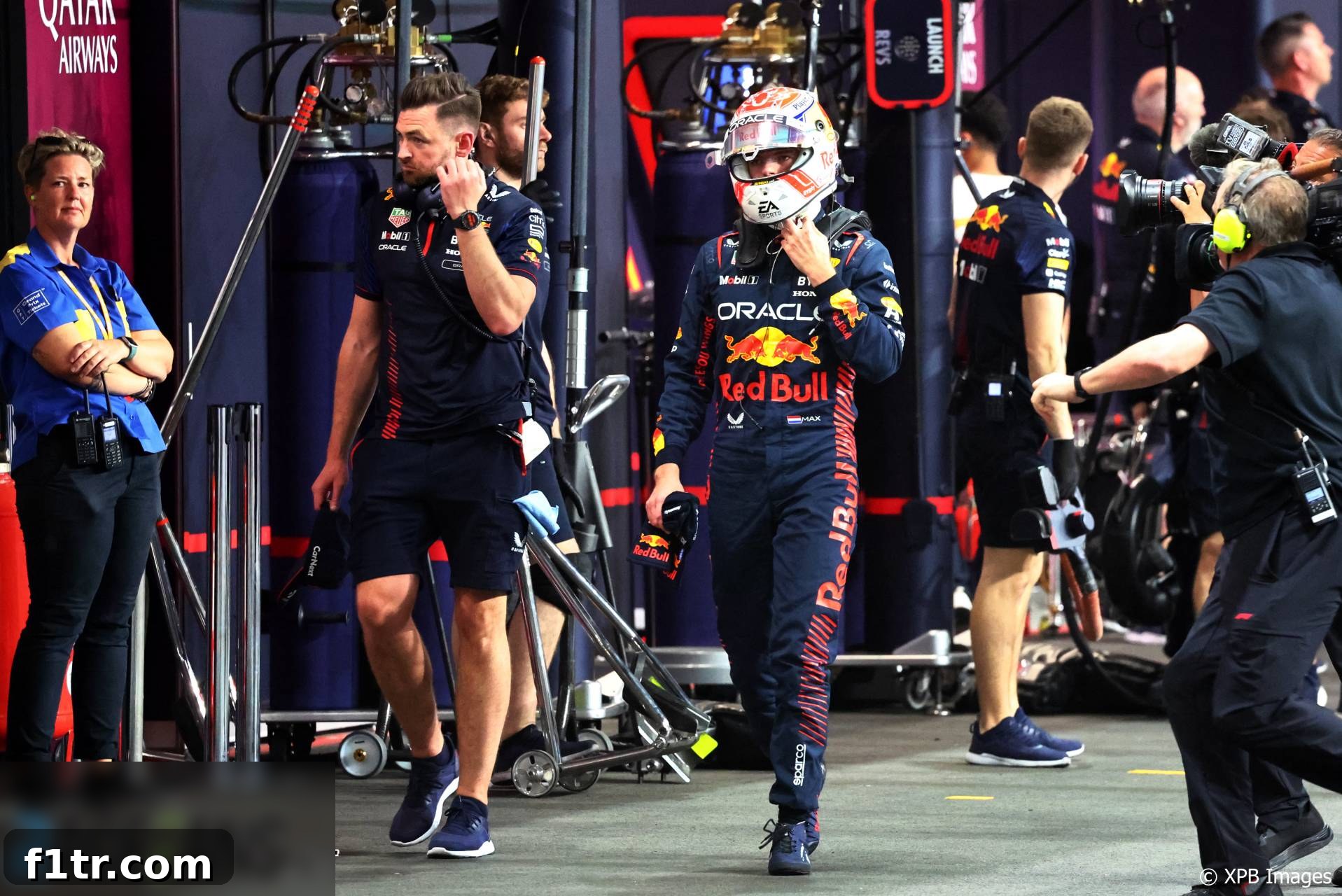
Reigning Formula 1 world champion Max Verstappen has underscored the critical importance of faultless reliability for his Red Bull Racing team, following a driveshaft failure that cruelly dashed his hopes of securing pole position for the Saudi Arabian Grand Prix. The unforeseen mechanical issue, which struck during the crucial Q2 segment of qualifying, relegated the championship leader to a disappointing 15th on the grid for Sunday’s race, a stark contrast to his dominant performance throughout all preceding practice sessions.
The incident unfolded as Verstappen was pushing his RB19 through the high-speed corners of the Jeddah Corniche Circuit. Initially, the Dutch driver suspected a power unit malfunction, relaying his concerns over team radio. However, subsequent analysis by the Red Bull engineering team pinpointed the driveshaft as the culprit, a component failure that left Verstappen and his team grappling with frustration and a sudden reversal of fortunes.
“Out of turn 10 the driveshaft just broke, so that’s really unfortunate,” stated a visibly disappointed Verstappen after the session. “It’s something I don’t quite understand because we haven’t really had any issues with that so far this year. But it did happen, so we will meticulously analyse everything and strive to comprehend precisely how it occurred and, more importantly, prevent a recurrence.” This candid assessment highlights the team’s immediate focus on technical investigation and quality control, a paramount concern when operating at the pinnacle of motorsport.
The failure was a particularly bitter pill to swallow for Verstappen, who had been in imperious form leading up to qualifying. He topped the timesheets in all three free practice sessions, consistently demonstrating the raw pace and exceptional balance of his Red Bull challenger. “It’s been really straightforward, to be honest,” he remarked, reflecting on his pre-qualifying performance. “A much better weekend in general for me personally than even Bahrain, in terms of how comfortable I felt in the car. I think that was clearly reflected in the practice times.” However, he quickly tempered this sentiment, acknowledging the harsh reality: “But all that stellar practice pace means very little when you can’t actually complete qualifying, right? So, we absolutely need to understand what went wrong and ensure such issues are eradicated.”
The sheer speed of the Red Bull RB19 was undeniable; in final practice, the car demonstrated a pace advantage of almost a second per lap over its closest rivals. Yet, Verstappen insisted that this overwhelming performance advantage offered no solace in the face of a critical mechanical breakdown. For a driver of his caliber, fighting for a world championship, the primary objective is flawless execution and maximum points, not just raw speed.
“I think it shouldn’t matter if the car is incredibly quick or not,” he asserted. “I believe you should always be equally disappointed or upset when things go wrong, irrespective of your competitive position. We must absolutely ensure that these kinds of issues do not happen again. It truly doesn’t matter if you’re battling at the very front or struggling at the back of the grid; what every driver demands and deserves is a car that is unfailingly reliable.” This statement underscores a fundamental principle in Formula 1: speed without reliability is ultimately a futile pursuit in the long game of a championship.
The Imperative of Reliability in F1: Beyond Raw Speed
Verstappen’s comments resonate deeply within the world of Formula 1, where the marriage of cutting-edge technology and robust engineering is paramount. A driveshaft, a crucial component responsible for transmitting power from the gearbox to the wheels, represents a critical link in the powertrain chain. Its failure, particularly on a non-impact incident, raises immediate questions within the team’s technical department. Such a mechanical glitch, early in a demanding season, introduces an element of uncertainty that could potentially undermine Red Bull’s seemingly dominant position. While the RB19 has proven to be a formidable machine, capable of extracting immense performance from its chassis and power unit, consistency is key to securing a championship title. Every lost point due to preventable mechanical issues could prove decisive in a tightly contested season, even one where one team appears to have a significant performance advantage.
The incident also highlights the immense pressure on F1 teams to push the boundaries of engineering while maintaining absolute reliability. With strict cost caps and limited component allowances, every failure not only impacts immediate race results but also carries potential strategic and financial ramifications for the rest of the season. Teams must meticulously balance performance gains with the resilience of their components, a challenge that requires constant innovation and rigorous testing. For Red Bull, having demonstrated unparalleled pace, the focus now shifts squarely to ensuring the integrity of every part, allowing their drivers to fully exploit the car’s potential without fear of premature retirement.
Verstappen’s Radio Messages: A Glimpse into the Crisis
The immediate aftermath of a technical failure in Formula 1 is often a tense exchange between driver and race engineer. Verstappen’s radio messages during the driveshaft failure offer a stark and unvarnished insight into the unfolding crisis from the cockpit, as he grappled with a sudden loss of power and the uncertainty of his car’s condition. These rapid-fire communications are vital for both driver safety and for helping the team understand the nature of the problem, allowing them to formulate immediate recovery plans or, if necessary, instruct the driver to stop the car safely.
| Verstappen | I have a problem. Engine, mate, problem. |
| Lambiase | Understood. |
| Verstappen | I don’t know. I put in the clutch. Let me know what I have to do. |
| Lambiase | Will do. |
| Lambiase | Okay you can continue to limp home. |
| Verstappen | It doesn’t sound good. |
| Lambiase | Okay next car coming through Hulkenberg |
| Verstappen | It’s almost not accelerating. |
| Lambiase | Okay understood Max, we’ll do what we can. We’re happy for you to try and limp home if possible. |
| Verstappen | Just give me recommendations, what gear. |
| Lambiase | Can we have recharge on and diff 12. So you’ve got Ocon at five seconds, he’s coming through quickly. |
| Verstappen | Any other cars? |
| Lambiase | Just Magnussen at the moment. Eight seconds. Now six. Five. Recommend letting him through before 27, Max, in case you have an issue. Track clear behind Magnussen. And box. |
| Lambiase | So look out for the weigh bridge. |
This transcript reveals the immediate confusion of a driver experiencing an unexpected failure, initially suspecting the engine due to the loss of power. Gianpiero Lambiase, Verstappen’s race engineer, quickly processes the information, provides instructions to protect the car, and offers crucial situational awareness regarding other cars on track. The instruction to “limp home” highlights the team’s hope of recovering the car to the pits for closer inspection, a common objective in such scenarios. Ultimately, the car couldn’t make it back, leading to the early exit from qualifying.
The Road Ahead: A Challenging Recovery Drive
Starting from 15th position on the grid at the Saudi Arabian Grand Prix presents a formidable challenge, even for a driver of Max Verstappen’s caliber and a car of the RB19’s pace. The Jeddah Corniche Circuit is known for its high speeds and tight walls, offering limited overtaking opportunities and a high risk of incidents. While Verstappen has proven his ability to carve through the field in the past, a recovery drive from so far back will demand a flawless performance, shrewd strategy, and perhaps a stroke of luck. The focus will be on minimizing damage and salvaging as many championship points as possible, turning a qualifying nightmare into a heroic Sunday performance.
For Red Bull Racing, the driveshaft failure is more than just a momentary setback; it’s a stark reminder that even the most dominant teams are not immune to the inherent complexities and fragility of Formula 1 machinery. The team’s diligent analysis and swift resolution of this reliability issue will be crucial for maintaining their championship aspirations. As the season progresses, consistency, underpinned by robust engineering, will be the ultimate differentiator in the relentless pursuit of another world title for Max Verstappen and Red Bull Racing.
2023 Saudi Arabian Grand Prix
- “Total transparency” needed over Ben Sulayem allegations – Russell
- FIA president Ben Sulayem under investigation for interfering in F1 race – report
- Two races, no points: How 2023 compares to McLaren’s worst starts to a season
- Don’t complain about Red Bull dominating F1, they deserve it – Sainz
- Alfa Romeo identify “massive debris” which ruined Bottas’ race
Browse all 2023 Saudi Arabian Grand Prix articles