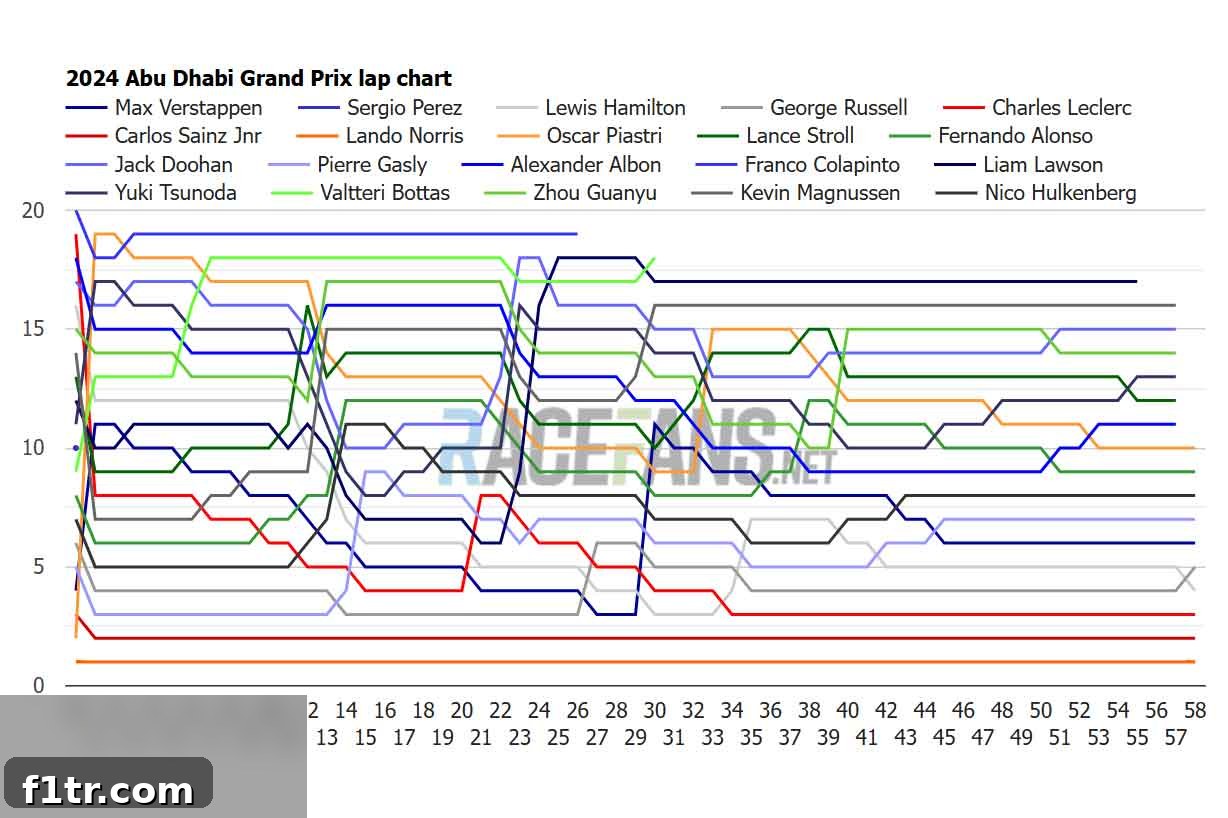
Lewis Hamilton’s impressive drive from a challenging 16th-place grid slot to a commendable fourth position in the Abu Dhabi Grand Prix allowed him to conclude his tenure with Mercedes on a far more positive note than initially anticipated after a difficult Saturday qualifying session. This remarkable recovery showcased his enduring skill and determination, providing a bittersweet farewell as he prepares for a new chapter in his illustrious career.
However, the race also brought into sharp focus a fascinating strategic contrast. Hamilton crossed the finish line just one place behind a competitor, Charles Leclerc, whom he had started three positions ahead of. This outcome prompts a crucial question for strategists and fans alike: did Leclerc’s alternative approach – starting the race on the medium tyre compound instead of the hard tyres favored by Hamilton – reveal a superior strategy that Mercedes perhaps overlooked?
The opening moments of the Abu Dhabi Grand Prix were fraught with drama, creating immediate opportunities for both drivers. A chaotic turn one saw Max Verstappen making contact with Oscar Piastri, sending the McLaren driver into a spin. Simultaneously, Sergio Perez was spun around by Valtteri Bottas. These incidents, while unfortunate for the drivers involved, significantly cleared the path for Hamilton and Leclerc, enabling them to make crucial early gains and setting the stage for their contrasting races. Without these early skirmishes, both drivers would undoubtedly have faced a much tougher challenge in carving their way through the midfield.
Hamilton, uniquely, was the only driver in the field to opt for the hard compound tyres at the start. Despite this seemingly conservative choice, known for its slower warm-up but greater durability, he managed to climb four places on the first lap, beginning lap two in an encouraging 12th position. In stark contrast, Leclerc’s decision to start on the softer medium compound proved instantly advantageous. His Ferrari launched off the line with exceptional traction, allowing him to navigate the opening corners with incredible agility. By the end of the first lap, Leclerc had soared an astonishing 11 positions, completing it in eighth place – a breathtaking surge that was arguably the most spectacular start witnessed all season, solidifying the initial success of his medium tyre gamble.
From this strong initial position, Leclerc continued to make impressive progress on his medium tyres. By lap 12, he had expertly dispatched formidable rivals such as Fernando Alonso and the resilient Haas duo, steadily climbing the order. Meanwhile, Hamilton, still grappling with the hard compound tyres, was only just beginning to make significant inroads into the midfield pack as their softer tyres naturally began to degrade. As several competitors started making their mandatory pit stops, the race picture rapidly evolved. Within just two more laps, a remarkable turn of events saw only Max Verstappen separating Hamilton from Leclerc on the track. Adding to the intrigue, Verstappen was carrying a looming 10-second time penalty, which, once served, would inevitably drop him behind the Mercedes, further consolidating Hamilton’s position.
Ferrari’s strategic decision to bring Leclerc in early for his first pit stop was a calculated move designed to diversify their strategy options between their two drivers. This aggressive approach aimed to exert maximum pressure on the race leaders and their championship rivals, McLaren, by creating an undercut opportunity or forcing others to react. At this critical juncture, a Safety Car intervention would have had significant implications for Hamilton, potentially forcing him onto the medium tyres earlier than desired and leaving him vulnerable in the latter stages of the race. However, much to Mercedes’ relief, no such intervention occurred, allowing Hamilton to execute his planned long stint on the hard compound tyres.
Hamilton steadfastly extended his first stint on the hard tyres until lap 34, a testament to the compound’s durability and his meticulous tyre management, making him the last driver in the leading pack to pit. By this time, Verstappen had finally completed his pit stop. Mercedes, ever calculating, waited as long as they possibly dared, pushing the limits of Hamilton’s tyre life to ensure that when he eventually pitted, he would emerge back on track ahead of the reigning world champion, a strategic masterstroke that paid off handsomely and kept him in contention for a strong finish.
Following his pit stop, Hamilton truly came alive on the fresh medium compound tyres for his final stint. He unleashed a blistering pace, consistently setting the fastest laps of the race as he relentlessly pursued his teammate, George Russell. The intensity of his charge culminated in a thrilling overtake on Russell on the very final lap, a fitting display of his competitive spirit. At one point, his team even suggested that a podium finish might be within reach, fueling the Mercedes garage with anticipation. However, despite Leclerc’s older hard tyres showing signs of degradation towards the end of the race, the Ferrari driver had built up a sufficient time advantage to fend off Hamilton’s late surge, securing his hard-fought position and denying Hamilton a fairytale podium finish.
This raises the compelling strategic debate: could Lewis Hamilton have achieved an even better result if he had mirrored Charles Leclerc’s medium-to-hard tyre strategy? Leclerc’s phenomenal start was undeniably the cornerstone of his entire race. While his softer rubber certainly provided a significant traction advantage during those chaotic opening moments, it’s crucial to acknowledge Leclerc’s exceptional racecraft and opportunistic driving. He didn’t just benefit from the right tyres; he brilliantly exploited every opportunity that presented itself amidst the opening lap chaos. Race starts are inherently unpredictable, a delicate balance of tyre performance, driver skill, and sheer luck. Leclerc’s masterful execution demonstrated that he was not only on the optimal tyres at the perfect moment but also possessed the positional awareness and aggression to place his car exactly where it needed to be to maximize his gains, making his strategy a resounding success tailored to his driving style and the unfolding circumstances.
Adding a quirky footnote to the strategic battles, Kevin Magnussen unexpectedly claimed the fastest lap of the race. Hamilton’s scorching pace in the final stint strongly suggested he was poised to secure this bonus point. However, in a commendable gesture, Haas decided to inject some excitement into Magnussen’s final race with the team. Having been unfortunately taken out of contention earlier in the proceedings when he became Valtteri Bottas’s second victim, the team gave him the green light to push for the fastest lap, providing a memorable, albeit non-scoring, send-off.
Equipped with a fresh set of soft tyres, Magnussen delivered an extraordinary lap time of 1’25.637, a full second and a half quicker than any other driver managed during the race. As he finished a distant 16th, he was not eligible to score the single bonus point that typically accompanies the fastest lap. This race marked the final instance of this particular bonus point rule, as it is set to be dropped from the regulations. Thus, what many considered F1’s least necessary rule exited the stage in a blaze of irrelevance, perfectly encapsulated by Magnussen’s impressive yet unrewarded effort. This final, dramatic flourish from a driver far down the order highlighted the peculiar nature of the rule and its imminent departure from the sport’s lexicon.
2024 Abu Dhabi Grand Prix Lap Chart: A Visual Journey Through Race Positions
Delve into the dynamic shifts of the Abu Dhabi Grand Prix with our interactive lap chart. This detailed visualization tracks the position of each driver on every single lap, offering a clear perspective on overtakes, strategic moves, and how the race unfolded for each competitor. Click on a driver’s name to highlight their individual progress throughout the Grand Prix, or right-click to reset the view and explore other storylines. Utilize the controls below to toggle drivers on and off, allowing for a customized analysis of the race narrative.
2024 Abu Dhabi Grand Prix Race Chart: Analyzing Gaps and Performance Trends
Gain deeper insights into the performance differentials across the field with our comprehensive race chart. This visual tool illustrates the gaps between each driver on every lap, benchmarked against the leader’s average lap time. Very large, unrepresentative gaps have been omitted for clarity, ensuring a focused view on competitive interactions. Use the scroll function to zoom in on specific race segments, drag to pan across the timeline, and right-click to reset the chart. The controls provided below enable you to toggle various drivers, facilitating a detailed comparison of their on-track performance and strategic pacing.
Go Ad-Free for Just £1 Per Month: Enhance Your RaceFans Experience>> Discover the benefits and sign up today
2024 Abu Dhabi Grand Prix Lap Times: Unpacking Every Second of the Action
Explore the raw performance data with our detailed breakdown of all driver lap times from the 2024 Abu Dhabi Grand Prix. Presented in seconds, with excessively slow laps (e.g., due to pit stops or incidents) intelligently excluded to provide a clearer picture of true racing pace. Navigate through the data by scrolling to zoom, dragging to pan across the race timeline, and toggling drivers using the intuitive control panel below for a comparative analysis of individual performance curves throughout the Grand Prix.
2024 Abu Dhabi Grand Prix Fastest Laps: The Ultimate Speed Test
Witness the pinnacle of speed from the 2024 Abu Dhabi Grand Prix with a comprehensive list of each driver’s fastest lap during the race. This table highlights the blistering pace set by the quickest drivers on the circuit.
| Rank | # | Driver | Car | Lap time | Gap | Avg. speed (kph) | Lap no. |
|---|---|---|---|---|---|---|---|
| 1 | 20 | Kevin Magnussen | Haas-Ferrari | 1’25.637 | 222 | 57 | |
| 2 | 44 | Lewis Hamilton | Mercedes | 1’27.278 | 1.641 | 217.83 | 44 |
| 3 | 4 | Lando Norris | McLaren-Mercedes | 1’27.438 | 1.801 | 217.43 | 52 |
| 4 | 81 | Oscar Piastri | McLaren-Mercedes | 1’27.690 | 2.053 | 216.8 | 51 |
| 5 | 1 | Max Verstappen | Red Bull-Honda RBPT | 1’27.765 | 2.128 | 216.62 | 56 |
| 6 | 55 | Carlos Sainz Jnr | Ferrari | 1’27.765 | 2.128 | 216.62 | 55 |
| 7 | 14 | Fernando Alonso | Aston Martin-Mercedes | 1’27.948 | 2.311 | 216.17 | 51 |
| 8 | 24 | Zhou Guanyu | Sauber-Ferrari | 1’27.982 | 2.345 | 216.09 | 56 |
| 9 | 16 | Charles Leclerc | Ferrari | 1’28.018 | 2.381 | 216 | 51 |
| 10 | 63 | George Russell | Mercedes | 1’28.195 | 2.558 | 215.56 | 56 |
| 11 | 18 | Lance Stroll | Aston Martin-Mercedes | 1’28.604 | 2.967 | 214.57 | 42 |
| 12 | 30 | Liam Lawson | RB-Honda RBPT | 1’28.751 | 3.114 | 214.21 | 52 |
| 13 | 61 | Jack Doohan | Alpine-Renault | 1’29.121 | 3.484 | 213.32 | 56 |
| 14 | 27 | Nico Hulkenberg | Haas-Ferrari | 1’29.152 | 3.515 | 213.25 | 17 |
| 15 | 22 | Yuki Tsunoda | RB-Honda RBPT | 1’29.200 | 3.563 | 213.13 | 41 |
| 16 | 10 | Pierre Gasly | Alpine-Renault | 1’29.212 | 3.575 | 213.11 | 37 |
| 17 | 43 | Franco Colapinto | Williams-Mercedes | 1’29.411 | 3.774 | 212.63 | 5 |
| 18 | 23 | Alexander Albon | Williams-Mercedes | 1’29.438 | 3.801 | 212.57 | 46 |
| 19 | 77 | Valtteri Bottas | Sauber-Ferrari | 1’29.482 | 3.845 | 212.46 | 14 |
2024 Abu Dhabi Grand Prix Tyre Strategies: Decoding Every Team’s Choices
Unravel the intricate strategic decisions behind each team’s tyre choices throughout the 2024 Abu Dhabi Grand Prix. This comprehensive chart visually represents the tyre compounds used by every driver during each stint, offering critical insights into how different strategies played out. Analyze the bold decisions, the conservative approaches, and the tactical gambles that shaped the race results, providing a complete overview of the tyre battle.
2024 Abu Dhabi Grand Prix Pit Stop Times: The Race Against the Clock
Examine the crucial moments in the pit lane with our detailed table of every driver’s pit stop times during the 2024 Abu Dhabi Grand Prix. This data reveals the efficiency of each team’s pit crew, showing the complete stop time (including entry, stationary time, and exit) and the gap to the fastest stop. Analyze how pit stop durations impacted race positions, highlighting the precision and speed required to minimize time lost during these vital strategic interventions.
| Rank | # | Driver | Team | Complete stop time (s) | Gap to best (s) | Stop no. | Lap no. |
|---|---|---|---|---|---|---|---|
| 1 | 4 | Lando Norris | McLaren | 21.276 | 1 | 26 | |
| 2 | 55 | Carlos Sainz Jnr | Ferrari | 21.28 | 0.004 | 1 | 25 |
| 3 | 27 | Nico Hulkenberg | Haas | 21.53 | 0.254 | 1 | 13 |
| 4 | 63 | George Russell | Mercedes | 21.656 | 0.38 | 1 | 26 |
| 5 | 20 | Kevin Magnussen | Haas | 21.678 | 0.402 | 2 | 29 |
| 6 | 44 | Lewis Hamilton | Mercedes | 21.694 | 0.418 | 1 | 34 |
| 7 | 16 | Charles Leclerc | Ferrari | 21.869 | 0.593 | 1 | 20 |
| 8 | 22 | Yuki Tsunoda | RB | 21.869 | 0.593 | 1 | 22 |
| 9 | 18 | Lance Stroll | Aston Martin | 22.053 | 0.777 | 2 | 32 |
| 10 | 10 | Pierre Gasly | Alpine | 22.059 | 0.783 | 1 | 14 |
| 11 | 23 | Alexander Albon | Williams | 22.065 | 0.789 | 1 | 12 |
| 12 | 61 | Jack Doohan | Alpine | 22.08 | 0.804 | 1 | 22 |
| 13 | 20 | Kevin Magnussen | Haas | 22.09 | 0.814 | 4 | 55 |
| 14 | 14 | Fernando Alonso | Aston Martin | 22.437 | 1.161 | 2 | 37 |
| 15 | 20 | Kevin Magnussen | Haas | 22.815 | 1.539 | 3 | 30 |
| 16 | 24 | Zhou Guanyu | Sauber | 23.024 | 1.748 | 1 | 12 |
| 17 | 18 | Lance Stroll | Aston Martin | 23.266 | 1.99 | 1 | 11 |
| 18 | 14 | Fernando Alonso | Aston Martin | 23.326 | 2.05 | 1 | 13 |
| 19 | 30 | Liam Lawson | RB | 23.415 | 2.139 | 1 | 23 |
| 20 | 81 | Oscar Piastri | McLaren | 23.582 | 2.306 | 1 | 4 |
| 21 | 43 | Franco Colapinto | Williams | 24.941 | 3.665 | 1 | 3 |
| 22 | 20 | Kevin Magnussen | Haas | 26.363 | 5.087 | 1 | 12 |
| 23 | 24 | Zhou Guanyu | Sauber | 28.765 | 7.489 | 2 | 39 |
| 24 | 1 | Max Verstappen | Red Bull | 32.652 | 11.376 | 1 | 29 |
| 25 | 81 | Oscar Piastri | McLaren | 32.774 | 11.498 | 2 | 32 |
| 26 | 77 | Valtteri Bottas | Sauber | 41.144 | 19.868 | 1 | 6 |
Don’t Miss a Moment: Subscribe to RaceFans for Exclusive Updates
Get a daily email with all our latest stories – meticulously curated, with no marketing fluff and absolutely no ads. Sign up here to stay fully informed:
Explore More: 2024 Abu Dhabi Grand Prix Related Articles
- Did Tsunoda ‘destroy’ his team mates – and are Red Bull wrong to pick Lawson over him?
- McLaren were ‘0.7 seconds away from losing the title’ in Abu Dhabi – Brown
- Another name change for RB and new driver numbers revealed in 2025 F1 entry list
- Ranked: The Formula 1 cars of 2024, from slowest to fastest
- McLaren are world champions with fewest grand prix wins in 25 years
Browse all 2024 Abu Dhabi Grand Prix articles