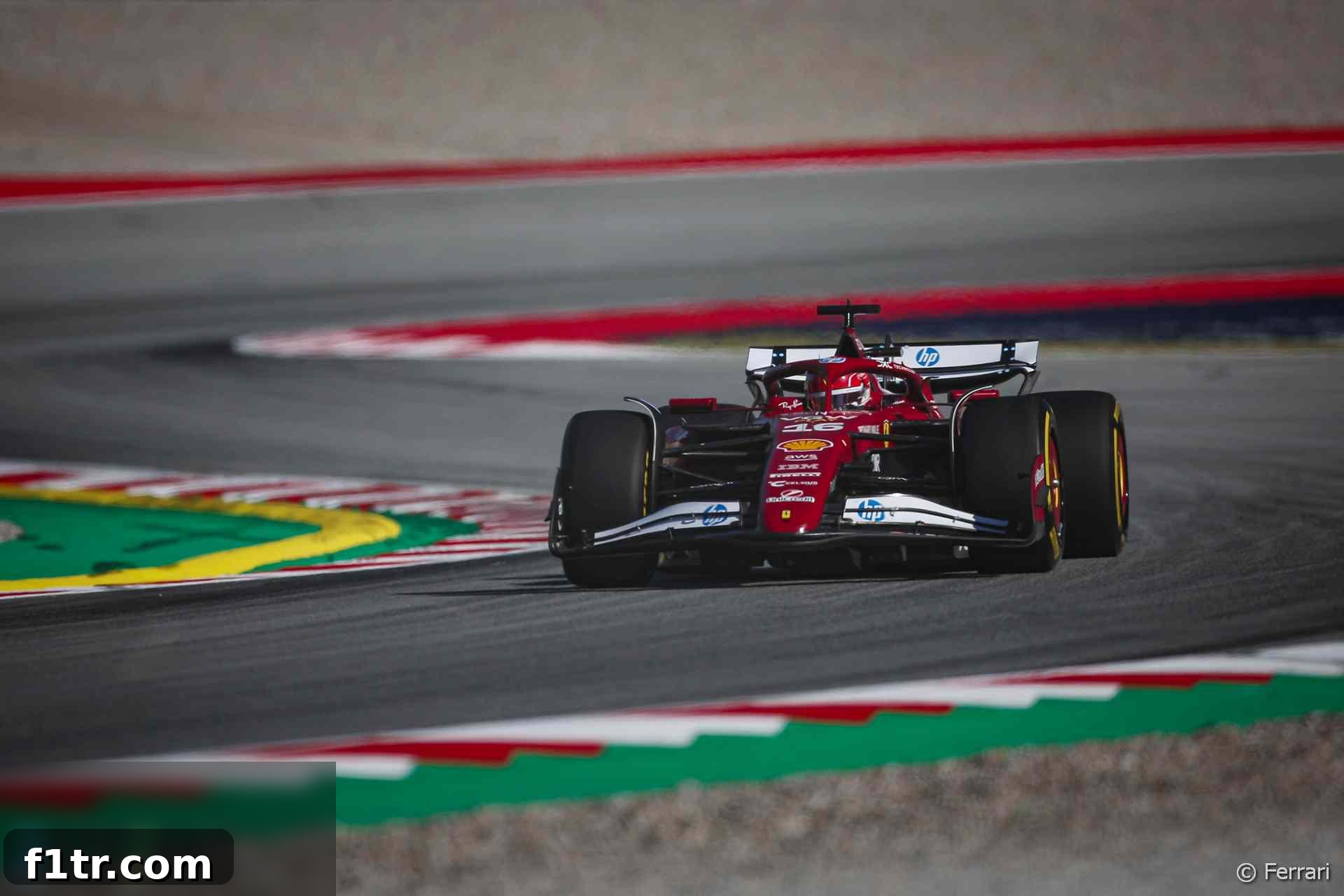
In a bold strategic move ahead of the Spanish Grand Prix, Ferrari team principal Frederic Vasseur confirmed that the Scuderia deliberately put Charles Leclerc at a disadvantage in qualifying to prioritize his race strategy. This calculated decision, centered around specific tyre selections, saw Leclerc starting the hotly contested Barcelona event from seventh on the grid, despite showing promising pace early in the final qualifying session.
Leclerc’s journey through qualifying was unconventional. After a strong first run in Q3, which saw him momentarily P4 and even ahead of Max Verstappen, he did not complete a second flying lap. This unusual tactic stemmed directly from Ferrari’s pre-planned tyre allocation, aimed at conserving fresh rubber for Sunday’s race. The team’s rationale is rooted in their performance trend throughout the current season: consistently demonstrating stronger race pace compared to their single-lap qualifying performance.
Ferrari’s Calculated Gamble: Prioritizing Race Pace Over Grid Position
Frederic Vasseur elaborated on the team’s thinking, highlighting their unwavering focus on Sunday’s main event. “With Charles, we decided from the beginning to be focused on the race,” Vasseur told the official F1 channel. This commitment meant making significant sacrifices during Saturday’s qualifying sessions. “We saved two sets of new mediums for tomorrow, one set of softs. For sure, you therefore have less tyres for the quali,” he explained, underlining the direct impact on Leclerc’s qualifying efforts.
The choice to save these particular tyre compounds is highly strategic. New medium tyres offer greater flexibility in race strategy, allowing for longer stints and opening up various pit stop window possibilities. They also typically provide more consistent performance over extended periods, which is crucial on a demanding circuit like Barcelona-Catalunya, known for its high-speed corners and significant tyre degradation.
Vasseur expressed satisfaction with Leclerc’s execution, considering the constraints he faced. “It means that we had one attempt [in Q3]. I think the lap time that he did on the first stint was good, it was P4, he was in front of Max [Verstappen]. I think that it means that it was a good lap.” This initial strong showing by Leclerc, even with a compromised tyre strategy, speaks volumes about his inherent pace and the car’s potential in optimal conditions.
However, the team principal acknowledged the inherent trade-offs involved in such a high-stakes decision. “Now, for sure, when you do a choice like this, you have pros and cons. We sacrificed a little bit the quali for the race, but with the high temperature and the degradation, we hope that it’s a good choice.” The Spanish Grand Prix is often characterized by high ambient and track temperatures, which exacerbate tyre wear. Ferrari is banking on their superior fresh tyre allocation to give them a tangible advantage as the race unfolds and competitors struggle with worn rubber.
Charles Leclerc Navigates a Challenging Qualifying Session
From the driver’s seat, Charles Leclerc confirmed the difficulty of qualifying with fewer new tyres than his rivals. “I think we were one of the only cars that had four [sets of] softs going into quali, which was very difficult already,” he stated. Normal qualifying procedure often sees top teams having five or even six sets of new soft tyres available to navigate Q1, Q2, and Q3, allowing for multiple attempts and maximum performance extraction.
Leclerc’s challenge was compounded early on. “Then we had to go out in Q1 once again and [that] means we sacrificed another soft. So I only had three new softs for Q1, Q2 and Q3 against others that had five new softs.” This meant that for crucial segments of qualifying, Leclerc had significantly fewer opportunities to set a representative lap time on fresh, optimal rubber. Each run carried greater pressure, and the margin for error was considerably smaller.
Despite the inherent handicap, Leclerc remained pragmatic and hopeful about the overall strategy. “So it was a bit tricky, but it’s the way it is. I hope that our tyre choice will pay off for tomorrow because on the other hand tomorrow we have more new than others.” His comments underscore the team’s long-term vision, prioritizing potential race gains over a higher grid slot in qualifying.
This strategic decision by Ferrari for the Spanish Grand Prix is a testament to the complex interplay of factors in modern Formula 1. On a circuit like Barcelona-Catalunya, renowned for its technical demands and often high tyre degradation, tyre management becomes paramount. The circuit’s layout, featuring a mix of high-speed corners and a relatively abrasive surface, puts immense stress on the tyres, making the preservation of fresh compounds a potentially race-winning factor.
The Strategic Implications for Race Day
The advantages of having fresh tyres, particularly new mediums, cannot be overstated in a race scenario. With two new sets of mediums and an additional new soft tyre at his disposal, Charles Leclerc will have significantly more strategic flexibility than many of his direct competitors. This could manifest in several ways:
- Extended Stints: Leclerc might be able to run longer stints on his initial set of tyres, potentially allowing him to undercut or overcut rivals during pit stop windows.
- Optimal Pit Stop Windows: The availability of fresh rubber provides more options for pit stop timing, allowing Ferrari to react more dynamically to safety cars, virtual safety cars, or unexpected race events.
- Stronger Performance in Key Phases: Having fresh tyres for the latter half of the race could give Leclerc a performance edge when other drivers are struggling with heavily degraded tyres, enabling him to push harder and potentially make overtakes.
- Defensive Capabilities: Fresh tyres also offer better grip and speed for defending positions against challengers on older compounds.
Ferrari’s confidence in their car’s race trim, as opposed to its qualifying trim, has been a recurring theme this season. While other teams might prioritize a front-row start for track position, Ferrari seems willing to sacrifice a few grid places to ensure their drivers have the best possible tools for a sustained fight for points and podiums on Sunday. This approach is particularly relevant for a team aiming for consistent championship contention, where maximizing points on every race day is more crucial than a single Saturday glory run.
The Spanish Grand Prix often serves as a crucial benchmark for car performance due to its familiar nature and demanding layout. If Ferrari’s gamble pays off, it will not only validate their strategic acumen but also provide valuable data for their ongoing car development and future race strategies. The high temperatures predicted for race day only amplify the potential impact of superior tyre management, making Leclerc’s conserved compounds even more valuable.
As the grid lines up for the start of the Spanish Grand Prix, all eyes will be on Charles Leclerc to see if Ferrari’s calculated risk transforms into a strategic masterstroke. His starting position of seventh belies the underlying potential the team believes he has for a strong race performance, fueled by their unconventional but potentially rewarding tyre allocation strategy. The true test of this decision will unfold over the demanding laps of the Circuit de Barcelona-Catalunya, where tyre longevity and strategic precision often dictate success.
The season has already seen Ferrari demonstrate flashes of brilliance, particularly in races where tyre degradation is a major factor. This strategic play in Spain could be a defining moment, showcasing their evolving understanding of their car and their willingness to deviate from conventional wisdom to gain an advantage. Fans and pundits alike will be watching closely to see if this sacrifice in qualifying translates into a triumphant drive on Sunday.
The team’s long-term goal for the 2025 season is clear: to be competitive and consistent. By opting for a strategy that optimizes for race day, Ferrari is signaling its intent to fight for every possible point. This comprehensive approach, balancing immediate qualifying performance with the broader objectives of the championship, underlines the sophistication required at the pinnacle of motorsport.