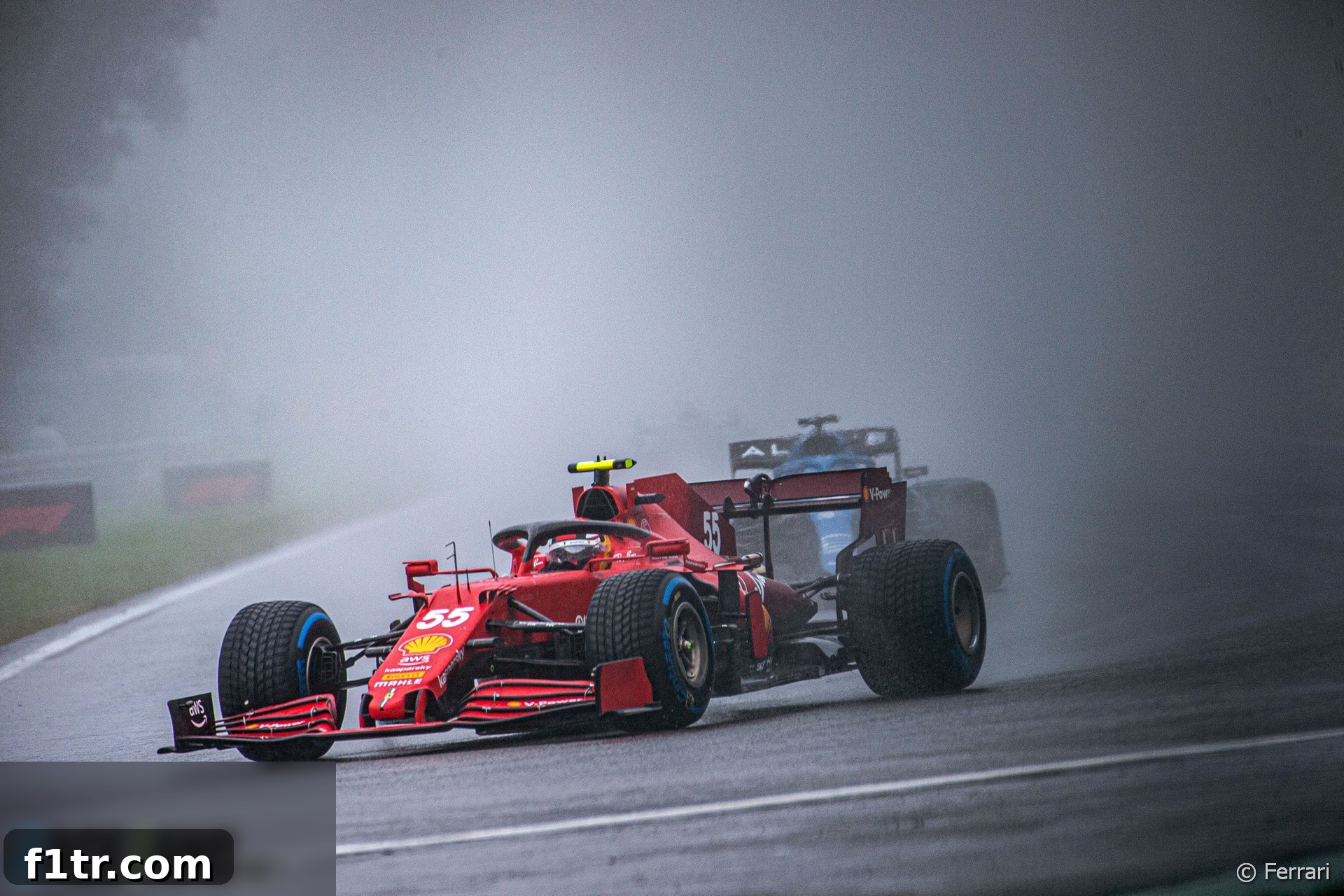
2021 Belgian Grand Prix: Safety, Disappointment, and the Enduring Spirit of Racing at Spa
The 2021 Belgian Grand Prix at the iconic Spa-Francorchamps circuit will forever be etched in Formula 1 history as one of its most controversial events. Torrential rain transformed the challenging track into a treacherous landscape, leading to an unprecedented scenario where the race effectively consisted of just a handful of laps behind the Safety Car, ultimately resulting in half-points being awarded. This outcome sparked widespread debate among drivers, teams, officials, and, most vocally, the thousands of dedicated fans who endured the relentless downpour.
At the heart of the controversy were paramount concerns over driver safety, a sentiment strongly echoed by competitors like Carlos Sainz Jnr. His candid remarks following the bizarre events highlighted the extreme risks involved, painting a vivid picture of the impossible conditions faced by the world’s elite racing drivers. This extraordinary race weekend brought into sharp focus the delicate balance between sporting spectacle, commercial interests, and the absolute necessity of ensuring participant well-being.
Carlos Sainz Jnr on Unavoidable Dangers at a Soaked Spa
Ferrari driver Carlos Sainz Jnr was unequivocal in his assessment of the conditions at Spa-Francorchamps during the ill-fated 2021 Belgian Grand Prix. He articulated that the visibility was so severely compromised that drivers would have been utterly incapable of avoiding collisions if the race had proceeded under normal circumstances. This stark warning underscored the gravity of the situation, emphasizing that even the most skilled drivers would be helpless against the elements.
Sainz went further, suggesting that the only feasible way to have any on-track action during the prolonged rain delay would have been a ‘super pole’ style session, where cars navigated the circuit one by one. “One by one, we could have done a ‘super pole’ today, no problem,” Sainz stated, highlighting that the challenge wasn’t necessarily the track itself, but the collective blindness induced by spray. “We could’ve gone through Eau Rouge, this was not the issue. The issue was visibility and the two laps that we did behind the Safety Car, the tyres cool down to zero and you’re going to go into Eau Rouge and into that straight with zero visibility.”
His concerns about cold tires compounding the visibility problem were particularly poignant. Entering high-speed sections like Eau Rouge with minimal grip and no forward sight creates an almost unimaginable hazard. Sainz painted a chilling scenario: “If someone spins in front of you with cold tyres, I’m telling you that if P10 crashes, back to P20 everyone hits him and this is where a big accident at 300kph could happen.” This powerful statement served as a stark reminder of the potential for a catastrophic multi-car pile-up, solidifying the arguments for prioritizing safety above all else, even at the cost of a full race. The drivers’ collective experience and deep understanding of these conditions proved crucial in informing the difficult decisions made by race control.
F1 and Spa-Francorchamps Address Fan Disappointment
The aftermath of the 2021 Belgian Grand Prix saw Formula 1 Management and the Spa-Francorchamps circuit issue sympathetic statements directed at the thousands of fans who had patiently endured a day of relentless rain, only to witness minimal on-track action. The circuit management, Spa Grand Prix SA, expressed its “deepest disappointment” over the outcome, acknowledging the immense effort that went into preparing for the event. They praised the “tenacity” and “exemplary” behavior of the fans, many of whom stayed throughout the continuously wet day, hoping for a return to racing.
“It started well, the show was there, but the weather conditions were not in our control and the decision made by the race direction must be respected, as the safety of the drivers must remain the priority,” read the circuit’s statement. This highlighted the unavoidable nature of the weather and the ultimate responsibility of race officials to safeguard participants. The statement further lauded the crowd: “We share the disappointment of our customers, who have been exemplary in the way they have suffered this incredible day, but also in the way the evacuation has been carried out. This underlines, once again, the quality and the perfect behaviour of our public of enthusiasts.”
Formula 1 echoed these sentiments, expressing regret for the lack of racing but firmly standing by the stewards’ decisions. “Following the significant weather disruption to the 2021 FIA Formula 1 Belgian Grand Prix, the FIA and Formula 1 are disappointed for all the fans at the track and at home that today’s race could not go to full distance, but the safety of the drivers, marshals and spectators must always be the priority.” The organization explained that every possible opportunity was given to maximize running, with the stewards extending the window for the race. However, “the weather conditions unfortunately did not improve sufficiently to complete more laps.” While both parties conveyed their understanding and regret, no immediate plans for financial compensation were announced, though reports suggested these considerations were underway, leaving many fans feeling short-changed despite the safety rationale.
The social media landscape quickly filled with strong opinions. Veteran F1 journalist Paul-Henri Cahier critically remarked, “The best race drivers in the world have completed a two lap race behind a safety car. Race officially completed. Spectators won’t have to be refunded. Well done.” This sentiment reflected a widespread frustration among fans and observers who felt the decision to award points after such limited running, particularly when it might impact championship standings, was driven by commercial rather than sporting integrity. Damon Hill, a former F1 champion, offered a contrasting view, supporting the race director Michael Masi’s “brave decision,” stating, “If the race had gone ahead and there had been a serious accident, we’d be asking why he started the race. Tough. But ultimately a mature thing to do.” These diverse reactions underscored the complexity of the situation and the inherent conflict between safety, entertainment, and the financial implications for organizers and broadcasters.
Daniel Ricciardo: The Pursuit of Passion Beyond Profit
Amidst the unusual and disappointing backdrop of the 2021 Belgian Grand Prix, McLaren driver Daniel Ricciardo marked a significant personal milestone: his 200th Grand Prix start. This occasion prompted a reflection from the popular Australian driver about his motivations for competing in Formula 1, revealing a profound and unwavering love for the sport that transcends financial reward.
Ricciardo asserted that he would continue racing only as long as his primary drive remained his genuine passion, rather than monetary incentives. When directly asked if he would still be driving in Formula 1 without a salary, his answer was a resounding “yes.” This introspective response offered a rare glimpse into the mindset of a top-tier athlete in a highly commercialized sport. “Maybe it’s the age in me but I do ask myself that question and the answer is ‘yes’,” Ricciardo mused. “And I think the day the answer is ‘no’ is then the day I have to stop racing.”
His philosophy stems from his childhood dreams, where the allure of racing was pure and untainted by external pressures. “I am pretty good at kind of checking myself on that and as a kid, I never did it to be on TV, to get paid money, it was because I loved it,” he explained. This candid insight resonates with many who believe that true sporting greatness comes from an innate desire to compete and excel. Ricciardo’s commitment to self-awareness means he constantly evaluates his internal compass. “The day that becomes outweighed or overpowered by the money or the fame or whatever it is, then that’s simply the day I have enough, inner awareness, self awareness to say, ‘alright, I’m done with this.'” His declaration served as a powerful testament to the enduring spirit of motorsport, where for some, the thrill of competition and the love of the craft remain the ultimate motivators, even during events as frustrating and bizarre as the 2021 Belgian Grand Prix.
The Half-Points Controversy: A Divisive Decision
One of the most contentious aspects of the 2021 Belgian Grand Prix was the decision to award half-points to the drivers despite the minimal running. This move ignited a fierce debate, with many fans and pundits arguing that it undermined the integrity of the sport, as competitors received championship points for what was essentially a procession behind a Safety Car, with no actual racing laps completed. Critics pointed to the unprecedented nature of the situation, where a “race” was declared after just a few laps, seemingly to satisfy regulatory requirements for points distribution and commercial agreements.
However, not everyone viewed the decision negatively. One prominent perspective, shared by F1 Frog in a widely discussed “comment of the day,” defended the awarding of points, particularly in the context of the championship battle. F1 Frog argued, “If you just take the title protagonists as an example, Verstappen has gained five points on Hamilton. Some may say that is unfair as he didn’t have to beat him in the race to gain those points, but the fact that he took pole and Hamilton was only third means that if there had been a race, it is most likely that Verstappen would have gained some points on Hamilton, so the half-points are fair.”
This argument hinges on the idea that qualifying performance, which determined the starting grid, was a legitimate measure of potential on-track superiority. Therefore, partially acknowledging that performance through half-points, even without a full race, provided a pragmatic solution to a challenging situation. F1 Frog further suggested that much of the anger stemmed from the sheer frustration of the day rather than a fundamental flaw in the decision-making: “Nothing wrong with what Masi did today, I think it’s just the anger of watching replays of people pulling trollies in slow motion and rain falling for four hours that is getting to people. Nowhere to point the blame today, except at the weather gods.” The debate surrounding the half-points highlighted the complexities of F1 regulations and the difficulty of finding universally accepted solutions when faced with extreme, unforeseen circumstances.