As the curtain fell on the 2021 Formula 1 season, Mattia Binotto, the esteemed team principal of Scuderia Ferrari, confidently heralded a new era. He declared that the legendary Italian outfit had emerged from two challenging campaigns with a revitalized team culture, anchored by four fundamental principles: relentless innovation, transforming mistakes into valuable learning opportunities, fostering a collective sense of responsibility, and an indomitable team spirit. This fresh philosophy was intended to propel the Prancing Horse back to its rightful place at the pinnacle of motorsport.
However, by the time the 2022 Formula 1 season reached its highly anticipated Italian Grand Prix at Monza – Ferrari’s cherished home race – any lingering hopes of a world championship title had been brutally quashed. The sheer, unwavering speed and consistency of Max Verstappen and Red Bull Racing had made a seemingly insurmountable gap in the standings. Yet, despite the championship despair, every member representing the Scuderia in the Monza paddock that weekend, from the dedicated mechanics and welcoming hospitality staff to Binotto himself, was determined to showcase that the promised team spirit remained vibrant and intact.
The 2022 season had been a relentless test for Ferrari. For fifteen gruelling rounds, the team had endured intense scrutiny from all corners of the F1 world. Every strategic misstep, every operational slip-up, and every driver error provided an endless stream of content for creators across the internet, who mercilessly scrutinized and mocked Maranello’s storied team. Race commentators, both on air and online, openly chastised Ferrari’s often perplexing strategy calls every Sunday, adding to the mounting pressure.
In Italy, where Ferrari’s status as the most revered automotive brand on the planet is a source of immense national pride, the frustration stemming from the team’s failures reached a boiling point. The dissatisfaction was palpable, with vivid red stickers boldly proclaiming ‘BinottOut’ appearing on lampposts, park benches, and various other public fixtures scattered around the historic grounds of Monza. This public display of discontent underscored the passionate, yet often unforgiving, nature of the Tifosi.
While the critiques from pundits or the disgruntled murmurs of a few ticketholders could often be brushed aside, the pronouncements of Ferrari’s influential chairman, John Elkann, carried undeniable weight. With both Elkann and the esteemed Italian President attending the circuit on race day Sunday, Ferrari knew that nothing short of their absolute best performance would be deemed acceptable. The stakes for the Italian Grand Prix were not just about points; they were about national pride and the very image of the iconic Scuderia.
It was no surprise, then, that Charles Leclerc had been absolutely ecstatic to secure pole position for the race during Saturday afternoon’s qualifying session. This achievement, however, came with a significant asterisk. Max Verstappen was already slated to incur a five-place grid penalty for utilizing a fourth power unit component, while Carlos Sainz Jr., Lewis Hamilton, and Sergio Perez were all destined for the back of the grid due to similar technical infringements. Despite these numerous penalties affecting key rivals, Leclerc’s pole was still a remarkable feat, as he had genuinely outpaced Verstappen on merit for the first time in four rounds. This provided Ferrari with their most promising opportunity for victory on Sunday. Leclerc’s immediate task was clear: he needed to win the sprint to the Rettifilo chicane against his front-row companion, George Russell.
As the five red lights extinguished, signalling the start of the race, the Mercedes of Russell launched off the line with a getaway just as strong and immediate as Leclerc’s Ferrari. For a fleeting second, Russell’s front wheels drew level with Leclerc’s rear, a tight squeeze into the first braking zone. The Mercedes then decisively switched from the inside line, diving aggressively down the outside of the Ferrari under heavy braking for the Rettifilo chicane. Russell bravely held his ground around the outside through the right-hander. However, Leclerc, acutely aware of the crucial inside line for the subsequent left-hand turn, had no intention of relinquishing it. Russell, forced wide, bounced over the kerbs on the inside runoff area, narrowly re-emerging ahead of Leclerc for a brief moment. The battle was intense and immediate.
“He just pushed me wide,” Russell immediately protested over his team radio, even as Leclerc, leveraging his superior traction on exit, swiftly regained the lead, solidifying his position at the front of the pack.
As the tightly packed field navigated Curva Grande for the very first time, Leclerc and Russell led a promising charge, followed by two previous Monza winners: Daniel Ricciardo’s McLaren in a strong third position, and Pierre Gasly’s AlphaTauri securing fourth. Meanwhile, Max Verstappen, starting from seventh on the grid due to his penalty, had already demonstrated his formidable pace. By the time he emerged from the Rettifilo chicane, he had effortlessly dispatched two cars, his Red Bull carving through the pack with ominous ease. Gasly’s hold on fourth place proved fleeting, lasting only approximately 40 seconds longer before Verstappen executed a daring lunge down the inside under braking for Ascari. His relentless quest to seize the lead, commencing from a compromised grid position, was already halfway complete before the culmination of the very first lap, a clear statement of intent.
At the dawn of lap two, Verstappen emphatically proved that his higher-downforce setup, tailored for the weekend, would pose no impediment to his blistering overtaking prowess that afternoon. He breezed past Ricciardo on the pit straight with such remarkable ease, it appeared as though he was already in the process of lapping the McLaren, a testament to the Red Bull’s raw speed and his exceptional driving skill.
“Good job, Max,” Verstappen’s race engineer, Gianpiero Lambiase, calmly praised his driver over the radio, the casual tone belying the sheer brilliance of the overtakes. “That’s P3 for the moment.” It was a simple message, but it underscored the methodical and unstoppable progress of the reigning world champion.
Out in front, Charles Leclerc was already receiving ominous warnings from his Ferrari pit wall regarding Verstappen’s rapid advancement. Now, only George Russell stood as a temporary barrier between the two championship contenders. With DRS (Drag Reduction System) activated on the long straights of Monza, the Red Bull was enjoying a significant 20km/h speed advantage over the Mercedes. At the start of lap five, Verstappen masterfully deployed this advantage, slipping effortlessly inside Russell into the Rettifilo chicane and decisively moving into second place. The stage was set for the inevitable showdown.
Leclerc’s engineer, Xavier Marcos Padros, was left with the unenviable task of relaying the grim news. “Now next car behind is Verstappen,” he reported to his driver, the words hanging heavy with an ominous implication of the challenge ahead. Despite being so easily overtaken, Russell demonstrated commendable tenacity, managing to cling onto the back of the Red Bull. He remained within DRS range, a strategic move that allowed him to be pulled along in Verstappen’s potent slipstream as the championship leader relentlessly closed the gap on Leclerc. This leading trio had already established a commanding six-second lead over last year’s Monza winner, Daniel Ricciardo, who now headed the remainder of the field. Among those who started out of position at the back, Carlos Sainz was orchestrating by far the most impressive recovery drive, having already gained seven crucial places to elevate himself to 11th. In contrast, Sergio Perez had surprisingly fallen one position to 14th, while Lewis Hamilton had only managed to move up a single spot to 18th, highlighting the varying difficulties of navigating the packed midfield.
Verstappen continued his unwavering, systematic march towards the rear of Charles Leclerc’s Ferrari. With all three leading cars initially on fresh soft tyres, the prevailing expectation was that they would strive to extend their stints for as long as possible, aiming to execute a single-stop strategy. Pirelli’s estimates suggested that laps 18-20 would be the optimal window for such a stop. However, the strategic dynamic of the race dramatically shifted when Sebastian Vettel began reporting a significant loss of power from his Aston Martin at the close of lap 11. Puffs of acrid smoke visibly billowed from the rear of his car, signalling an imminent retirement.
Vettel, displaying characteristic composure, pulled his stricken car off the track at the exit of the second Lesmo corner. This immediately triggered yellow flags in the sector as he began the process of climbing out of his now inert machine. When Ferrari promptly alerted their race leader, Leclerc, of the hazard half a lap ahead, the Monegasque driver’s response was immediate and strategic.
“Is the Safety Car window open?” he urgently inquired over the radio, a question that was almost immediately followed by the deployment of the Virtual Safety Car (VSC) just seconds later. Sensing an opportunity, Marcos Padros quickly asked his driver, “What do you think about boxing for Plan A?”
“Err, yeah,” Leclerc responded, his mind racing to weigh the implications of such a swift decision. “It will be tight, but it’s probably the best solution, yeah?” He cautiously agreed, recognizing the calculated risk involved but also the potential for a significant gain if executed perfectly.
Ferrari’s strategists concurred with their driver’s assessment, making the crucial call to bring Leclerc into the pits at the end of the 12th lap. The team opted not for the expected hard tyres, which would have offered greater longevity, but instead fitted a set of medium compounds. This choice presented Leclerc with an even tougher challenge: he would now need to manage his tyres exceptionally well to make them last until the end of the race, a gamble that reflected Ferrari’s desperate desire to gain an advantage.
“How many laps are we short?” Leclerc pressed, acutely aware of the challenge of making his medium tyres stretch beyond their anticipated lifespan. The reply from the pit wall was stark: “Six laps short.” Unfortunately for Ferrari, fate intervened almost immediately. As Leclerc entered the pit lane, Vettel’s car was already being cleared from the track. Poignantly, at almost the exact moment Leclerc dropped the clutch to exit his pit box with his glistening new set of mediums, the green flags waved, signifying the end of the VSC period. The new race leader, Max Verstappen, immediately resumed full racing speeds. Fortunately for Ferrari, Leclerc emerged in third place, precisely as their strategists had predicted, thus avoiding getting caught in the train of cars behind Ricciardo. However, the ill-timed restart had nullified the crucial handful of seconds they had hoped to gain from the VSC intervention.
“With hindsight, we believe it was the right decision,” Mattia Binotto later explained after the race, defending the strategic gamble. “We knew that Charles had good pace, but Max had better tyre degradation and he was already faster than us. Staying on the simple same strategy as him, he would have beaten us sooner or later. So, the only chance for us was to somehow try to move the strategy to two stops, rather than staying on one, and pitting at the time of the Virtual Safety Car.” Binotto’s words articulated the difficult position Ferrari found themselves in, forced to take risks against a faster opponent.
A significant 17-second chasm separated Charles Leclerc, on his freshly fitted medium tyres, from the commanding presence of Max Verstappen. After meticulously bringing his new mediums up to their optimal operating temperature, Leclerc began the arduous task of chipping away at Verstappen’s formidable advantage. His focus was dual-pronged: he was as equally concerned with preserving the finite life of his tyres as he was with diligently closing the ever-so-slowly shrinking gap to the race leader. This delicate balancing act underscored the challenge Ferrari faced.
Despite their strategic gamble under the VSC, Ferrari’s engineers knew deep down that even with this potential benefit, they would still struggle immensely to beat Verstappen in a straightforward fight if both cars were on a one-stop strategy. Recognising this harsh reality, Ferrari pivoted decisively to what they termed “Plan C,” which almost certainly signalled a full commitment to a two-stop strategy. This was an attempt to provide themselves with some form of alternative attack, a different roll of the dice in the hope of disrupting Verstappen’s serene march to victory.
As the race approached its midway point, George Russell was informed by his Mercedes team that they were contemplating the hard compound tyre for his upcoming pit stop. This consideration stemmed from observing how effectively it appeared to be performing for numerous cars further down the field that had already made the switch. “I’d feel probably more comfortable on that,” Russell promptly relayed to his team, his feedback taken onboard. Mercedes acted on this by pitting him for the hard compound at the end of lap 23, a move that consequently elevated Leclerc to a temporary second place.
Just two laps later, it was Max Verstappen’s turn to make his scheduled pit stop. However, in a stark contrast to Russell’s choice, Red Bull opted against the hard tyres, instead sticking with another set of mediums. As Charles Leclerc zoomed past the pit lane, briefly reclaiming the lead, Lambiase was quick to emphasize to his driver that he could afford to take his time. There was no need to launch an immediate, all-out attack straight out of the pits. “You’ve got a 14-lap advantage on Leclerc’s tyre set, so bring these in gently,” Lambiase instructed his driver with a composed tone. “Still a 28-lap stint to go – you’ll need them.” This conveyed Red Bull’s confidence in their tyre choice and Verstappen’s ability to manage them.
Whether Verstappen strictly adhered to this advice remained unclear, as he almost immediately began to aggressively eat into the 10-second lead Leclerc held, consistently lowering the fastest lap time in the race. Any lingering questions about the wisdom of Red Bull’s medium tyre choice appeared to be emphatically answered by George Russell’s experience behind them. The Mercedes driver was visibly struggling and not at all enjoying his switch to the hardest compound, highlighting the performance disparity. “I’m not very happy on this tyre,” Russell reported with evident frustration. “I don’t feel the grip – sliding. I’m just going to go as fast as I can,” a clear indication of his difficulties.
Leclerc’s dwindling lead continued to shrink as Verstappen pushed ever harder, carving a full second out of the Ferrari’s advantage on the 32nd lap. In a decisive response, Ferrari “pulled the trigger” on their two-stop strategy, calling Leclerc into the pits at the end of the very next lap. A fresh set of soft tyres was bolted onto his car, sending him back out just ahead of Russell, allowing him to retain a crucial second place. With only 19 laps remaining in the race, Verstappen’s lead had swelled to a commanding 19.6 seconds. To snatch victory, Leclerc would now have to consistently extract over a second per lap from the Red Bull, a monumental task, and then still find a way to overtake his rival.
Yet, it took a frustrating five full laps before Leclerc could even manage to reduce Verstappen’s lead to under 19 seconds. Even armed with faster, softer tyres that were a significant nine laps younger than Verstappen’s mediums, it simply wasn’t enough for Leclerc to make any meaningful progress on the leader. Five laps later, the gap stubbornly remained north of 17 seconds. Just as he had demonstrated in the four preceding races, Verstappen appeared to be entirely at ease at the front of the field, driving with an almost serene confidence, never needing to cast a single glance in his mirrors. His dominance was absolute.
As Verstappen commenced his 47th lap, he once again overtook Daniel Ricciardo’s eighth-placed McLaren into the Rettifilo chicane for the second time in just over an hour – though on this occasion, he was genuinely putting the Australian a lap down. However, as Ricciardo rounded the first Lesmo corner, his car abruptly and completely cut out, bringing his race to a sudden halt. “I’ve lost the engine,” Ricciardo reported with evident frustration over the radio, repeating the critical information to ensure his team understood the gravity of the situation.
Crucially, unlike Sebastian Vettel earlier in the race, Ricciardo was unable to pull his McLaren far enough off the track into an access road past the second Lesmo. Instead, his car came to a rest precariously on the side of the track, positioned between the two challenging right-handers, creating a significant safety hazard. As yellow flags immediately began to wave, indicating the danger, Red Bull, Ferrari, and Mercedes each put their top three drivers on high alert, ready to pit the instant they received any Safety Car or VSC indication. Verstappen and Leclerc both passed the pit lane entry, but to the bewilderment of all, no such call came. Then, precisely one minute after the initial yellow flags were displayed, the Safety Car was indeed deployed, sparking confusion and frustration across the pit lane.
Exiting the fast Parabolica corner, George Russell had to react instantaneously to the signals to pull into the pits. His Mercedes was fitted with a set of used soft tyres, and he was released still holding third place, with fourth-placed Carlos Sainz also stopping behind him for fresh rubber. Both Max Verstappen and Charles Leclerc were called in by their respective teams, with both drivers reassured that they would not lose track position by making the stop. They executed their pit stops concurrently at the end of lap 48, setting the stage for a potential thrilling restart.
However, half a lap behind, Russell had already caught the Safety Car. The issue was that while he was not the race leader, he was also not receiving the customary signal to pass the Aston Martin Vantage Safety Car. After a quick verification with his race engineer, Ricardo Musconi, Russell cautiously held back, leading to a critical exchange:
| Musconi | So you can go by. You’re not the leader. You can go by the Safety Car. |
| Russell | Are you sure? I can overtake the Safety Car? |
| Musconi | If there’s a green light on top. |
| Russell | There’s a yellow light on top. |
| Musconi | They should wave you through. |
| Russell | Copy that – I will overtake the Safety Car. |
| Musconi | Stay behind, stay behind. When the lights are green, they should wave you through. |
But the crucial green lights never illuminated. Instead, Russell remained frustratingly stuck behind the Safety Car for two agonizing additional laps until he was finally released, along with the entire queue of cars behind him, on lap 51. By this point, Max Verstappen, who was supposed to be leading the train, had already caught the very rear of it, creating further confusion and eliminating any chance of a quick reset.
As ten cars eventually peeled away to complete their lap, Max Verstappen calmly took his correct place behind the Safety Car. However, frustratingly, Valtteri Bottas and Yuki Tsunoda were still positioned between him and Charles Leclerc in second place. Leclerc, his hopes of a final battle fading, grew increasingly agitated. “How many laps left?” Leclerc enquired, his voice laced with urgency. “Two laps left,” came the response. Just a few moments later, Leclerc received the news he had been dreading. “And we will finish the race behind the Safety Car,” Marcos Padros disappointedly informed him, his voice mirroring the general frustration.
“Oh, come on!” Leclerc groaned, gesticulating his profound disgust from the confines of his cockpit, the image a stark reflection of his dashed hopes. “It’s clear!” he exclaimed, referring to the track. “Bullshit!” he raged, his frustration boiling over. “It’s cleared now. It’s a joke. It’s a joke. It’s a big joke. The track was cleared, come on! We are in Formula 1. What are we doing?” His emotional outburst encapsulated the feelings of many fans and drivers who felt deprived of a proper racing conclusion.
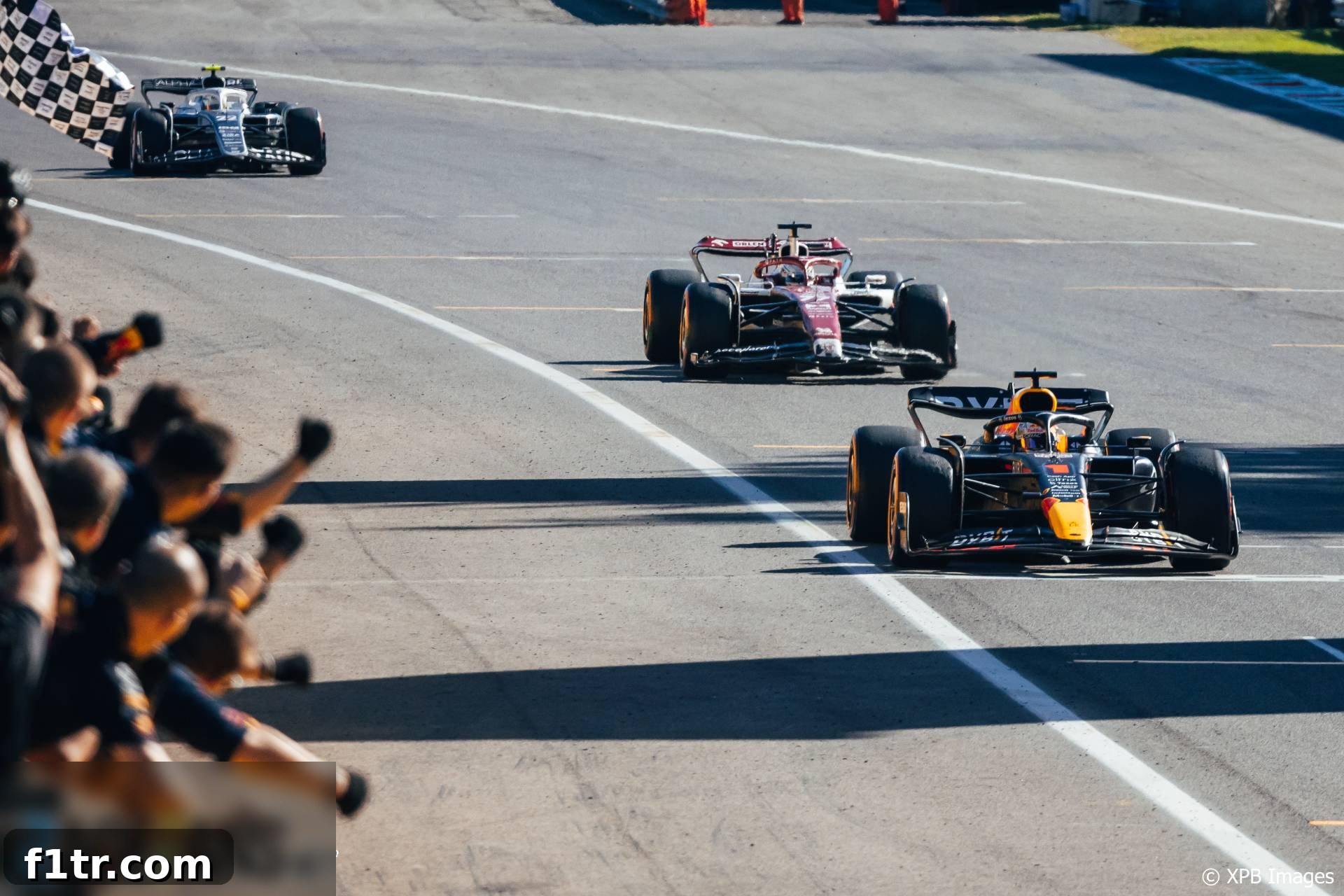
Denied a final opportunity to at least attempt to challenge Verstappen in a thrilling shootout over a single lap or two, Leclerc could only cruise around the final 5.8 kilometres of the legendary circuit. He watched with a mixture of disappointment and resignation as his formidable rival, Max Verstappen, crossed the finish line ahead of him to claim the chequered flag first for a remarkable 11th time in the 2022 season, further cementing his dominance.
“Obviously I really wanted this race to start again,” Leclerc commented with noticeable disappointment after the race. “From the car, I didn’t understand because the last time we passed through, the track was clean. So, I really thought that we would restart again. But it didn’t happen. So maybe there are things in the background that I didn’t know that didn’t make the restart possible.” Despite his personal frustration, Leclerc, ever the sportsman, acknowledged he could have no complaints about the eventual victor. Verstappen had once again demonstrated an almost unstoppable race pace, effortlessly overcoming his latest five-place grid handicap to secure his fifth consecutive win, a testament to his unparalleled form.
“We had a great race,” Verstappen stated with his characteristic understated confidence. “On every compound, we were quickest. I was just controlling the gap at the end, but of course then the Safety Car came out. Unfortunately, we didn’t get a restart. But overall, we had again a really good day.” His calm assessment reflected the ease with which he had dominated the event.
George Russell, despite the Safety Car confusion, expressed satisfaction with a well-earned third place on the podium. Carlos Sainz, starting from a challenging back-of-grid position, orchestrated a superb recovery drive to finish an impressive fourth, ahead of fellow back-of-grid starters Lewis Hamilton and Sergio Perez, the latter having regrettably lost positions to both his rivals. Lando Norris capitalized on a comparatively poor race for Alpine, securing modest points that slightly reduced Alpine’s lead over McLaren in their intense battle for fourth in the constructors’ championship. Pierre Gasly delivered a solid performance, bringing his AlphaTauri home in eighth place.
The standout performance of the day arguably belonged to Nyck de Vries, making an unexpected but highly impressive Grand Prix debut for Williams. He remarkably claimed ninth place, a testament to his talent and resilience. The sheer strain of fending off 10th-placed Zhou Guanyu for the majority of the race appeared to take a significant physical toll, as de Vries had to be physically carried out of his car due to exhaustion and strain on his shoulders. Meanwhile, the Alfa Romeo driver, Zhou, successfully ended his team’s six-race points drought, a valuable result for their campaign.
While Red Bull had once again secured a dominant victory in Ferrari’s own backyard, the Scuderia could at least find some solace. They had displayed a renewed fighting spirit in front of their most important VIPs, who watched intently from the garage, and crucially, there were no major operational errors or embarrassing mechanical failures to further tarnish their image. Ferrari could hold their heads high, understanding that they hadn’t necessarily “lost” this race due to their own blunders; rather, Max Verstappen had simply won it, demonstrating an almost unassailable advantage. “It’s not difficult, it’s impossible to beat the fastest car,” conceded Mattia Binotto, acknowledging the undeniable reality of Red Bull’s superior performance.
“Normally, you win if you’ve got the fast car, and you may only make it wrong with strategies and lose the race if you’ve got a fast car, with strategy,” Binotto elaborated, offering a nuanced perspective. “So I think today he was faster – whatever has been the strategy, he would have won.” His assessment highlighted that even perfect strategy might not have been enough against Verstappen’s overwhelming pace.
Charles Leclerc, resigned to the near-certainty that 2022 would not be his championship year, found some solace in the unwavering, passionate support from the Tifosi. As he gazed out over the vibrant sea of red from the Monza podium, the sight was a powerful reminder of what he fought for – even if he stood on a slightly lower step than he would have preferred. “It’s always incredible,” he said, reflecting on the crowd’s energy. “Starting from pole, I wanted to get that – and we didn’t. So it’s not the best day, but the podium makes it a lot better.”
Support Formula 1 Journalism: Become a RaceFans Supporter
RaceFans thrives thanks in part to the generous contributions of its dedicated readers. By supporting us with just £1 per month or £12 per year (or the equivalent in your local currency), you can directly help cover the essential costs of creating, hosting, and continually developing RaceFans now and into the future.
Join the RaceFans Supporter community today and enjoy an ad-free browsing experience across the entire site. Learn more or sign up via the links below:
- Become a RaceFans Supporter
- RaceFans Supporter FAQ
More from the 2022 Italian Grand Prix
- Helmet rows, hot mics and more forgotten motorsport stories from 2022
- McLaren ‘surprised two teams found more performance than everyone else’ in 2022
- Alpine confident for Singapore and Suzuka races after “massive” floor upgrade
- Red Bull’s RB18 suits Verstappen more than Perez now – but that’s not by design
- “We’ll have four racing laps’: How F1’s Safety Car confusion unfolded at Monza
Browse all 2022 Italian Grand Prix articles
Latest F1 Race Reviews
- Antonelli lucks in for second win and becomes youngest F1 championship leader
- Emotional Antonelli grabs first Formula 1 victory in Chinese Grand Prix
- Russell sees off Ferrari threat to lead Mercedes one-two in Melbourne
- Norris clinches F1 title by two points as Verstappen wins finale at Yas Marina
- McLaren strategy blunder in Losail hands Verstappen crucial win and shot at title
Read all F1 race reviews