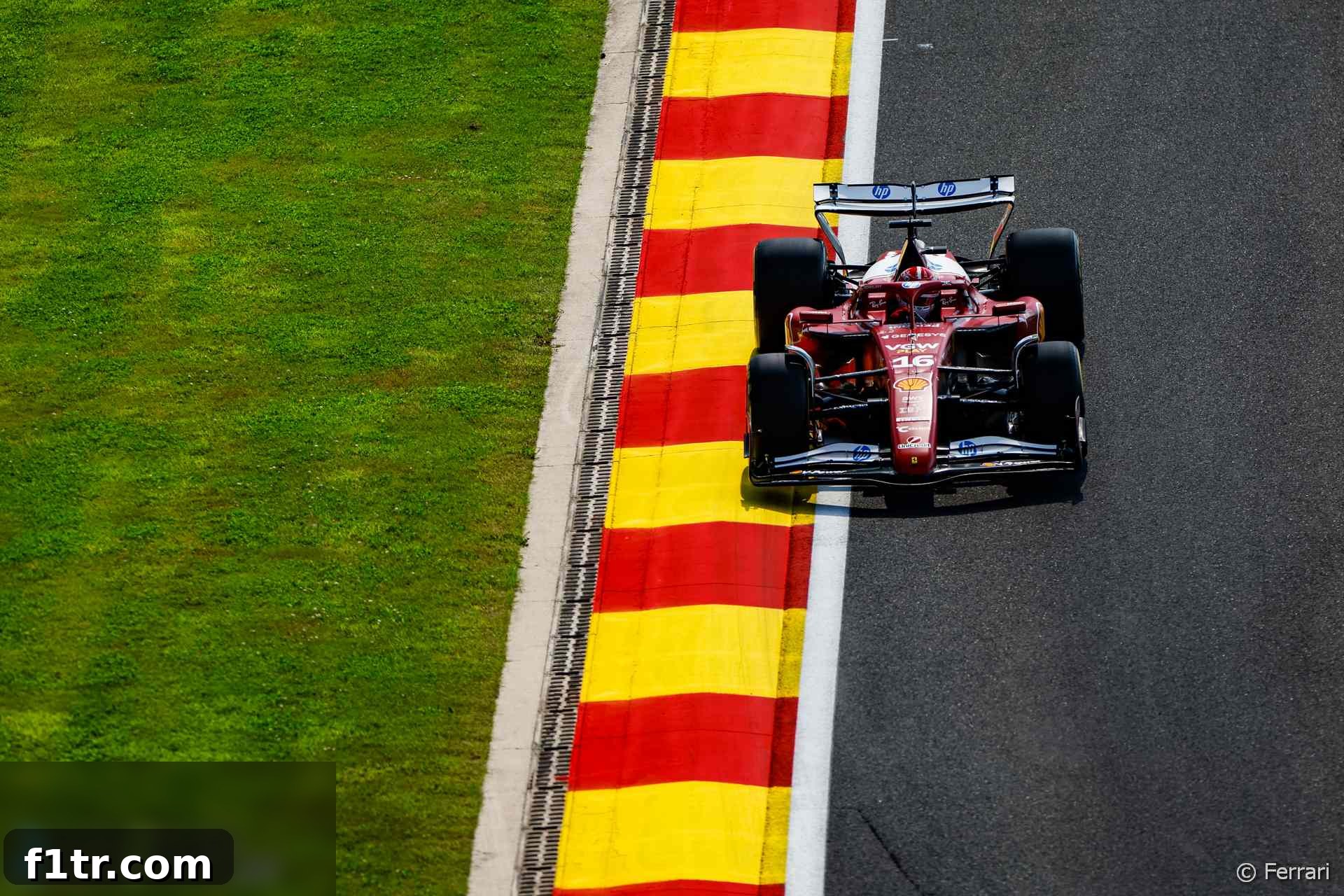
Ferrari’s Bold Move: Unveiling Suspension Upgrade Amidst Sprint Weekend Challenges
In the high-stakes world of Formula 1, every strategic decision can significantly impact a team’s championship aspirations. Ferrari, a name synonymous with racing heritage and fervent competition, recently made a calculated gamble, introducing a crucial suspension upgrade during a challenging sprint race weekend. Team principal Frederic Vasseur has staunchly defended this decision, asserting that despite the severely limited practice time – often just a single session to thoroughly evaluate new components – it was undeniably the right path for the Scuderia.
The decision to deploy a significant car upgrade, particularly one as intricate as a suspension system, during a sprint race format is not one taken lightly. These weekends are notoriously demanding, compressing the usual three practice sessions into just one, followed immediately by qualifying for the Grand Prix. This leaves teams with minimal opportunity to gather data, fine-tune setups, and properly understand the nuances of new hardware. Yet, Vasseur’s conviction highlights a broader philosophy within Ferrari: a commitment to relentless development and an unwillingness to defer progress.
The intricate dance of developing an F1 car involves constant innovation. Every component, from the front wing to the rear diffuser, and critically, the suspension, plays a vital role in extracting performance. A new suspension system can dramatically alter a car’s handling characteristics, tire wear, aerodynamic stability, and ultimately, its lap time potential. Ferrari’s engineers likely spent countless hours in simulations and wind tunnels perfecting this upgrade, making its track debut a moment of intense anticipation and scrutiny for the entire team.
Navigating the Sprint Format: A Double-Edged Sword for Development
Frederic Vasseur openly acknowledged the inherent complexities that arose from introducing such a vital component under the restrictive conditions of a sprint weekend. “For sure it’s a bit more difficult,” Vasseur conceded to the official F1 channel, highlighting the stark contrast to a conventional Grand Prix weekend where extensive mileage and diverse testing protocols are the norm. The compressed schedule means that crucial track time, usually dedicated to extensive setup changes, aerodynamic correlation, and long-run simulations, is dramatically curtailed.
One of the primary challenges Vasseur elaborated on was the inability to perform extended runs. In standard practice sessions, teams dedicate significant time to ‘long stints’ – simulating race distances to understand tyre degradation, fuel consumption, and how the car’s balance shifts over a prolonged period. This data is invaluable for race strategy and for validating the performance of new parts. With only short runs permissible during a sprint weekend’s singular practice, the depth of analysis possible for a new suspension upgrade is significantly reduced, making ‘adaptation’ for both car and driver considerably tougher.
Moreover, the risk associated with an unproven upgrade is magnified. Any unforeseen issues or sub-optimal performance cannot be easily rectified or compensated for with additional track time. Teams are forced to make snap judgments based on limited data, potentially jeopardizing their weekend’s results. This is precisely why many teams prefer to introduce major upgrades during traditional Grand Prix weekends, where Friday’s ample practice offers a safety net for testing and adjustment.
Despite these undeniable hurdles, Vasseur’s strategic mindset prevailed. He framed the sprint weekend’s intense pressure not as an impediment, but as a crucible for future success. “But on the other hand it’s also a good preparation for next weekend. If you postpone, you postpone all your life,” he asserted. This statement encapsulates Ferrari’s proactive approach: rather than delaying the introduction of a potentially game-changing upgrade, the team opted to face the challenge head-on. The rationale is clear – immediate feedback, even if limited, is more valuable than waiting, allowing them to iterate and refine for subsequent races. This forward-thinking strategy underscores a team determined to close the gap to their rivals and continually push the boundaries of performance, irrespective of the format.
Leclerc Shines: A Glimmer of Progress for Ferrari
The immediate litmus test for the new suspension upgrade came during Grand Prix qualifying, and for Charles Leclerc, the results offered a compelling narrative of progress. Against formidable opposition, the Monegasque driver delivered a stellar performance, securing third place on the grid. This achievement was particularly significant as he managed to pip Max Verstappen’s Red Bull in a thrilling final run, showcasing the potential of the updated SF-24.
Vasseur was quick to acknowledge Leclerc’s brilliant drive, attributing it not only to the driver’s exceptional talent but also to the tangible gains provided by the new components. “We are improving a little bit on the set-up of the car and I think it was also a very good lap from his side,” Vasseur remarked. This suggests that the suspension upgrade, even with minimal setup time, has positively influenced the car’s balance and handling characteristics, allowing Leclerc to extract more pace and confidence through the corners.
The battle for front-row positions is intensely competitive, and to outpace a Red Bull – a benchmark for performance – even momentarily, serves as a significant morale booster for the Scuderia. It signals that Ferrari’s development trajectory is moving in the right direction, albeit with a clear understanding of the challenges that remain. Leclerc’s ability to extract such performance under pressure, and with a new element on the car, speaks volumes about his skill and the potential of the upgrade. It provides crucial validation for the engineering choices made and reinforces the team’s belief in their development pathway.
However, while Leclerc’s P3 was a strong indicator, Vasseur tempered expectations by noting, “But McLaren is still a step ahead.” This realistic assessment underlines the ongoing battle for supremacy in Formula 1’s tightly packed upper-midfield and the continuing efforts required to challenge for consistent victories. McLaren, having shown impressive form recently, continues to set a high benchmark, pushing Ferrari to find even more performance from their development efforts. This healthy competition drives innovation and ensures that teams are constantly striving for marginal gains.
Hamilton’s Unlucky Turn: Pace Versus Precision
While Charles Leclerc’s qualifying performance provided a positive headline for Ferrari, the weekend presented a contrasting picture for his teammate, Lewis Hamilton. The seven-time world champion endured a particularly frustrating period, compounded by his elimination in the first round of qualifying for the sprint race, and subsequently, a critical track limits infringement during the Grand Prix qualifying session that saw a vital lap time deleted, relegating him to a disappointing 16th on the grid.
This sequence of events might lead some to question Hamilton’s adaptation to the car or the upgrade, but Frederic Vasseur was quick to dispel such notions. The team principal expressed unwavering confidence in Hamilton’s underlying pace and ability. “He was able to have the same pace as Charles in Q1,” Vasseur stated, emphasizing that the issue was not a deficit in performance but rather a fine margin of error. The intricate nature of track limits, often decided by mere millimeters, can be brutal in F1, and as Vasseur put it, “Track limits are [about] a couple of millimetres but the rule is the rule and the lap time was deleted.”
Vasseur’s defence of Hamilton underscores the team’s understanding of the razor-thin margins that separate success from setback in Formula 1. He made it clear that Hamilton’s struggles were a matter of circumstance and precision, not a fundamental lack of speed or an inability to adapt to the new suspension. “But it’s not a matter of pace or adaptation. I think he was able to do the job,” Vasseur affirmed. This perspective is crucial for maintaining team morale and reinforcing the belief that both drivers, with the right conditions, can extract maximum performance from the updated car. The focus for Hamilton will undoubtedly shift to making amends in the race, demonstrating the car’s true potential from a challenging grid position, and proving Vasseur’s confidence well-placed.
The deletion of a lap time due to track limits is a common, yet often heartbreaking, occurrence in modern F1. For a driver of Hamilton’s calibre, such errors are rare but highlight the extreme pressure and precision required at every single moment on track. It’s a cruel reminder that even the slightest transgression can have severe consequences, irrespective of the underlying pace of the car or driver.
Looking Ahead: The Continuous Pursuit of Performance
The introduction of Ferrari’s suspension upgrade during such a high-pressure sprint weekend offers a microcosm of the relentless development cycle in Formula 1. While the immediate results were mixed, with Charles Leclerc demonstrating strong pace and Lewis Hamilton encountering misfortune, the underlying message from Frederic Vasseur is one of resolute progression. The team’s willingness to take calculated risks and gather crucial data, even in less-than-ideal conditions, is a testament to their ambition.
The data collected from this weekend, however limited, will be meticulously analyzed by engineers back at Maranello. Every telemetry point, every driver feedback, will contribute to further understanding the new suspension’s characteristics and how it interacts with the rest of the car’s aerodynamic package. This iterative process is vital for unlocking incremental gains that can collectively make a significant difference over a season. The true measure of an upgrade often comes not in its immediate debut, but in how it enables subsequent refinements and unlocks further performance potential.
Vasseur’s foresight in viewing this weekend as “good preparation for next weekend” speaks volumes. Formula 1 is a sport where every session, every race, is a learning opportunity. The challenges faced, particularly by Hamilton, will serve as valuable lessons, helping the team and drivers to better optimize the car in similar high-pressure scenarios in the future. It’s about building resilience and refining processes under adversity, which are invaluable traits for any championship-contending team.
The competitive landscape remains fierce, with McLaren showing strong form and Red Bull consistently at the front. Ferrari’s journey to reclaim championship glory is paved with such strategic decisions, bold upgrades, and the unwavering belief in their continuous development path. The pursuit of perfection is endless, and this weekend’s upgrade rollout, despite its complexities, marks another determined step forward for the Scuderia. Their unwavering commitment to innovation, even when faced with procedural challenges, is a clear statement of intent as they strive to return to the pinnacle of motorsport.