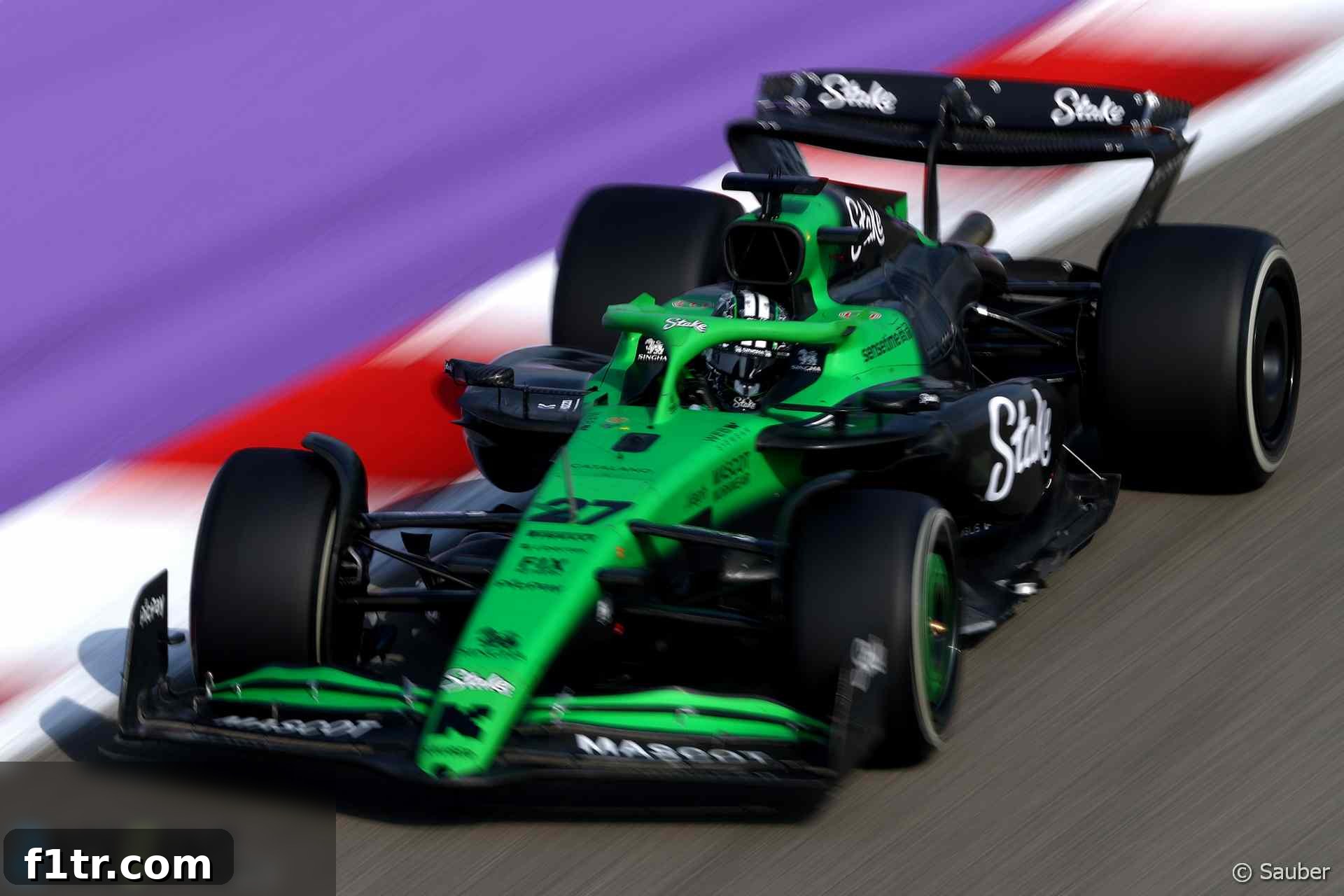
The highly competitive world of Formula 1 qualifying often hinges on fractions of a second and the precise application of rules. However, a recent incident during qualifying saw Alexander Albon unfairly denied a spot in Q2 due to a delayed penalty issued to rival Nico Hulkenberg. This contentious event ignited a debate about the efficiency of real-time track limits monitoring and the overall fairness of stewarding decisions in the pinnacle of motorsport.
Advert | Become a Supporter & go ad-free
The stewards’ late intervention meant that Hulkenberg, driving for Sauber, was allowed to compete in the second qualifying session despite having committed a clear infringement in Q1. The core issue stemmed from the fact that the Sauber driver’s breach of track limits was not reported to the race stewards until Q2 had already commenced, creating a chain reaction of unfortunate consequences for Albon and raising significant questions about procedural timelines.
A Costly Infringement and Delayed Justice
The incident unfolded during the frantic closing moments of Q1. Nico Hulkenberg had initially edged out Alexander Albon for the coveted final spot in Q2 by a minuscule margin, less than a tenth of a second. This narrow gap underscored the intense competition and the high stakes involved in every qualifying lap. Hulkenberg then proceeded to participate in Q2, where he was ultimately eliminated, but the legitimacy of his participation would soon be called into question.
It was later determined by the stewards that Hulkenberg had exceeded track limits at Turn 11 during his critical final flying lap in Q1. This particular infringement, which involves running all four wheels beyond the white lines defining the edge of the circuit, is strictly prohibited and typically results in the deletion of the offending lap time. Hulkenberg himself seemed to be aware of his error, candidly admitting to his race engineer, Steven Petrik, during Q1: “I fucked up Turn 11.”
Following a review, the stewards definitively ruled that Hulkenberg had “clearly exceeded track limits in Turn 11.” However, their official explanation highlighted the procedural bottleneck that led to the controversy: “This was not reported to the stewards until Q2 had commenced. Car 27’s [Hulkenberg’s] time recorded on the lap that track limits were exceeded, was sufficient to place it in Q2. Hence at the time the Stewards were informed that car 27 had breached the Race Director’s Event Notes and that its lap should have been deleted, it was already on track in Q2.” This meant that Hulkenberg’s qualifying time for Q1 should have been deleted, thereby disqualifying him from advancing to Q2, and consequently, all his subsequent lap times in Q2 were struck from the record.
Advert | Become a RaceFans supporter andgo ad-free
Albon’s Frustration and Williams’ Missed Opportunity
For Alexander Albon and the Williams Racing team, this delay was a bitter pill to swallow. Being denied a chance to participate in Q2, especially under such controversial circumstances, represents a significant setback. Every session in Formula 1 qualifying is crucial for gathering data, refining car setup, and maximizing grid position. Missing Q2 not only impacts starting position but also limits valuable track time and exposure for the team.
Albon voiced his frustration, not only with the delayed penalty but also with his own team’s operational execution. While acknowledging the stewards’ decision, he felt his final Q1 lap could and should have been faster, irrespective of Hulkenberg’s penalty. He pinpointed a delay in leaving the garage as a primary factor, stating: “We need to understand what went on. We were supposed to go out on track with four minutes to go but we ended up getting stuck in that pit exit traffic jam.”
This delay had a cascading effect. “We were there for a few minutes, lost about 20-25 degrees of tyre temperature and then we were fighting to make the flag. So we had to push around, overtook a few cars, started the lap and the tyres were cold,” Albon explained. The optimal operating window for Formula 1 tyres is incredibly narrow, and a significant drop in temperature can severely compromise grip and overall lap performance. Albon termed these as “procedural matters” that need to be addressed, emphasizing the importance of flawless execution in such a competitive environment. “We’re not normally bad at these kinds of things but we need to review it and not have it happen again for the next time,” he concluded, highlighting the team’s commitment to continuous improvement.
A Recurring Issue: Precedents and the FIA Sporting Code
Disturbingly, this incident was not an isolated event. A similar situation arose at the 2022 Austrian Grand Prix, where Sergio Perez was incorrectly allowed to participate in Q3, subsequently having his times deleted, while Pierre Gasly was denied a fair chance to compete in the session. The fact that the stewards handled both situations in an identical manner, retrospectively applying penalties after the affected session had begun, underscores a potential systemic issue within the real-time monitoring and reporting framework of Formula 1.
In response to these “unusual situations,” the stewards invoked Article 11.9.2.a of the FIA International Sporting Code. This specific article grants the stewards significant authority to take appropriate action in unforeseen circumstances or when established procedures lead to an unfair outcome. While it provides a legal basis for their post-factum decisions, its repeated application in cases of delayed track limits infringements suggests a need for re-evaluation of the initial detection and reporting mechanisms.
Advert | Become a RaceFans supporter andgo ad-free
The FIA’s Acknowledgment and Future Reforms
The governing body, the FIA, offered a candid explanation for the delay, shedding light on the complexities of real-time officiating. They revealed that Turn 11 in Bahrain was not designated as a “track limit hot spot” for that particular event. “There are a number of track limit hot spots which are monitored continuously live,” a spokesperson explained. “Track limit hot spots are given precedence. Based on previous sessions, Turn 11 was not deemed to be an area of focus for track limits. In hindsight, it should have been higher on our priority list as a corner.”
This prioritization system, while logical for resource allocation, proved to be a critical flaw in this instance. Checks in less prioritized areas, such as Turn 11, naturally take longer to process. “Unfortunately, in this case due to the timing of the check it was not possible to act before the start of Q2. As soon as we became aware of the incident, we acted on it,” the spokesperson elaborated. The FIA’s transparency in admitting their error is commendable: “We are building towards increased resources and improved systems and processes. On this occasion, we got it wrong.”
This acknowledgment of fault and commitment to improvement are crucial for maintaining the integrity of Formula 1. The challenge for the FIA lies in balancing comprehensive real-time monitoring across all corners of a circuit with the need for immediate and accurate decisions. The rapid pace of qualifying, with cars constantly on track, leaves little room for delays in reporting and adjudication. Ensuring that every driver adheres to the regulations, and that penalties are applied swiftly and consistently, is paramount to upholding fairness and preventing similar unfortunate incidents from impacting competitive outcomes.
Looking Ahead: Ensuring Fair Play in Formula 1
The unfortunate situation involving Alexander Albon and Nico Hulkenberg serves as a potent reminder of the fine margins and intricate details that define Formula 1. While the FIA has acknowledged its shortcomings in this specific instance, the recurring nature of such delays – as evidenced by the 2022 Austrian Grand Prix – necessitates a thorough review of the entire track limits monitoring and penalty issuance process. The sport, its teams, and its fans expect and deserve immediate and consistent application of the rules.
Moving forward, the focus must be on leveraging advanced technology, potentially with greater automation and real-time alerts, to ensure that track limits infringements are identified and reported to the stewards instantaneously. This would enable stewards to make timely decisions, preventing scenarios where a driver’s legitimate progression is hampered by a competitor’s unpunished breach. Only through such improvements can Formula 1 guarantee a truly level playing field and preserve the competitive spirit that makes it one of the world’s most thrilling sports.
Miss nothing from RaceFans
Get a daily email with all our latest stories – and nothing else. No marketing, no ads. Sign up here:
2025 Bahrain Grand Prix
- Hamilton making “drastic shift” in driving style to master Ferrari’s car
- Leclerc revealed Ferrari strategy details to Gasly before Bahrain Grand Prix
- Lawson made “very significant step forward” in Bahrain – Mekies
- Russell’s transponder was ‘frazzled and charred’ after Bahrain Grand Prix DRS drama
- “Don’t give me too much now”: Hamilton’s search for speed at Ferrari continues
Browse all 2025 Bahrain Grand Prix articles