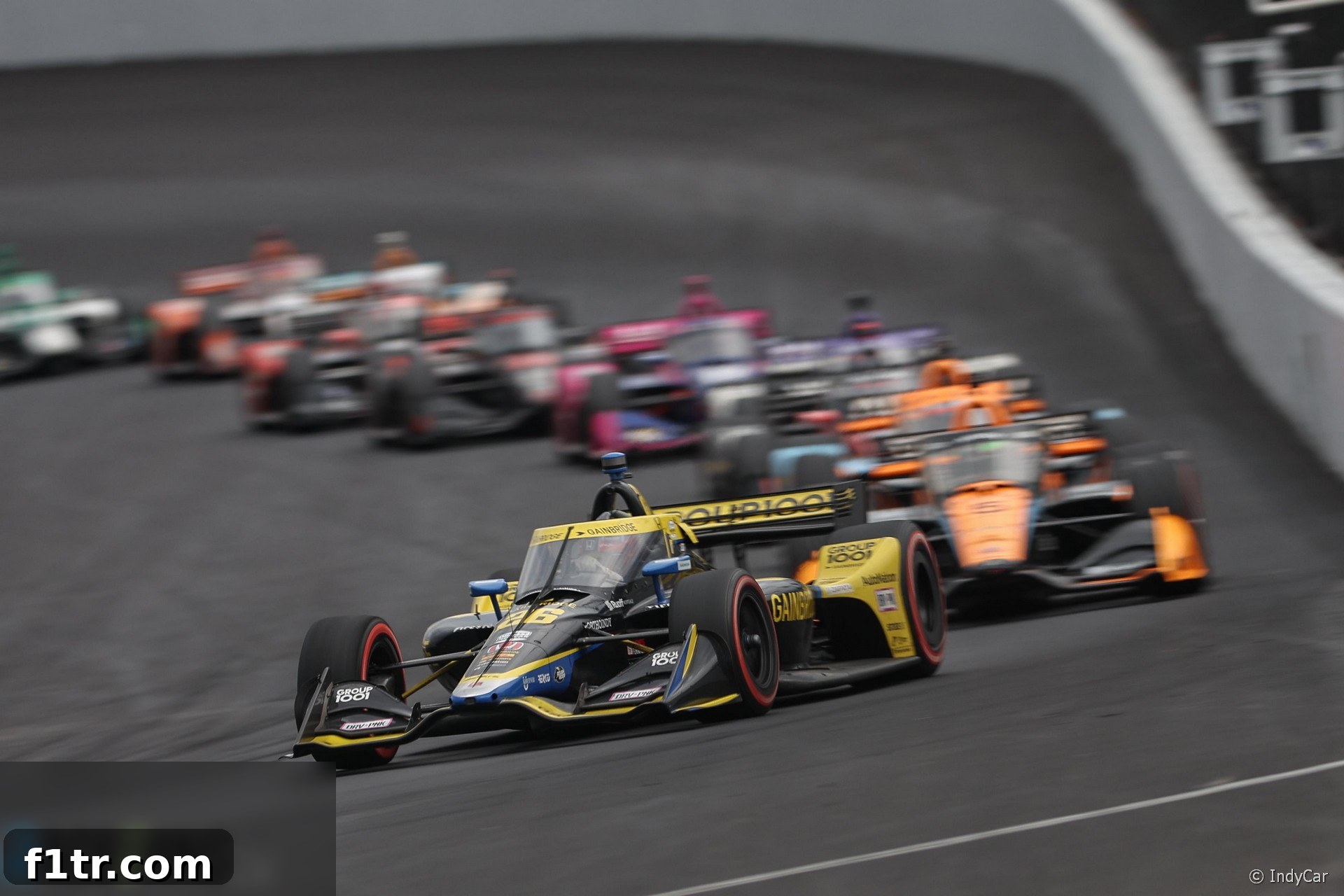
Colton Herta’s triumph at the 2022 Grand Prix of Indianapolis was a masterclass in strategic decision-making and exceptional car control amidst ever-changing conditions. His victory was notably attributed to an audacious call made by both him and his father, Bryan Herta, his race strategist, to switch to slick tyres after just two laps of the rain-soaked circuit. This pivotal moment set the stage for a race where Herta would defy expectations, navigate treacherous conditions, and ultimately secure a memorable win that significantly boosted his season.
The Indianapolis Motor Speedway Road Course presented a formidable challenge, with intermittent rain making tire strategy a high-stakes gamble. As the race began, the track was drenched, leading the entire field to start on wet weather tires. However, even as competitors cautiously felt out the conditions, a bold and unconventional move was decided in the Andretti Autosport pit. Just two laps into the race, Colton Herta, in conjunction with his father Bryan, opted to pit for slick tires. This was a daring decision, as the track was far from fully dry, and many in the paddock viewed it as a potentially reckless gamble that could easily backfire and send Herta tumbling down the order.
Yet, as Herta humorously reflected after the race, initially attributing his victory to “pure talent” before quickly admitting the true architect of his success: “It was really just the call for wets to slicks.” This understatement belied the strategic foresight at play. While other teams waited, hoping the track would dry further or sticking to a more conventional strategy, the Herta duo identified a fleeting window of opportunity. The early switch meant Herta rejoined the track with the inherent speed advantage of slicks on a rapidly forming dry line, even if significant portions of the circuit remained damp. This aggressive play paid immediate and significant dividends. While the rest of the field eventually followed suit, they did so a crucial lap or two later, giving Herta a significant head start. He vividly recalled the impact: “I think we gained 15 spots on that transition. We pitted on lap three, everybody pitted on lap four or five. We gained 15 spots in that transition to go from 15th to first.” In actuality, his charge was even more dramatic, vaulting from 14th on the grid to the provisional lead. This meteoric rise was not just impressive; it was historically significant, as no IndyCar driver had previously won at the Indianapolis Grand Prix circuit from a grid position lower than eighth. Herta’s audacious strategy had undeniably set the stage for an unforgettable performance, transforming a midfield start into an unexpected leadership position, showcasing the fine line between risk and reward in elite motorsport strategy.
A Near Miss and a Masterful Save: Herta’s Display of Car Control
Just as Herta seemed to be consolidating his newly acquired lead, the treacherous nature of the drying track presented its next, most heart-stopping challenge. On lap four, barely a moment after his strategic gamble had begun to pay off, Herta faced a critical incident at turns eight and nine. As he pushed the limits on his slick tires on the still-damp surface, his car suddenly snapped sideways, threatening to send him spiraling out of contention. It was an incident that would have ended many races prematurely, but Herta’s exceptional car control shone through.
He was on “full opposite lock,” wrestling the steering wheel with every ounce of strength, desperately trying to keep the car pointed forward. This demanding maneuver involves turning the steering wheel sharply in the opposite direction of the skid, a delicate balance of throttle and steering input required to prevent a full spin and regain control. Herta later described the intensity of the moment: “I was on the rack stops, and I was shoving so hard to get more wheel, but I couldn’t.” The sudden loss of grip was attributed to a subtle change in his racing line. “I think what happened is it was drying, but maybe I went out a little bit wider on the entry of the corner than I had been, and got that left rear on a damp patch or something. That’s what it felt like – because I turned in and it just lost everything immediately.”
What makes this save even more remarkable is Herta’s candid revelation that he was unaware of the gravity of the situation at the time. He thought he was battling for a much lower position, perhaps tenth or eleventh, illustrating the intense, tunnel-vision focus required in such demanding conditions. “I would have been upset if I spun there, but I would have been even more upset because I didn’t know that was for the lead of the race… I had no clue where I was on track. I guess that was one of the only mistakes we made today.” This incredible display of skill not only kept him in the race but, crucially, preserved his net lead over Pato O’Ward, demonstrating an uncanny ability to recover from the brink and maintain composure under immense pressure—a true hallmark of a champion driver.
The Mid-Race Tire Quandary: A Fortunate Misstep
The dynamic nature of the Indianapolis weather continued to play a central role throughout the race, constantly testing the strategic acumen of every team. During the sixth caution period of the race, on lap 59, Herta and his team faced another critical decision regarding tire choice. With track conditions once again ambiguous, leaning towards either further drying or a return of rain, the pit lane became a hive of intense strategic debate. Herta recalled a crucial conversation with his father, Bryan, who diligently served as his race strategist: “What we were talking about is – I said, ‘with the track conditions right now it’s probably wets, but if you think it’s going to get drier or wetter, that will change my decision.'”
Based on their assessment at the time, believing the track would eventually dry out, the team again opted for slick tires. However, the moment Herta rejoined the track, the conditions proved to be less favorable than anticipated. “Immediately when I got out there, I knew it was going to be tough,” he admitted, yet he held out hope, communicating to his team, “if you guys think it’s going to be dry, then we’ll stay out here.” But the radar, and the rapidly changing conditions, told a different story. The forecast shifted, indicating the track would remain wet for longer, necessitating a rapid course correction. Just two laps after pitting for slicks, Herta was back in the pit lane, switching back to wet weather tires.
This double pit stop, a rare occurrence, could have been catastrophic, potentially costing him precious track position and, indeed, the entire race. However, a stroke of good fortune, combined with a collective misjudgment by the rest of the field, mitigated the damage. As Herta himself explained, “We made the wrong choice, but luckily, everyone followed our direction and did the wrong thing also, so we didn’t actually lose that much.” This surprising turn of events meant that while Herta lost some initial ground due to his strategic error, his primary competitors were also caught out by the changing conditions and made similar strategic miscalculations. The ensuing chaos on track following the subsequent restart, further compounded by drivers on slicks struggling immensely, allowed Herta to quickly regain his position, turning a near disaster into a mere hiccup in his dominant charge towards the checkered flag.
From Chaos to Controlled Dominance: Sealing the Victory
Rejoining the race from fourth position after his double pit stop for tires, Herta quickly demonstrated his superiority on the correct wet tires. The conditions, which had been so challenging for Herta just moments before on slicks, now favored him perfectly. Competitors like Scott McLaughlin and Romain Grosjean, who had committed to slick tires and found themselves utterly out of sorts on the still-wet track, spun and dropped dramatically down the order under the safety car. This immediately elevated Herta’s standing and solidified his tactical advantage.
As the race restarted, briefly, before being neutralized once more under another safety car, Herta effortlessly passed Pato O’Ward, who was also on slicks and visibly struggling for grip. This rapid series of events showcased Herta’s decisive execution and underscored the crucial importance of having the right tire at the right time in the unpredictable world of mixed-condition racing. Once back in front, Herta never looked back. He proceeded to lead an astonishing 50 out of the 75 laps contested, a testament to his sheer pace, consistency, and the strategic brilliance that had put him in that commanding position. This was not just any victory; it was his first of the season, a much-needed boost that propelled him to sixth in the championship standings and re-established him as a formidable contender in the highly competitive IndyCar series. The victory at the Indianapolis Grand Prix circuit was a powerful declaration of intent, affirming Herta’s status as one of the sport’s brightest talents, capable of performing under the most demanding and dynamic circumstances.
The Unlikely Versatility of the Andretti Autosport Machine
One of the most intriguing aspects of Herta’s victory, and a point he highlighted himself, was the remarkable versatility and adaptability of his Andretti Autosport machine. “The most interesting thing is you never have a car that works in the wet and the dry. It’s just not possible, but it happened today. It was very interesting, [it] felt comfortable in all conditions.” This observation speaks volumes about the meticulous preparation by his engineering team and Herta’s exceptional ability to adapt his driving style to the ever-changing grip levels.
Typically, engineers and drivers face a perennial trade-off: a car optimized for maximum performance in wet conditions often sacrifices performance in the dry, and vice-versa. The suspension settings, aerodynamic balance, and tire pressures that provide maximum grip and stability on a slippery, wet track are usually detrimental on a dry circuit where precision and outright speed are paramount. For Herta to feel “comfortable in all conditions” on such a day of extreme variability is a rare commendation, highlighting either a superbly balanced setup or Herta’s innate talent for extracting performance regardless of the specific configuration. This unusual versatility was undoubtedly a contributing factor to his ability to capitalize on strategic opportunities and maintain his lead throughout the race’s ever-changing phases, making his dominant lead of 50 laps even more impressive given the challenging nature of the track and the elements.
The Enduring Impact of a Strategic Victory
Colton Herta’s win at the 2022 Grand Prix of Indianapolis transcended a mere race victory; it was a powerful demonstration of how crucial strategic decision-making, combined with unparalleled driving skill, can dictate the outcome in the unpredictable world of IndyCar. The father-son synergy between Colton and Bryan Herta provided a compelling narrative of trust and audacity, where their shared conviction in unconventional choices ultimately paid off handsomely. From the initial daring switch to slick tires that rocketed him to the lead, through a breathtaking save that preserved his position, to navigating a mid-race tire gamble that could have undone it all, Herta’s performance was a masterclass in adapting to chaos.
This victory not only marked a significant milestone in Herta’s career, breaking a long win drought and boosting his championship aspirations, but also solidified his reputation as one of IndyCar’s most exciting and intelligent talents. The 2022 Grand Prix of Indianapolis will undoubtedly be remembered as a race where strategy, skill, and a touch of fortune converged to script a truly unforgettable triumph. It served as a stark reminder that in motor racing, the fastest car doesn’t always win; sometimes, it’s the smartest team that does.
Explore More IndyCar Insights
- IndyCar Driver McLaughlin Cleared of Injury After Crashing Through Barrier at Barber
- Schumacher Compares IndyCar to F2 with Better Tyres
- Grosjean: IndyCar “Way Faster Than Formula 1” in Certain Corners
- FIA to Award More F1 Superlicence Points to IndyCar Drivers from 2026
- Schumacher Confirmed for Full-Time IndyCar Campaign with RLL in 2026
Browse All IndyCar Articles for More News and Analysis