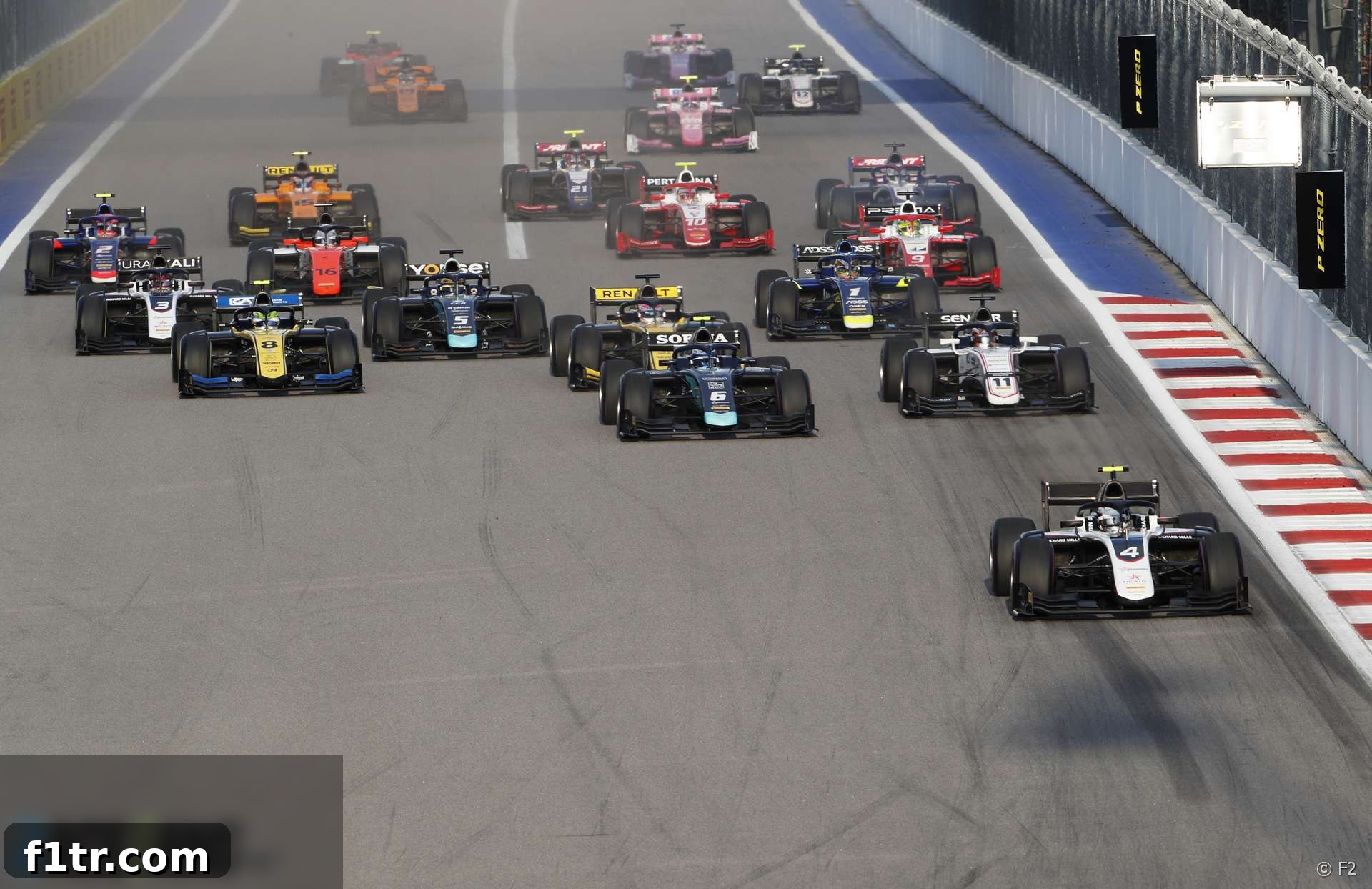
Nyck De Vries etched his name into the history books of motorsport by securing the 2019 Formula 2 championship title in spectacular fashion at the Sochi Autodrom. Starting from a commanding pole position, De Vries navigated a challenging race weekend to emerge victorious, even as his closest rival, Luca Ghiotto, led the majority of the race with an aggressive strategy. This hard-fought triumph marked the culmination of a dominant season for the Dutch driver, solidifying his status as one of the most promising talents in the feeder series.
Advert | Become a Supporter & go ad-free
De Vries arrived in Sochi with a substantial 63-point advantage over his primary championship contender, Nicholas Latifi, after securing four crucial bonus points for snatching pole position from Latifi the day prior. The mathematics were clear: De Vries needed to finish at least three points ahead of Latifi in the feature race to seal the championship early. From the moment the lights went out, De Vries demonstrated his intent, launching off the line with an exceptional getaway that immediately created a buffer. Latifi, meanwhile, found himself swallowed by the hungry pack behind, a critical setback in his bid to keep the title fight alive.
Nyck De Vries Crowned 2019 Formula 2 Champion in Dramatic Sochi Race
Pre-Race Dynamics: Championship Pressure Mounts
The 2019 Formula 2 season had been a masterclass in consistency and speed from Nyck De Vries. Throughout the year, he had shown remarkable pace and strategic acumen, setting the stage for a championship showdown in Russia. Latifi, his Canadian rival, had also delivered a strong campaign, making the fight for the ultimate prize a compelling narrative. The pressure on both drivers was immense as they lined up on the grid in Sochi, knowing that every position, every point, could prove decisive. De Vries, however, held the upper hand, and his pole position offered him the best possible starting point to control his destiny.
The Sochi Autodrom: A Circuit of Strategic Intrigue
The Sochi Autodrom, home to the Russian Grand Prix, is known for its long straights, technical sections, and smooth tarmac. It often presents unique challenges for tyre management and strategic planning, with its relatively low degradation often leading to varied approaches in tyre compounds. The circuit’s layout, particularly the lengthy run down to Turn 2 after the start, also creates opportunities for overtakes and dramatic jostling for position. For the Formula 2 drivers, understanding these nuances and executing a flawless strategy would be paramount to success.
Race Start and Early Drama: A Virtual Safety Car Interrupts Proceedings
As the race commenced, De Vries capitalized on his pole position with a textbook start, pulling clear of the immediate chaos behind. Latifi, starting further back, struggled to maintain his position and dropped into the midfield scrum, making his championship aspirations significantly harder. Early in the race, drama unfolded when local hero Artem Markelov, making a return to F2 for the final two rounds with Arden, suffered a car failure on lap one. This incident triggered a brief Virtual Safety Car (VSC) period, which inadvertently played a role in keeping the field tightly bunched. For Latifi, the VSC offered a momentary reprieve, keeping him within striking distance of a very close group that included the impressive Callum Ilott and a rapidly advancing Luca Ghiotto.
Tyre Strategies Unfold: The Mediums Gain the Advantage
The early laps of the race quickly revealed a fascinating battle of tyre strategies. Many of the front-runners, including De Vries, had opted to start on the softer super-soft compound, hoping to gain an initial pace advantage. However, within just a few laps, it became evident that those who had chosen the more durable medium tyres were starting to exert significant pressure. Luca Ghiotto, in his Uni-Virtuosi car, was a prime example. His medium-shod machine displayed a clear grip advantage, allowing him to scythe through the field. Within five laps, Ghiotto effortlessly passed De Vries to seize the lead, demonstrating the potent combination of superior grip and strategic foresight. This shift in momentum forced a swift reaction from the super-soft runners.
Early Pit Stops and the Battle for Track Position
Recognizing the immediate disadvantage of their rapidly degrading super-soft tyres, both Nicholas Latifi and Nyck De Vries made early strategic pit stops on lap six. They quickly switched to the medium compound, committing to running the remaining 22 laps of the race on the more durable rubber. This decision meant they would have to work their way back up the field, relying on the longevity and consistent performance of their new tyres as their rivals on alternative strategies eventually pitted. It was a calculated risk, but one necessary to remain competitive for the duration of the race.
Mid-Race Spectacle: Schumacher’s Charge and Mazepin’s Home Ambition
Further back, Mick Schumacher, also on medium tyres from the start, was making impressive progress. He gained four places on the opening lap and climbed to second position by lap eight, showcasing his raw talent and racecraft. However, he faced fierce competition from Nikita Mazepin, who was particularly keen to shine at his home race. Mazepin and Schumacher engaged in a thrilling wheel-to-wheel battle over laps eight and nine, swapping positions no fewer than three times, much to the delight of the Russian crowd. Mazepin ultimately emerged on top in this skirmish. This intense duel, while exciting for spectators, inadvertently kept both drivers within the main pack, allowing Tadasuke Matsushita to capitalise and take third place from Schumacher. Meanwhile, Luca Ghiotto, enjoying clear air at the front, was free to extend his lead to a commanding nearly 10 seconds.
Advert | Become a RaceFans supporter andgo ad-free
Schumacher’s Heartbreak and the Resurgence of De Vries and Latifi
The order of Ghiotto, Mazepin, Matsushita, and Schumacher held until lap 18 when a dramatic plume of smoke began spewing from the rear of Schumacher’s Prema car. Despite the alarming visual, which prompted Jordan King behind to radio in about difficulty breathing and oil spills, Schumacher’s pace initially appeared unaffected. He continued to close on the Carlin ahead, displaying incredible resilience. However, the issue proved insurmountable, and Schumacher was eventually forced to pit and retire two laps later, ending what had been a promising drive. During this period, De Vries and Latifi, having made their early pit stops, were diligently working their way back through the field. Their patience and consistent pace paid off, as they had climbed to sixth and eighth positions respectively. They were strategically poised to reclaim leading positions once the drivers ahead of them, still needing to pit, eventually made their mandatory stops.
Ghiotto’s Final Stint and a Late Podium Scramble
Luca Ghiotto finally surrendered his commanding lead on lap 25, entering the pits for a clean and efficient stop. He emerged back on track in fourth place, now trailing the provisional leader by a gap of six and a half seconds. Sandwiched between him and the new leader were Nicholas Latifi and Louis Delétraz, highlighting the effectiveness of the early pit stop strategy. Ghiotto, determined to reclaim his top position, managed to pass Delétraz on lap 27, leaving only Latifi between him and the championship leader, De Vries. However, the relentless pace of the race had taken its toll on Ghiotto’s tyres. Despite his best efforts, they were severely degraded and simply not up to the task of hunting down the leaders. His tyres gave up entirely on the final lap, allowing Delétraz to gladly reclaim the final podium spot just before the chequered flag, a testament to the unpredictable nature of Formula 2 racing.
A Champion Crowned: De Vries Joins Elite Company
As the chequered flag waved, Nyck De Vries crossed the finish line to clinch not only the race victory but also the coveted 2019 Formula 2 title. His triumph solidified his place as the third champion of Formula 2’s new era, following in the illustrious footsteps of Charles Leclerc and George Russell – both of whom swiftly ascended to Formula 1 and demonstrated their exceptional talent on the global stage. This achievement was a monumental moment in De Vries’ career, marking the culmination of years of hard work, dedication, and raw racing talent. The championship win was a fitting reward for a season defined by consistent performance, strategic brilliance, and an unwavering drive to win.
The Road Ahead: Formula E with Mercedes-EQ
Despite securing the championship, De Vries and his rivals still had three more races left in the 2019 F2 season, providing further opportunities for glory and experience. However, the future for Nyck De Vries beyond Formula 2 was already set. Following his championship success, De Vries was slated to embark on a new chapter in his racing career, joining the Mercedes-EQ Formula E team for its much-anticipated entry into the all-electric championship. This move represented a significant transition, from the high-octane world of traditional single-seater racing to the innovative and rapidly evolving landscape of electric motorsport. It presented a fresh challenge and a new platform for De Vries to showcase his versatility and speed, promising an exciting future for the newly crowned F2 champion.
Advert | Become a RaceFans supporter andgo ad-free
Formula Two Excellence
- Explore More Formula Two Articles
Browse all Formula Two articles