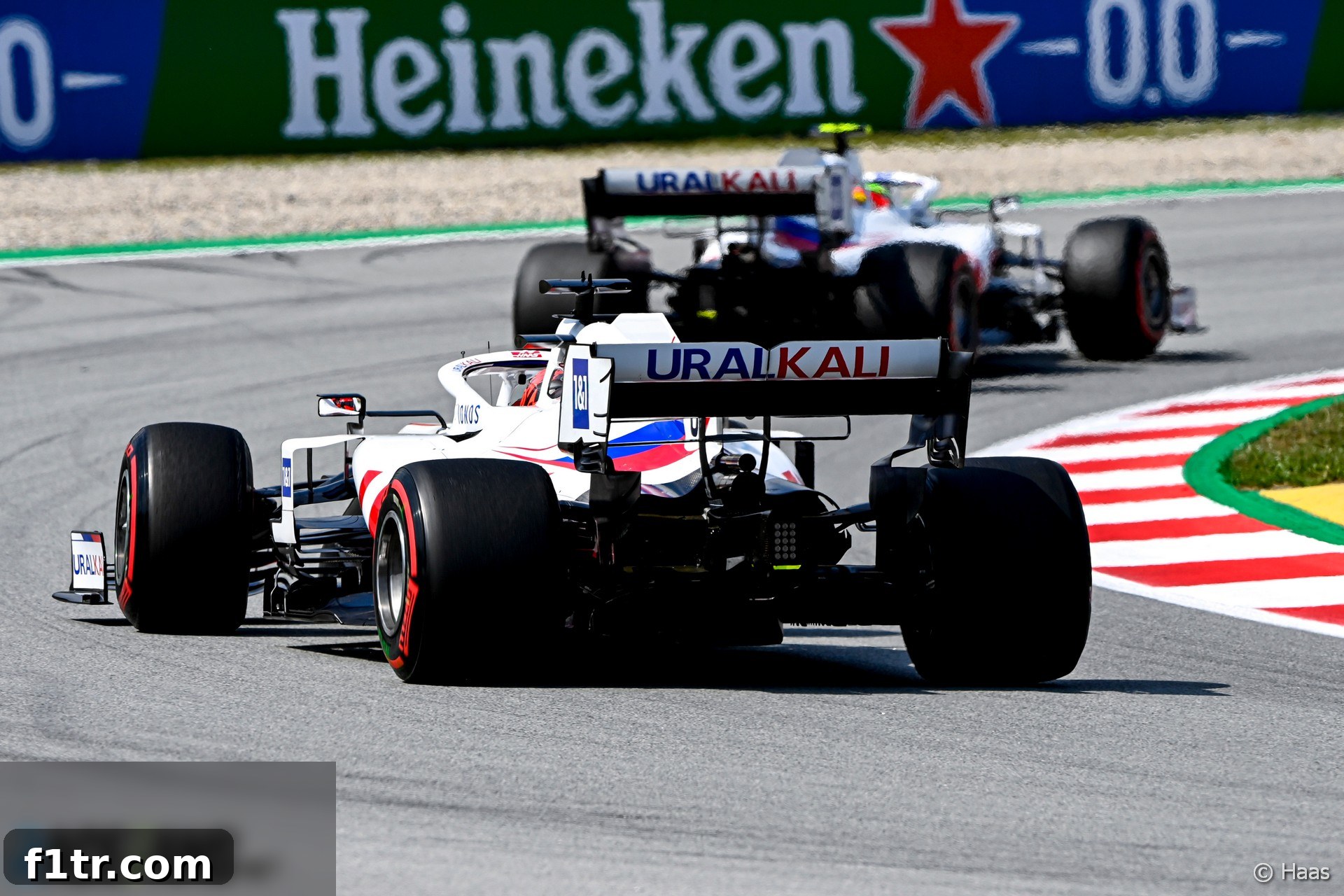
The unforgiving world of Formula 1 presents a monumental challenge for any rookie driver, but for Nikita Mazepin, the initial races of the 2021 season have proven particularly arduous. Haas team principal Guenther Steiner has openly acknowledged that Mazepin is grappling with the team’s VF-21 car more significantly than his fellow debutant teammate, Mick Schumacher. The crux of Mazepin’s struggle, according to Steiner, lies in the car’s inherent lack of rear-end stability, a critical factor influencing driver confidence and performance at the pinnacle of motorsport.
From the moment the lights went out at the season-opening Bahrain Grand Prix, where Mazepin notably crashed out on the very first lap, his journey has been marked by a series of high-profile spins and difficulties in finding the car’s limits. In the subsequent races, Mick Schumacher has consistently managed to bring his car home ahead of Mazepin, often with a more controlled and less eventful performance. Mazepin’s challenges haven’t been confined to race day; frequent spins during practice sessions have underscored his ongoing battle to tame the Haas VF-21, including an incident early in a recent practice session.
Understanding Nikita Mazepin’s F1 Car Balance Struggles
Steiner’s analysis pinpoints the car’s “deficiencies” as a major contributor to Mazepin’s woes. He elaborated, “The car is very unstable in turn-in, and I guess Mick maybe can manage that one better and Nikita struggles a little bit more, because he wants the rear end, just to be confident that it sticks.” This insight offers a clear picture of the differing experiences between the two Haas rookies. While both are navigating the steep learning curve of Formula 1, Mazepin’s driving style or perhaps his specific feedback loop with the car makes him more susceptible to the VF-21’s inherent instability.
A stable rear end is paramount for an F1 driver to confidently attack corners and extract maximum performance from the car. Without that assurance, a driver naturally becomes more cautious, leading to slower lap times and a higher propensity for errors. “So it’s one of the things where we need to try to get Nikita Mazepin into a better spot, that he feels more confident,” Steiner emphasized. “Because if he has no confidence in his cars, it’s very difficult to drive then, because the speeds you are going, it is not easy, so that is what [we] are trying to do.” The team’s immediate focus is therefore on working closely with Mazepin to adjust the car’s setup, aiming to provide him with a more predictable and confidence-inspiring machine.
The Haas VF-21 itself is a carry-over chassis from the previous season, with minimal development due to the team’s strategic decision to channel resources towards the radical 2022 regulation changes. This means both rookies are driving a car that is inherently challenging and one that will see little in the way of performance upgrades throughout the season. This context amplifies the difficulty for a rookie like Mazepin, who not only has to adapt to Formula 1 but must do so in a car that is widely considered the slowest on the grid and possesses significant handling quirks.
Mazepin’s Perspective: A Steep Learning Curve in Formula 1
Despite the very public struggles, Nikita Mazepin maintains a pragmatic and forward-looking outlook. He acknowledges the immense learning opportunities presented by each race weekend and believes he is making tangible progress. “Being rookies, I guess you improve so much every weekend that you’re going to continue improving the same amount, if not more, from round three until round 23,” he stated, highlighting the exponential growth expected in a driver’s first F1 season. This relentless pursuit of improvement is a hallmark of any aspiring F1 driver, and Mazepin is no exception, constantly seeking ways to refine his approach, understand the car, and adapt to the ever-changing track conditions.
Mazepin also shed light on the additional complexities faced at circuits like the Autodromo do Algarve in Portimao, where gusting winds last weekend compounded the difficulties in understanding the car’s behavior. “Every driver is finding his routes with the wind and the conditions changing all the time and I’m no different,” he explained. Variable weather conditions, particularly strong crosswinds, can dramatically alter a car’s aerodynamic balance and stability, making it incredibly challenging for even experienced drivers to find a consistent rhythm, let alone a rookie still coming to grips with an already unstable car.
Navigating the Challenges of Portimao and Beyond
Recounting his experience at Portimao, Mazepin described a particularly trying Friday. “The conditions in Friday and Saturday kept changing for us and it was very difficult to really put a nail on what’s happening with the car and the set-up and exactly what I like and what I don’t.” This inability to precisely identify car characteristics and optimal setup parameters is a common frustration when external factors like wind gusts interfere with data correlation and driver feedback.
However, the weekend wasn’t without its silver linings for Mazepin. “Then Saturday I took a step forward in the set-up and in the understanding of the team, how they see the car should be performing at its finest. And then Sunday it was a very long, lonely race as well.” The progress made on Saturday, aligning his understanding with the team’s technical insights, was a crucial step. Even the “long, lonely race” on Sunday, though perhaps not the most exciting from a spectator’s perspective, proved invaluable for learning. “But it was great to get those laps in because the conditions kept changing and the tyres’ temperatures kept varying. And I think I learnt a lot about how to manage the tires over a long stint,” he concluded. This emphasizes the importance of track time for rookies, regardless of pace or position, as it provides critical experience in complex areas like tire management and adapting to evolving track conditions.
The Psychological Aspect of Driver Confidence and F1 Car Handling
Driver confidence is a nuanced and often understated component of success in Formula 1. For Nikita Mazepin, the lack of rear-end stability directly erodes this confidence, making it difficult to push the Haas VF-21 to its absolute limit. In an F1 car, where the margins of error are microscopic and speeds are breathtaking, a driver needs to trust implicitly that the car will behave as expected through a corner. If the rear end feels loose or unpredictable upon turn-in, the driver will instinctively lift off the throttle earlier, brake more cautiously, and generally drive below the car’s potential, even if that potential is already limited by the machinery itself.
Mick Schumacher, perhaps having encountered similar characteristics in his junior formula career (F2 and F3 cars can also be quite lively), or simply possessing a driving style that is more adaptable to an unstable rear, appears to be managing the VF-21’s quirks more effectively. This highlights that while car balance issues affect all drivers, individual techniques and psychological approaches play a significant role in how well one can cope. For Mazepin, the task at hand involves not just understanding the car mechanically but also developing the mental resilience and adaptability to drive around its inherent flaws.
Looking Ahead: Haas’s Strategy and Rookie Development
The Haas F1 team’s strategy for the 2021 season is distinct: minimal car development, a focus on cost management, and providing their two rookies with essential Formula 1 experience. This means Mazepin and Schumacher are not in a position to fight for points but rather to learn, grow, and provide valuable feedback for the team’s future endeavors. For Mazepin, this translates into a season of continuous self-improvement, working closely with his engineers to fine-tune his driving style and the car’s setup to mitigate the rear-end instability as much as possible.
Guenther Steiner’s supportive but realistic stance underscores the team’s commitment to their rookie lineup. He understands that both drivers, particularly Mazepin given his current struggles, need time, patience, and targeted support. The goal is not immediate podiums but steady, incremental progress throughout the 2021 F1 season. As the season progresses, the challenge for Nikita Mazepin will be to translate the lessons learned from each spin and each lonely race into a more consistent and confident performance. His ability to adapt to the Haas VF-21’s characteristics and build his confidence will be a key storyline to watch, not just for his own development but for the team’s long-term aspirations.
The demanding nature of Formula 1 ensures that only the most resilient and adaptable drivers succeed. While Nikita Mazepin’s journey has been punctuated by significant hurdles, his stated commitment to continuous improvement and the ongoing support from the Haas F1 team suggest that his learning curve, though steep, is far from over. His progress in mastering the challenging VF-21, especially its rear-end stability issues, will be a critical measure of his development as a Formula 1 driver throughout the remainder of the 2021 season.
2021 Spanish Grand Prix
- Two reasons why Catalunya may not predict the championship – at least this year
- McLaren to keep “drip-feeding” updates onto 2021 car
- Working group tackling F1’s track limits problem
- ‘We’ll discuss what went wrong’: Hamilton and Verstappen team radio transcript analysis
- 2021 Spanish Grand Prix Star Performers
Browse all 2021 Spanish Grand Prix articles