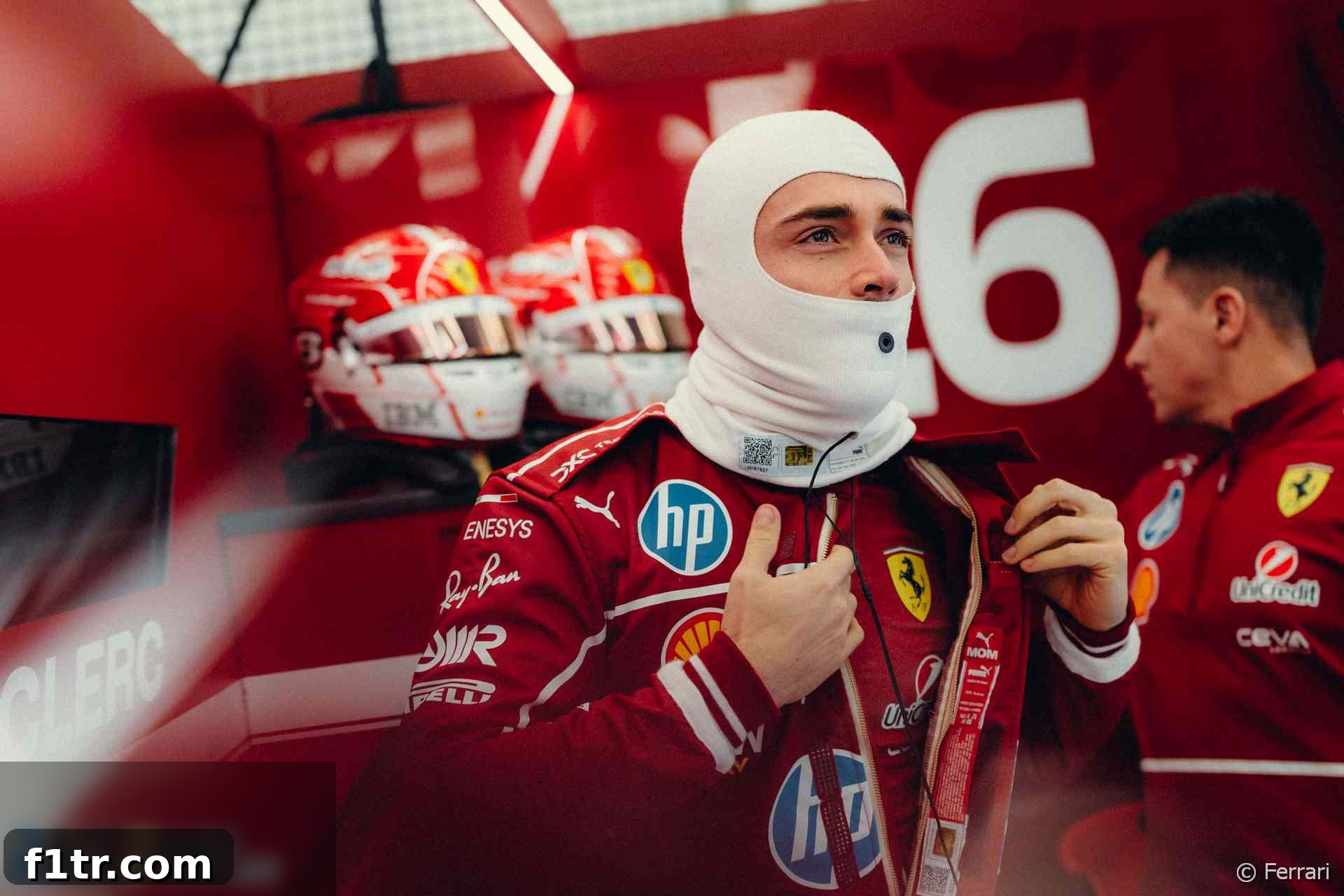
Leclerc Expresses Caution After Unpredictable Bahrain F1 Pre-Season Testing
Charles Leclerc, Ferrari’s highly-regarded driver, has voiced a degree of uncertainty regarding his team’s true pace after concluding the crucial pre-season testing in Bahrain. Unlike previous years, the Monegasque driver admitted to a less definitive understanding of Ferrari’s new challenger, the SF-25, attributing this ambiguity primarily to the highly unusual and inconsistent weather conditions experienced throughout the three-day test event at the Sakhir circuit.
Advert | Become a Supporter & go ad-free
Navigating Unpredictable Conditions: A Testing Challenge
“The initial feeling on the first day was genuinely good,” Leclerc commented to the assembled media after completing his final laps in the SF-25. “However, as we progressed into the second and third days, the conditions became significantly more difficult, making it quite a bit trickier to extract consistent data and precise feedback from the car.” This dramatic shift in track conditions presented a formidable challenge for Ferrari and indeed all teams, as they strived to understand their new machinery.
Leclerc elaborated on the team’s immediate focus, stating, “Right now, our primary objective is to bring the car’s balance back into its optimal operating window. This is where our concentration lies at the moment. There’s still some work required to achieve the ideal feeling with the balance, particularly when contending with the challenging conditions we encountered yesterday afternoon and again this morning.” The pursuit of perfect balance is paramount in Formula 1, and any deviation can significantly impact driver confidence and lap times.
Ferrari had concluded the previous season with a competitive car, demonstrating flashes of brilliance and securing crucial victories. Their ambition for the new season was clear: to deliver comprehensive improvements across the board with their latest chassis. Yet, Leclerc highlighted that the extreme variability of the Bahrain weather made it exceptionally difficult to accurately discern where the SF-25 had made genuine gains or where potential weaknesses might still persist. This lack of clarity is a concern for any team, especially one with championship aspirations.
An Unprecedented Bahrain Test: Wind, Rain, and Temperature Swings
“Overall, this Bahrain test has been profoundly different compared to every other year I’ve experienced,” Leclerc revealed, emphasizing the unique difficulties. “It’s been an incredibly tough three days.” The typical reliability and consistency of Bahrain’s climate, often ideal for testing, were nowhere to be found this time around.
The conditions, Leclerc stressed, were remarkably inconsistent, which severely hampered the ability to draw definitive conclusions from the testing sessions. “The wind has changed so dramatically and frequently, altering the car’s behavior considerably. We even witnessed rain yesterday, and on the very first day, the ambient temperatures were unusually low for Bahrain. These wildly different conditions day after day made it exceedingly difficult to establish a reliable lap time reference, which is often crucial for the team’s detailed analysis and understanding of car performance.” The wind, in particular, can significantly impact aerodynamic stability, making it hard to assess inherent aero performance. Rain adds another layer of complexity, forcing teams to run on wet tires, which are not representative of dry race conditions. These factors combined to create a scenario far from ideal for comprehensive data gathering.
Despite the challenges, Leclerc maintained a positive outlook regarding the learning process. “However, at least there’s the feeling I’ve gained, and I genuinely believe we’ve learned an immense amount about the SF-25. But it’s undeniably difficult to make direct comparisons with past tests or to precisely identify the strengths and weaknesses relative to the previous year’s car. This unique situation has simply made this entire testing period far more intricate and demanding.” The ability to benchmark against previous data is vital for development, and its absence leaves more questions unanswered.
Advert | Become a RaceFans supporter andgo ad-free
Approaching the First Race with More Unknowns
“Consequently, I’m likely heading into the first race of the season with a greater degree of unknown compared to previous years,” Leclerc admitted, highlighting the uncertainty that lingers for Ferrari. This sentiment underscores the unpredictable nature of the upcoming Australian Grand Prix in Melbourne, where the true pecking order will finally begin to emerge. While testing provides valuable data, its limitations, especially under such varied conditions, mean that teams often go into the opening rounds with educated guesses rather than absolute certainties.
Yet, it wasn’t all negatives. Leclerc also pointed to significant positives from Ferrari’s testing program. “On the other hand, we meticulously went through our planned program, and that in itself is a very positive aspect. We didn’t encounter any particularly major issues or significant reliability concerns, which is also a crucial positive indicator for the start of the season. So, while the picture isn’t entirely clear, these aspects give us confidence. Now, all that remains is to see where we truly stand when we arrive in Melbourne for the first Grand Prix.” Reliability is often considered half the battle in early season F1, and Ferrari’s trouble-free running is a strong foundation.
Scrutinizing Rivals: McLaren’s Promising Long Runs
During the Thursday sessions, Ferrari, along with key rivals such as McLaren, dedicated significant track time to long runs. These simulations, designed to mimic race conditions, appeared to suggest that the reigning world champions were in formidable shape. Leclerc openly acknowledged having closely observed Lando Norris’s particularly promising stint in McLaren’s MCL39, indicating that inter-team observation remains a vital part of the testing process.
“As much as pre-season testing is predominantly about focusing intensely on ourselves and our own car development, whenever there’s a race run unfolding, we invariably cast a glance at what the other teams are doing,” he explained. This passive observation provides initial clues, though it comes with inherent limitations. “However, it’s critical to remember that we lack complete information; we don’t know the exact fuel loads they are running, the engine modes they are deploying, or the precise tire degradation profiles they might be experiencing under specific conditions. Therefore, what we see is merely a first glimpse of what we might potentially expect from our competitors.” This nuanced perspective is essential, as testing mind games are a common occurrence in Formula 1.
Leclerc advised caution when interpreting these early signs. “There are still numerous unknowns floating around, so we absolutely need to take these observations with a significant pinch of salt. Nevertheless, it was a genuinely important run for us to better understand where we might be lacking in comparison to them, but also crucially, how our car felt compared to my own internal benchmarks and expectations. As I’ve reiterated quite a few times now, we still have a considerable amount of work to complete to ensure we are fully prepared and optimized for the challenge that awaits us in Melbourne.” The emphasis on self-improvement and maximizing their own package remains paramount for Ferrari.
Miss nothing from RaceFans
Get a daily email with all our latest stories – and nothing else. No marketing, no ads. Sign up here:
Advert | Become a RaceFans supporter andgo ad-free
The Road to Melbourne: Ferrari’s Outlook
As the Formula 1 circus packs up from Bahrain and prepares for the journey to Australia, the atmosphere within Ferrari, as expressed by Charles Leclerc, is one of cautious optimism tempered by pragmatic awareness. The unpredictable nature of the Bahrain test, while challenging, has arguably provided the team with valuable data in a wider array of conditions than initially anticipated. This could potentially equip them with a more versatile understanding of the SF-25’s behavior, crucial for adapting to different track environments throughout a long and demanding season.
The engineering teams at Maranello will now pour over every byte of data, meticulously analyzing the car’s performance in varied wind directions, temperatures, and even brief wet spells. The goal is to fine-tune the SF-25’s setup, optimize its aerodynamic package, and perfect the power unit’s integration to maximize its potential. Leclerc’s feedback, combined with Carlos Sainz’s insights, will be instrumental in guiding these critical pre-race preparations. The true test, however, will be the competitive environment of the Australian Grand Prix, where the qualifying sessions and the race itself will finally reveal the pecking order and indicate whether Ferrari has genuinely closed the gap to its championship rivals.
Related Formula 1 Articles
- Verstappen loathes F1’s new generation of cars – but what do his rivals reckon?
- The ‘throwback weekend’ is back in fashion. But it’s a flawed concept – especially for F1
- Is Formula 1’s double race cancellation a blessing in disguise?
- Todt admits Schumacher crashed on purpose – but did it really cost him two titles?
- 25 of the most memorable radio exchanges from the ‘Max and GP show’
Browse all Formula 1 articles