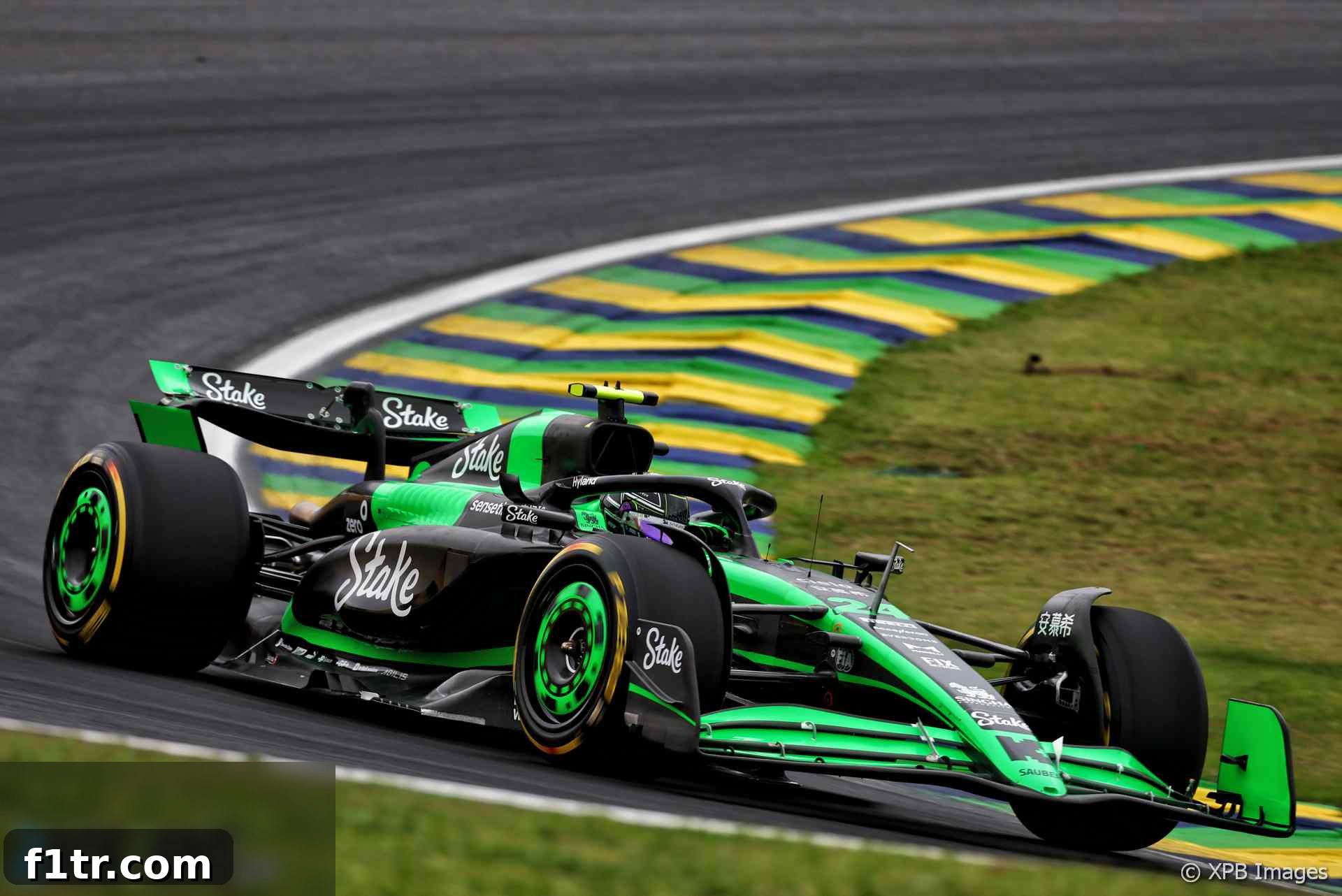
Sauber’s Costly Timing Blunder: Zhou Guanyu Denied Crucial Final Sprint Qualifying Lap
The high-stakes world of Formula 1 sprint qualifying demands absolute precision, where every millisecond and strategic call can determine a driver’s fate. At the recent Brazilian Grand Prix, Sauber found itself in an unenviable position, publicly apologising to driver Zhou Guanyu after a catastrophic timing error left him unable to complete his final flying lap in SQ1. This operational misstep not only ruined Zhou’s qualifying session but also highlighted the immense pressure and the critical importance of impeccable team communication in top-tier motorsport.
The incident unfolded with dramatic tension. Despite Zhou repeatedly querying his team over the radio about the remaining time, he was consistently assured that there was enough. His race engineer, Benisi, maintained a composed demeanor, advising Zhou on brake management and tyre temperatures, suggesting ample margin. However, as Zhou pushed to commence his final run, crossing the timing line, the lights had already turned a definitive red. The opportunity was lost, a victim of a collective miscalculation.
Zhou’s Frustration and Disappointment
Post-session, Zhou Guanyu’s frustration was palpable and deeply evident. Speaking to the official F1 channel, he didn’t mince words about the profound disappointment. “To be honest, it was quite a disaster session because to be the only driver not doing the last lap, crossing the line with fully red [lights] was just not so acceptable,” he stated, his voice reflecting a mix of anger and resignation. The unique severity of his situation – being the sole driver denied a final attempt – underscored the magnitude of the team’s blunder.
He further elaborated on the team’s operational failing, stating, “We completely messed up the timing for the final run. We’re sat in the garage too long and we go out last, couldn’t do the lap so, game over.” This candid assessment painted a clear picture of the strategic oversight: spending too much time stationary in the garage, leading to a late exit, and ultimately, missing the window for a crucial qualifying lap. For a driver striving to make his mark in F1, such a fundamental error by his own team is not just a missed opportunity on track but also a significant blow to morale and confidence.
Sauber’s Apology and Commitment to Rectification
In the aftermath, Sauber team representative Alessandro Alunni Bravi swiftly acknowledged the team’s error and issued a direct apology to their driver. “We must apologise to Zhou, as we made the wrong call in SQ1, and he was unable to start his second attempt,” Alunni Bravi conceded. His words confirmed the team’s acceptance of full responsibility for the misjudgment that cost Zhou a chance to improve his grid position for the sprint race.
Alunni Bravi also highlighted the critical impact of the missed lap, especially concerning track evolution. “A new lap would have given him the chance to improve his time with the track evolution—as we saw on Valtteri’s car with his improvement on the second push lap,” he explained. Track evolution, where the circuit becomes faster as more rubber is laid down, is a well-known phenomenon in F1 qualifying, and missing out on this advantage is a significant handicap. The contrast with Valtteri Bottas, who not only made it to SQ2 but also improved his time, only amplified the sting of Zhou’s situation. Crucially, Alunni Bravi emphasized the need for a thorough review: “Analysing what went wrong in the communication process is very important to avoid repeating such a mistake.” This commitment to internal investigation underscores the seriousness with which the team views the incident.
The Intricacies of F1 Sprint Qualifying Strategy
Formula 1 qualifying sessions, particularly sprint qualifying with its condensed format, are a high-wire act of strategy, timing, and execution. Teams must meticulously manage multiple variables: tyre warm-up sequences, brake conditioning, fuel load, and crucially, track position and traffic. The concept of ‘track evolution’ is paramount; as rubber accumulates on the asphalt and the track dries, lap times generally improve, meaning the latest possible lap often yields the fastest result, provided the car can get across the line in time.
However, this pursuit of optimal track conditions must be balanced against the finite time available. Misjudging the gap required to complete an out-lap and then a flying lap before the chequered flag falls is a cardinal sin. Engineers continuously monitor the pit lane queue, the pace of other cars, and the session clock, making split-second decisions that can elevate a driver or condemn them to the back of the pack. The Brazilian incident serves as a stark reminder that even in a sport driven by advanced technology and data analytics, human error in coordination and communication can still derail the best-laid plans. Sprint qualifying, with its shorter windows and fewer opportunities for redemption, amplifies the consequences of such mistakes, leaving less room for recovery in the subsequent race.
Immediate Consequences and Broader Implications
For Zhou Guanyu, the immediate consequence of this timing error was a disheartening back-of-the-grid start for the sprint race. This severely hampered his chances of making progress and scoring points, especially on a circuit like Interlagos where overtaking can be challenging. Beyond the single race, such incidents can have broader implications for a driver’s confidence and the team’s overall morale. In a sport where performance is everything and margins are minuscule, operational errors can erode trust and create an atmosphere of doubt.
For Sauber, the incident is a public stain on their operational efficiency. While apologies are necessary, consistent execution is what truly builds a reputation in Formula 1. The commitment to understanding the communication breakdown is crucial, as similar errors could prove even more costly in future Grand Prix events. Teams are constantly striving for perfection, and this incident serves as a powerful case study in the relentless pursuit of flawlessness required to compete at the pinnacle of motorsport.
Zhou’s Radio Messages from SQ1: A Timeline of Misjudgment
The radio transcript from SQ1 offers a poignant insight into Zhou’s increasing anxiety and the team’s repeated, yet ultimately flawed, assurances. It paints a picture of a driver seeking clarity and a team attempting to provide it, but ultimately failing to deliver on the fundamental task of time management.
| Zhou | Zhou joins the queue of cars in the pit lane Am I the last one in the queue, or… |
| Benisi | At the moment, yes. Just one car behind you. |
| Zhou | Are we okay with the timing? |
| Benisi | We are. Remember, work on brakes. |
| Benisi | Tyre temperatures at the moment are good. |
| Zhou | Between turns one and two in the pit exit Timing okay, yeah? |
| Benisi | Yes, we are. |
| Zhou | How long we have? |
| Benisi | One minute 50. |
| Benisi | Turn three in the pit lane exit You have time, don’t you worry. Just think about tyres. At the moment tyres are good, temperatures are good so nothing new to do. |
| Benisi | Tsunoda now opening into corner four. |
| Benisi | Approaching Subida do Lago Verstappen behind. |
| Zhou | Who else? |
| Benisi | No more traffic, just go. |
| Benisi | Approaching Ferradura Leclerc behind you pushing, two seconds behind you. |
| Benisi | Leclerc passes him at Ferradura Let him go, good. |
| Benisi | At Bico de Pato Alonso five behind you, pushing. Brake warming off. |
| Benisi | Approaching Mergulho 30 seconds, we’ve got margin. And Sainz is four behind Alonso. |
| Benisi | Alonso passes him into Juncao Now push. Push, push. Mode ‘push’ and go. |
| Zhou | Zhou crosses the timing line where red lights are illuminated My God, guys. |
| Zhou | I’ve taken the chequered flag, man! Fuck’s sake. |
| Benisi | Copy that. |
| Zhou | Yeah I thought… I mean… Guys, I had no margin. |
| Benisi | Mode ‘end’. |
| Zhou | Entering the pits We need to be better on timings. But we talk later. |
The transcript underscores Zhou’s foresight and his repeated attempts to confirm the timing, juxtaposed with the engineer’s consistent reassurances that ultimately proved incorrect. The shift from calm instructions to a frantic “Now push. Push, push. Mode ‘push’ and go” just moments before the inevitable red lights paints a vivid picture of the unfolding operational failure. Zhou’s raw, unedited exclamations upon seeing the red lights perfectly capture the crushing realization of a lost opportunity due to a team error. His final comment, “We need to be better on timings. But we talk later,” speaks volumes about the immediate need for review and the underlying frustration that such a fundamental mistake could occur.
Conclusion: A Critical Lesson for Sauber
The Sauber team’s qualifying blunder at the Brazilian Grand Prix serves as a poignant reminder of the relentless demands of Formula 1. It underscores that even the most experienced teams, equipped with cutting-edge technology and a wealth of data, can falter due to human error in communication and execution. While apologies have been issued and investigations into the communication process promised, the immediate consequence for Zhou Guanyu was a back-of-the-grid start, significantly impacting his weekend. For Sauber, it’s a critical lesson in the absolute necessity of precision and flawless coordination, particularly in the unforgiving environment of F1 sprint qualifying where every second genuinely counts. The sport offers no room for error, and teams must continuously learn and adapt to maintain their competitive edge.