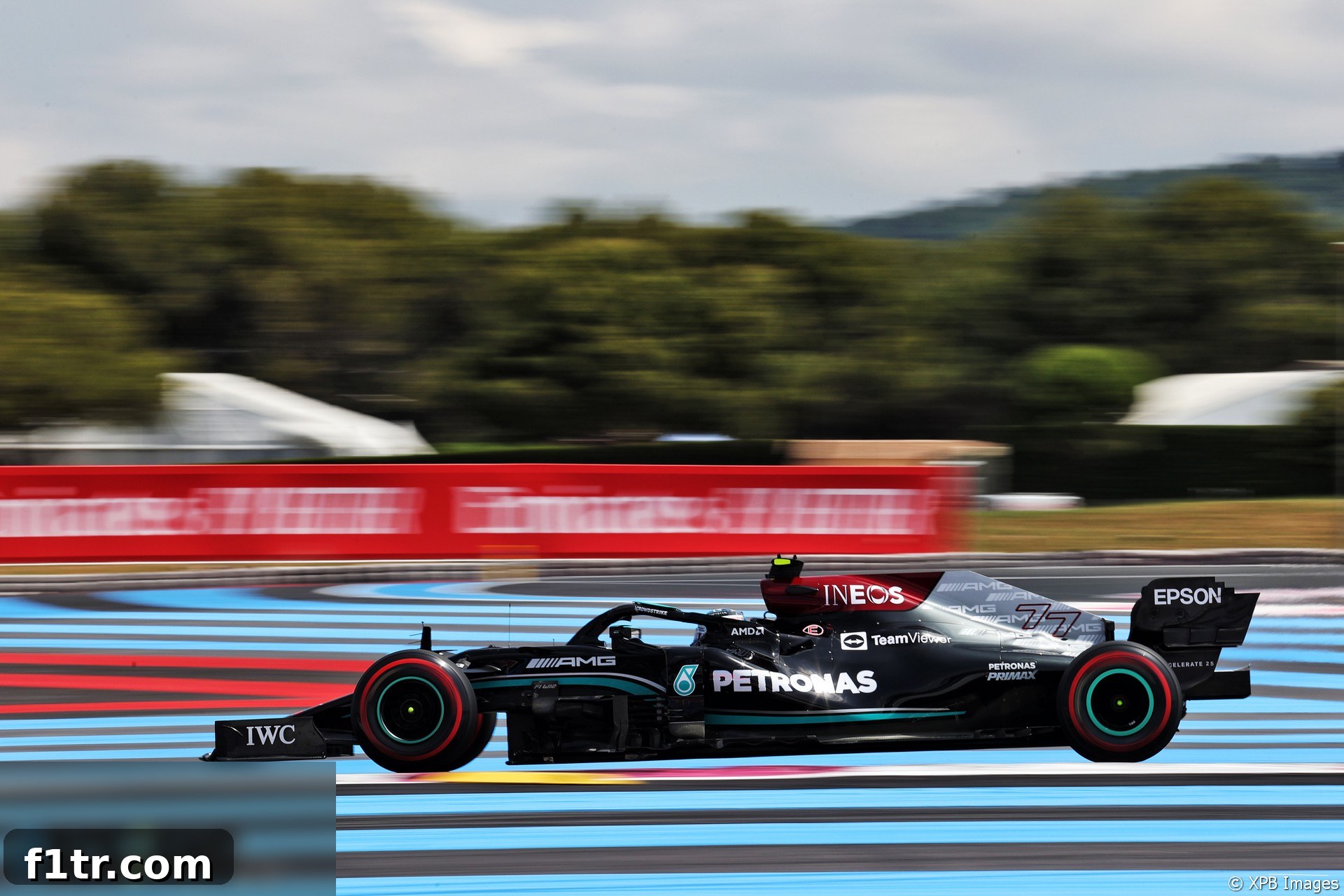
Valtteri Bottas Leads Mercedes 1-2 in Action-Packed French Grand Prix Practice at Paul Ricard
The highly anticipated 2021 French Grand Prix weekend kicked off with an eventful first practice session (FP1) at the picturesque Paul Ricard Circuit. Mercedes’ Valtteri Bottas set the pace, topping the timingsheets with a commanding performance, leading a strong one-two for the Silver Arrows. His teammate and reigning world champion, Lewis Hamilton, secured the second-fastest time, solidifying Mercedes’ early dominance as the championship battle intensifies.
This session marked the seventh round of the thrilling Formula 1 championship, and the stakes were visibly high. Both Mercedes drivers had swapped chassis ahead of the weekend, a routine but significant procedure aimed at ensuring optimal performance from their machinery. Bottas’s fastest lap, a blistering 1’33.448, was recorded in the initial phase of the session, a trend mirrored by many drivers who found their quickest rhythm early on. He managed to pull three-tenths of a second clear of Hamilton, an impressive margin demonstrating his strong start to the weekend.
Mercedes’ Early Dominance and Hamilton’s Setback
While Bottas enjoyed a relatively smooth run to the top, Hamilton’s quest for a late hot lap was interrupted by an unfortunate incident in the pit lane. As the session neared its conclusion, Hamilton was on what appeared to be a promising flying lap, but confusion involving AlphaTauri’s Yuki Tsunoda, who was attempting to avoid another car, led to a slight obstruction of the Mercedes. This minor, yet crucial, delay prevented Hamilton from fully unleashing his car’s potential and potentially challenging Bottas for the top spot, highlighting the fine margins that define Formula 1 performance.
Championship Leader Max Verstappen Battles Track Limit Challenges
Championship leader Max Verstappen, who currently holds a slender lead in the drivers’ standings, registered the third-fastest time for Red Bull Racing Honda. However, his session was not without its dramas. Towards the latter half, Verstappen radioed his Red Bull pit wall with a complaint about significant damage to his car’s floor. The damage was attributed to an aggressive encounter with a red-and-white kerb at Turn 15, a clear indication of the challenging nature of the Paul Ricard circuit and its stringent track limit enforcement. The floor damage likely compromised his car’s aerodynamics and performance, forcing him to abandon the lap he was on and potentially hindering his ability to improve his time further.
Paul Ricard’s Demanding Nature: Kerbs and Their Costly Impact
The Paul Ricard circuit, known for its extensive run-off areas and open nature, relies heavily on bollards and various kerbing to define track limits. These elements proved to be a significant challenge for several teams during FP1. Mercedes was among the first to voice concerns, with team manager Ron Meadows directly contacting Race Director Michael Masi. Meadows reported that the yellow rumble strips located beyond the limits of Turn 2 had caused substantial damage to Bottas’s car, estimating the cost of repairs to be in the “tens of thousands” of dollars. This incident underscored the high financial stakes involved in even minor track infringements and the constant battle between pushing limits and preserving machinery.
Verstappen’s floor damage, stemming from a similar issue with kerbs, further highlighted the severity of these track-side elements. Such incidents not only impact a driver’s immediate performance but can also lead to extensive repair work, consuming valuable team resources and potentially impacting development budgets. The drivers must navigate the fine line between maximizing cornering speed by using the track’s full width and avoiding the potentially catastrophic consequences of misjudging the kerbs.
Midfield Battle Heats Up: Alpine Impresses, Ferrari Struggles
The midfield fight also saw significant action and varying fortunes. Alpine, in particular, showcased strong form during the opening session. Following a commendable performance at the Autodromo do Algarve, Esteban Ocon continued his impressive run, positioning himself firmly among the fastest cars. He managed to outpace both McLaren and Ferrari, securing a commendable fifth place behind Sergio Perez in the second Red Bull, signaling Alpine’s potential for a strong weekend. His teammate Fernando Alonso also posted a solid time, indicating a competitive package from the French team on home soil.
Meanwhile, McLaren’s Daniel Ricciardo found himself ahead of teammate Lando Norris, suggesting a tighter intra-team battle for the British squad. AlphaTauri, with Pierre Gasly and Yuki Tsunoda, appeared to be roughly on par with the pace of McLaren and Alpine, hinting at a closely contested battle for points in the middle of the pack. Conversely, Ferrari, who had shown exceptional pace in Monaco and Baku, seemed to have slipped back. Both Charles Leclerc and Carlos Sainz Jnr finished outside the top ten, suggesting they might have work to do to regain their recent competitive edge.
Challenging Wind Conditions Lead to Spins and Incidents
The conditions at Paul Ricard were far from straightforward, with a changeable and strong wind blowing directly across Turn 2 at various points throughout the session. This unpredictable element contributed to several minor offs and lockups, with Turn 2 emerging as a particular hot spot for incidents. Four-time world champion Sebastian Vettel was notably caught out by a gust of wind at this corner, sending his Aston Martin into a spin. The rear of his car made contact with the barriers, a heart-stopping moment for the German driver and his team. Fortunately, Vettel was able to regain control of his car and make it back to the pits, avoiding any significant damage that would have disrupted the session.
Later, Carlos Sainz Jnr experienced an almost identical incident at Turn 2. The Spaniard’s Ferrari spun violently, but he displayed remarkable car control, managing to keep it from hitting the barriers. Despite avoiding a crash, the spin severely flat-spotted his tyres, necessitating a slow return to the pits for a fresh set. These incidents served as a stark reminder of the challenges posed by the circuit’s layout and the ever-present environmental factors that can catch even the most experienced drivers off guard.
At the very back of the field, Roy Nissany, who took over George Russell’s Williams car for the session, posted the slowest time among all drivers, gaining valuable experience but indicating the significant gap to the front-runners. His participation underscores the vital role practice sessions play in allowing young talent to gain track time and teams to collect crucial data.
Overall, the first practice session for the French Grand Prix provided a tantalizing glimpse into the weekend’s potential dynamics. Mercedes showed strong initial form, while Red Bull faced immediate challenges with track limits. The midfield remains fiercely competitive, and the circuit itself, with its unique kerbs and unpredictable wind, is set to be a significant factor in the unfolding drama of the Grand Prix weekend. Teams will now analyse the gathered data meticulously to prepare for the crucial qualifying and race sessions ahead, aiming to master Paul Ricard’s intricate demands.
2021 French Grand Prix First Practice Result
| Pos. | No. | Driver | Car | Best lap | Gap | Laps |
|---|---|---|---|---|---|---|
| 1 | 77 | Valtteri Bottas | Mercedes | 1’33.448 | 23 | |
| 2 | 44 | Lewis Hamilton | Mercedes | 1’33.783 | 0.335 | 21 |
| 3 | 33 | Max Verstappen | Red Bull-Honda | 1’33.880 | 0.432 | 23 |
| 4 | 11 | Sergio Perez | Red Bull-Honda | 1’34.193 | 0.745 | 25 |
| 5 | 31 | Esteban Ocon | Alpine-Renault | 1’34.329 | 0.881 | 25 |
| 6 | 3 | Daniel Ricciardo | McLaren-Mercedes | 1’34.644 | 1.196 | 23 |
| 7 | 14 | Fernando Alonso | Alpine-Renault | 1’34.693 | 1.245 | 21 |
| 8 | 10 | Pierre Gasly | AlphaTauri-Honda | 1’34.699 | 1.251 | 20 |
| 9 | 4 | Lando Norris | McLaren-Mercedes | 1’34.707 | 1.259 | 21 |
| 10 | 22 | Yuki Tsunoda | AlphaTauri-Honda | 1’34.847 | 1.399 | 22 |
| 11 | 16 | Charles Leclerc | Ferrari | 1’34.950 | 1.502 | 24 |
| 12 | 99 | Antonio Giovinazzi | Alfa Romeo-Ferrari | 1’35.116 | 1.668 | 23 |
| 13 | 7 | Kimi Raikkonen | Alfa Romeo-Ferrari | 1’35.135 | 1.687 | 20 |
| 14 | 18 | Lance Stroll | Aston Martin-Mercedes | 1’35.275 | 1.827 | 23 |
| 15 | 5 | Sebastian Vettel | Aston Martin-Mercedes | 1’35.289 | 1.841 | 16 |
| 16 | 55 | Carlos Sainz Jnr | Ferrari | 1’35.342 | 1.894 | 23 |
| 17 | 6 | Nicholas Latifi | Williams-Mercedes | 1’35.612 | 2.164 | 22 |
| 18 | 9 | Nikita Mazepin | Haas-Ferrari | 1’36.651 | 3.203 | 24 |
| 19 | 47 | Mick Schumacher | Haas-Ferrari | 1’37.329 | 3.881 | 14 |
| 20 | 45 | Roy Nissany | Williams-Mercedes | 1’37.881 | 4.433 | 16 |
First Practice Visual Gaps
Valtteri Bottas – 1’33.448
Lewis Hamilton – 1’33.783 (Gap: +0.335)
Max Verstappen – 1’33.880 (Gap: +0.432)
Sergio Perez – 1’34.193 (Gap: +0.745)
Esteban Ocon – 1’34.329 (Gap: +0.881)
Daniel Ricciardo – 1’34.644 (Gap: +1.196)
Fernando Alonso – 1’34.693 (Gap: +1.245)
Pierre Gasly – 1’34.699 (Gap: +1.251)
Lando Norris – 1’34.707 (Gap: +1.259)
Yuki Tsunoda – 1’34.847 (Gap: +1.399)
Charles Leclerc – 1’34.950 (Gap: +1.502)
Antonio Giovinazzi – 1’35.116 (Gap: +1.668)
Kimi Raikkonen – 1’35.135 (Gap: +1.687)
Lance Stroll – 1’35.275 (Gap: +1.827)
Sebastian Vettel – 1’35.289 (Gap: +1.841)
Carlos Sainz Jnr – 1’35.342 (Gap: +1.894)
Nicholas Latifi – 1’35.612 (Gap: +2.164)
Nikita Mazepin – 1’36.651 (Gap: +3.203)
Mick Schumacher – 1’37.329 (Gap: +3.881)
Roy Nissany – 1’37.881 (Gap: +4.433)
All drivers completed the session.