Lewis Hamilton, a name synonymous with modern Formula 1 dominance, has consistently placed himself in the pantheon of motorsport legends. Despite his unprecedented success and numerous broken records, Hamilton has always maintained a profound respect for those who came before him. Even as he approached and eventually surpassed many of the statistical achievements of the sport’s most iconic figures, Hamilton publicly stated that he continued to consider Michael Schumacher the greatest Formula 1 driver of all time. This humility, coupled with an insatiable drive for victory, defines much of Hamilton’s journey in a sport where comparisons across eras are both inevitable and endlessly debated.
The conversation around the ‘Greatest of All Time’ (GOAT) in Formula 1 is a dynamic one, constantly evolving with each new championship and record broken. For many years, Michael Schumacher stood as the undisputed benchmark, his seven world titles and 91 race wins seemingly insurmountable. Then came Lewis Hamilton, who, after replacing Schumacher at Mercedes in 2013, embarked on a trajectory that would redefine what was possible in the hybrid era. When Hamilton secured his fifth world championship, drawing level with the legendary Juan Manuel Fangio and just two shy of Schumacher’s monumental tally, the question of his own GOAT status became more prominent than ever. Yet, Hamilton’s perspective remained rooted in deep admiration for his predecessors.
Advert | Become a Supporter & go ad-free
Lewis Hamilton’s Respect for the Titans of F1
In a candid reflection following a championship triumph that placed him firmly among the sport’s elite, Lewis Hamilton addressed the persistent ‘GOAT’ question head-on. He acknowledged the statistical milestones he was achieving but firmly reiterated his belief that Michael Schumacher still held the top spot. “Michael’s still quite far ahead in race wins so you have to say he’s still the ‘GOAT’,” Hamilton stated, referencing Schumacher’s then-record of 91 victories. At the time of this particular quote, Hamilton was 20 wins away from matching Schumacher’s record, a gap he would eventually close and surpass in subsequent seasons, ultimately setting new benchmarks for race victories and pole positions.
Hamilton’s admiration, however, extends beyond mere statistics. He consistently highlights the unique challenges and circumstances faced by previous generations of drivers. Juan Manuel Fangio, for instance, is referred to as “the godfather” – a testament to his pioneering achievements in an era of unparalleled danger. “Fangio I think is the godfather and always will be from a driver’s perspective. To do what he did in that time where it was so dangerous, I respect him so highly. I feel a great honour to have my name alongside his, that’s for sure,” Hamilton articulated. This sentiment underscores a crucial aspect of the GOAT debate: it’s not just about the numbers, but also about the context, the inherent risks, and the sheer audacity of those who pushed the boundaries of speed and skill when the sport was far less sophisticated and safety measures were rudimentary.
The Legacy of Michael Schumacher: A Benchmark of Excellence
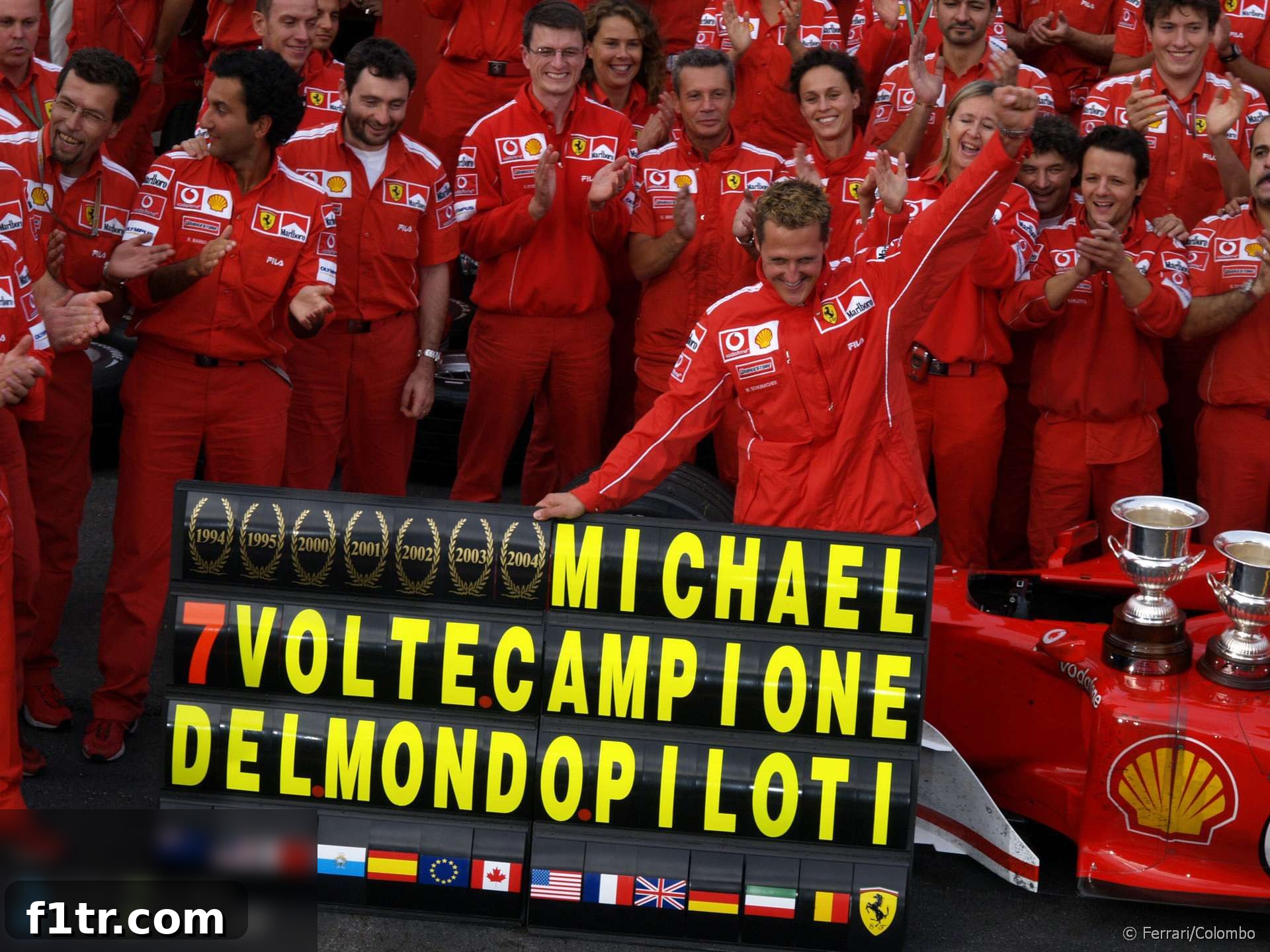
Michael Schumacher’s name is etched into the very fabric of Formula 1 history, representing an era of relentless pursuit of perfection and unprecedented success with Ferrari. His seven world championships and 91 race wins were once considered insurmountable records, a testament to his extraordinary talent, unwavering focus, and formidable work ethic. Schumacher’s impact extended beyond his driving; he transformed the role of a modern F1 driver, meticulously involving himself in every aspect of the team’s operations, from car development to strategy. His ability to consistently extract maximum performance from any car, coupled with his legendary rain driving and tactical prowess, set a new standard for excellence.
Schumacher’s tenure at Ferrari, particularly during the early 2000s, created a dynasty that captivated millions worldwide. He not only brought unparalleled success to the Scuderia after a long drought but also instilled a winning culture that reverberated through the entire team. His aggressive yet precise driving style, combined with an almost mystical ability to perform under pressure, made him a truly singular figure in the sport. When Lewis Hamilton spoke of Schumacher as the GOAT, he was acknowledging not just the statistical achievements but also the profound influence Schumacher had on the sport, the benchmarks he set, and the very concept of what a Formula 1 champion could be.
Juan Manuel Fangio: The Quintessential Pioneer
Before Schumacher and Hamilton, there was Juan Manuel Fangio, a figure whose achievements in the 1950s laid the groundwork for modern motorsport greatness. Fangio’s remarkable record of five world championships, achieved with four different manufacturers (Alfa Romeo, Ferrari, Mercedes-Benz, and Maserati), speaks volumes about his adaptability, skill, and sheer dominance across various machinery. In an era where driving was exceptionally dangerous and technological advancements were swift, Fangio’s ability to consistently win and adapt set him apart.
The F1 of Fangio’s time was a perilous arena. Drivers faced rudimentary safety features, circuits that were barely more than public roads, and cars that were powerful yet unpredictable. To compete and triumph in such conditions required an extraordinary blend of bravery, mechanical sympathy, and strategic intelligence. Fangio was not only a master behind the wheel but also a meticulous preparer and a shrewd tactician, often choosing his teams and cars carefully to maximize his chances of success. His “godfather” status, as described by Hamilton, is a direct acknowledgement of his foundational role in establishing the very idea of a dominant F1 champion and the immense courage required to race at the pinnacle of motorsport in its nascent stages.
The Evolving GOAT Debate: Comparing Across Eras
The question of who is the greatest F1 driver of all time is one of motorsport’s most enduring and passionate debates. It’s a complex discussion, as comparing drivers across different eras presents numerous challenges. How does one accurately weigh the achievements of Fangio in the 1950s, driving highly dangerous cars with minimal safety, against Schumacher’s technical prowess and team-building at the turn of the millennium, or Hamilton’s consistent dominance in the modern hybrid era?
Several factors contribute to the difficulty of such comparisons:
- Technological Evolution: Cars have changed dramatically. Modern F1 machines are technological marvels with advanced aerodynamics, powerful hybrid powertrains, and sophisticated electronics, vastly different from the raw, mechanical beasts of earlier decades.
- Safety Standards: The inherent danger of racing has been significantly reduced, allowing drivers to push limits previously unimaginable. Fangio’s contemporaries often faced fatal accidents, making every race a life-or-death gamble.
- Competition Intensity: The depth and breadth of talent in the field can vary. While all eras have seen great champions, the overall competitive landscape might differ.
- Race Calendars and Reliability: Modern F1 seasons are longer, offering more opportunities for wins and points. Reliability has also vastly improved, meaning fewer mechanical retirements.
- Team Dominance: Drivers like Schumacher and Hamilton benefited from periods of team dominance, raising questions about the extent to which their success was car-dependent versus purely individual skill. However, great drivers are often the catalyst for such dominance.
Ultimately, while statistics provide a quantitative measure, the qualitative aspects—charisma, adaptability, influence on the sport, and ability to inspire—are equally important. Drivers like Ayrton Senna, Alain Prost, and Jim Clark also frequently feature in this discussion, each bringing unique qualities and achievements that enrich the sport’s history.
Hamilton’s Enduring Fire and Future Aspirations
Lewis Hamilton’s journey has been marked by an extraordinary blend of raw talent, unwavering determination, and a continuous desire for self-improvement. He articulated this drive perfectly: “I’m naturally just very proud to have the Hamilton name up there. The Hamilton name will always be there. If you could see how tough it was for us in the beginning – even this year still fighting and still becoming stronger each year – I feel like I’m still driving with that fierce fire I had when I was eight years old. So I’ll keep going until that goes. Which I don’t think is every going to go, but I’m probably going to run out at some stage.”
This statement encapsulates the essence of Hamilton’s career: a deeply personal connection to his family name, a recognition of the struggles faced to reach the pinnacle, and an ever-present, almost childlike passion for racing. This “fierce fire” is what has enabled him to continually adapt, evolve, and maintain his physical and mental edge in a relentlessly demanding sport. Beyond the track, Hamilton has expanded his influence, becoming a vocal advocate for diversity, environmental sustainability, and social justice. These off-track pursuits demonstrate a broader vision for his legacy, one that extends beyond championship trophies and into shaping a better world.
Despite his unparalleled success, Hamilton remains driven by numerous goals. “I’ve still got things to achieve, still so many targets, so many things ahead,” he stated. While his interests are diverse, the core aspiration remains constant: “If I can tick off one of the things on my list each year it’s always at the top, winning the world title. I give everything for that.” This singular focus on the world championship, year after year, speaks to the competitive spirit that continues to define him. His dedication to his craft, combined with his growing influence as a global icon, ensures that Lewis Hamilton’s story is far from over, and his place among the absolute legends of Formula 1 is not just secured but continuously being written.
Advert | Become a RaceFans supporter andgo ad-free
2018 F1 season
- F1 feared “death knell” for Drive to Survive after Ferrari and Mercedes snub
- McLaren staff told us we were “totally crazy” to take Honda engines in 2018 – Tost
- ‘It doesn’t matter if we start last’: How Red Bull’s junior team aided Honda’s leap forward
- Honda’s jet division helped F1 engineers solve power unit problem
- McLaren Racing losses rise after Honda split
Browse all 2018 F1 season articles