2025 Spanish Grand Prix: A Deep Dive into Strategy, Overtaking, and Championship Battles at Circuit de Catalunya
The stage is set for a thrilling 2025 Spanish Grand Prix at the iconic Circuit de Catalunya, where McLaren has asserted its dominance by locking out the front row. However, their rivals are not to be underestimated, with various strategic options poised to challenge the papaya team’s early advantage. This comprehensive race preview delves into the critical factors that will shape the 66-lap contest, from weather conditions and the pivotal race start to complex tyre strategies and potential overtaking hotspots.
Race Day Weather Forecast: Consistent Conditions Expected
The meteorological outlook for race day mirrors the warm and sunny conditions that have characterized the entire weekend in Barcelona. Clear skies are anticipated throughout, with ambient temperatures expected to remain comfortably in the high 20s Celsius. Such stable and predictable weather eliminates the variable of rain, allowing teams to fully focus on optimizing their car setups and race strategies for dry track conditions. However, consistently high temperatures will place significant demands on tyre degradation and engine cooling, adding an extra layer of challenge for drivers and engineers alike.
The Race Start: A Crucial Dash to Turn One
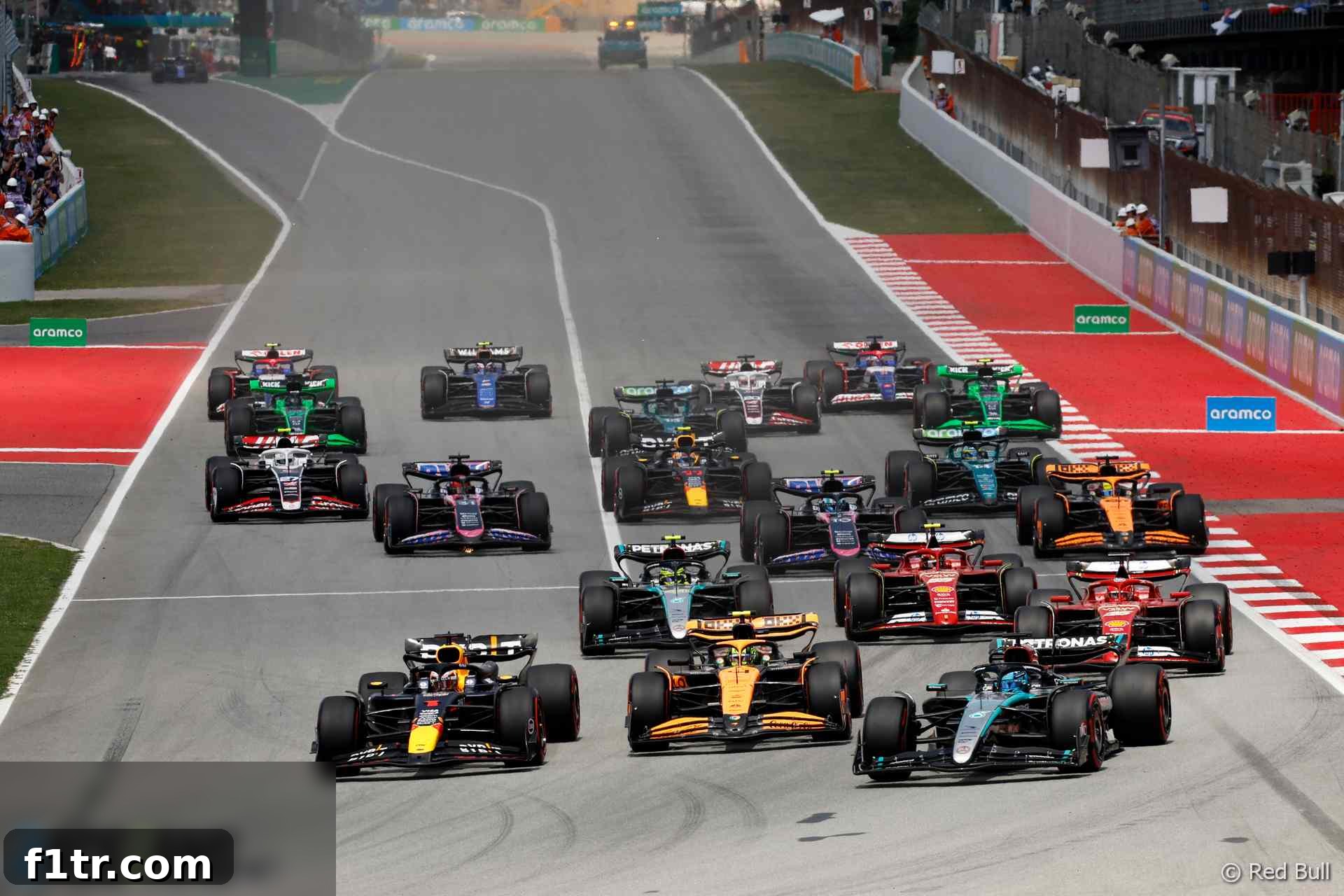
The Circuit de Catalunya is renowned for one of the longest runs from pole position to the first corner on the entire Formula 1 calendar. This extensive straight, stretching over 600 meters, makes the initial getaway exceptionally critical. A strong start can propel a driver several positions forward, while a poor one can be severely punished, potentially costing valuable time and track position early in the race.
The significant distance from pole position to the first braking zone demands precise timing and controlled aggression. Source: Mercedes data highlights this challenge.
History provides a compelling precedent: last year, the Spanish Grand Prix was one of only two races where the lead was seized by a driver starting outside the front row. George Russell, demonstrating exceptional race craft, launched himself from fourth on the grid to brilliantly sweep around both Lando Norris and Max Verstappen to claim the lead. Should Russell aim to replicate this remarkable feat this year, he will need to navigate past Verstappen, who lines up third, and then conquer the formidable McLaren duo who have secured the coveted front row.
Oscar Piastri, starting from pole position, finds himself in a familiar, yet challenging, scenario, having also started from pole at Imola. On that occasion, his focus on defending against Russell allowed Verstappen to capitalize and overtake him on the outside. Lessons learned from Imola will undoubtedly make Piastri more vigilant this time. With Lando Norris alongside him, McLaren holds a strong strategic hand, positioning themselves to effectively repel any early threats from behind and potentially dictate the pace of the race from the outset. The dynamics of the first few corners will be instrumental in setting the tone for the entire grand prix.
Strategic Showdown: Tyre Choices and Pit Stop Tactics
Strategy is often the differentiating factor at the Circuit de Catalunya, a track known for its demanding corners and high tyre degradation. Understanding the tyre compounds and how they performed in previous races offers valuable insight into potential race day tactics.
Looking back at last year’s race, a clear trend emerged regarding starting tyre compounds:
| Pos. | Driver | Team | Tyre compound |
|---|---|---|---|
| 1 | Lando Norris | McLaren-Mercedes | Soft |
| 2 | Max Verstappen | Red Bull-Honda RBPT | Soft |
| 3 | Lewis Hamilton | Mercedes | Soft |
| 4 | George Russell | Mercedes | Soft |
| 5 | Charles Leclerc | Ferrari | Soft |
| 6 | Carlos Sainz Jnr | Ferrari | Soft |
| 7 | Pierre Gasly | Alpine-Renault | Soft |
| 8 | Esteban Ocon | Alpine-Renault | Soft |
| 9 | Oscar Piastri | McLaren-Mercedes | Soft |
| 10 | Fernando Alonso | Aston Martin-Mercedes | Soft |
| 11 | Sergio Perez | Red Bull-Honda RBPT | Soft |
| 12 | Valtteri Bottas | Sauber-Ferrari | Soft |
| 13 | Nico Hulkenberg | Haas-Ferrari | Soft |
| 14 | Lance Stroll | Aston Martin-Mercedes | Soft |
| 15 | Zhou Guanyu | Sauber-Ferrari | Soft |
| 16 | Kevin Magnussen | Haas-Ferrari | Soft |
| 17 | Yuki Tsunoda | RB-Honda RBPT | Soft |
| 18 | Daniel Ricciardo | RB-Honda RBPT | Soft |
| 19 | Logan Sargeant | Williams-Mercedes | Soft |
| 20 | Alexander Albon | Williams-Mercedes | Medium |
As observed, nearly every driver last year opted for the soft tyre compound to begin the race, highlighting its initial performance advantage. However, the majority then switched to the more durable medium compound for their second stint, seeking a balance between pace and longevity. Towards the final stint, many front-runners were able to deploy another set of soft tyres for a late push, while others, having pitted earlier, strategically chose the harder compound for greater durability to the checkered flag.
This year, Charles Leclerc and Ferrari have opted for a high-stakes strategic gamble, prioritizing race pace over qualifying performance by saving more fresh sets of tyres for the race than his rivals. This calculated risk, while compromising his grid position, could pay significant dividends in the demanding grand prix, potentially offering him a crucial advantage in terms of grip and performance during key phases of the race.
Understanding the available tyres for each driver is paramount, as a pit stop at Circuit de Catalunya typically costs around 22 seconds compared to a car that remains on track. This substantial time penalty makes every pit decision critical and multi-stop strategies challenging but often necessary.
| Tyres available for the race | Hard | Medium | Soft | |||
|---|---|---|---|---|---|---|
| Driver | New | Used | New | Used | New | Used |
| Oscar Piastri | 1 | 0 | 1 | 0 | 1 | 3 |
| Lando Norris | 1 | 0 | 1 | 0 | 1 | 3 |
| Max Verstappen | 1 | 0 | 1 | 0 | 1 | 3 |
| George Russell | 1 | 0 | 1 | 0 | 1 | 3 |
| Lewis Hamilton | 1 | 0 | 1 | 0 | 0 | 4 |
| Andrea Kimi Antonelli | 1 | 0 | 1 | 0 | 0 | 4 |
| Charles Leclerc | 1 | 0 | 2 | 0 | 0 | 3 |
| Pierre Gasly | 1 | 0 | 1 | 0 | 0 | 4 |
| Isack Hadjar | 1 | 0 | 1 | 0 | 0 | 4 |
| Fernando Alonso | 0 | 1 | 0 | 1 | 0 | 4 |
| Alexander Albon | 1 | 0 | 1 | 0 | 1 | 4 |
| Gabriel Bortoleto | 1 | 0 | 1 | 0 | 1 | 4 |
| Liam Lawson | 1 | 0 | 1 | 0 | 1 | 4 |
| Lance Stroll | 0 | 1 | 0 | 1 | 1 | 4 |
| Oliver Bearman | 1 | 0 | 2 | 0 | 1 | 3 |
| Nico Hulkenberg | 1 | 0 | 1 | 0 | 3 | 2 |
| Esteban Ocon | 1 | 0 | 2 | 0 | 1 | 3 |
| Carlos Sainz Jnr | 1 | 0 | 1 | 0 | 3 | 2 |
| Franco Colapinto | 1 | 0 | 1 | 0 | 2 | 3 |
| Yuki Tsunoda | 1 | 0 | 1 | 0 | 3 | 2 |
The tyre allocation table reveals interesting differences. Drivers like Leclerc, Oliver Bearman, and Esteban Ocon possess two new sets of medium tyres, potentially offering them more flexibility for a two-stop strategy with longer stints. Conversely, drivers such as Nico Hulkenberg, Carlos Sainz Jnr, and Yuki Tsunoda have three new soft sets, which could enable them to push harder in the initial or final phases, or even attempt an aggressive three-stop strategy if tyre degradation proves particularly high.
Overtaking Opportunities: The Art of the Pass
The Circuit de Catalunya has a reputation for being a challenging track for overtakes, primarily due to its aerodynamically demanding corners which make it difficult for cars to follow closely. For this year’s race, there have been no changes to the existing DRS (Drag Reduction System) zones, which remain crucial for creating passing chances.
By far, the most prominent overtaking opportunity lies on the long main straight leading into Turn One. This high-speed section allows drivers to gain significant slipstream and deploy DRS, setting up a dive into the right-left corner combination. However, this is also a notorious hotspot for collisions, as drivers often run out of road or misjudge braking points in their quest for position. Any drivers forced off track at this point must follow a designated route to safely rejoin the circuit, ensuring fair play and avoiding shortcuts.
In recent years, we have witnessed several late defensive maneuvers on the approach to Turn One. Attacking drivers sometimes push the limits, placing their right-hand-side wheels beyond the track limits onto the asphalt runoff area that extends after the pit lane exit. While this can provide an extra few meters of track, it is a risky endeavor. The runoff is bumpy and does not extend all the way to Turn One, making it a high-risk strategy that can easily end in tears or a penalty. Beyond Turn One, other overtaking zones are significantly more difficult, demanding precise timing, aggressive driving, and often relying on tyre differences or driver errors.
For any drivers who find themselves involved in incidents, the current Formula 1 penalty points system will be in effect, adding another layer of consequence to aggressive driving decisions:
- Formula 1 drivers’ current penalty points
Speed Trap Analysis: Unpacking Raw Pace
The speed trap data from qualifying offers valuable insights into each car’s straight-line performance and aero setup. This information is particularly relevant for the race, as top speed can be a critical factor in both defending and executing overtakes, especially on the Circuit de Catalunya’s long main straight.
Pole-winner Oscar Piastri’s impressive speed through the trap suggests that the McLaren MCL39 possesses a strong balance of downforce and straight-line efficiency. This dual capability could make him particularly difficult to dislodge from the lead, as he won’t be easily passed on the straights while maintaining strong cornering performance.
| P. | # | Driver | Car | Engine | Model | Max kph (mph) |
|---|---|---|---|---|---|---|
| 1 | 63 | George Russell | Mercedes | Mercedes | W16 | 330.0 (205.1) |
| 2 | 81 | Oscar Piastri | McLaren | Mercedes | MCL39 | 329.5 (204.7) |
| 3 | 5 | Gabriel Bortoleto | Sauber | Ferrari | C45 | 328.1 (203.9) |
| 4 | 18 | Lance Stroll | Aston Martin | Mercedes | AMR25 | 327.7 (203.6) |
| 5 | 12 | Andrea Kimi Antonelli | Mercedes | Mercedes | W16 | 327.6 (203.6) |
| 6 | 16 | Charles Leclerc | Ferrari | Ferrari | SF-25 | 327.5 (203.5) |
| 7 | 55 | Carlos Sainz Jnr | Williams | Mercedes | FW47 | 327.3 (203.4) |
| 8 | 23 | Alexander Albon | Williams | Mercedes | FW47 | 327.2 (203.3) |
| 9 | 14 | Fernando Alonso | Aston Martin | Mercedes | AMR25 | 326.9 (203.1) |
| 10 | 27 | Nico Hulkenberg | Sauber | Ferrari | C45 | 326.9 (203.1) |
| 11 | 43 | Franco Colapinto | Alpine | Renault | A525 | 326.5 (202.9) |
| 12 | 44 | Lewis Hamilton | Ferrari | Ferrari | SF-25 | 326.5 (202.9) |
| 13 | 1 | Max Verstappen | Red Bull | Honda RBPT | RB21 | 326.3 (202.8) |
| 14 | 4 | Lando Norris | McLaren | Mercedes | MCL39 | 326.2 (202.7) |
| 15 | 31 | Esteban Ocon | Haas | Ferrari | VF-25 | 326.0 (202.6) |
| 16 | 10 | Pierre Gasly | Alpine | Renault | A525 | 325.8 (202.4) |
| 17 | 87 | Oliver Bearman | Haas | Ferrari | VF-25 | 325.7 (202.4) |
| 18 | 6 | Isack Hadjar | Racing Bulls | Honda RBPT | 02 | 325.2 (202.1) |
| 19 | 30 | Liam Lawson | Racing Bulls | Honda RBPT | 02 | 325.0 (201.9) |
| 20 | 22 | Yuki Tsunoda | Red Bull | Honda RBPT | RB21 | 323.7 (201.1) |
While George Russell recorded the highest speed, indicating a potentially lighter downforce setup on his Mercedes W16, the consistency of McLaren’s speed, with Piastri in second and Norris slightly lower, shows their strong overall package. Interestingly, Max Verstappen and Lando Norris are relatively close in speed, suggesting that the Red Bull RB21 and McLaren MCL39 might be running similar levels of downforce, optimized for a blend of cornering grip and straight-line acceleration crucial for this circuit.
Safety Car Scenarios: A Race-Altering Variable
The recent history of the Spanish Grand Prix at Circuit de Catalunya has been notably free of major incidents, with no Safety Car periods or Virtual Safety Car deployments in the last two races. Furthermore, neither of those events saw any incidents significant enough to trigger a yellow flag, pointing to a relatively clean and controlled racing environment in recent years.
Consequently, Formula 1 has not experienced a Safety Car restart at this circuit since the original, faster final two corners were reinstated. Previously, the tight, slow chicane that formed the final sector offered the leading driver a distinct advantage when restarting after a Safety Car period. This configuration allowed them to perfectly manage the gap and acceleration out of the final corner, making it exceedingly difficult for any pursuing cars to launch an immediate attack. However, with the simpler, high-speed configuration of the final corners now in place, that strategic advantage for the leader is likely diminished. The longer, faster run to the start/finish line could provide more opportunities for chasing drivers to get a slipstream and challenge for position, potentially making Safety Car restarts a more unpredictable and exciting prospect if they occur.
While the recent track record suggests a low probability, a Safety Car or Virtual Safety Car deployment could dramatically alter race strategies. It offers a “cheap” pit stop opportunity, allowing drivers to change tyres without losing as much time to their rivals, which could shuffle the running order and open up new tactical avenues for teams.
The Starting Grid and Championship Implications
The grid for the 2025 Spanish Grand Prix will feature 19 cars, as Lance Stroll has unfortunately withdrawn from the event. The final confirmed grid for this year’s race is available at the link below, with any last-minute changes prior to the race start being promptly updated:
- 2025 Spanish Grand Prix grid
With McLaren occupying the front row, the championship implications are significant. If the drivers were to finish in their starting positions, Oscar Piastri would further extend his championship lead to a comfortable 10 points over teammate Lando Norris and a substantial 35 points over Max Verstappen. This would solidify Piastri’s position at the top of the standings and place immense pressure on his rivals to respond. Furthermore, Fernando Alonso would be on track to score his first championship point of the season, a much-needed boost for the Aston Martin driver and his team.
Fans can explore all potential championship scenarios and calculate the points implications of various race outcomes using the dedicated championship points calculator:
- RaceFans 2025 Formula 1 championship points calculator
Your Thoughts on the Spanish Grand Prix
The 2025 Spanish Grand Prix promises an enthralling spectacle of speed, strategy, and high-stakes racing. How do you foresee the crucial long run to Turn One unfolding? Can any of McLaren’s formidable rivals mount a serious challenge for victory, or will the papaya team convert their front-row lockout into a dominant performance? And will Charles Leclerc’s strategic gamble with tyre management ultimately pay off, propelling him through the field?
Share your predictions, insights, and opinions on the Spanish Grand Prix in the comments section below.
2025 Spanish Grand Prix News & Analysis
- Verstappen: Don’t blame Spanish GP penalty for hitting Russell if I narrowly lose title
- Russell’s radio comments influenced Red Bull’s decision to let him past Verstappen
- Verstappen says he won’t make any changes to his driving to avoid a ban
- ‘No issues’ with Verstappen but ‘it’d be different if he’d taken me out’ – Russell
- Ferrari “don’t want us to talk much” about “massive” Spanish GP problems – Hamilton
Browse all 2025 Spanish Grand Prix articles