Magnussen’s Miami Misfortune: A Weekend Plagued by Penalties and a Looming Race Ban
The 2024 Miami Grand Prix proved to be another challenging and controversial weekend for Haas driver Kevin Magnussen, who found himself at the center of multiple incidents and accumulated a concerning number of penalties. His most significant infraction involved a collision with Williams driver Logan Sargeant, an event that not only curtailed Sargeant’s home race but also cast a shadow over Magnussen’s recent driving record and brought him precariously close to an automatic race ban.
The Collision: Magnussen vs. Sargeant at Turn 3
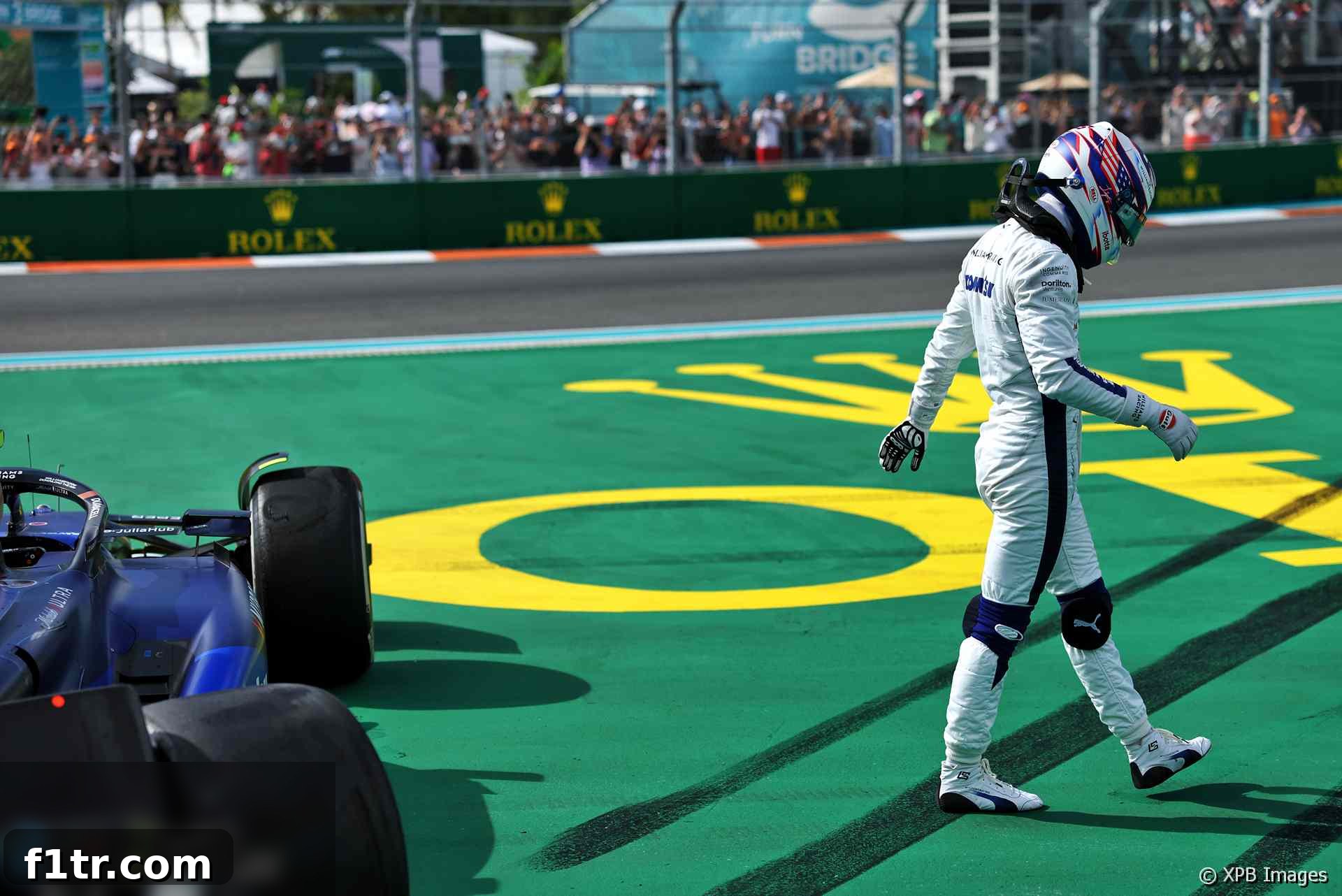
The pivotal moment unfolded during the main race when Magnussen, attempting an aggressive overtaking maneuver, tangled with Logan Sargeant. The incident occurred at Turn 3, a complex section of the Miami International Autodrome, as Magnussen sought to make a move on the inside of the Williams. The contact was immediate and decisive, sending Sargeant’s car into the trackside barrier and forcing his premature retirement from the Grand Prix. It was a disheartening end to Sargeant’s home race weekend, a moment of high anticipation tragically cut short by the on-track skirmish.
The stewards swiftly investigated the clash, and their verdict was unequivocal: Kevin Magnussen was deemed wholly responsible for the collision. This judgment resulted in a 10-second time penalty added to his race time, a standard consequence for such incidents. More critically, the stewards also imposed two penalty points on Magnussen’s Super Licence. This addition brings his cumulative tally dangerously close to the 12-point threshold that triggers an automatic one-race ban within a 12-month period, intensifying the pressure on the Danish driver for future events.
Magnussen’s Candid Admission and the Quest for Clarity
Following the race, a visibly frustrated Magnussen admitted, “Not a good day again.” His words conveyed a sense of weariness with the recurring issues that have plagued his recent outings. He expressed a desire for a clearer understanding of the rules and how to navigate aggressive racing scenarios without incurring penalties. “Hopefully I can get some clarity on things going forward,” he stated, indicating a need for deeper introspection and perhaps discussions with his team and the FIA regarding driving standards. “What happened today, of course it’s not good. Nonetheless, we move on and try to have a better weekend next weekend.” This sentiment underscores the relentless nature of Formula 1, where drivers must quickly process setbacks and refocus on upcoming challenges, even amidst ongoing controversy.
Dissecting the Stewards’ Ruling: A Detailed Look at Driving Standards
The stewards’ detailed report provided an illuminating insight into their decision-making process, highlighting precisely why Magnussen was held entirely accountable for the collision with Sargeant. Their analysis revealed that Magnussen’s aggressive approach began earlier in the sequence of corners, as he initially attempted to pass Sargeant at Turn 1, then again on the outside at Turn 2, before the ultimate contact at Turn 3.
Crucially, the stewards referred to the “Driving Standards Guidelines,” a framework designed to ensure fair and safe racing. For an overtaking car to be granted room on the outside, the guidelines stipulate that its front axle must be at least alongside the front axle of the other car at the apex of Turn 2. The stewards found it “clear that Car 20 [Magnussen] did not have its front axle in that position such that it was entitled to room in that corner.” This meant Magnussen had not established sufficient overlap to command space.
Furthermore, even if the incident were considered solely as an inside overtake attempt at Turn 3, Magnussen would still not have had the “right to the corner” according to the established standards for such maneuvers. The guidelines for an inside overtake require the attacking car to be substantially alongside the defending car at the turn-in point to earn the right to the corner and expect room.
The stewards concluded that even when viewed as a sequence of corners or a chicane, the outcome remained unchanged. The guidelines prioritize the first corner in such sequences, and if a driver does not establish the right to be given room at that initial point, they do not gain the benefit for subsequent corners within the same sequence. Consequently, the stewards firmly reiterated that “Car 20 was therefore wholly to blame for the collision that occurred.” This meticulous breakdown underscores the intricate and often nuanced application of racing rules, leaving little room for ambiguity in their final judgment against Magnussen.
A Cascade of Infractions: More Penalties for Magnussen
The collision with Sargeant was, unfortunately, just one part of Magnussen’s tumultuous Miami weekend. He received a further penalty for a procedural error during a Safety Car period. The Haas team admitted that Magnussen had entered the pits without changing tyres, an infraction of the regulations designed to prevent teams from gaining an unfair advantage under Safety Car conditions. This mistake, acknowledged by Haas as their own error, resulted in a post-race drive-through penalty for Magnussen, which was converted into an additional 20 seconds added to his overall race time.
Adding to his woes, Magnussen remained under investigation for failing to serve his initial 10-second time penalty during the race, a potentially serious oversight that could lead to further sanctions. This pattern of accumulating penalties became a significant talking point, particularly given that Magnussen had already received four separate penalties during the sprint race held just the day before. This persistent pattern of infringements raises questions about communication, strategy, and Magnussen’s on-track conduct, piling immense pressure on the driver and his team as the season progresses.
Sargeant’s Home Race Heartbreak and Positive Outlook
For Logan Sargeant, the incident was a bitter pill to swallow, ending his participation in his home Grand Prix prematurely. Despite the frustration of being taken out of the race, Sargeant maintained a measured and mature tone. “I haven’t seen it back so I don’t have a lot to say other than that it’s a very disappointing way to end up at my home race weekend,” he remarked shortly after the incident. While avoiding immediate blame, his disappointment was palpable.
However, Sargeant was keen to extract positives from an otherwise challenging weekend. “But nonetheless, it’s been a positive weekend and I have to take those positives. I feel like generally I’ve been able to get almost everything out of it this weekend. Little bits to find but I just have to take those, draw a line under it and move on.” His focus on personal performance and development, despite the setback, highlights the resilience required of a Formula 1 driver, especially one competing under the intense scrutiny of a home crowd.
The Safety Car’s Pivotal Role: A Game-Changer for Norris
Beyond the immediate consequences for Magnussen and Sargeant, their collision had a profound and unexpected impact on the outcome of the Miami Grand Prix. The incident triggered a crucial Safety Car period, which inadvertently reshaped the race dynamics entirely. At the time of the collision, several front-running drivers, including Lando Norris, had not yet made their mandatory pit stops. The Safety Car provided Norris with a golden opportunity to pit under neutralized conditions, minimizing his time loss compared to a regular pit stop under green flag racing.
This strategic advantage was monumental. Norris rejoined the track at the head of the field, effectively leapfrogging competitors who had already pitted or were less fortunate with their timing. This stroke of luck, born from the Magnussen-Sargeant tangle, proved to be the decisive factor in Norris securing his maiden Formula 1 victory. The incident, therefore, serves as a powerful reminder of how quickly race fortunes can turn, and how a single collision can dramatically alter the narrative and result of an entire Grand Prix.
Broader Implications for Driver Conduct and the Championship
Kevin Magnussen’s Miami weekend underscores the intense scrutiny faced by Formula 1 drivers and the narrow margin for error, particularly in an era of stringent driving standards enforcement. His accumulation of penalty points and various infringements highlight a need for review and adaptation in his driving approach. With a potential race ban looming, the pressure on Magnussen to deliver clean, penalty-free races in the coming rounds will be immense, not only for his personal record but also for the Haas F1 Team’s championship aspirations.
The stewards’ detailed explanation of their rulings also provides valuable clarity for all drivers, emphasizing the importance of understanding and adhering to the established “Driving Standards Guidelines.” The incident involving Magnussen and Sargeant, while unfortunate, serves as a crucial case study in the complexities of modern F1 racing, where aggressive overtaking must be balanced with respect for competitors and the rules of engagement.
Looking Ahead
As the Formula 1 season progresses, all eyes will be on Kevin Magnussen to see if he can rebound from this challenging period and demonstrate a more consistent, penalty-free performance. For Logan Sargeant, the focus will be on building on the positive aspects of his Miami weekend and avoiding further misfortune. The incident will undoubtedly remain a significant talking point, a reminder of the fine line between aggressive racing and punishable contact, and the unpredictable nature of Grand Prix outcomes.
2024 Miami Grand Prix Related Articles
- McLaren had superior pace before Verstappen’s damage in Miami – Norris
- Sainz ‘struggles to understand’ why he got penalty when Perez didn’t
- Alonso’s unusual brake problem and more unheard Miami team radio
- McLaren’s Miami upgrade success points to even stronger form in coming races
- Norris expects more wins this year and believes “100%” in 2025 title bid
Browse all 2024 Miami Grand Prix articles