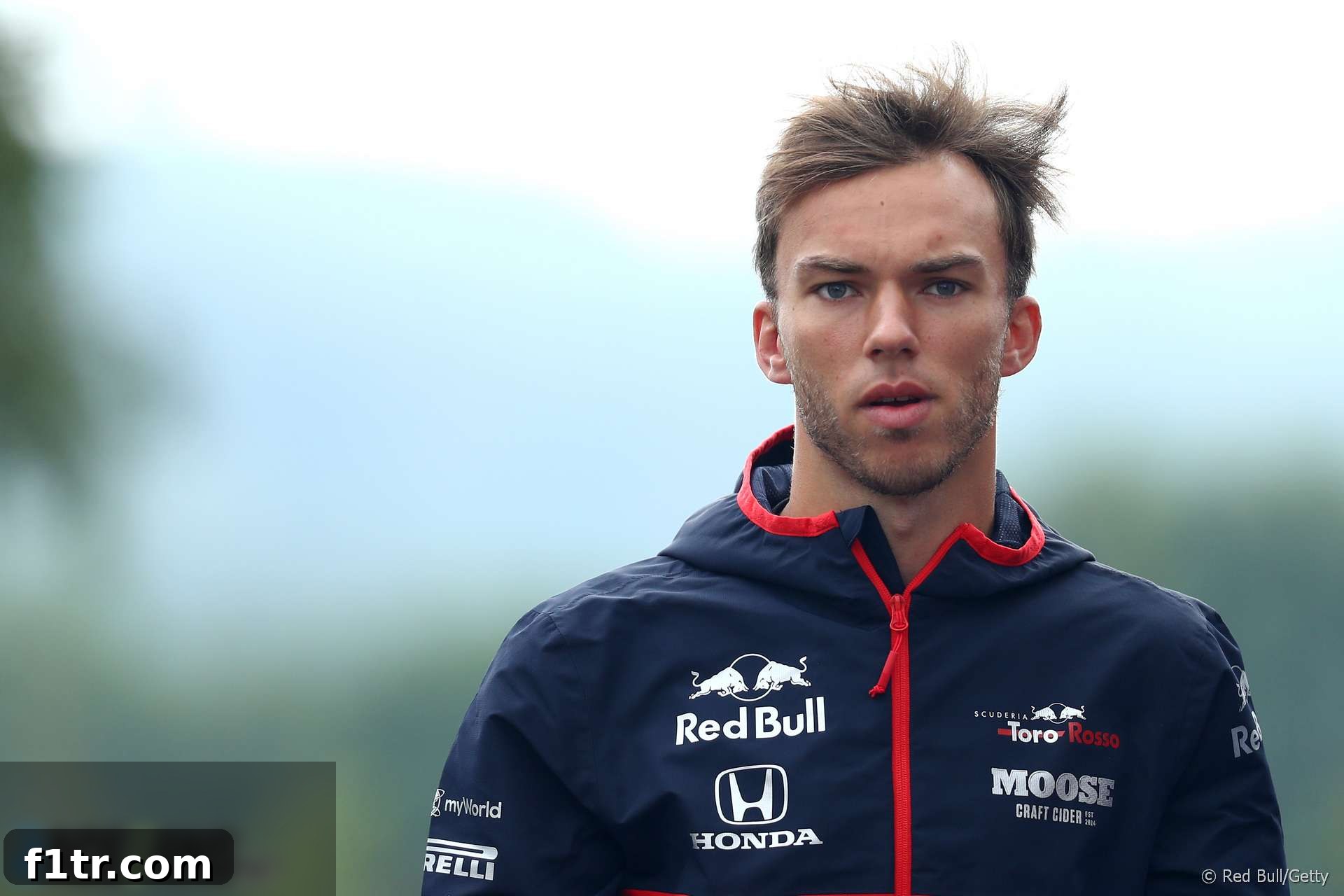
Daniel Ricciardo Weighs In: Understanding Red Bull’s Decision to Demote Pierre Gasly
The high-stakes world of Formula 1 is notoriously unforgiving, a reality starkly illustrated by Red Bull Racing’s decisive mid-season driver swap in 2019. Daniel Ricciardo, a former Red Bull star, has publicly expressed his understanding of why the team opted to demote Pierre Gasly just 12 races into his debut season with the senior squad. Drawing on his extensive experience within the Red Bull system, Ricciardo’s insights shed light on the brutal but effective culture that shapes the careers of many young drivers.
Ricciardo, who competed for Red Bull between 2014 and 2018, is no stranger to the team’s cutthroat approach. During his tenure, he witnessed first-hand the swift demotion of his then-teammate, Daniil Kvyat, underscoring a pattern of rapid decision-making when performance benchmarks are not met. This history provides a unique lens through which Ricciardo views Gasly’s situation, leading him to conclude that Red Bull’s actions, while harsh, were ultimately justifiable from the team’s perspective.
The Unrelenting Pressure of the Red Bull Program
“To be honest, I don’t think it’s unfair,” Ricciardo stated, reflecting on Gasly’s sudden return to Toro Rosso (now AlphaTauri). “I think they had to do something.” This straightforward assessment cuts to the core of Red Bull’s philosophy. The energy drink giant invests heavily in nurturing young talent through its junior program, but in return, it expects immediate and consistent performance at the highest level. Drivers are meticulously groomed for success, but the transition to the main Red Bull Racing team comes with immense pressure and a zero-tolerance policy for underperformance.
Ricciardo was quick to clarify that his comments were not a personal attack on Gasly. “Nothing against Pierre: I have no issue, I like Pierre as a person. I’m not happy to see him go back to Toro Rosso, but I think the reality is Red Bull did give him six months.” This acknowledgment highlights the human element of the decision while reiterating the professional obligation Red Bull felt to address the performance gap. Six months, or roughly half a season, is often deemed sufficient by Red Bull management to assess a driver’s capability to adapt and perform alongside a championship-contending teammate.
Gasly’s Struggles and the Search for Progression
The core issue, as Ricciardo identified, was the perceived lack of significant progress from Gasly. “I don’t think there was that much sign of progression or momentum,” he observed. Joining a top team like Red Bull Racing requires a steep learning curve, not just in mastering the car but also in integrating into a high-pressure environment. Gasly, in his second full F1 season, seemed to struggle with this adaptation, particularly when compared to the blistering pace and consistent podium finishes of his teammate, Max Verstappen.
Verstappen’s exceptional performances became an unofficial, yet undeniable, benchmark for Gasly. With Verstappen consistently extracting the maximum from the Red Bull chassis, often securing wins and multiple podiums, the car’s potential was evident. “Obviously with Max winning and showing that the car is capable of at least being on the podium, I think Red Bull did expect to see that, for now,” Ricciardo explained. The stark contrast in results between the two drivers underscored Gasly’s difficulties and amplified the team’s concerns about their constructors’ championship aspirations.
Max Verstappen: The Unyielding Benchmark
While no one expected Gasly, relatively new to top-tier F1, to consistently outperform a seasoned and supremely talented driver like Verstappen, the sheer magnitude of the performance gap became problematic. Verstappen, already in his fifth F1 season and a proven race winner, set an incredibly high bar. Ricciardo speculated on Red Bull’s internal expectations: “I don’t think they expected Pierre to beat him but sometimes the gap was too big. I think if he was a tenth, two-tenths or maybe even three sometimes it would be a bit better.”
This “gap” wasn’t just about raw speed over a single lap, but also about race management, consistency, and the ability to convert potential into points. Verstappen’s ability to regularly secure podiums, including two wins during that period, highlighted Gasly’s struggle to even register a single top-three finish. “I guess at least they would have expected maybe one podium from Pierre,” Ricciardo added, pointing to a realistic, yet unfulfilled, expectation from the team. The consistent disparity in points contributed significantly to Red Bull’s decision, as it directly impacted their standing against formidable rivals like Mercedes and Ferrari.
Alexander Albon: A New Opportunity and Immense Pressure
The swiftness of the demotion saw Alexander Albon promoted from Toro Rosso to take Gasly’s seat alongside Verstappen. Ricciardo, ever the pragmatist, acknowledged the predictable nature of such a move within Red Bull’s structure. “It’s also what, as a Red Bull driver, I’ve experienced in the programme. This is how they are. It’s no surprise that they are expecting this from you and if it doesn’t happen then they’ll move on.”
Albon’s promotion was, therefore, not just a vote of confidence but also an immediate imposition of the same immense pressure that Gasly had faced. Ricciardo recognized this double-edged sword: “It’s just the reality of their programme. It’s obviously a shame for him but I think Red Bull had to do something so now it’s Albon with an opportunity. We’ll see how that goes.” Albon would now inherit the challenge of adapting quickly, performing consistently, and closing the gap to Verstappen – a task that proved insurmountable for his predecessor.
Ricciardo’s Insightful Perspective: A History of Tough Choices
Having navigated the Red Bull system himself, culminating in multiple Grand Prix victories before his eventual departure, Ricciardo possesses a unique and empathetic understanding of both the team’s expectations and the drivers’ struggles. His comments are not rooted in speculation but in direct experience. The demotion of Daniil Kvyat mid-season in 2016, to make way for a then-rookie Max Verstappen, serves as a poignant reminder that Gasly’s situation was not an isolated incident but part of a well-established pattern.
“I don’t want to say it was unexpected as well. I’m sure Pierre probably had some suspicions that maybe something could change,” Ricciardo remarked. This suggests that drivers within the Red Bull ecosystem are acutely aware of the performance parameters and the consequences of not meeting them. The lack of shock in Ricciardo’s voice underscores the prevalent understanding within the F1 paddock that Red Bull operates with a clear, results-driven mandate, prioritising team performance over individual sentiment.
The Broader Implications for F1 Careers
Ultimately, Gasly’s demotion serves as a powerful testament to the cut-throat nature of Formula 1. Teams invest hundreds of millions, and every component, including the human one, must deliver. While the decision was undoubtedly tough on Gasly, it highlighted Red Bull’s unwavering commitment to performance and its readiness to make bold moves to achieve its objectives. It also demonstrated the immense pressure on young drivers to perform immediately and consistently, especially when paired with a generational talent like Max Verstappen.
For Daniel Ricciardo, his perspective is one of hard-won wisdom, acknowledging the practical necessities of the sport while maintaining respect for the individuals involved. His comments provide a valuable window into the inner workings of one of F1’s most successful, yet demanding, teams, affirming that in the realm of elite motorsport, results will always speak the loudest.
2019 F1 Season: Related Articles
- Crying in the Melbourne car park at 2019 grand prix was my career low – Ocon
- McLaren Racing reports reduced £71 million loss in 2019
- Kvyat: Hockenheim podium last year was “my biggest achievement” so far
- How the FIA’s new encrypted fuel flow meter targets Ferrari’s suspected ‘aliasing’ trick
- “He smashed my office door”: 23 must-see moments from ‘Drive to Survive’ season two
Browse all 2019 F1 season articles