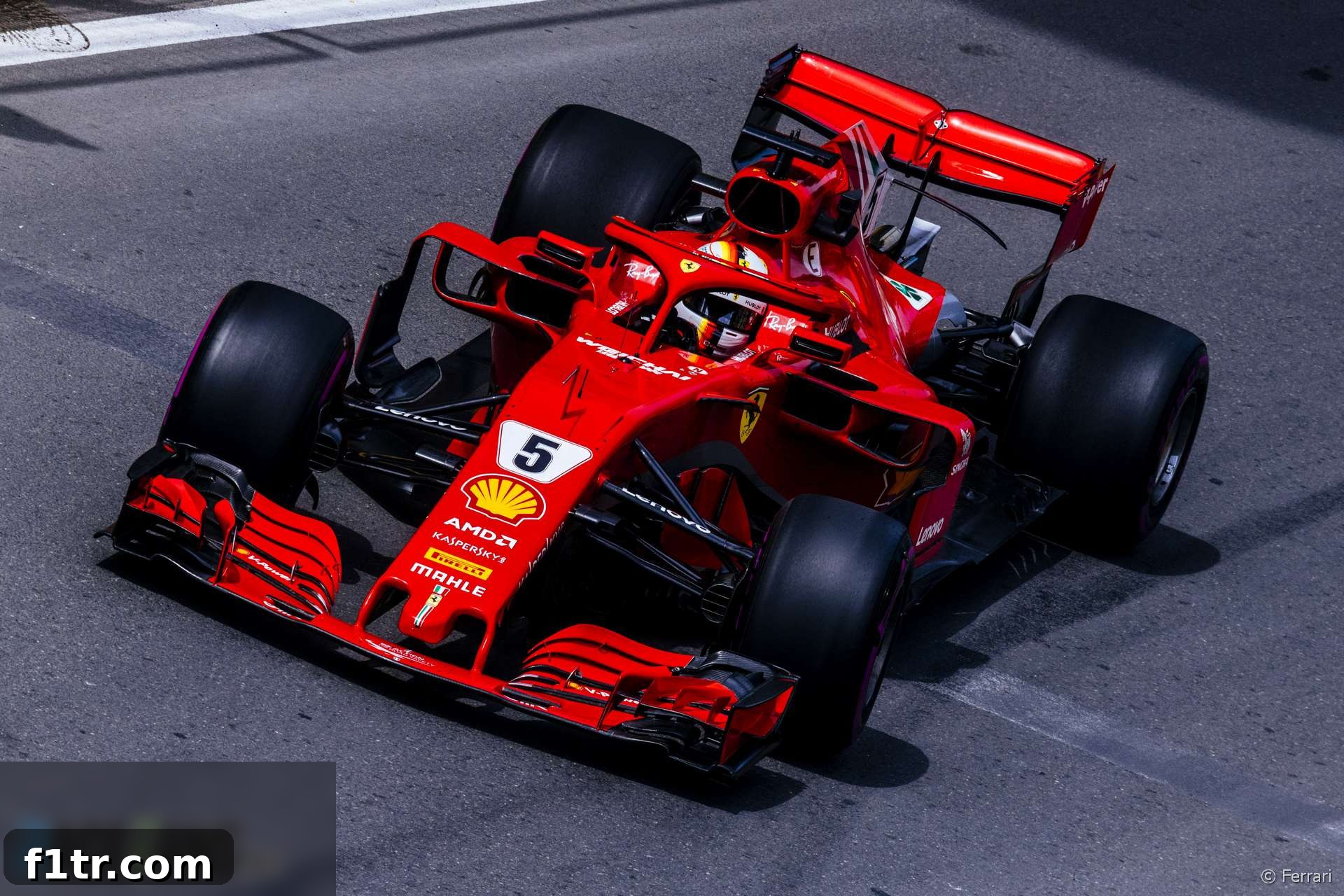
The exhilarating qualifying session for the Azerbaijan Grand Prix delivered a truly unexpected grid, especially given the blistering pace displayed by some drivers. It is a rare occurrence when a driver who clocks the quickest times across all three sectors in qualifying ultimately finds themselves starting sixth on the grid. This scenario vividly highlights the significant cost of Kimi Raikkonen’s critical slip-up at Turn 16 of the Baku City Circuit.
Raikkonen had demonstrated supreme speed, setting the fastest times through the initial first and second sectors. However, his performance in the crucial final part of the lap only ranked as the tenth-fastest. Had he managed to string together these individual sector bests into a single flawless lap, his theoretical time of 1’41.413 would have comfortably secured him pole position, surpassing the best theoretical time of any of his rivals. It’s no surprise that the typically stoic Raikkonen was moved to describe this missed opportunity, this latest defeat, as profoundly “painful” – a testament to the immense potential he squandered.
Compounding Raikkonen’s qualifying disappointment is the strategic disadvantage he faces for the race start. Due to an unfortunate lock-up during Q2, which forced him to abandon his attempt to advance on super-soft tyres, he will now begin the race on a set of ultra-soft tyres. This decision carries significant implications, as the five cars directly ahead of him on the grid – driven by Sebastian Vettel, Lewis Hamilton, Valtteri Bottas, Daniel Ricciardo, and Max Verstappen – will all start on the more durable super-soft compound. This positions them on a theoretically superior one-stop strategy, aiming to switch to soft tyres approximately 20 laps into Sunday’s 51-lap race.
Pirelli’s predictions suggest that if the race unfolds without extended Safety Car periods, Raikkonen could be compelled to pit as many as 10 laps earlier than his immediate rivals. This makes his race start absolutely critical. He must execute a clean getaway, avoiding any repeat of the early race collisions that prematurely ended his challenge here last year. A strong start will be essential to enable him to aggressively position his Ferrari amidst the formidable Red Bulls and Mercedes machines. His inherently grippier ultra-soft tyres, combined with the raw power of his Ferrari engine, should provide a significant advantage in the initial laps, offering a window of opportunity to make up ground and mitigate the strategic tyre offset.
Following last year’s incredibly eventful race, which famously featured four Safety Car periods and a red flag due to debris, the return of Formula 1 to Baku has been met with widespread anticipation for another thrilling spectacle. While the potential for chaos and excitement is undeniable, it is equally important to recall the 2016 event, which was, to put it mildly, rather uneventful and processional. Even Saturday’s F2 race initially promised to be a straightforward affair until a late Safety Car intervention completely reshuffled the order, reminding everyone of Baku’s inherent unpredictability. This duality underscores the unique character of the Baku City Circuit, a track capable of delivering either a strategic masterclass or an absolute demolition derby, often hinging on the timing of Safety Car deployments.
As F1 drivers demonstrated emphatically last year, restarts following a Safety Car period on the monumental run down to the start/finish line can be absolutely hair-raising. Last year’s primary antagonists, Sebastian Vettel and Lewis Hamilton, find themselves sharing the front row once again, setting the stage for a potentially electrifying opening lap and subsequent restarts. Both drivers, along with their rivals, will undoubtedly have meticulously reviewed last year’s contentious restart procedures, particularly the nuances of managing the gaps and the timing of their acceleration. The leader faces a precarious balancing act: they must simultaneously protect their hard-earned position from aggressive challengers while also ensuring they do not inadvertently overtake the Safety Car before it peels into the pits. The sheer length of the main straight in Baku makes the latter a particularly challenging prospect, as Hamilton himself almost fell afoul of this rule at one point last year, highlighting the fine margins involved in managing these crucial moments.
The other significant talking point surrounding this weekend’s race has been the persistent possibility of strong winds. While the latest forecasts for Sunday indicate that wind strength should noticeably decrease around the scheduled race start time, there remains a distinct possibility of powerful gusts reaching up to 35 kph. Such winds are more than sufficient to significantly unsettle the exquisitely balanced handling of Formula 1 cars, potentially leading to instability, reduced confidence, and even errors. The stronger winds experienced earlier in the day will have already made life considerably more challenging for the F2 drivers, providing a preview of the conditions. Additionally, there is an outside chance that their race might even see a few isolated spots of rain, further complicating the already intricate dynamics of track conditions.
Just as witnessed in the early stages of the Chinese Grand Prix, the battle among the front-runners will be intricately shaped by the timing of pit stops and the pursuit of the undercut. Teams like Red Bull will be keenly assessing how early they can bring their drivers in to swap for the more durable soft tyres. The theoretical benefit of being the first to switch to fresh rubber – the infamous “undercut” – is particularly high at Baku, given that its six-kilometer lap length makes it one of the longest circuits on the calendar. A longer lap amplifies the time loss suffered by a car on older tyres compared to one on fresh rubber exiting the pits, making the undercut a potent strategic weapon.
The crucial question then becomes: will Red Bull, known for their aggressive strategic calls, attempt their daring double-stacked early pit stop strategy again, as they did to great effect in China? Mercedes also holds a strong hand, having demonstrated their ability to leverage strategic advantages, notably through the brilliant execution by Valtteri Bottas in Shanghai. Bottas himself reflected on the strategic battle on Thursday: “It seemed like the middle of the stint pace-wise Ferrari was better in the first stint. We were trying everything to keep up as close as possible.”
He continued, offering insight into their strategy: “But then I think for some reason they could extract a bit more of the tyres so they had also bigger drop-off. So I could get closer before the stop. I think the second stint was strong for us with the soft tyre, as we’ve seen the trend this year.” This observation points to a critical difference in tyre management and degradation between the Ferrari and Mercedes cars, particularly on the soft compound. If this trend persists into the race, Vettel could find himself in a much tougher fight than his pole position suggests. And critically, Raikkonen’s costly qualifying error means that Vettel will embark on this strategic and on-track battle without the crucial support of his Ferrari teammate acting as a “tail-gunner,” leaving him more exposed to attacks from behind.
Azerbaijan Grand Prix Qualifying Times in Full
Here’s a detailed breakdown of the qualifying results, showcasing the outright pace of each driver during the three sessions:
| Driver | Car | Q1 | Q2 (vs Q1) | Q3 (vs Q2) | |
| 1 | Sebastian Vettel | Ferrari | 1’42.762 | 1’43.015 (+0.253) | 1’41.498 (-1.517) |
| 2 | Lewis Hamilton | Mercedes | 1’42.693 | 1’42.676 (-0.017) | 1’41.677 (-0.999) |
| 3 | Valtteri Bottas | Mercedes | 1’43.355 | 1’42.679 (-0.676) | 1’41.837 (-0.842) |
| 4 | Daniel Ricciardo | Red Bull | 1’42.857 | 1’43.482 (+0.625) | 1’41.911 (-1.571) |
| 5 | Max Verstappen | Red Bull | 1’42.642 | 1’42.901 (+0.259) | 1’41.994 (-0.907) |
| 6 | Kimi Raikkonen | Ferrari | 1’42.538 | 1’42.510 (-0.028) | 1’42.490 (-0.020) |
| 7 | Esteban Ocon | Force India | 1’43.021 | 1’42.967 (-0.054) | 1’42.523 (-0.444) |
| 8 | Sergio Perez | Force India | 1’43.992 | 1’43.366 (-0.626) | 1’42.547 (-0.819) |
| 9 | Nico Hulkenberg | Renault | 1’43.746 | 1’43.232 (-0.514) | 1’43.066 (-0.166) |
| 10 | Carlos Sainz Jnr | Renault | 1’43.426 | 1’43.464 (+0.038) | 1’43.351 (-0.113) |
| 11 | Lance Stroll | Williams | 1’44.359 | 1’43.585 (-0.774) | |
| 12 | Sergey Sirotkin | Williams | 1’44.261 | 1’43.886 (-0.375) | |
| 13 | Fernando Alonso | McLaren | 1’44.010 | 1’44.019 (+0.009) | |
| 14 | Charles Leclerc | Sauber | 1’43.752 | 1’44.074 (+0.322) | |
| 15 | Kevin Magnussen | Haas | 1’43.674 | 1’44.759 (+1.085) | |
| 16 | Stoffel Vandoorne | McLaren | 1’44.489 | ||
| 17 | Pierre Gasly | Toro Rosso | 1’44.496 | ||
| 18 | Marcus Ericsson | Sauber | 1’45.541 | ||
| 19 | Brendon Hartley | Toro Rosso | 1’57.354 | ||
| 20 | Romain Grosjean | Haas |
Key Sector Times Analysis
Understanding sector times provides crucial insights into where cars perform best and where drivers gain or lose time. Kimi Raikkonen’s dominant performance in Sectors 1 and 2, contrasted with his drop-off in Sector 3, is clearly visible here. Esteban Ocon’s fastest Sector 1 time showcases the Force India’s strong straight-line speed.
| Driver | Sector 1 | Sector 2 | Sector 3 |
|---|---|---|---|
| Sebastian Vettel | 35.305 (3) | 40.905 (4) | 25.288 (6) |
| Lewis Hamilton | 35.296 (2) | 41.158 (6) | 25.091 (2) |
| Valtteri Bottas | 35.477 (4) | 41.155 (5) | 25.183 (4) |
| Daniel Ricciardo | 35.629 (5) | 40.863 (3) | 25.213 (5) |
| Max Verstappen | 35.664 (6) | 40.820 (2) | 25.293 (7) |
| Kimi Raikkonen | 35.283 (1) | 40.704 (1) | 25.426 (10) |
| Esteban Ocon | 35.740 (8) | 41.441 (8) | 25.044 (1) |
| Sergio Perez | 35.708 (7) | 41.430 (7) | 25.304 (8) |
| Nico Hulkenberg | 35.861 (9) | 41.480 (10) | 25.586 (13) |
| Carlos Sainz Jnr | 36.218 (14) | 41.460 (9) | 25.170 (3) |
| Lance Stroll | 36.138 (11) | 41.571 (11) | 25.610 (14) |
| Sergey Sirotkin | 36.154 (12) | 41.797 (14) | 25.427 (11) |
| Fernando Alonso | 36.133 (10) | 41.749 (12) | 25.643 (15) |
| Charles Leclerc | 36.195 (13) | 41.754 (13) | 25.577 (12) |
| Kevin Magnussen | 36.439 (16) | 41.886 (15) | 25.328 (9) |
| Stoffel Vandoorne | 36.634 (17) | 42.079 (16) | 25.735 (16) |
| Pierre Gasly | 36.279 (15) | 42.229 (17) | 25.872 (17) |
| Marcus Ericsson | 36.679 (18) | 42.651 (18) | 25.948 (18) |
| Brendon Hartley | 36.741 (19) | 47.863 (19) | 27.892 (19) |
Speed Trap Insights
The speed trap data is particularly revealing at a circuit like Baku, dominated by a colossal straight. High speeds here indicate both engine power and aerodynamic efficiency. Esteban Ocon’s top speed is remarkable, showcasing the power unit advantage and low-drag setup employed by Force India. Notice the Ferrari drivers, Vettel and Raikkonen, lower down the list, suggesting a higher-downforce setup sacrificing outright straight-line speed for cornering performance.
| Pos | Driver | Car | Engine | Speed (kph/mph) | Gap |
|---|---|---|---|---|---|
| 1 | Esteban Ocon | Force India | Mercedes | 329.0 (204.4) | |
| 2 | Sergey Sirotkin | Williams | Mercedes | 320.0 (198.8) | -9.0 |
| 3 | Kevin Magnussen | Haas | Ferrari | 319.8 (198.7) | -9.2 |
| 4 | Carlos Sainz Jnr | Renault | Renault | 319.2 (198.3) | -9.8 |
| 5 | Lance Stroll | Williams | Mercedes | 318.4 (197.8) | -10.6 |
| 6 | Lewis Hamilton | Mercedes | Mercedes | 318.0 (197.6) | -11.0 |
| 7 | Sergio Perez | Force India | Mercedes | 316.7 (196.8) | -12.3 |
| 8 | Daniel Ricciardo | Red Bull | TAG Heuer | 316.6 (196.7) | -12.4 |
| 9 | Valtteri Bottas | Mercedes | Mercedes | 315.7 (196.2) | -13.3 |
| 10 | Max Verstappen | Red Bull | TAG Heuer | 315.4 (196.0) | -13.6 |
| 11 | Charles Leclerc | Sauber | Ferrari | 313.9 (195.0) | -15.1 |
| 12 | Stoffel Vandoorne | McLaren | Renault | 312.5 (194.2) | -16.5 |
| 13 | Nico Hulkenberg | Renault | Renault | 312.1 (193.9) | -16.9 |
| 14 | Fernando Alonso | McLaren | Renault | 309.9 (192.6) | -19.1 |
| 15 | Sebastian Vettel | Ferrari | Ferrari | 309.4 (192.3) | -19.6 |
| 16 | Kimi Raikkonen | Ferrari | Ferrari | 309.3 (192.2) | -19.7 |
| 17 | Marcus Ericsson | Sauber | Ferrari | 307.6 (191.1) | -21.4 |
| 18 | Pierre Gasly | Toro Rosso | Honda | 304.3 (189.1) | -24.7 |
| 19 | Brendon Hartley”>Brendon Hartley | Toro Rosso | Honda | 300.0 (186.4) | -29.0 |
| 20 | Romain Grosjean | Haas | Ferrari | 299.0 (185.8) | -30.0 |
Remaining Tyre Sets for the Race
Tyre management and availability are critical strategic components in modern Formula 1. The table below details the remaining tyre sets for each driver, indicating whether they are new or used. The distinction between the top five starting on used super-softs and Raikkonen on used ultra-softs is particularly salient, setting up a fascinating strategic battle. Teams with more new soft tyres might have greater flexibility later in the race.
| Driver | Team | Soft | Super-soft | Ultra-soft | |||
|---|---|---|---|---|---|---|---|
| New | Used | New | Used | New | Used | ||
| Lewis Hamilton | Mercedes | 1 | 0 | 0 | 1 | 1 | 3 |
| Valtteri Bottas | Mercedes | 1 | 0 | 0 | 1 | 1 | 3 |
| Sebastian Vettel | Ferrari | 1 | 0 | 0 | 1 | 1 | 3 |
| Kimi Raikkonen | Ferrari | 1 | 0 | 0 | 1 | 1 | 3 |
| Daniel Ricciardo | Red Bull | 1 | 0 | 0 | 1 | 1 | 3 |
| Max Verstappen | Red Bull | 1 | 0 | 0 | 1 | 1 | 3 |
| Sergio Perez | Force India | 1 | 0 | 1 | 0 | 0 | 4 |
| Esteban Ocon | Force India | 1 | 0 | 1 | 0 | 0 | 4 |
| Lance Stroll | Williams | 1 | 0 | 1 | 0 | 1 | 4 |
| Sergey Sirotkin | Williams | 1 | 0 | 1 | 0 | 1 | 4 |
| Carlos Sainz Jnr | Renault | 1 | 0 | 1 | 0 | 0 | 4 |
| Nico Hulkenberg | Renault | 1 | 0 | 1 | 0 | 0 | 4 |
| Pierre Gasly | Toro Rosso | 1 | 0 | 1 | 0 | 3 | 2 |
| Brendon Hartley | Toro Rosso | 1 | 0 | 1 | 0 | 3 | 2 |
| Romain Grosjean | Haas | 1 | 0 | 1 | 0 | 4 | 1 |
| Kevin Magnussen | Haas | 1 | 0 | 1 | 0 | 1 | 4 |
| Fernando Alonso | McLaren | 1 | 0 | 1 | 0 | 1 | 4 |
| Stoffel Vandoorne | McLaren | 1 | 0 | 1 | 0 | 3 | 2 |
| Marcus Ericsson | Sauber | 1 | 0 | 1 | 0 | 4 | 1 |
| Charles Leclerc | Sauber | 1 | 0 | 1 | 0 | 1 | 4 |
Over to You: Predicting the Baku Grand Prix Thriller
With Sebastian Vettel on pole and a strategic advantage, can he effectively manage the threats from the Mercedes and Red Bull cars and clinch his third victory of the 2018 season? Or will the Silver Arrows, hungry for their first win of the year, finally break through with either Hamilton or Bottas? The high potential for Safety Cars, coupled with the varied tyre strategies and the challenging Baku street circuit, promises a race filled with twists and turns. The battle for the lead, the midfield skirmishes, and the critical moments of tyre degradation and pit stop strategy will all play a decisive role in crowning the victor.
What are your predictions for the Azerbaijan Grand Prix? Share your insights and expectations in the comments below!
Go ad-free for just £1 per month>> Find out more and sign up
Quotes: Dieter Rencken
Further Reading: 2018 Azerbaijan Grand Prix
- 2018 Azerbaijan Grand Prix Star Performers
- Top ten pictures from the 2018 Azerbaijan Grand Prix
- Baku provides another race to remember – but not for luckless Bottas
- Leclerc is first points-scorer from Monaco in 978 races
- Paddock Diary: Azerbaijan Grand Prix day four
Browse all 2018 Azerbaijan Grand Prix articles