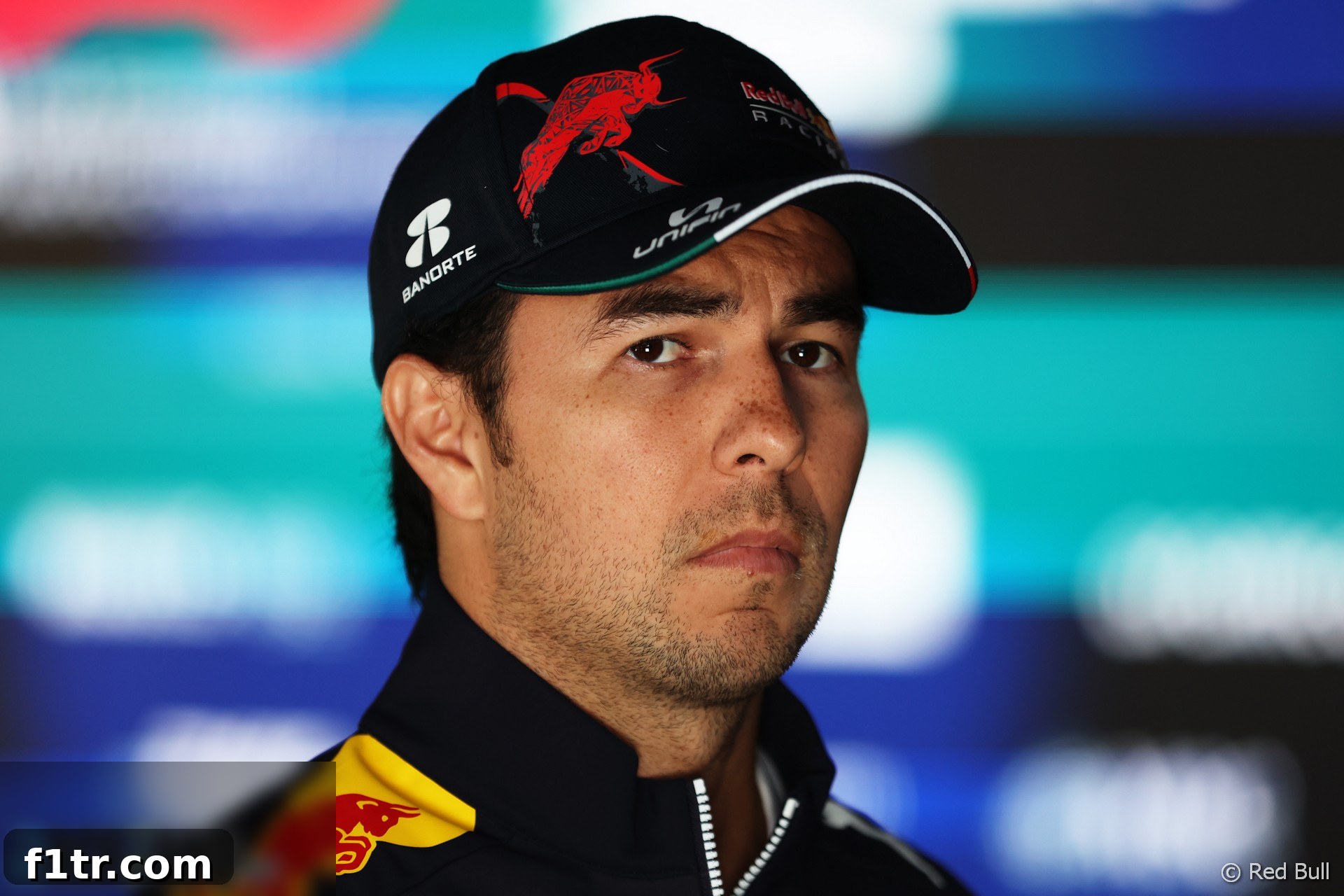
Sergio Perez, the accomplished Red Bull Racing driver, has recently articulated a notable shift in his comfort level with his RB18 Formula 1 challenger. His candid comments highlight a growing unease with the car’s evolving characteristics, a significant contrast to the exceptional form he displayed at the commencement of the 2022 season. Perez’s journey through the current campaign has been a captivating narrative of remarkable highs and challenging lows, punctuated by significant victories but also periods of struggle as the team continuously refines and develops the car.
The start of the Mexican driver’s second season with Red Bull was nothing short of spectacular, teeming with promise and a compelling surge in performance that immediately established him as a serious contender. He brilliantly secured the very first pole position of his distinguished career at the Saudi Arabian Grand Prix, a momentous achievement that powerfully underscored his burgeoning confidence and mastery within the team. This historic pole was swiftly followed by a triumphant victory on the legendary and demanding streets of Monaco, a race universally acclaimed as the most prestigious jewel in the F1 calendar. These early, resounding successes not only propelled him to a strong position in the Drivers’ Championship standings but also unequivocally solidified his role as a genuine title challenger, proving himself a formidable and capable partner to his reigning world champion teammate, Max Verstappen.
Perez openly acknowledged that his adaptation to his previous Red Bull car, the RB16B from the 2021 season, had been a far more protracted and arduous process. He had joined the team with minimal pre-season testing opportunities, essentially being thrust directly into a highly competitive environment under a set of technical regulations that had been stable and well-understood for several years. “Last year’s car was a great car, but it [required] a very unique driving style,” Perez elaborated to media outlets, including RaceFans, reflecting on the intricacies of the previous year’s machinery. “You had to adapt to it. I managed to do so, but it took me a while. I came here with no testing and straight into it in regulations that had been there for a while. So that was hard.” This historical context makes his early 2022 form even more impressive and understandable, as he significantly benefited from a clean slate and a fresh start with the advent of the new regulatory cycle. “Starting from zero [this year], I think that that’s been quite helpful,” he reflected, emphasizing the distinct advantage of tackling a brand-new car design from its inception, which allowed him to more effectively integrate his inherent driving preferences into the initial phases of development and setup.
Advert | Become a Supporter & go ad-free
Nevertheless, the inherently demanding and relentlessly competitive nature of Formula 1 car development dictates that the performance characteristics of a vehicle are never static. Teams are engaged in a perpetual race against time, continuously introducing a myriad of upgrades, strategic modifications, and intricate refinements throughout the season in an incessant bid to extract even the minutest marginal gains over their fiercely competitive rivals. These incremental changes, while meticulously engineered to enhance overall performance and pace, can sometimes inadvertently alter the car’s handling balance, potentially making it less optimally suited for one driver’s particular driving style or comfort zone. Perez has candidly admitted that he hasn’t found it as straightforward to extract the maximum potential from the RB18 following these recent development iterations, which have seemingly steered the car’s characteristics away from his initial preference.
“I think the development of the car has been… I haven’t been as comfortable with it as I was in the beginning, let’s put it that way,” he confessed with an air of frankness. This sentiment reveals a universally acknowledged challenge within the demanding world of F1, where a car’s evolutionary path can, at times, subtly begin to favor one driver’s nuanced preferences over another’s. Historically, engineering teams often tend to gravitate towards optimizing the car primarily for their lead driver, or the driver who consistently provides the clearest, most actionable feedback, which can inadvertently leave the second driver in a position where they must increasingly adapt to a machine that progressively deviates from their innate comfort zone. Perez’s current situation appears to distinctly reflect this prevalent phenomenon, indicating a crucial period of intense introspection, rigorous analysis, and necessary adjustment for the driver and his engineering team. “So I think I’ve got some work to do to understand what’s going on and hopefully have a more straightforward weekend here in Austria.” His statement powerfully underscores the intricately complex relationship between a driver’s intuitive feel, precise technical feedback, and the continuous, iterative process of car development, emphasizing the critical need for seamless alignment and understanding between all involved parties to sustain peak performance levels.
Further exacerbating his struggles with the car’s evolving dynamic characteristics, Perez also candidly acknowledged that he was not operating at his full physical fitness during the immediately preceding race weekend in Canada. A significant and impactful crash during the qualifying session for the Canadian Grand Prix resulted in a painful neck injury, an ailment that undoubtedly hampered his on-track performance and severely impacted his ability to provide precise and nuanced feedback on the car’s intricate behavior. A Formula 1 driver’s physical condition is of paramount importance; even seemingly minor discomforts can profoundly diminish their exquisite sensitivity to the car’s subtle nuances and significantly impair their capacity to consistently push the vehicle to its absolute limit for the duration of an entire Grand Prix. This unfortunate injury meant that his recent performances might not offer a completely accurate reflection of his true capabilities or his current understanding of the car’s updated setup.
Reflecting on his recent dip in form and comfort, Perez articulated his feelings with clarity: “It’s just going away from me in terms of how comfortable I was in the beginning.” He then directly pointed to the tangible impact of his physical state on his recent showings: “But saying that, I’ve had only two races, last weekend I wasn’t up to it, I was feeling pretty bad. So this is the first weekend where I will see, really.” This perspective powerfully highlights the critical importance of the upcoming Austrian Grand Prix as a definitive and pivotal benchmark for his recovery and adaptation. It is poised to serve as his first genuine opportunity since the car’s most recent changes and his recovery from injury to comprehensively assess his renewed connection with the RB18 and to discern whether the perceived discomfort originates purely from the car’s developmental trajectory, or if his complete physical recuperation will enable him to rediscover the formidable early-season form that marked his initial successes. A full physical recovery and a completely clear mental state are absolutely essential for him to provide accurate, unbiased feedback to his dedicated engineers and to collaboratively work towards achieving a more harmonious and responsive car setup.
Beyond the immediate technical and physical challenges, there lies the ever-present, immense pressure of the fiercely contested championship battle. Having been unceremoniously forced to retire from the Canadian round due to unexpected technical problems, Perez is acutely and painfully aware of the detrimental impact that non-finishes, or “zeros” as they are commonly referred to, can have on his ambitious title aspirations. The Formula 1 season is an arduous marathon, not a mere sprint, and every single point amassed holds colossal significance, particularly when one is vying for the coveted world championship against a teammate as relentlessly dominant and consistent as Max Verstappen. Any further retirements in subsequent races would undeniably deliver a severe, perhaps even fatal, blow to his hopes of closing the currently significant points gap to his championship-leading teammate.
“Having another couple of zeros will kill the championship for sure,” he stated emphatically, leaving no room for doubt about the gravity of the situation. This stark and unambiguous assessment vividly underlines the exceptionally high stakes associated with every single race weekend that remains. Reliability, therefore, emerges as an equally, if not more, crucial factor than sheer raw pace alone in the cutthroat environment of championship contention. For an elite team like Red Bull, which has built its reputation on engineering excellence and meticulous attention to detail, ensuring that both their cars are robust, mechanically sound, and consistently capable of reaching the checkered flag in every single race is of paramount importance. “But hopefully reliability issues are going now and we’re able to finish races. That’s the most important.” His heartfelt desire for consistent finishes speaks volumes about the enhanced maturity and strategic understanding he has cultivated as a true championship contender, recognizing that accumulating points consistently, race after race, is often a more valuable and sustainable strategy than chasing heroic, but inherently risky, individual race wins.
The intricate dynamic within Red Bull Racing, with Perez striving to consistently match Verstappen’s blistering pace while simultaneously adapting to a car that may be increasingly tailored to his teammate’s specific driving style, represents a classic and oft-repeated scenario within Formula 1. While all teams unequivocally aim to provide ostensibly equal machinery to both their drivers, the nuanced and highly technical development trajectory of a modern F1 car can, almost inevitably, begin to favor the specific driving attributes and feedback preferences of one driver over the other. To effectively overcome this inherent challenge, Perez will need to engage in even more intensive collaboration with his dedicated engineering team, meticulously analyzing vast quantities of performance data, experimenting with a multitude of setup configurations, and potentially even subtly adapting his own driving style to better align with the car’s current and evolving characteristics. Extensive simulator work will become an invaluable tool, allowing him to rigorously test different approaches and gain a deeper understanding of the car’s behavior in a controlled, virtual environment before transitioning to the unforgiving real-world track conditions. His ability to articulate his precise needs and effectively guide the car’s development trajectory back towards a more comfortable and responsive operating window will be absolutely critical for the remainder of the demanding season.
The intense mid-season battle for development supremacy between two titans of the sport, Red Bull and Ferrari, introduces yet another layer of formidable complexity to the unfolding championship narrative. As both teams relentlessly push the very boundaries of performance through their aggressive upgrade programs, the rate, direction, and ultimate impact of these new developments can often be unpredictable and highly influential. For Perez, finding his optimal footing and comfort with the continuously evolving RB18 is not merely about competing directly with his formidable teammate Max Verstappen; it is also fundamentally about ensuring that Red Bull collectively maintains its crucial competitive edge against a truly resurgent and highly threatening Ferrari challenge. The championship remains finely poised, precariously balanced on a knife-edge, and every single race from this point forward holds immense and potentially season-defining significance for both the drivers vying for individual glory and the constructors competing for team supremacy.
Advert | Become a RaceFans supporter andgo ad-free
In conclusion, Sergio Perez finds himself at an exceptionally pivotal juncture in his ambitious 2022 Formula 1 campaign. His early-season brilliance and undeniable momentum have subtly given way to a demanding period of intense adaptation and crucial physical recovery, as he grapples with the evolving and sometimes challenging characteristics of the Red Bull RB18 and navigates the lingering effects of a recent physical injury. The upcoming Austrian Grand Prix looms large on the calendar as a truly crucial test, offering him a vital opportunity to reset his focus, regain his cherished comfort level with the car, and powerfully reaffirm his championship aspirations. For Perez, the challenging path forward necessitates a precise blend of meticulous technical work alongside his engineers, unwavering physical determination to return to peak fitness, and a razor-sharp focus on maintaining consistent performance. Only by successfully mastering these multifaceted elements can he realistically hope to reignite his formidable title challenge and continue to push his exceptionally talented teammate, Max Verstappen, in what promises to be an utterly enthralling and unpredictable conclusion to the gripping 2022 Formula 1 season.
2022 Austrian Grand Prix
- FIA affirms three sprint races on 2023 Formula 1 calendar
- “Oh, so unlucky!” How Alonso’s cursed Austrian Grand Prix unfolded on his radio
- Ferrari believe their performance deficit to Red Bull is now “negligible”
- Another fan’s experience of harassment last weekend – and why F1 must act
- AlphaTauri “desperately” need upgrades after “disaster” weekend, urges Gasly
Browse all 2022 Austrian Grand Prix articles