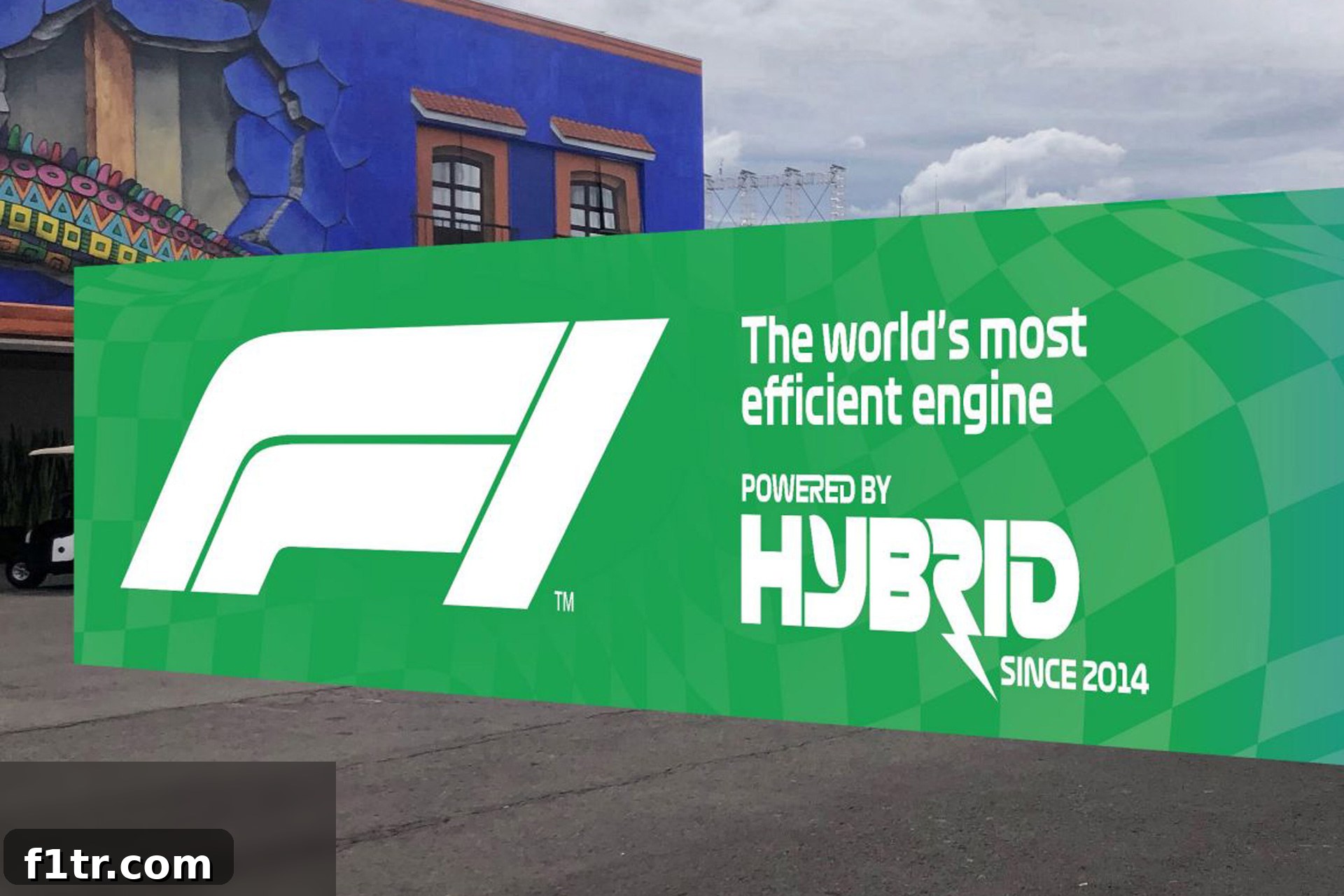
Formula 1 is set to amplify the groundbreaking technological prowess of its V6 hybrid turbo power units, officially launching a new branding campaign that proudly labels them as the “world’s most efficient engine.” This significant promotional push will commence at this weekend’s highly anticipated Sao Paulo Grand Prix, aiming to redefine public perception and highlight the sport’s commitment to innovation and sustainability.
For too long, the true engineering marvels nestled within F1 cars have remained understated. The series recognizes that the unparalleled efficiency of these power units, first introduced in 2014, has not been adequately communicated to a global audience. This rebranding initiative is a direct effort to rectify that oversight, showcasing Formula 1 not just as a spectacle of speed, but as a crucible for cutting-edge automotive technology that holds significant relevance for the broader automotive industry.
The journey to the current V6 hybrid era has been one of continuous evolution and innovation. Prior to 2014, Formula 1 relied on normally aspirated V8 engines, which were introduced in 2006. These powerful, high-revving engines delivered a distinct, visceral soundtrack that many traditional fans cherished. By 2009, a crucial step towards electrification was taken with the introduction of the Kinetic Energy Recovery System (KERS). KERS allowed drivers to briefly harness braking energy to provide a short burst of additional horsepower, adding a strategic dimension to racing.
However, the shift in 2014 marked a revolutionary leap. The V8s and KERS were superseded by the current, far more sophisticated hybrid power units. These complex systems harvest energy from two primary sources: kinetic and thermal. The Motor Generator Unit–Kinetic (MGU-K) recovers energy during braking, similar to KERS but integrated more seamlessly into the powertrain. More remarkably, the Motor Generator Unit–Heat (MGU-H) captures waste heat from the turbocharger, converting it into electrical energy. This dual energy recovery approach has propelled Formula 1 engines to levels of thermal efficiency previously thought unattainable in internal combustion engines.
The introduction of these advanced power units was not without controversy. Bernie Ecclestone, then CEO of Formula 1, was a prominent and vociferous critic of the new regulations. His objections primarily stemmed from concerns over the diminished engine sound, the increased complexity and cost for teams, and a perceived alienation of traditional fans who yearned for the raw, naturally aspirated roar. He strongly opposed the vision championed by then FIA President Jean Todt, who pushed for the hybrid technology to make F1 more relevant to road car development and to align the sport with growing environmental consciousness.
Fast forward to today, under the leadership of Stefano Domenicali, who took over from Ecclestone’s successor Chase Carey earlier this year, Formula 1 is actively embracing the narrative of technological leadership. Speaking in Mexico, Domenicali articulated the new direction: “We are going to start actually to remind all of us who we are.” He emphasized the core message, stating, “We have today, since 2014, the most efficient hybrid engine, and this is something that we need to remember.” This statement underscores a strategic pivot to highlight the innovation that has been a cornerstone of the sport for years but often overshadowed by other aspects.
Indeed, the figures speak for themselves. In the eighth year since their debut, Formula 1’s V6 hybrid power units now boast an astonishing thermal efficiency of approximately 52%. To put this into perspective, conventional internal combustion engines typically achieve around 30% thermal efficiency. This remarkable difference signifies that far less of the heat energy generated by F1’s engines is wasted, instead being converted into usable power. This incredible feat of engineering is a testament to years of research, development, and intense competition among manufacturers like Mercedes, Ferrari, Honda (now Red Bull Powertrains), and Renault.
Achieving over 50% thermal efficiency is a monumental accomplishment. It means that more than half of the energy contained in the fuel is converted into mechanical work, drastically reducing fuel consumption and emissions. The MGU-H, in particular, is a complex and highly effective component that recuperates energy from the exhaust gases, which would otherwise be lost as heat. This recovered energy can then be deployed to either power the MGU-K for additional propulsion or to spool up the turbocharger, eliminating ‘turbo lag’ and providing instant power delivery. This synergy of mechanical and electrical systems creates a power unit that is not only immensely powerful but also incredibly frugal and responsive, setting a benchmark for automotive engineering globally.
Looking ahead, Formula 1 is not resting on its laurels. The sport is actively planning further significant changes to continuously improve the efficiency and sustainability of its power units. A pivotal moment will be the introduction of new technical regulations in 2026. These regulations are expected to place an even greater emphasis on electrical power, potentially increasing the power output from the hybrid components, while also addressing concerns regarding cost and accessibility for new engine manufacturers. This forward-thinking approach ensures that F1 remains at the forefront of powertrain development, pushing the boundaries of what is possible.
Beyond the 2026 engine regulations, Formula 1 has set an ambitious goal to switch to 100% sustainable synthetic fuels by 2030. This initiative is a cornerstone of F1’s broader sustainability strategy, aiming for a net-zero carbon footprint by the same year. These advanced synthetic fuels are designed to be carbon-neutral, meaning that the carbon dioxide emitted during combustion is balanced by the CO2 captured during their production. This groundbreaking development positions Formula 1 as a vital testing ground for future automotive energy solutions, offering a credible pathway to decarbonize global road transport without relying solely on full electrification. The transition to such fuels underscores F1’s commitment to showcasing how high-performance motorsport can coexist with stringent environmental goals.
The strategic importance of this new branding campaign cannot be overstated. From this weekend, the “world’s most efficient engine” messaging will be prominently displayed across various high-visibility areas at the Autódromo José Carlos Pace (Interlagos), including the television pen, paddock, and hospitality suites. This omnipresent branding aims to embed the core message of efficiency and technological leadership into the minds of fans, media, and stakeholders alike. It’s a clear statement that Formula 1 is not just about thrilling races, but also about pioneering engineering that directly contributes to the future of automotive technology and environmental responsibility.
By proactively highlighting the remarkable achievements in thermal efficiency and outlining ambitious plans for synthetic fuels and future engine regulations, Formula 1 is repositioning itself. It is transforming the narrative from one solely focused on speed and sound to one that champions innovation, sustainability, and real-world relevance. This shift is crucial for attracting new audiences, appealing to a younger generation, and demonstrating that the pinnacle of motorsport is also a powerful force for positive change in the automotive world.
Don’t miss anything new from RaceFans
Follow RaceFans on social media:
- Join RaceFans on Facebook
- Follow RaceFans on Twitter
- Get daily email updates from RaceFans
Recent News and Features on the 2021 F1 Season
- Masi ‘basically gifted the championship’ to Verstappen says 2021 FIA steward Sullivan
- Las Vegas race backers looking to extend F1 deal beyond 2025
- Why Mercedes put ‘a reminder of joy and pain’ on display in their factory lobby
- Verdict on error in GT race suggests Mercedes would have lost 2021 Abu Dhabi GP appeal
- Title ‘stolen’ from Mercedes made us ‘underdogs people cheer for’ – Wolff
Browse all 2021 F1 season articles