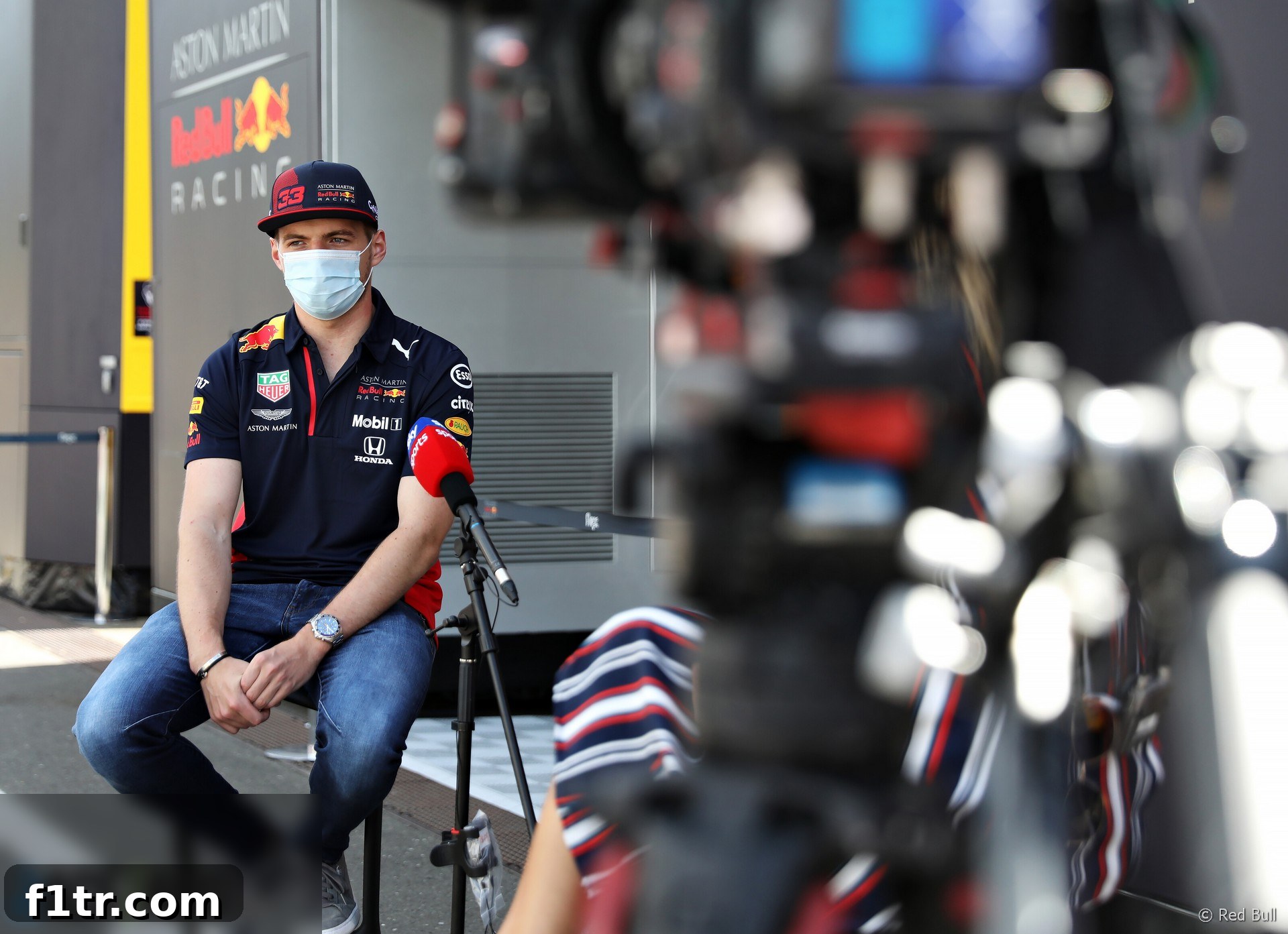
In a Formula 1 season unlike any other, marked by unprecedented global challenges and a dramatically reshaped calendar, Red Bull Racing’s star driver, Max Verstappen, maintains a remarkably consistent and pragmatic approach to the pursuit of the world championship. Despite the significant shortening of the 2020 F1 calendar, Verstappen firmly asserts that this alteration will not influence his willingness to take additional risks on track. His steadfast philosophy underscores a deep-seated commitment to performance without succumbing to the pressures of a truncated schedule, emphasizing calculated aggression over reckless abandon.
The Unprecedented Challenge of the 2020 F1 Season
The year 2020 presented Formula 1 with its greatest challenge in recent memory. The global COVID-19 pandemic brought the world to a standstill, and motorsport was no exception. The eagerly anticipated 22-race schedule, meticulously planned over months, was heavily disrupted, leading to widespread cancellations and postponements. The uncertainty loomed large over the sport’s future, with many questioning if a championship season could even be held.
Through diligent planning, strict health protocols, and immense logistical efforts, F1 eventually forged a path forward. The initial eight races were confirmed, primarily in Europe, with the hope of expanding the calendar to between 15 and 18 rounds. This significantly reduced number of events, compared to the original blueprint, naturally sparked discussions about how drivers might adapt their strategies. A shorter season traditionally means fewer opportunities to recover from mistakes or poor performances, potentially incentivizing drivers to push harder and take greater gambles.
However, for Max Verstappen, the core principles of racing remain unchanged regardless of the number of rounds. His mature perspective highlights that the desire to achieve the best possible result, coupled with a disciplined approach to risk management, is a constant in his driving philosophy, irrespective of external circumstances.
Max Verstappen’s Unwavering Approach: Risks and Rewards
Verstappen’s comments on his approach to the shortened season cut straight to the heart of a racing driver’s mindset. “Even if it’s 22 races or eight or whatever or 15, you never want to [retire]. You always want the best result possible without, of course, a crazy amount of risk,” he stated. This declaration speaks volumes about his focus and understanding of championship racing. While a reduced calendar might tempt some drivers to gamble more aggressively due to fewer chances to accumulate points, Verstappen believes his approach remains fundamentally the same.
He acknowledges the increased cost of errors in a condensed season. “Of course if you make a mistake or whatever, it’s more costly. But that’s how it is, I think the approach is pretty similar. You always want a good result, you never want to retire.” This reflects a deep understanding that consistent point-scoring, even if it means sometimes settling for a strong finish rather than pushing for a win at all costs, is crucial for a championship campaign. For a driver of Verstappen’s caliber, renowned for his aggressive yet often calculated overtakes and racecraft, this unwavering commitment to intelligent risk assessment demonstrates a significant level of maturity and strategic thinking.
In a season where every single point could prove decisive, avoiding unnecessary retirements becomes paramount. A DNF (Did Not Finish) not only means zero points but also potential damage to the car, which could impact subsequent races in a tightly packed schedule. Verstappen’s emphasis on minimizing ‘crazy amounts of risk’ suggests a deliberate strategy to maximize his chances of crossing the finish line in a strong position in every race, reinforcing his reputation as a formidable and intelligent competitor.
Prioritizing Preparation: The Quarantine Dilemma
As Formula 1 prepared for its delayed return, teams began limited filming days and shakedowns to get back into rhythm and conduct initial checks on their machinery. Red Bull Racing was no exception, scheduling a 100-kilometre filming day for their RB16 at Silverstone, to be shared by their two drivers, Max Verstappen and Alexander Albon.
However, Verstappen made a calculated decision to pass up his share of the track time. The reason? Strict quarantine measures in place in the UK at the time. To participate, he would have needed to fly from his home in the Netherlands to Britain and then endure a mandatory two-week quarantine period. For a mere 50 kilometres of driving – a very limited distance primarily used for promotional filming and basic system checks rather than serious testing – this lengthy isolation was deemed too disruptive to his vital pre-season training and preparation schedule.
“For me, those two weeks quarantine just for 50 kilometres in a car, I don’t think it justifies that,” he explained. “I prefer to stay home then and have those two weeks to train a bit more and basically get here from your own home instead of like being already travelling for two weeks and living out of a bag.” His choice underscores the immense importance F1 drivers place on their physical and mental conditioning. Losing two weeks of optimal training time, especially ahead of a condensed and intense racing calendar, was a sacrifice he was unwilling to make for such limited on-track activity. Alexander Albon, presumably either already based in the UK or with different logistical considerations, was able to complete the filming day, providing the team with some early data and promotional material. This pragmatic decision by Verstappen highlights a professional prioritizing long-term readiness over short-term, minimal gains.

The Specter of Zandvoort and Racing Behind Closed Doors
The disruption to the 2020 F1 season had particularly poignant implications for Max Verstappen and his legions of dedicated fans. The highly anticipated return of his home race at Zandvoort, marking the first Dutch Grand Prix in 35 years, was a dream come true for many. However, the pandemic forced its cancellation, a decision that undoubtedly brought significant disappointment for Verstappen and the massive Orange Army that had eagerly awaited the event.
Beyond Zandvoort, the entire landscape of the opening rounds of the championship was altered dramatically. All races would be held “behind closed doors,” meaning without spectators. This creates an atmosphere vastly different from the usual F1 spectacle, which thrives on the energy and passion of thousands of fans in the grandstands. For drivers accustomed to the roar of the crowd and the palpable excitement on race weekends, this new reality would require an adjustment.
Verstappen openly acknowledged the impact of these changes. “I would always prefer to have the normal weekends, but that’s how it is at the moment,” he remarked. “We can’t change what happened in the world so we have to deal with it in the best way possible.” This pragmatic acceptance of the circumstances reflects the resilience required from everyone involved in the sport. Despite the absence of fans and the sterile environment of empty paddocks, the focus remains on delivering the thrilling racing that fans watch from home.
Adapting to the ‘New Normal’: Tests and Resilience
One of the most immediate and tangible changes for everyone in the F1 paddock, including drivers, was the implementation of rigorous health and safety protocols. Central to these measures was frequent COVID-19 testing. Verstappen, like many others, found this particular aspect less than pleasant. “The other thing I’m not looking forward to is, of course, the [Covid-19] test. I mean, that’s not a very nice feeling having a stick that deep in your nose. But it is, of course, necessary.”
His candid comment about the discomfort of the nasal swab tests resonates with countless individuals globally who have undergone similar procedures. Yet, his immediate follow-up – “But it is, of course, necessary” – highlights the collective understanding and commitment within F1 to ensure the sport could resume safely. These tests, along with other stringent measures such as bio-secure bubbles, social distancing, and mandatory mask-wearing, became the ‘new normal’ for everyone traveling with Formula 1.
Beyond the physical discomfort, adapting to these new protocols demanded mental resilience. Drivers and team personnel had to operate within strict confines, with limited interaction and constant awareness of health guidelines. Despite these challenges, Verstappen’s underlying message remained positive and forward-looking: “That’s really the only thing. All the other things, I mean, we’re back to racing, we’ll try to do it the best way possible and also the safest way possible. And hopefully we’ll have exciting racing as well, that’s what everyone wants to see.” This encapsulates the spirit of the sport – an unwavering dedication to competitive racing, even when faced with unprecedented adversities.
Red Bull’s Championship Ambitions in a Unique Year
The 2020 F1 season, despite its irregularities, still presented a formidable championship challenge. For Red Bull Racing, with Max Verstappen spearheading their charge, the goal remained clear: to challenge Mercedes for supremacy. A shortened calendar, while posing logistical hurdles, also introduced a degree of unpredictability that could, in theory, create more opportunities for a consistent challenger. Every race carried immense weight, and reliability, strategic acumen, and flawless execution became even more critical.
Verstappen’s calm and consistent approach was therefore not just a personal preference but a crucial asset for his team. In a season where chaos reigned outside the cockpit, his focused mindset and refusal to be swayed by external pressures provided a steady anchor for Red Bull’s championship aspirations. His ability to compartmentalize and concentrate solely on extracting the maximum performance from his car, without letting the pandemic’s shadow dictate his on-track risk appetite, underlined his status as a true championship contender.
In conclusion, Max Verstappen’s measured stance on risk, his pragmatic decision regarding pre-season testing, and his resilient attitude towards the ‘new normal’ of Formula 1 in 2020 paint a picture of a driver supremely focused on the task at hand. While the world grappled with uncertainty, Verstappen consistently emphasized professionalism, safety, and above all, the pursuit of exciting and competitive racing. His leadership, both on and off the track, showcased Formula 1’s remarkable ability to adapt, persevere, and continue to deliver thrilling motorsport to its global audience, even under the most challenging circumstances.
2020 F1 season
- Grosjean to make F1 test return tomorrow for first time since Bahrain horror crash
- Pictures: Wrecked chassis from Grosjean’s Bahrain fireball crash to go on display
- Bottas vs Rosberg: Hamilton’s Mercedes team mates compared after 78 races each
- F1 revenues fell by $877 million in Covid-struck 2020 season
- Hamilton and Mercedes finally announce new deal for 2021 season
Browse all 2020 F1 season articles