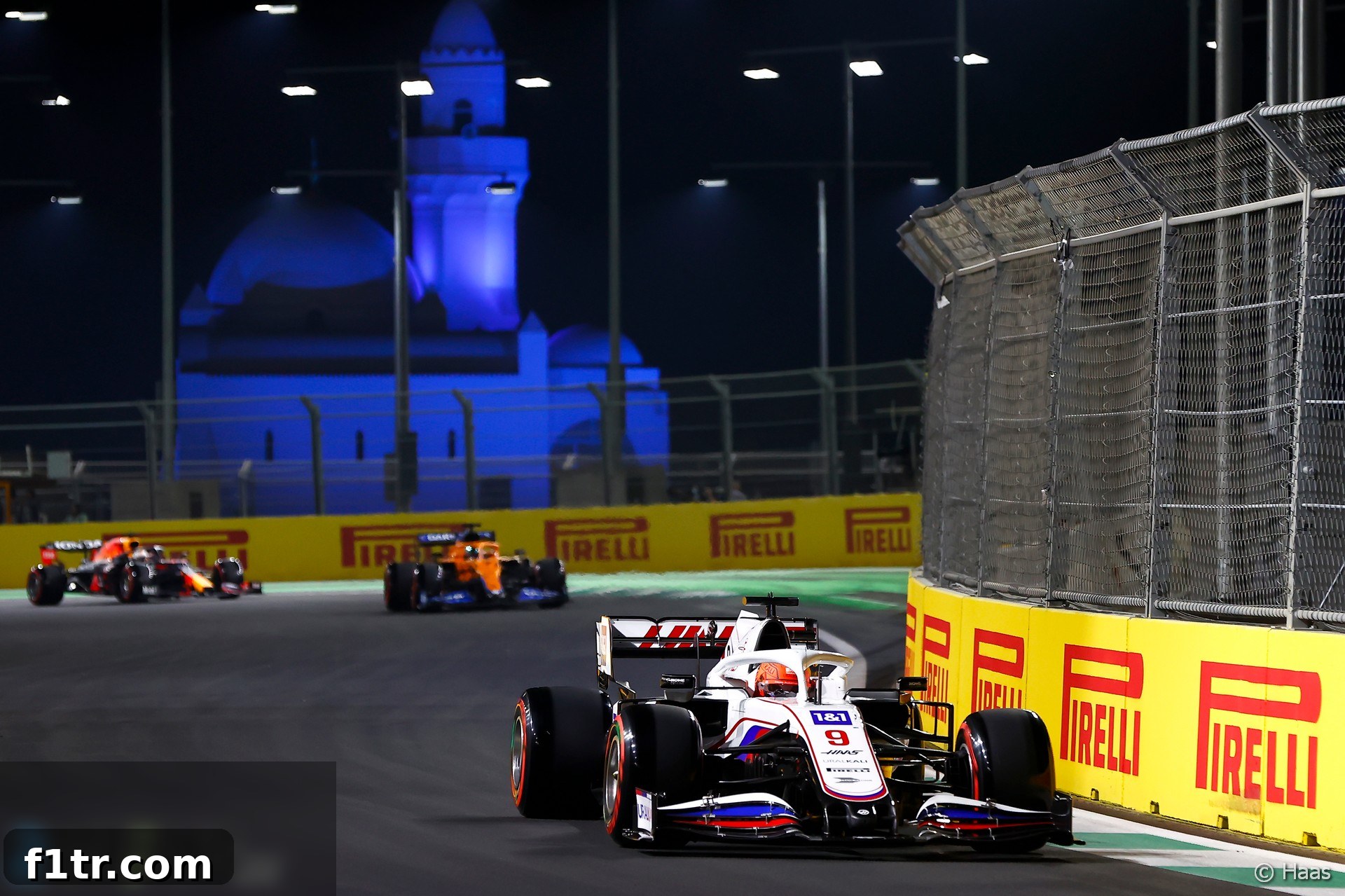
Nikita Mazepin expressed his satisfaction with the outcome of the incident involving him and Lewis Hamilton during the third practice session for the Saudi Arabian Grand Prix, affirming that he was pleased Hamilton did not receive a more severe penalty. The incident, which occurred on the challenging Jeddah Corniche Circuit, brought into sharp focus the demanding nature of the track and the critical importance of effective team communication in Formula 1.
Advert | Become a Supporter & go ad-free
The high-stakes 2021 Formula 1 season was nearing its climax, with the championship battle between Lewis Hamilton and Max Verstappen intensifying with each race. Against this backdrop, every on-track incident, no matter how minor, was scrutinized. The particular event unfolded in the latter half of the final practice hour in Jeddah when Hamilton, who was on a slow lap, inadvertently impeded Mazepin, who was pushing hard on a flying lap. The Haas driver was forced to take evasive action, riding over the kerbs at Turn 8 to prevent what could have been a dangerous high-speed collision on one of the fastest and most unforgiving street circuits on the calendar.
Mazepin recounted the moment with a pragmatic view, highlighting the specific challenges posed by the Jeddah track. “I was on a fast lap and was going through Turns 7 and 8, which are completely flat out in our car,” he explained. “They are all blind corners, meaning you cannot see what’s ahead until you’re right upon it. I had no prior knowledge that there was a car on the racing line, so I maintained full throttle until the precise moment I realized he wasn’t going to move out of the way. It was a close call, but honestly, from my perspective, it wasn’t an insurmountable issue. As Formula 1 drivers, we undergo extensive training to cultivate the necessary lightning-fast reactions to navigate and mitigate these kinds of precarious situations safely.” This insight underscores the mental fortitude and physical preparedness required to compete at the pinnacle of motorsport, especially on circuits that leave little margin for error.
Following the session, the two drivers engaged in a direct and respectful exchange, which Mazepin was keen to share. “Lewis was incredibly gracious about the whole thing, and we exchanged text messages afterward regarding the incident,” Mazepin revealed. “I simply conveyed my hopes that he would have a strong qualifying session, which, as is often the case with him, he certainly did. So, ultimately, that’s what truly mattered.” This interaction speaks volumes about the sportsmanship that can prevail even amidst the fierce competition of Formula 1, demonstrating a mutual respect between drivers from different ends of the grid and experience levels.
Mazepin elaborated on the content of their conversation, adding, “He expressed genuine remorse for what transpired and admitted that it wasn’t the best job done by his team in terms of communication. It’s genuinely refreshing and commendable to witness such an experienced and venerable driver, a true legend of the sport, paying such close attention to these finer details and demonstrating accountability. In feeder series like Formula 2, you might never encounter a driver who would give such incidents a second thought, whereas in Formula 1, a seven-time world champion like Lewis is so considerate. That speaks volumes about his character and is truly a kind gesture from him.” This observation not only highlights Hamilton’s professionalism but also draws a compelling contrast between the development categories and the elite level of Formula 1, where every action and interaction is imbued with a higher degree of significance and scrutiny.
The stewards, after reviewing the evidence, decided to issue Hamilton a reprimand for impeding Mazepin, while his Mercedes team was handed a hefty €25,000 fine. Their ruling explicitly stated that Hamilton had been given insufficient warning from his team about the rapidly approaching Haas, placing the onus primarily on Mercedes’ pit wall for the communication lapse. This decision sparked considerable discussion, as a more severe penalty for Hamilton could have had significant ramifications for his tight championship battle. However, Mazepin himself believed the stewards’ decision was the appropriate outcome, showcasing a mature and considerate stance for a rookie driver.
“I hold immense respect and genuine admiration for Lewis, and I sincerely wish him nothing but the absolute best in his ongoing pursuit of the world title,” Mazepin stated. “Therefore, I would have been genuinely disheartened if he had been penalized more severely for an incident that, in my view, involved both of us. As a driver still in my inaugural year in Formula 1, I fully understand the immense pressure he operates under. He was likely engrossed in adjusting his steering wheel settings or meticulously searching for those crucial fractions of a second in lap time before the all-important qualifying session. So, if the ultimate cost of that moment was for me to miss completing one of my practice laps in FP3, then so be it. The bigger picture of his championship fight far outweighs my single practice lap.” This powerful statement not only underscores Mazepin’s sportsmanship but also demonstrates his nuanced understanding of the pressures and priorities within elite motorsport, especially when a championship is on the line.
Despite his composed public statements, Mazepin candidly admitted to a moment of intense frustration inside the cockpit immediately after the high-speed near-miss. “Naturally, in such high-pressure, adrenaline-fueled moments, you might let slip a swear word or two,” he confessed with a hint of a smile. “That’s because we invest every ounce of our effort and focus into maximizing that particular lap, pushing the car and ourselves to the absolute limit. When that effort is then compromised or nullified through no fault of your own, it’s undeniably frustrating. However, I’ve gained considerable experience in dealing with such incidents throughout my racing career, which helps in managing those immediate reactions.” His honesty provides a relatable glimpse into the raw emotions drivers experience in the heat of competition, even as they project an image of calm professionalism.
The stewards’ verdicts on both Hamilton and Pierre Gasly – who received a warning for a similar impeding incident – served as a stern reminder to all teams. They explicitly highlighted the absolute necessity for teams to ensure their drivers receive timely and accurate warnings when other cars are rapidly approaching, particularly given the unique characteristics of the Jeddah Corniche Circuit. This track, known for its multitude of fast and blind corners, leaves drivers exceptionally vulnerable to such encounters, making precise communication not just desirable but absolutely critical for safety.
Mazepin further elaborated on the crucial role of team radio and the complexities faced by race engineers in such demanding environments. “On a circuit like Jeddah, you simply don’t have the luxury of relying on your mirrors alone; you are entirely dependent on your race engineer for real-time information,” he explained. “However, it’s imperative to remember that an engineer is not an infallible robot; they are human beings, managing a myriad of complex tasks simultaneously, in addition to constantly relaying your on-track position and the approaching traffic. Sometimes, despite their best efforts, they might not be able to provide that crucial warning at the precise, split-second moment when another car is hurtling towards you at speeds exceeding 250 kilometers per hour. Therefore, I strongly believe that these dedicated engineers truly do not deserve the harsh criticism that often comes their way for these communication lapses. In my particular case, I have always been more than willing to accept my part of the blame, understanding the intricacies of the situation.” This insightful defense of race engineers provides a valuable perspective on the human element behind the scenes in Formula 1, emphasizing the immense pressure and multi-tasking involved in managing a driver’s race from the pit wall, especially on a circuit as challenging as Jeddah.
The incident, while ultimately resulting in a relatively minor penalty, served as a potent lesson for all involved in Formula 1. It underscored the inherent dangers of new, high-speed street circuits and the critical role of infallible communication in maintaining driver safety. It also highlighted the sportsmanship and mutual respect that can exist between competitors, even in the white-hot intensity of a championship battle. Mazepin’s mature response, combined with Hamilton’s swift apology and the stewards’ balanced judgment, collectively contributed to an understanding that while mistakes happen, the sport is committed to learning from them and continually enhancing safety and fairness for everyone on the track.
Advert | Become a RaceFans supporter andgo ad-free
2021 Saudi Arabian Grand Prix
- Mercedes seal record eighth consecutive constructors title as Hamilton misses driver’s crown
- Analysis: Is Jeddah circuit’s layout fit for F1 or a “recipe for disaster”?
- Hamilton closes on another Schumacher record with first ‘hat-trick’ of 2021
- How Hamilton and Verstappen’s roughest scrap yet played out on the radio
- Brawn defends Masi following criticism of Saudi Arabian GP decisions
Browse all 2021 Saudi Arabian Grand Prix articles