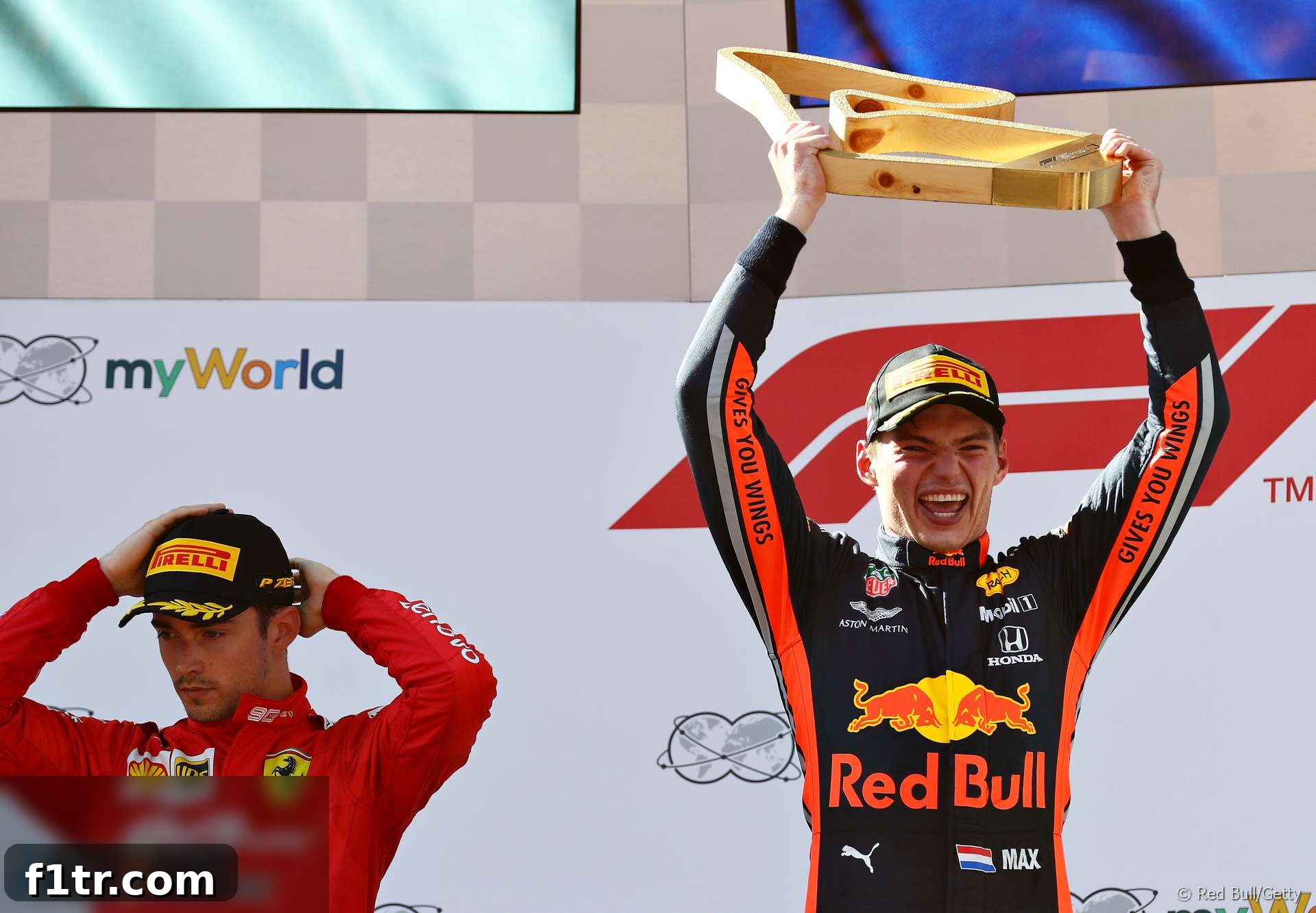
The 2019 Formula 1 Austrian Grand Prix delivered a thrilling spectacle, reshaping current narratives and solidifying long-standing records in the sport’s rich history. While the race saw a new victor and several drivers achieving personal milestones, one monumental record, McLaren’s 11 consecutive Grand Prix victories from 1988, remained firmly intact, a testament to its enduring legacy. Mercedes, having reached a formidable ten-win streak three times in their illustrious hybrid era, once again found themselves just shy of surpassing this legendary benchmark.
The irony or fitting nature, depending on one’s perspective, was palpable: a Honda-powered car was instrumental in preserving the record originally set by a McLaren-Honda collaboration. Max Verstappen, driving for Red Bull, masterfully piloted his Honda-powered machine to victory at the Red Bull Ring. This triumph marked the first win for a Honda engine in Formula 1 since Jenson Button’s emotional victory at the 2006 Hungarian Grand Prix, signifying a powerful return for the Japanese manufacturer to the sport’s top step.
This momentous victory was the 73rd for a Honda-powered car in Formula 1 history. Impressively, Red Bull became the fifth distinct chassis manufacturer to secure a win with Honda engines. Beyond their own factory efforts, Honda has previously powered iconic teams like Williams, Lotus, and McLaren to Grand Prix victories, underscoring their significant impact on the sport’s engineering landscape over decades.
Verstappen’s strong second-place starting position on the grid was also a significant achievement for Honda, marking their first front-row start since Button’s P2 at Imola in 2006. While the young Dutchman further cemented his status as a future champion by increasing his career wins tally to six, drawing level with celebrated names such as Tony Brooks, John Surtees, Jochen Rindt, Gilles Villeneuve, Jacques Laffite, Riccardo Patrese, and Ralf Schumacher, he achieved this feat without a single pole position to his name. This unique distinction places him in an unprecedented category, as no other driver in the history of Formula 1 has claimed more than four victories without securing a pole position. It’s a statistic that highlights his incredible race craft and ability to fight through the field, often delivering spectacular overtakes and strategic masterclasses.
However, this peculiar statistic for Verstappen is almost certainly a temporary one, given his raw speed and aggressive driving style. Similarly, another emerging star, Charles Leclerc, currently holds a contrasting statistical anomaly: two pole positions without yet converting either into a race win. Leclerc’s exceptional qualifying pace has been a standout feature of his season, showcasing his blistering single-lap speed. As it stands, he is one of only five drivers in F1 history to achieve multiple pole positions without tasting victory. The exclusive club includes legends and notable figures like Chris Amon (with an astonishing five poles), Teo Fabi (three poles), Jean-Pierre Jarier (three poles), and Stuart Lewis-Evans (three poles). This highlights the fine margins in F1, where qualifying brilliance doesn’t always guarantee Sunday success due to race incidents, strategic challenges, or car performance.
For Leclerc, this reality has been particularly frustrating during the current season. Despite his impressive qualifying performances, he has accumulated a staggering 124 laps led this year. This figure is higher than any other driver on the grid, with the sole exception of the reigning champion, Lewis Hamilton. In stark contrast, Max Verstappen, the victor of the Austrian Grand Prix, had led a mere six laps before this race – four during his dominant performance at the Red Bull Ring and just two during the season-opening round in Melbourne. This disparity underscores the challenges Leclerc has faced in converting his evident pace into tangible results, often due to circumstances beyond his control.
Mercedes, while still dominating the constructors’ championship, experienced a relatively subdued weekend by their own high standards. For the first time this year, Lewis Hamilton did not feature on the podium, breaking a remarkable streak. Furthermore, it marked only the second occasion this season where a Mercedes car failed to secure a front-row start. However, Valtteri Bottas continued to uphold the team’s incredible consistency by extending their run of podium finishes to every round of the championship so far, demonstrating Mercedes’ underlying strength and reliability even on challenging weekends.
Red Bull’s victory at their home race, the Red Bull Ring, marked their second consecutive win at this venue, much to the delight of the fervent Austrian crowd. While Max Verstappen currently lacks a true “home race” on the F1 calendar, this is set to change with the highly anticipated addition of Zandvoort to the 2020 F1 calendar, bringing the Dutch Grand Prix back into the fold and promising a colossal turnout for their national hero.
The Austrian Grand Prix also witnessed a significant personal milestone for Antonio Giovinazzi, who secured the very first point of his Formula 1 career with a commendable tenth-place finish. This achievement was not only a breakthrough for the young Italian driver but also carried historical weight for his nation. Giovinazzi became the 48th driver from Italy to score a point in Formula 1. Only two nations boast more points-scoring drivers: the USA with 51, many of whom earned points in the Indianapolis 500 during its brief inclusion as part of the World Championship, and Britain with an unparalleled 60 drivers. Giovinazzi’s point signifies a hopeful resurgence for Italian talent in the sport.
Adding another layer of historical significance to the weekend, Alfa Romeo, with Kimi Raikkonen finishing ninth and Antonio Giovinazzi tenth, achieved their first two-car points finish in an astonishing 68 years. The last time two Alfa Romeo drivers scored points in the same Grand Prix was all the way back at the 1951 Spanish Grand Prix. In that legendary race, Juan Manuel Fangio secured victory for Alfa Romeo in his iconic Alfa 159, while Felice Bonetto brought the second car home in fifth place, sealing a dominant performance for the Italian marque. This remarkable feat in Austria harks back to Formula 1’s inaugural years, where Alfa Romeo was a formidable force.
Following that 1951 success, Alfa Romeo briefly withdrew from Formula 1, only to return with its own factory team from 1979 to 1985. During this second stint, under the rules of the time where points were exclusively awarded to the top six finishers, they never quite managed a double points finish. However, they did achieve more than one instance of having both cars finish within the top ten, which, under today’s expanded points system, would have counted as double points scores. The most recent of these close calls occurred at Monza in 1984, where Riccardo Patrese skillfully secured third place, and Eddie Cheever, despite running out of fuel and being classified ninth, six laps down, demonstrated the team’s potential for strong two-car finishes. The 2019 Austrian Grand Prix thus represents a true milestone for the modern Alfa Romeo Racing team, showcasing their steady progress and ambition to reclaim a significant position in the sport’s history books.
Reviewing the Season: Key Statistics and Insights
The Austrian Grand Prix served as a pivotal moment in the 2019 Formula 1 season, offering a wealth of new data and reinforcing ongoing trends. For enthusiasts and analysts alike, delving into the season’s statistics provides a deeper understanding of the championship’s unfolding narrative.
- Current 2019 F1 Championship Standings and Points
- Breaking Down 2019 F1 Season Records
- Comprehensive 2019 F1 Race Data and Results
- In-depth 2019 F1 Qualifying Data Analysis
- Overview of 2019 F1 Retirements and Penalties
- Analyzing 2019 F1 Strategy and Pit Stop Performance
The 2019 Austrian Grand Prix was undoubtedly packed with intriguing statistics and unforgettable moments. What other interesting facts or observations did you notice from this thrilling race weekend?
Further Coverage of the 2019 Austrian Grand Prix
For a complete recap and more detailed analysis of the event, explore our extensive coverage:
- Highlighting the 2019 Austrian Grand Prix Star Performers
- A Gallery of the Top Ten Pictures from the 2019 Austrian Grand Prix
- Leclerc Denied Again as Verstappen’s Hard Racing Secures Red Bull Home Win
- Verstappen: Six Wins, Zero Poles. Leclerc: Two Poles, Zero Wins – A Statistical Deep Dive
- Paddock Diary: Behind the Scenes at the Austrian Grand Prix – Day Four
Explore all articles related to the 2019 Austrian Grand Prix