Japanese Grand Prix: Mercedes Dominates FP1, Ferrari’s Tyre Gamble Underwhelms at Suzuka
The highly anticipated Formula 1 Japanese Grand Prix weekend kicked off at the iconic Suzuka International Racing Course with a compelling first free practice (FP1) session. Despite earlier forecasts predicting rain, the track remained dry throughout the crucial 90-minute session, allowing all teams to meticulously execute their testing programs on slick tyres. However, the session highlighted significant tyre degradation, particularly on the super-soft compound, which noticeably limited the duration of longer stints for many competitors.
Mercedes Sets the Pace: A Strong Statement on Harder Compounds
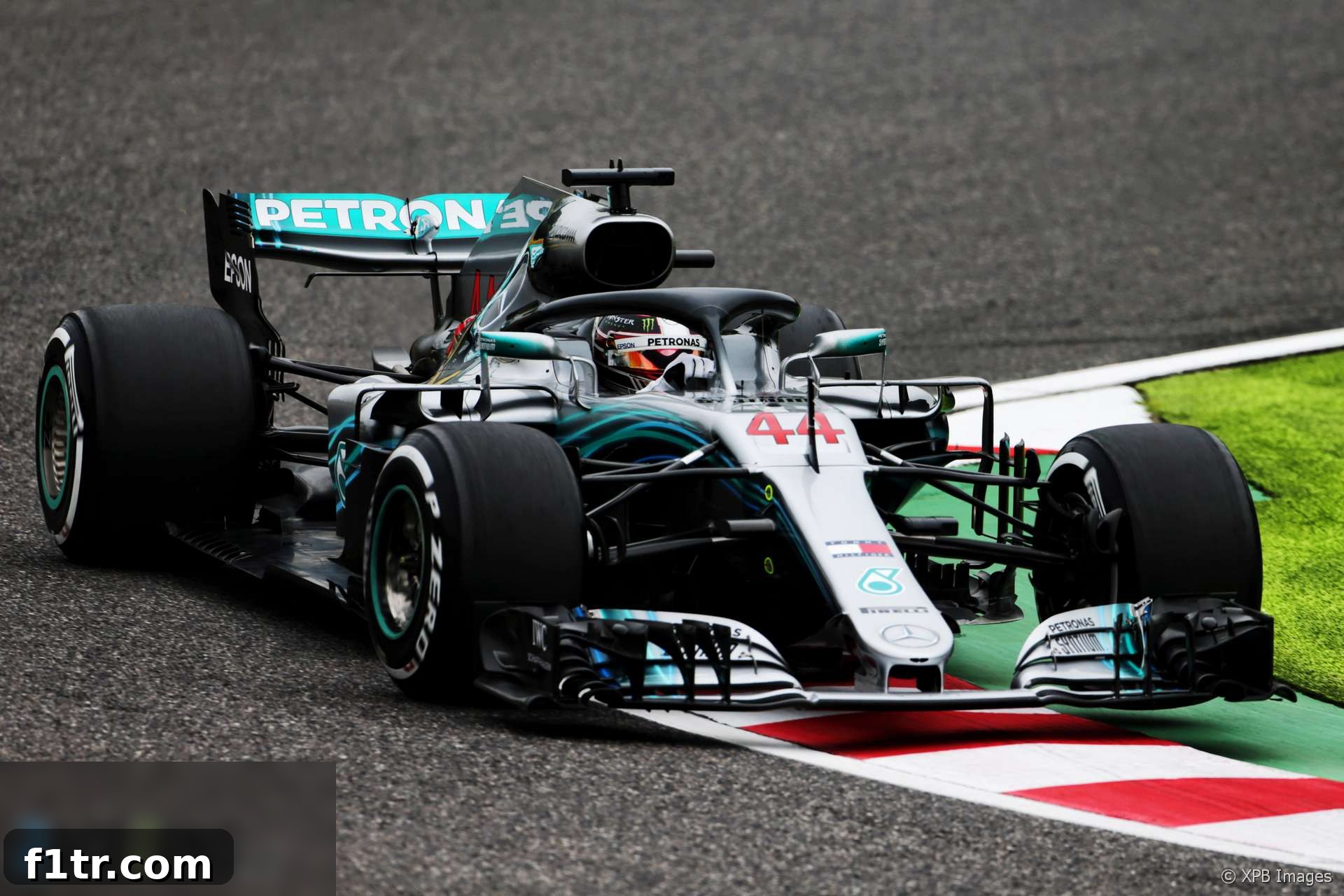
Mercedes-AMG Petronas Motorsport wasted no time in making their intentions clear, asserting dominant performance right from the outset of FP1. Remarkably, both Lewis Hamilton and Valtteri Bottas topped the timesheets without even needing to deploy the softest tyre available for the session – a powerful display of their car’s inherent pace and balance. This strategic approach suggests Mercedes might have a comfortable performance buffer over their rivals, even on less aggressive rubber.
Reigning world champion Lewis Hamilton, seemingly unfazed by a minor encounter with traffic involving Pierre Gasly at the chicane, delivered a blistering lap of 1’28.691 on the soft compound tyres. This impressive time not only secured him the top spot but also underscored Mercedes’ formidable speed, clocking in nearly half a second quicker than the fastest FP1 time recorded at Suzuka in 2017. His performance offered an early glimpse into Mercedes’ strong form as they aim to consolidate their championship lead.
Valtteri Bottas, Hamilton’s teammate, further solidified Mercedes’ commanding one-two finish in the session. Opting for the medium compound tyres, Bottas demonstrated the W09’s adaptability and robustness across different tyre strategies, proving that Mercedes’ pace wasn’t solely reliant on specific tyre choices. His ability to secure second place on a harder compound speaks volumes about the team’s engineering prowess and their potential for strong race performance.
Ferrari’s Super-Soft Gamble: A Puzzling Start to the Weekend
In stark contrast to Mercedes’ cautious yet effective tyre strategy, Scuderia Ferrari embarked on a more aggressive path, dedicating their entire FP1 session to running exclusively on the super-soft compound. This decision, following their choice to bring more sets of super-softs than any other team to Suzuka, was a bold move aimed at maximizing raw pace early on.
However, Ferrari’s gamble appeared to fall short of expectations. Despite utilizing the quickest tyre available, both Sebastian Vettel and Kimi Räikkönen struggled to match the front-running Mercedes cars, consistently logging lap times barely within a second of their main rivals. Sebastian Vettel’s attempt to improve his final run was further hampered by traffic congestion at the challenging chicane section of the track, preventing him from extracting maximum potential from his super-soft tyres. This early session performance poses critical questions for Ferrari regarding their optimal tyre strategy and car setup for the demanding Suzuka circuit, especially given the observed high degradation rates of the super-softs.
Red Bull Racing and the Midfield Hustle
Separating the Mercedes and Ferrari contingents was Daniel Ricciardo in his Red Bull-TAG Heuer, securing a respectable third position. Like Ferrari, Ricciardo utilized the super-soft tyres, showcasing Red Bull’s ability to be a strong contender in the mix. His teammate, Max Verstappen, finished a solid sixth, indicating that Red Bull also has pace, though perhaps a slight deficit to the top two teams in this initial outing.
The “best of the rest” battle, a keenly contested segment in Formula 1, saw Esteban Ocon lead the charge for Force India (then Racing Point Force India). Finishing seventh, 1.9 seconds adrift of Hamilton, Ocon demonstrated strong performance on the soft tyres. His teammate Sergio Perez, however, opted for the medium compound, providing the team with valuable data across different tyre specifications.
Behind Force India, the Ferrari-powered cars showed competitive form. Romain Grosjean placed his Haas in eighth, followed closely by the Sauber pair. Charles Leclerc, making his Suzuka debut, continued to impress by outpacing his more experienced teammate Marcus Ericsson, who rounded out the top ten. Pierre Gasly, driving for Toro Rosso-Honda, mirrored Ericsson’s time to within an astonishing one-thousandth of a second, highlighting the tight competition in the midfield. Gasly, however, found himself under investigation for his near-miss incident with Lewis Hamilton earlier in the session, adding an element of drama to his otherwise strong showing.
McLaren’s Continued Struggles and an Unusual Tyre Strategy
McLaren faced another challenging session, opting for an unexpectedly large stock of medium tyres for the weekend and running exclusively on them during FP1. This conservative tyre choice left them languishing at the bottom of the timesheets, finishing last among all participating teams. The session also saw Lando Norris step in for Stoffel Vandoorne, and the young British driver ended up slowest overall. Adding to McLaren’s woes, veteran driver Fernando Alonso spun into the gravel trap at the notorious Degner One corner, highlighting the team’s ongoing difficulties in finding performance and stability.
Further compounding the pressure on McLaren, both they and Renault incurred a curfew breach the previous night, having personnel working on their cars beyond the permitted hours. This marked McLaren’s second and final exemption from a penalty for such an infringement this season, while it was Renault’s first. Curfew breaches often signal late nights and extensive work required to prepare or troubleshoot car issues, suggesting potential underlying problems that teams are trying to address.
Tyre Degradation and Strategic Implications for Suzuka
The Suzuka circuit is renowned for its high-speed, flowing corners and technical layout, which places immense stress on tyres. Pirelli’s tyre compounds for the Japanese Grand Prix typically include the medium, soft, and super-soft options. The observed high degradation, especially on the super-softs during FP1, will be a critical factor for teams to consider. High degradation means tyres lose performance quickly, forcing drivers to either manage their pace or pit more frequently. This phenomenon can significantly influence race strategy, making single-stop races challenging and potentially favoring cars that are gentler on their tyres or teams that can manage multi-stop strategies effectively. The data collected from FP1 will be crucial for understanding how each compound behaves over longer runs and how best to optimize for both qualifying and race day.
Looking Ahead: What FP1 Means for the Japanese Grand Prix Weekend
The first free practice session at Suzuka, while not entirely indicative of qualifying or race pace, provides vital data and a crucial benchmark for the teams. Mercedes’ strong showing suggests they are well-prepared for the unique challenges of Suzuka, known for its demanding S-curves and high-speed sections that reward aerodynamic efficiency and driver skill. Ferrari, despite their aggressive tyre choice, will need to analyze their data meticulously to understand why their super-softs didn’t yield the expected performance advantage and how to close the gap to Mercedes.
Red Bull, always a threat at circuits requiring high downforce, appears to be in the hunt, particularly with Ricciardo’s promising pace. The midfield battle promises to be intense, with several teams demonstrating similar performance levels. McLaren’s struggles, coupled with their curfew breach, signal a challenging weekend ahead as they seek to understand their car’s limitations at this demanding venue. The potential for rain in subsequent sessions could also dramatically alter the competitive landscape and present new challenges for all teams.
As the teams head into FP2, the focus will shift towards longer runs, race simulations, and fine-tuning setups. The insights gained from FP1, particularly regarding tyre wear and degradation, will be instrumental in shaping the strategic decisions that could define the outcome of the 2018 Japanese Grand Prix.
2018 Japanese Grand Prix First Free Practice Results
| Pos. | No. | Driver | Car | Best lap | Gap | Laps |
|---|---|---|---|---|---|---|
| 1 | 44 | 1’28.691 | 25 | |||
| 2 | 77 | 1’29.137 | 0.446 | 26 | ||
| 3 | 3 | 1’29.373 | 0.682 | 32 | ||
| 4 | 7 | 1’29.627 | 0.936 | 20 | ||
| 5 | 5 | 1’29.685 | 0.994 | 20 | ||
| 6 | 33 | 1’29.841 | 1.150 | 30 | ||
| 7 | 31 | 1’30.591 | 1.900 | 28 | ||
| 8 | 8 | 1’30.814 | 2.123 | 22 | ||
| 9 | 16 | 1’30.929 | 2.238 | 27 | ||
| 10 | 9 | 1’31.073 | 2.382 | 29 | ||
| 11 | 10 | 1’31.073 | 2.382 | 20 | ||
| 12 | 55 | 1’31.100 | 2.409 | 23 | ||
| 13 | 11 | 1’31.272 | 2.581 | 29 | ||
| 14 | 20 | 1’31.274 | 2.583 | 28 | ||
| 15 | 27 | 1’31.418 | 2.727 | 18 | ||
| 16 | 18 | 1’31.508 | 2.817 | 27 | ||
| 17 | 28 | 1’31.908 | 3.217 | 23 | ||
| 18 | 14 | 1’32.034 | 3.343 | 21 | ||
| 19 | 35 | 1’32.513 | 3.822 | 26 | ||
| 20 | 47 | Lando Norris | 1’32.683 | 3.992 | 30 |
First practice visual gaps
Lewis Hamilton – 1’28.691
+0.446 Valtteri Bottas – 1’29.137
+0.682 Daniel Ricciardo – 1’29.373
+0.936 Kimi Raikkonen – 1’29.627
+0.994 Sebastian Vettel – 1’29.685
+1.150 Max Verstappen – 1’29.841
+1.900 Esteban Ocon – 1’30.591
+2.123 Romain Grosjean – 1’30.814
+2.238 Charles Leclerc – 1’30.929
+2.382 Marcus Ericsson – 1’31.073
+2.382 Pierre Gasly – 1’31.073
+2.409 Carlos Sainz Jnr – 1’31.100
+2.581 Sergio Perez – 1’31.272
+2.583 Kevin Magnussen – 1’31.274
+2.727 Nico Hulkenberg – 1’31.418
+2.817 Lance Stroll – 1’31.508
+3.217 Brendon Hartley – 1’31.908
+3.343 Fernando Alonso – 1’32.034
+3.822 Sergey Sirotkin – 1’32.513
+3.992 Lando Norris – 1’32.683
Drivers more than ten seconds off the pace omitted.
More from the 2018 Japanese Grand Prix
- 2018 Japanese Grand Prix team radio highlights
- 2018 Japanese Grand Prix Star Performers
- Mercedes take first back-to-back one-twos since 2016
- Top ten pictures from the 2018 Japanese Grand Prix
- Hamilton on cusp of fifth title as Vettel throws in the towel
Browse all 2018 Japanese Grand Prix articles