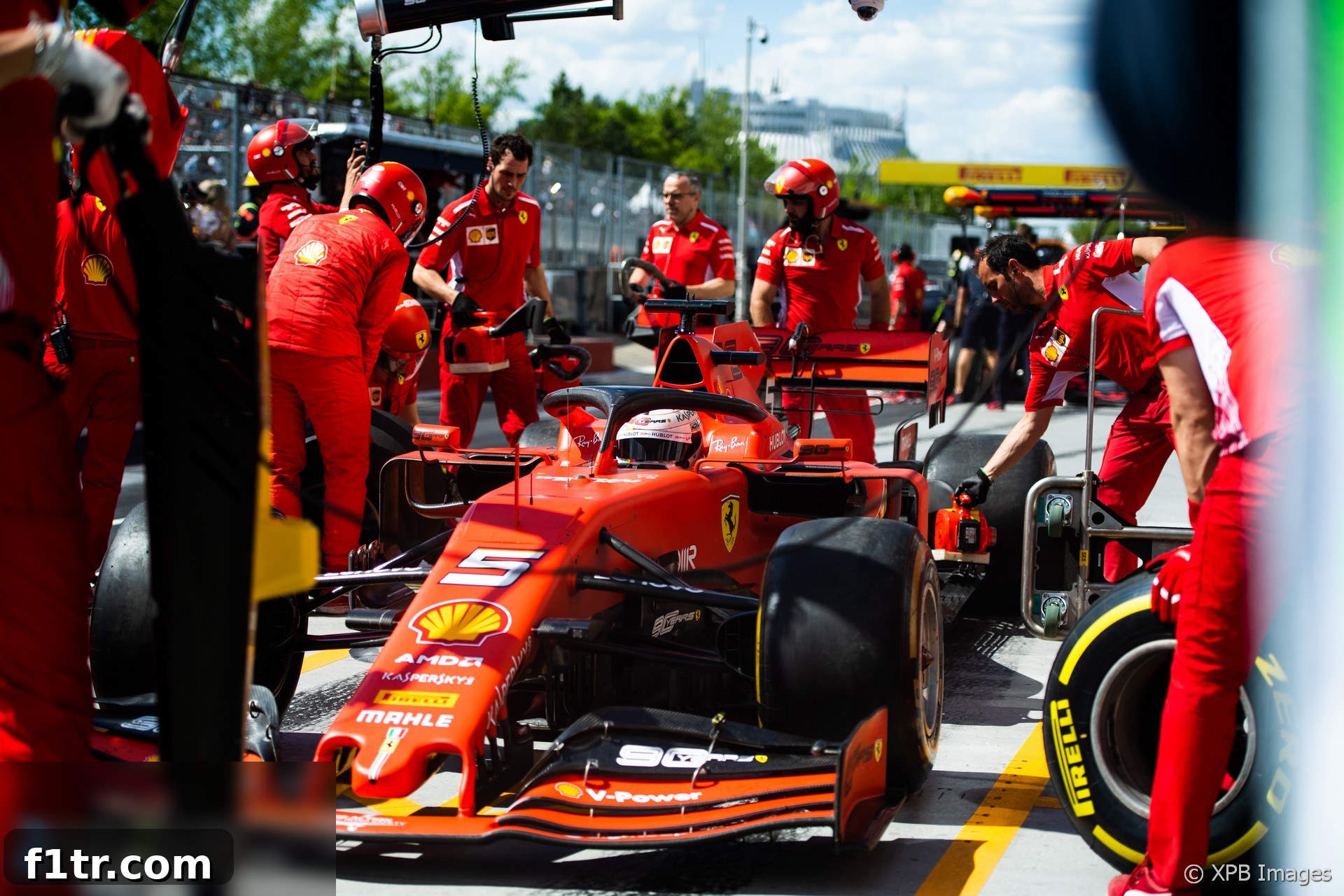
Canadian Grand Prix: Ferrari Surges, Mercedes Grapples on Challenging Friday Practice
The opening day of the Canadian Grand Prix practice sessions at the Circuit Gilles Villeneuve delivered a fascinating blend of speed, strategy, and unexpected challenges. While Ferrari topped the timesheets, sparking immediate excitement among their Tifosi, the team was quick to temper expectations. This cautious approach is understandable given their season-long struggle to convert promising practice pace into dominant race-day performances. Yet, the unique characteristics of the Montreal circuit, combined with Ferrari’s inherent strengths, suggest this weekend could indeed offer a more competitive showing for the Scuderia.
With its long straights and fast chicanes, the Circuit Gilles Villeneuve naturally plays to the strengths of Ferrari’s class-leading power unit. The SF90’s efficiency, which has sometimes been a double-edged sword earlier in the season – perhaps even too efficient at times on circuits demanding high downforce – appeared to find its sweet spot on Friday. Crucially, the warm track temperatures in Montreal provided the ideal conditions for Ferrari to bring their Pirelli tyres into their optimal operating window, a factor that has frequently plagued their performance in cooler conditions. These combined elements suggest Ferrari is undoubtedly a more potent force than they’ve been in recent rounds, setting the stage for a potentially thrilling battle at the front. However, whether this newfound competitiveness will be enough to genuinely challenge the formidable Mercedes W10s remains the ultimate question.
Mercedes Encounters Unfamiliar Challenges in Montreal
Mercedes, the dominant force of the season, did not enjoy a trouble-free Friday in Canada. While they were emphatically quickest in the first practice session, the afternoon saw a shift in their fortunes. Valtteri Bottas, usually a picture of consistency, reported that changes made to his car for the second session, although seemingly improving outright performance, paradoxically made the car’s handling significantly trickier. This candid feedback from Bottas is telling; Mercedes, known for prioritizing driver confidence and consistent performance, is unlikely to sacrifice handling stability purely for marginal lap time gains. This suggests the team acknowledges that their usual significant advantage over the opposition might be narrower than anticipated this weekend, hinting at a tighter fight for pole position and race victory.
Adding to Mercedes’ concerns, both drivers faced issues. Bottas experienced a minor power unit problem that cost him valuable track time, albeit briefly. More significantly, Lewis Hamilton’s brush with the infamous “Wall of Champions” proved to be a more costly setback. The incident not only prevented him from honing his crucial qualifying effort in the second session but also meant he missed out on potentially invaluable long-run data. This lost data could prove problematic, particularly given the anticipated high degradation of the soft tyres, which might push teams towards more strategic use of harder compounds during the race. Understanding the longevity and performance of each compound is paramount for race strategy, and Hamilton’s missing data could leave Mercedes with a slight information deficit heading into Saturday and Sunday.
Tyre Strategy Comes to the Fore: A “Traffic Jam” Predicted
The notoriously abrasive nature of the Circuit Gilles Villeneuve, coupled with the softest compounds of Pirelli tyres available, has set the stage for a fascinating and potentially chaotic tyre strategy. Renault driver Nico Hulkenberg painted a vivid picture of the challenges ahead, predicting a mass exodus to the pits early in the race. “Anyone who starts on the soft compound will want to get rid of them quickly,” he asserted. His humorous, yet pointed, observation that “There’s going to be a traffic jam on lap six in the pits. I think we need to introduce some traffic lights…” underscores the extreme degradation expected from the soft tyres. This suggests that a one-stop strategy might be difficult to achieve for many, and early pit stops could create bottlenecks and tactical opportunities. Teams will be meticulously analyzing their long-run data to determine the optimal window for pit stops, with the medium and hard compounds likely playing a critical role in the main event. Managing tyre life effectively will be a key differentiator, potentially elevating teams with superior car-tyre synergy or adept strategic calls.
Red Bull Struggles While Midfield Teams Make Gains
For Red Bull Racing, Friday looked set to be a tricky weekend right from the start. Their true pace was likely masked by Max Verstappen’s unfortunate brush with the wall during second practice, which significantly curtailed his running. This incident deprived the team of crucial setup data and long-run simulations for their lead driver. Meanwhile, Pierre Gasly, who had shown promising signs of closing the gap to his highly-rated teammate in recent races, appeared to revert to his early-season struggles on day one in Canada. His pace was noticeably off Verstappen’s before the Dutchman’s incident, indicating a potential struggle to adapt to the circuit and extract maximum performance from the RB15. The team’s fortunes were further complicated by the fact that Honda had already introduced its latest power unit upgrade in Baku, meaning Red Bull does not have the benefit of fresh hardware that their Mercedes-powered rivals enjoy this weekend. In contrast, Ferrari-powered customer teams are also receiving new components; Haas, for example, did not run Ferrari’s new turbo and MGU-H on Friday but expects to deploy them on Saturday, potentially giving them an even stronger edge in the competitive midfield battle against Red Bull.
McLaren Shines and Renault Eyes Qualifying Boost
One of the standout performances on Friday came from McLaren. Carlos Sainz Jnr demonstrated impressive pace, with the team looking genuinely competitive. As the chart below illustrates, McLaren is the sole team that has managed to improve on their best time from last year’s Canadian Grand Prix, a testament to their significant progress and the effectiveness of their car development. This advancement positions them well for a strong points finish, potentially even challenging the established front-runners if conditions allow. The question now turns to Saturday: can McLaren maintain this impressive speed? Historically, Renault, McLaren’s engine supplier, has struggled to match the qualifying power modes of their rivals. However, in Monaco, Daniel Ricciardo hinted at a breakthrough, speaking of finally having a proper ‘qualifying mode’ for the first time. All eyes will be on both McLaren and the factory Renault team in qualifying to see if this crucial engine boost materializes, potentially reshuffling the grid order and creating even more excitement.
Deep Dive into Practice Data and Tyre Performance
The practice sessions offered a wealth of data for teams to analyze, particularly regarding long-run pace and tyre degradation. The Circuit Gilles Villeneuve, with its high-speed sections and braking zones, demands a delicate balance between outright speed and tyre preservation. Understanding how each car manages its tyres over a full race stint is crucial for Sunday’s strategy. The data collected from Friday’s running will be meticulously analyzed to determine the optimal pit stop windows, the relative performance of each tyre compound, and potential alternative strategies. The diagram below provides a visual representation of drivers’ long-stint performance, illustrating the consistency and degradation trends across the field. This chart, excluding extremely slow laps, offers valuable insights into who might have the upper hand in terms of race pace and tyre management.
Longest stint comparison – second practice
This chart shows all the drivers’ lap times (in seconds) during their longest unbroken stint. Very slow laps omitted. Scroll to zoom, drag to pan, right-click to reset:
Advert | Become a RaceFans supporter andgo ad-free
Combined Practice Times: A Snapshot of the Grid
The combined practice times offer a clear snapshot of the pecking order after Friday’s running, even accounting for various test programs and differing fuel loads. Ferrari’s strong showing is undeniable, with Charles Leclerc and Sebastian Vettel leading the charge. Leclerc’s best time of 1’12.177, closely followed by Vettel, underscores the Scuderia’s outright pace. Mercedes’ Valtteri Bottas was not far behind, indicating that despite their challenges, the W10 remains a potent package. Carlos Sainz Jnr’s fourth place for McLaren is particularly noteworthy, highlighting their strong performance and suggesting they could be a dark horse this weekend. Lewis Hamilton, despite his earlier incident, still managed to secure a respectable fifth position in combined times, showcasing his inherent speed even with limited running. The tightly packed midfield promises a thrilling qualifying battle, with teams like Haas, Racing Point, and Renault showing competitive times. Red Bull, with Verstappen in 13th and Gasly in 12th, appears to be grappling more than their rivals, but their true pace is often revealed only when it truly matters.
Combined practice times
| Pos | Driver | Car | FP1 | FP2 | Total laps |
|---|---|---|---|---|---|
| 1 | Charles Leclerc | Ferrari | 1’13.720 | 1’12.177 | 63 |
| 2 | Sebastian Vettel | Ferrari | 1’13.905 | 1’12.251 | 66 |
| 3 | Valtteri Bottas | Mercedes | 1’12.914 | 1’12.311 | 71 |
| 4 | Carlos Sainz Jnr | McLaren-Renault | 1’13.973 | 1’12.553 | 79 |
| 5 | Lewis Hamilton | Mercedes | 1’12.767 | 1’12.938 | 39 |
| 6 | Kevin Magnussen | Haas-Ferrari | 1’14.202 | 1’12.935 | 73 |
| 7 | Sergio Perez | Racing Point-Mercedes | 1’14.172 | 1’13.003 | 70 |
| 8 | Daniel Ricciardo | Renault | 1’14.123 | 1’13.016 | 71 |
| 9 | Nico Hulkenberg | Renault | 1’14.474 | 1’13.168 | 72 |
| 10 | Lance Stroll | Racing Point-Mercedes | 1’14.812 | 1’13.171 | 69 |
| 11 | Lando Norris | McLaren-Renault | 1’14.246 | 1’13.249 | 71 |
| 12 | Pierre Gasly | Red Bull-Honda | 1’14.570 | 1’13.345 | 65 |
| 13 | Max Verstappen | Red Bull-Honda | 1’13.755 | 1’13.388 | 48 |
| 14 | Alexander Albon | Toro Rosso-Honda | 1’14.703 | 1’13.436 | 81 |
| 15 | Daniil Kvyat | Toro Rosso-Honda | 1’15.343 | 1’13.521 | 72 |
| 16 | Kimi Raikkonen | Alfa Romeo-Ferrari | 1’13.945 | 1’13.542 | 71 |
| 17 | Romain Grosjean | Haas-Ferrari | 1’14.645 | 1’13.598 | 70 |
| 18 | Antonio Giovinazzi | Alfa Romeo-Ferrari | 1’14.582 | 1’14.870 | 33 |
| 19 | George Russell | Williams-Mercedes | 1’15.989 | 1’15.036 | 65 |
| 20 | Robert Kubica | Williams-Mercedes | 1’15.287 | 44 |
Advert | Become a RaceFans supporter andgo ad-free
Teams’ Progress: An Annual Comparison
The “Teams’ progress vs 2018” chart is an excellent indicator of which teams have made significant strides over the past year and who might be struggling. As highlighted earlier, McLaren stands out as the only team to have improved their best time from the previous year’s Canadian Grand Prix practice sessions, signalling a genuine upward trajectory in their performance. This comparative analysis helps to put the current weekend’s performance into a broader context, revealing underlying trends in car development and overall competitiveness. While some teams might appear strong on a given Friday, their year-on-year progress, or lack thereof, can reveal more about their long-term potential and the effectiveness of their development programs. This chart offers a deeper perspective beyond raw lap times, focusing on relative gains and losses.
Teams’ progress vs 2018
Go ad-free for just £1 per month>> Find out more and sign up
Looking Ahead to Qualifying and the Race
As the Canadian Grand Prix weekend progresses, Friday’s practice sessions have laid the groundwork for what promises to be an exhilarating battle. Ferrari’s surprising pace, Mercedes’ unusual struggles, Red Bull’s mixed fortunes, and McLaren’s impressive gains all contribute to an unpredictable scenario. With tyre strategy looming large and the potential for a “qualifying mode” boost from Renault, Saturday’s qualifying session will be crucial in determining the grid order. The long-run data and tyre management will then dictate the race’s outcome. Fans can anticipate a high-stakes weekend where every decision, from car setup to pit wall strategy, will play a pivotal role in securing victory on the challenging Circuit Gilles Villeneuve.
2019 Canadian Grand Prix Related Articles
- Ferrari lose bid to have Vettel’s Canadian GP penalty reviewed
- Ferrari confirm no appeal on Vettel penalty
- 2019 Canadian Grand Prix Star Performers
- “I believe in the project”: Verstappen responds to Marko’s fears he could leave
- Top ten pictures from the 2019 Canadian Grand Prix
Browse all 2019 Canadian Grand Prix articles