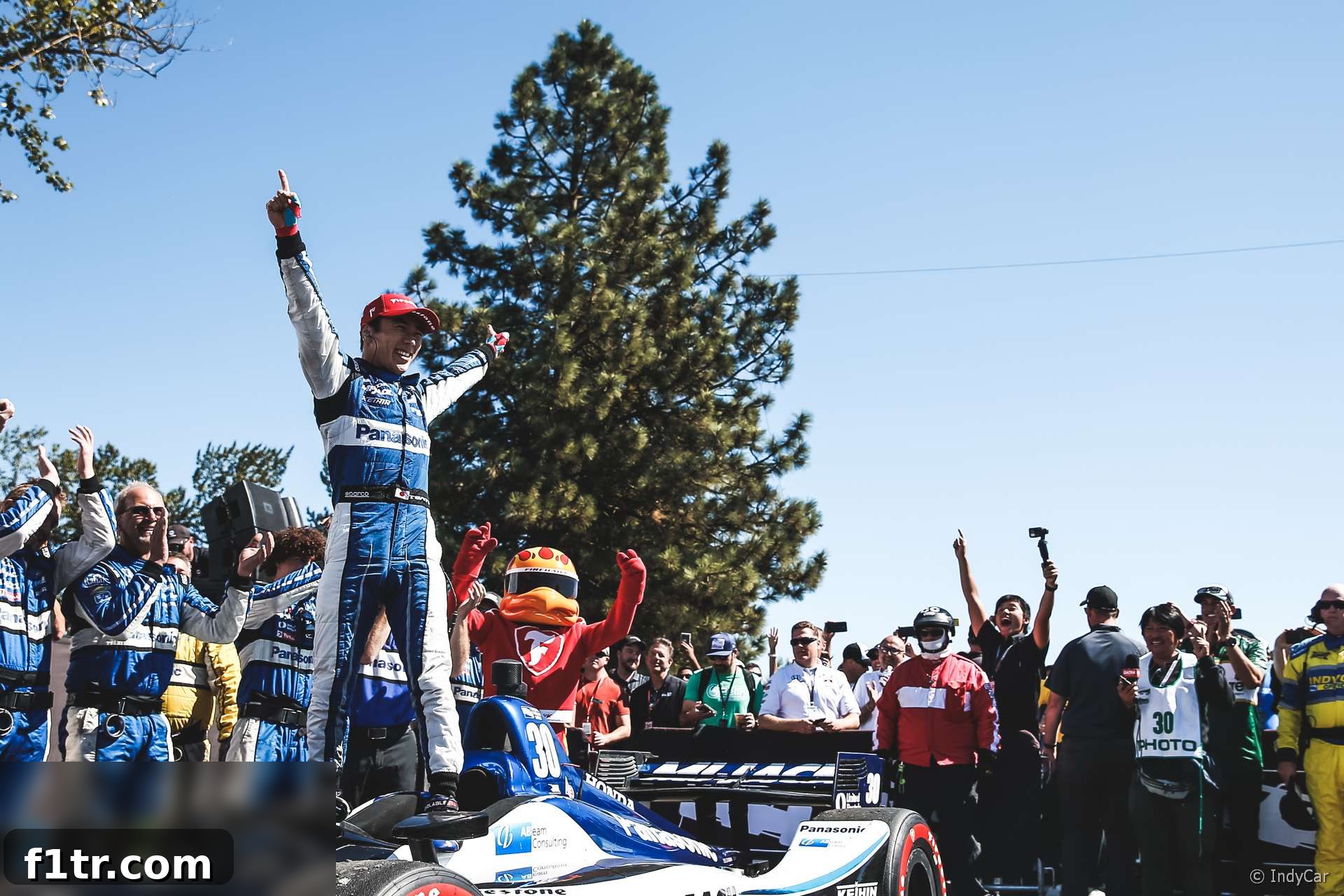
Takuma Sato Secures Stunning Victory in Dramatic IndyCar Grand Prix of Portland Amidst Championship Shake-Up
The 2018 IndyCar Series made a highly anticipated and ultimately unforgettable return to the iconic Portland International Raceway, delivering a Grand Prix packed with high-octane drama, strategic brilliance, and unforeseen twists. In a race that defied all expectations, Takuma Sato, starting from a distant 20th position on the grid, orchestrated a masterful performance to claim a surprise but thoroughly deserved victory. This pivotal event sent ripples through the championship standings, setting the stage for a nail-biting season finale.
Chaos Reigns at the Start: A Multi-Car Melee
The Grand Prix of Portland began with immediate and breathtaking chaos, a stark reminder of IndyCar’s unpredictable nature. Just moments after the green flag dropped, the opening laps saw a dramatic multi-car incident that reshaped the early complexion of the race. Zach Veach initiated the contact, inadvertently squeezing James Hinchcliffe onto the kerb. The resulting loss of control sent Hinchcliffe’s Schmidt Peterson Motorsports machine spinning dangerously across the track directly into the path of the oncoming pack.
In a terrifying sequence, Hinchcliffe’s car was collected first by Graham Rahal, whose attempt to avoid the spinning vehicle was futile, and then, most dramatically, by Marco Andretti. Andretti’s car launched spectacularly over the top of Hinchcliffe’s, a heart-stopping moment that sent gasps through the crowd. Miraculously, despite the severity of the collision and the airborne nature of Andretti’s vehicle, all drivers involved emerged from their wrecked cars unharmed, a testament to the safety advancements in motorsport. This opening-lap melee immediately triggered the first of several caution periods that would heavily influence the race’s outcome.
Amidst this carnage, championship leader Scott Dixon, who found himself inadvertently entangled in the initial chaos but managed to escape significant damage, showcased incredible poise and damage limitation. Despite the tumultuous start, Dixon, a master of navigating challenging race scenarios, managed to salvage a crucial fourth-place finish by the race’s end, positioning himself advantageously against his closest title rivals. His ability to recover from such an adverse beginning highlighted his championship mettle and his consistent ability to extract maximum points even when circumstances seem stacked against him.
Championship Contenders Face Adversity: Rossi, Power, and Newgarden’s Battles
With Dixon momentarily delayed by the opening lap incident, the stage appeared set for his primary championship contender, Alexander Rossi, to capitalize. Rossi, demonstrating impressive pace from the outset, quickly established himself at the front of the field, leading comfortably ahead of Will Power. The prospect of Rossi extending his lead, or even taking the championship lead, became a tangible possibility, electrifying fans who anticipated a significant shift in the title battle as the season neared its climax.
However, the cruel hand of fate intervened for Will Power. The Australian driver, a formidable competitor, began to experience significant issues with his gearbox, specifically losing first gear. This mechanical ailment proved debilitating, particularly through the tight and technical Festival Curves at the beginning of the lap, where precise gear selection is paramount. The issue not only compromised his pace on track but also added crucial seconds to his pit stops, slowly eroding his competitive edge. Any hope of recovering from this setback was brutally dashed when Power, pushing to compensate for his car’s deficiencies, crashed at the final corner. This incident not only ended his chance of securing strong points at Portland but effectively extinguished his hopes for the 2018 IndyCar title, a devastating blow for the Penske driver.
Following Power’s misfortune, his teammate Josef Newgarden took up the pursuit of Rossi. Running on the softer, alternate compound tires, which offer superior grip but shorter longevity, Newgarden successfully executed a pass on Rossi’s Andretti Autosport machine, demonstrating impressive car control and strategic timing. He began to pull away, building what looked like a comfortable lead. Yet, the relentless nature of the Portland Grand Prix, characterized by its numerous caution periods, meant that no lead was truly safe. These interruptions, while offering opportunities for some, repeatedly scuppered the progress of the early leaders, forcing them to adapt their strategies on the fly and continuously reassess their race plans.
Tactical Masterclass and Caution Periods: The Race Unfolds
The numerous caution periods became the defining feature of the Portland Grand Prix, transforming a straightforward race into a strategic chess match. Each yellow flag effectively bunched up the field, erasing hard-won advantages and creating fresh opportunities for those who had either saved fuel or were on alternative pit strategies. This played directly into the hands of drivers who had adopted a more conservative approach in the early stages, patiently biding their time and conserving precious fuel, allowing them to stretch their stints longer than their rivals.
One such beneficiary of these caution flags was Takuma Sato, who, along with Ryan Hunter-Reay and the ever-resourceful Scott Dixon, found themselves in increasingly advantageous positions as the race progressed. The interruptions allowed them to mitigate the disadvantage of their earlier strategies or incidents. For Dixon, a drive-through penalty for speeding in the pit lane further compounded his woes, yet his ability to remain calm and focused allowed him to claw back positions and stay firmly in contention for a valuable points haul.
The cautions were primarily triggered by further on-track incidents. First, Zach Veach, who had been involved in the opening lap contact, went off track at the same corner where Will Power’s race ended, necessitating another recovery effort and bringing out the yellow flags. Soon after, series returnee Santino Ferrucci, making his mark in the IndyCar season, stopped on track due to a mechanical issue, prompting yet another interruption. These successive caution periods created a lottery-like scenario, constantly shuffling the running order and making it incredibly difficult for teams to execute long-term strategies, emphasizing the importance of quick thinking and adaptability.
Sato’s Stunning Ascent: From P20 to Victory Lane
The final restart of the race presented a fascinating grid. Max Chilton, driving for Carlin, found himself leading the field, a remarkable turnaround given the day’s events. However, Chilton still had one final pit stop to make, a critical factor that would ultimately decide his fate. As Chilton peeled off into the pit lane, the lead was handed back to the relentless Takuma Sato, who had quietly but effectively worked his way through the field from an astonishing 20th starting position.
Sato, a former Indianapolis 500 winner, demonstrated all his experience and race craft in the closing laps. Despite late and intense pressure from Ryan Hunter-Reay, who was also having a stellar recovery drive, Sato held his nerve with unwavering focus and precision. His defensive driving was impeccable, resisting every challenge and maintaining his lead through the final corners. The relief and elation were palpable as Takuma Sato crossed the finish line to claim his first victory since his memorable triumph at the Indianapolis 500 the previous year. It was a victory earned through patience, intelligent fuel management, and flawless execution during a highly turbulent race, solidifying his reputation as a driver capable of capitalizing on chaotic circumstances.
Podium Finishers and Key Movers
Behind Sato, the battle for the remaining podium places was equally fierce. Sebastien Bourdais, a veteran of the series, managed to claim the final podium spot, a strong result from a challenging race. He held off Spencer Pigot, who delivered one of the most memorable moves of the final restart, muscling his way past championship leader Scott Dixon with an aggressive yet fair maneuver that showcased his burgeoning talent.
Simon Pagenaud also put in a commendable performance, climbing an impressive 16 positions from his 22nd starting grid slot to finish in a solid sixth place, just ahead of Charlie Kimball. These drives highlighted the strategic diversity and competitive depth within the IndyCar field, where strong finishes can be forged from challenging starting positions through a combination of speed, strategy, and perseverance.
Championship Picture: Dixon vs. Rossi Heading to Sonoma
For Alexander Rossi, the Grand Prix of Portland proved to be a frustrating experience, despite showing significant promise early on. After briefly leading and looking poised to seize the championship lead, he was ultimately poorly rewarded with an eighth-place finish, having battled back past Josef Newgarden and Pietro Fittipaldi after the final restart. This outcome was a bitter pill to swallow, as it meant Rossi, who had looked like a formidable challenger throughout the season, failed to gain significant ground on his rival.
Consequently, Scott Dixon’s resilient fourth-place finish proved immensely valuable. Despite being involved in the opening lap incident and incurring a drive-through penalty, his ability to minimize damage and maximize points meant he maintained a crucial advantage. Rossi will now head into the season finale at Sonoma Raceway, scheduled for two weeks after Portland, trailing Dixon by 29 points. This margin, while not insurmountable, places the pressure firmly on Rossi to deliver a flawless performance and hope for some misfortune for Dixon. The Portland race, therefore, amplified the tension and anticipation for the championship decider, promising a thrilling conclusion to an unforgettable season of IndyCar racing.
Image Gallery: Reliving the Action at Portland
Further IndyCar Insights and Updates
For more detailed analysis, news, and features on the exhilarating world of IndyCar racing, explore our extensive archive of articles. Stay up-to-date with driver news, technical developments, and race reports from across the series. Dive into the thrilling narratives that define America’s premier open-wheel championship.
- IndyCar driver McLaughlin cleared of injury after crashing through barrier at Barber
- Schumacher says his IndyCar feels like ‘an F2 car, just with better tyres’
- IndyCar “way faster than Formula 1” in some corners, says Grosjean
- FIA to award more F1 superlicence points to IndyCar drivers from 2026
- Schumacher to race full-time in IndyCar with RLL in 2026
Browse all IndyCar articles