Ferrari F1’s Strategic Crossroads: Embracing Diversity for Enduring Success
In the high-stakes world of Formula 1, performance on track is paramount, yet for Scuderia Ferrari, the legendary Italian powerhouse, success has often been intertwined with its management philosophy. A pivotal moment in the team’s history in the early 1990s vividly illustrates this connection, offering crucial lessons for its current challenges. Faced with a dire lack of results and a looming threat to its very presence in Formula 1, Ferrari, under the guidance of Luca di Montezemolo, made a radical decision that would redefine its legacy for over a decade. This strategic shift towards embracing international talent, spearheaded by the appointment of Jean Todt, led to an unprecedented era of dominance. However, the subsequent return to a more insular, ‘Italy-first’ approach has coincided with a notable decline in performance, raising critical questions about Ferrari’s future trajectory and its ability to reclaim its position at the pinnacle of motorsport.
A Scuderia in Crisis: Ferrari’s Dark Days of the Early 90s
By late 1992, the illustrious Scuderia Ferrari found itself in an unenviable position. The Prancing Horse, synonymous with Formula 1 itself, was suffering from a prolonged period of underperformance that deeply concerned Bernie Ecclestone, who was then solidifying his control over F1’s commercial rights. The prospect of Ferrari, the sport’s most iconic brand, potentially withdrawing due to its lacklustre showing was a significant threat to F1’s overall value and appeal.
Luca di Montezemolo, who had taken the helm at Ferrari the previous year, was grappling with the mounting costs of an extended winless streak. The team’s last Grand Prix victory dated back to September 1990, and more alarmingly, Ferrari had not secured any championship silverware since clinching the Constructors’ title in 1983 – nearly a decade prior. This prolonged drought was a heavy burden on the team’s morale and its fervent fanbase, the Tifosi. Memories of Jody Scheckter’s 1979 Drivers’ Championship victory at Monza were fading, replaced by a yearning for renewed glory. To truly grasp the magnitude of this struggle, consider that as of today, it has been 12 years since Ferrari last won a Constructors’ title and 13 since Kimi Räikkönen’s celebrated Drivers’ Championship.
Montezemolo acutely understood that Ferrari’s decline was not merely an on-track issue. The team’s poor performance was actively eroding the revered brand image of the Prancing Stallion, directly impacting the premium prices customers were willing to pay for its high-performance road cars. This made the need for a radical transformation undeniable, not just for sporting pride but for the commercial health of the entire Ferrari enterprise. Both Montezemolo and Ecclestone, who shared a competitive history from their Brabham and Ferrari days in the mid-seventies, recognized the mutual interest in restoring Ferrari to its former glory. But the path to redemption was unclear; previous attempts, including those by Enzo Ferrari’s own son Piero, had failed to reverse the team’s fortunes, with six different team principals trying and failing in the three years leading up to 1992 alone. The 1991 season, in particular, saw an unprecedented turnover, with three team principals overseeing just 16 races.
The Todt Revolution: A New Era of International Leadership
Bernie Ecclestone, ever the astute strategist, had a candidate in mind to tackle Ferrari’s deep-seated issues: Jean Todt. A formidable 40-something sporting director, Todt had a stellar track record. He had competed internationally before transitioning to management, where he delivered numerous world championships and high-profile successes across a range of motorsport disciplines, including the World Rally Championship (WRC), Le Mans, the World Sports Car Championship, the Dakar Rally, and Pikes Peak, all with Peugeot. Ecclestone knew Todt was eager to bring his talents to Formula 1, especially after Peugeot’s main board had scuttled his plans for an F1 entry.
It wasn’t merely Todt’s impressive list of achievements that caught Ecclestone’s attention; it was his unwavering courage in the face of political adversity. Todt had famously challenged FISA (the sporting arm of the FIA at the time) in court over regulatory changes, demonstrating a resilience that would be vital for navigating the intense internal and external pressures inherent to any Ferrari team boss role. Moreover, Ecclestone was aware that Todt was potentially available, making the timing perfect for his audacious proposal.
Thus, Bernie made an inspired recommendation to Montezemolo: “Get Jean Todt.” He even offered to facilitate a secret meeting between the two. The proposition was accepted, leading to a series of intense negotiations. Todt, fully aware of the scale of the challenge and the need for complete autonomy, demanded carte blanche over Ferrari’s sporting division. Montezemolo, recognizing the necessity of such a radical move, acceded to Todt’s terms. Jean Todt officially began his tenure with Scuderia Ferrari at the 1993 French Grand Prix, a moment that would fundamentally alter the course of Formula 1 history.
Building a Dream Team: Diversity as the Key to Dominance
Todt’s appointment was an exceptionally bold and unprecedented decision by Montezemolo, as it represented a significant departure from Ferrari’s deeply ingrained traditions. For only the second time in Ferrari’s Formula 1 history, a non-Italian held the paramount sporting leadership position; the first being Swiss sportscar racer Peter Schetty, who briefly served as competition manager in 1971. Prior to Todt, a staggering 19 other individuals, predominantly Italian, had held the top team boss role by 1993, including Marco Piccinini, who was born and educated in Rome before relocating to Monaco.
However, Montezemolo wasn’t the sole agent of change in breaking with tradition. Todt himself extended this philosophy beyond Italy’s borders, meticulously assembling a multinational team of lieutenants. He swiftly recruited some of the brightest minds in motorsport, bringing in Britons Ross Brawn and Nigel Stepney as Technical Director and Chief Mechanic respectively. South African Rory Byrne was appointed Chief Designer, while Japan’s V10 engine specialist Osamu Goto took charge as Head of Engine Research and Development. Later, Frenchman Gilles Simon joined as Engine Director. This illustrious list of diverse talent was by no means exhaustive; at its peak, the Scuderia’s employee roster boasted nationalities rivaling that of the United Nations. In the paddock, English was often heard as frequently, if not more so, than Italian around the iconic red huddles. Crucially, this rich tapestry of international expertise and perspectives delivered spectacular results, rapidly closing the gap on formidable competitors like McLaren before ultimately surpassing them in overall victories.
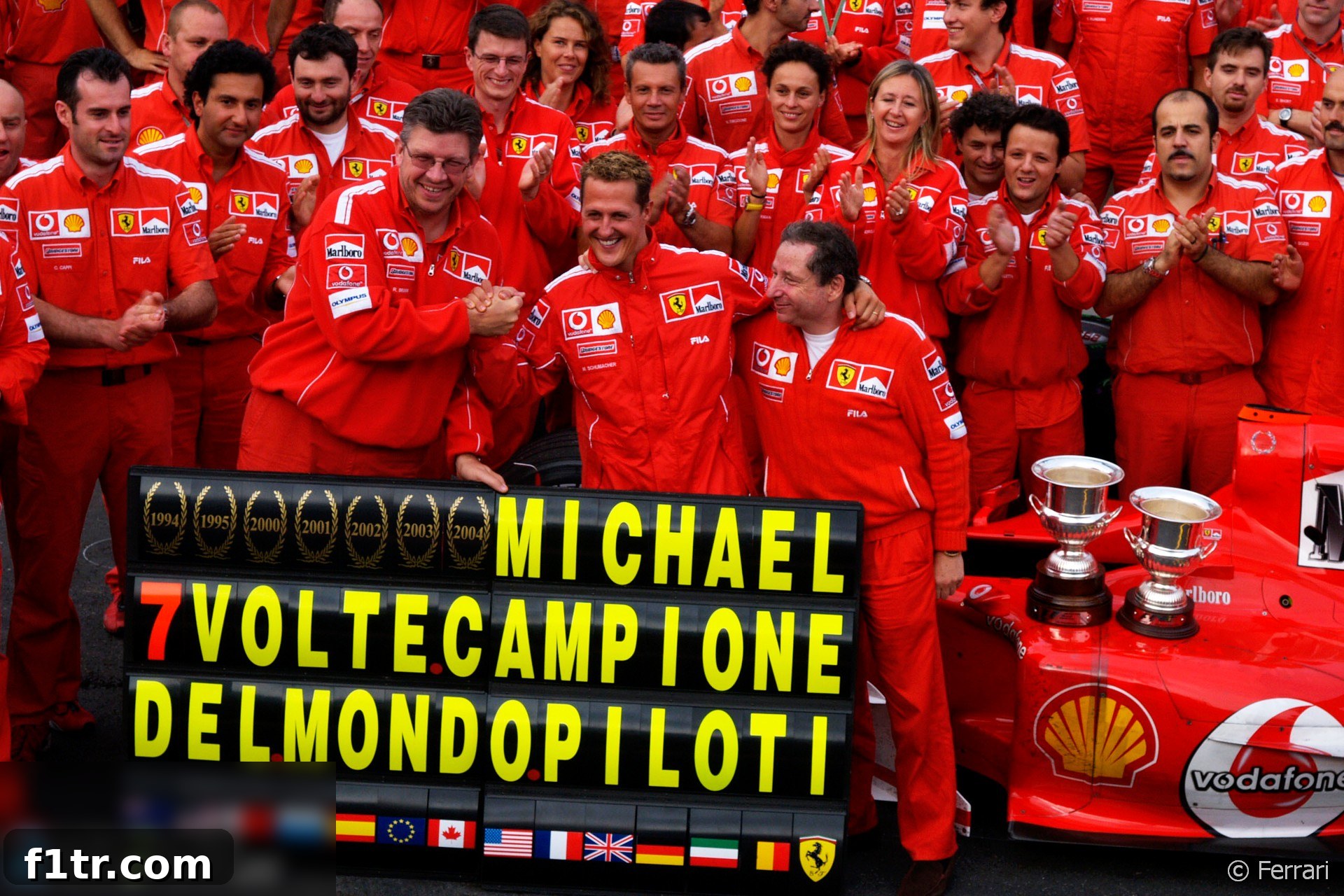
Despite the revolutionary changes, Ferrari’s journey back to the top was not immediate. The team’s foundational issues were deeply rooted, requiring six arduous years before Todt’s vision truly materialized with the Constructors’ Championship victory in 1999. The following season, Michael Schumacher, the legendary German driver who was another key recruitment, delivered the highly anticipated Drivers’ title, ending a 16-year wait since the 1983 Constructors’ title and a staggering 21 years since Scheckter’s success. Once Todt’s “Red Army” found its rhythm, it proved virtually unstoppable, embarking on an unprecedented run of six consecutive Constructors’ titles and five Drivers’ titles (all with Schumacher), a record that remains unmatched in Formula 1 history. This era of dominance was only briefly interrupted by regulation changes in 2005.
Purple patches of success soon returned, with Kimi Räikkönen and the team securing both the Drivers’ and Constructors’ titles in 2007, just as Todt was preparing to transition out of his role to succeed Max Mosley as FIA president. The team continued its championship form into 2008, securing another Constructors’ title, though Felipe Massa – another crucial Todt recruit – narrowly missed out on the Drivers’ championship in the unforgettable season finale at Interlagos.
The Post-Todt Era: A Reversion to Tradition and its Consequences
Following Jean Todt’s departure in November 2007, a noticeable shift began to occur within Ferrari’s management structure. Over the subsequent 13 years, four Italian team principals – Stefano Domenicali, Marco Mattiacci, Maurizio Arrivabene, and Mattia Binotto – have successively occupied the top leadership role. Their collective efforts, unfortunately, yielded only a single Constructors’ title in 2008, a victory that largely capitalized on the momentum and infrastructure established during Todt’s incredibly successful tenure. This period saw a gradual erosion of Ferrari’s competitive edge, paralleled by what appears to be a steady return to the “Ferrari of old,” where patriotism and internal promotions seemingly took precedence over a broad, international search for the absolute best talent.
The “Italy-first” policy seems to have firmly re-established itself. All of Todt’s successors have been of Italian nationality, with the current incumbent, Mattia Binotto, being born in Switzerland to Italian parents, still maintaining that strong Italian connection. For example, Marco Mattiacci, whose tenure lasted less than a year, was parachuted in from an executive position with Ferrari USA, possessing little discernible experience in the intricate inner workings of Formula 1. His debut at the Chinese Grand Prix in 2014 is perhaps best remembered for his sunglasses, worn consistently despite overcast, rainy weather and dusk, highlighting a perceived disconnect from the F1 paddock’s reality. The appointment of Mattia Binotto in 2019 was also met with scrutiny, and the team’s subsequent performance has done little to assuage initial concerns. In fact, for many, the situation has seemingly worsened.
Another striking commonality among the post-Todt team principals is that, with the sole exception of Jean Todt himself, all previous and subsequent team principals have either been “Ferrari lifers” – promoted internally after years within the company – or individuals with deep prior links to the company or its founder. Maurizio Arrivabene, though an external appointment, previously served as a senior marketing executive for Philip Morris, a long-time team partner, making him essentially an integral part of the Ferrari ecosystem.
A third, and perhaps most concerning, common thread is the perceived unsuitability of the four post-Todt team principals – Domenicali, Mattiacci, Arrivabene, and Binotto – for the relentlessly demanding and cutthroat environment of Formula 1. While undoubtedly good individuals, none of them appeared or seems entirely comfortable in the rough-and-tumble world of top-tier motorsport management. Stefano Domenicali, for instance, has since found considerable success and comfort as CEO of Lamborghini, while Marco Mattiacci has returned to high-end auto marketing in North America, and Maurizio Arrivabene has retired. Their professional trajectories post-Ferrari suggest that the role of Ferrari F1 Team Principal requires a unique blend of technical acumen, political resilience, and unwavering tenacity that perhaps these admirable individuals did not fully possess for that specific, intense role.
A Troubling Performance Trend and The Cost of Homogeneity
The stark reality of Ferrari’s post-Todt era is reflected in its performance metrics. In the 13 years since Todt’s departure in November 2007, the team has managed to secure only a single Constructors’ Championship in 2008. During this challenging period, Ferrari has twice slumped to fourth place in the Constructors’ standings, enduring winless seasons in both 2014 and 2016. This decline is particularly jarring given that Ferrari consistently operates with one of the largest budgets in Formula 1 and receives the most substantial share of F1’s revenues, regardless of its on-track results. Since 2010, the team has enlisted three world champions – Fernando Alonso and Sebastian Vettel, who together claimed six titles elsewhere, along with a returning Kimi Räikkönen (who was initially fired in 2009) – yet none of these esteemed drivers could bring a Drivers’ Championship back to Maranello.
The recent past further underscores these difficulties. Ferrari found itself embroiled in a controversial secret settlement with the FIA concerning its power unit operations, a situation that immediately coincided with a significant loss of performance. Engine customers reportedly estimated this deficit to be around half a second per lap. Compounding this, Ferrari consistently produced a ‘draggy’ car for two consecutive years, a chassis clearly not competitive with those of Mercedes or Red Bull. This year, the team mysteriously lost yet another half-second in performance, presumably due to persistent chassis or aerodynamic deficiencies. Qualifying firmly in the midfield has exposed the team to more frequent first-lap incidents, as tragically demonstrated by both cars colliding in a recent race, resulting in a completely pointless weekend. These on-track woes are mirrored by internal issues, exemplified by Ferrari being the only team to receive a formal FIA warning for COVID-19 protocol breaches. While Ferrari may not finish fifth in the standings, it is undeniably clear that 2020 presented an exceptionally tough season for the Scuderia.
The Enduring Question: Patriotism vs. Performance
All of these trends lead to a pointed and critical question: Does Ferrari’s apparent reversion to a policy of appointing almost exclusively Italian individuals with prior Ferrari experience to its top F1 job lie at the root of the Scuderia’s current downward trajectory? This policy drastically reduces the already limited pool of qualified individuals for arguably the most demanding and multifaceted leadership role in global sport, diminishing it by at least 95%. Surely, for a team with Ferrari’s ambition and stature, it needs to attract the absolute best talent available globally, not just the best found within the comparatively shallower pool available exclusively from Maranello or Italy.
Such fervent patriotism, while historically understandable, was arguably more appropriate in an era when racing cars proudly bore national colors and Ferrari raced in red primarily out of national pride, not commercial calculations. This was long before Ferrari was spun off from the Fiat Group in 2015 and registered as a Dutch Public Limited Company, subsequently quoted on the New York Stock Exchange to attract multinational investment. As a publicly traded entity, Ferrari owes its shareholders the best possible on-track results – results that are befitting its status as a true ‘grandee’ of Formula 1. Its entire global marketing platform, after all, centers around its F1 exploits; sustained underperformance directly impacts its brand value and commercial appeal.
Ferrari Team Principals Since Montezemolo’s First Stint
| Years | Principal |
|---|---|
| 1973-1975 | Luca di Montezemelo |
| 1976 | Daniele Audetto |
| 1977 | Roberto Nosetto |
| 1978-1988 | Marco Piccinini |
| 1989-1991 | Cesare Fiorio |
| 1991 | Marco Piccinini |
| 1991 | Piero Ferrari |
| 1991 | Claudio Lombardi |
| 1992-1993 | Sante Ghedini |
| 1993-2007 | Jean Todt |
| 2008-2014 | Stefano Domenicali |
| 2014 | Marco Mattiacci |
| 2014–2018 | Maurizio Arrivabene |
| 2019– | Mattia Binotto |
Historically, Ferrari has never hesitated to employ the finest drivers of their generations, irrespective of their national flag. Legends like Juan Manuel Fangio (Argentinian), Mike Hawthorn and John Surtees (British), Niki Lauda (Austrian), Scheckter (South African), Schumacher (German), and Räikkönen (Finnish) have all joined Italian champions Giuseppe Farina and Alberto Ascari in the pantheon of Ferrari greats. Why, then, does this open-minded philosophy not extend to its team principals or senior technical staff? Is it merely a coincidence that five of the seven senior team members listed under ‘team’ on Ferrari’s official website are Italian, joined by only a Frenchman and a Spaniard? While ‘foreigners’ have indeed served as technical directors or in similar roles in the past, their presence has been significantly outweighed by local talent. Consider that almost every F1 engine director, with the notable exception of Gilles Simon (a Todt recruitment), has been Italian. Is this truly just a coincidence, or a reflection of a deeper cultural preference?
A glance at other leading Formula 1 teams reveals a strikingly different approach. The currently dominant (German-owned) Mercedes F1 team is led by an Austrian Team Principal, supported by British technical and engine directors, and previously employed an Italian engineering director. (Austrian-owned) Red Bull Racing boasts a British Team Principal and Technical Director. McLaren Racing’s CEO is American, its Technical Director is British, and its Team Principal is German. Renault (now Alpine) is headed by a Frenchman, while its executive and technical directors come from diverse nationalities. The Swedish-owned, Swiss-based Sauber team, which races as Alfa Romeo, is managed by a French team boss. Similar diverse structures are commonplace across the grid, from Canadian-owned Racing Point (now Aston Martin) to numerous other outfits. This prevalence of international leadership and technical expertise across the most successful F1 teams highlights a strategic imperative that Ferrari seems to overlook.
Conclusion: A Call for Brave Decisions and a Return to Diversity
Ferrari’s future in Formula 1 will undoubtedly hinge on a series of brave and decisive actions. The most challenging of these will be whether the Scuderia chooses to venture beyond its existing bubble, as Luca di Montezemolo courageously did almost three decades ago, or if it will continue to adhere to its current, more traditional policies. Ferrari frequently champions its rich history, yet it appears stubbornly determined to obscure the lessons learned from its most successful period, rather than actively studying and replicating the factors that drove that unparalleled dominance. The enduring memory of Ferrari’s success at the turn of the millennium is one of unparalleled Italian glory, not merely that the team, proudly sporting the green, white, and red Tricolore, happened to be managed by a Frenchman.
Continuing down this “Italy-first” path does a disservice to Ferrari, to its vast legions of passionate fans and followers worldwide, and arguably to Formula 1 itself. It is an approach that inadvertently deprives the team, and the nation it represents on the global stage, of the consistent success they so deeply crave. Embracing diversity in leadership and talent, as demonstrated by its most glorious era, is not just a matter of modern corporate governance; for Ferrari, it is a proven pathway to renewed triumph and an essential ingredient for securing its rightful place at the very pinnacle of motorsport.
RacingLines Insights
- The year of sprints, ‘the show’ – and rising stock: A political review of the 2021 F1 season
- The problems of perception the FIA must address after the Abu Dhabi row
- Why the budget cap could be F1’s next battleground between Mercedes and Red Bull
- Todt defied expectations as president – now he plans to “disappear” from FIA
- Sir Frank Williams: A personal appreciation of a true racer
Browse all RacingLines columns