The highly anticipated inaugural Saudi Arabian Grand Prix at the Jeddah Corniche Circuit delivered on its promise of drama and unpredictability, unfolding into one of the most chaotic and incident-packed races in recent Formula 1 history. Expectations of numerous red flags and Safety Car periods were not only met but exceeded, shaping a truly unforgettable event.
From the moment the lights went out, the 2021 Saudi Arabian Grand Prix descended into a maelstrom of strategic gambles, daring overtakes, and contentious incidents. Within the opening 16 laps alone, the race witnessed a Safety Car deployment and two subsequent red flag stoppages. This unprecedented series of interruptions meant that green flag running was fleeting, severely limiting conventional pit stop opportunities and leaving many drivers at the mercy of rapidly changing fortunes.
The early chaos profoundly impacted the championship protagonists, Lewis Hamilton and Max Verstappen. Following an initial Safety Car deployment, Hamilton and his Mercedes teammate Valtteri Bottas opted to pit for fresh tyres. However, Max Verstappen made the critical decision to stay out, a gamble that paid immense dividends when the race was red-flagged for the first time. This stoppage allowed Verstappen a ‘free’ tyre change in the pits, enabling him to replace his worn tyres without losing track position, effectively retaining his hard-fought lead. This strategic divergence set the stage for much of the subsequent tension and controversy.
The first restart proved incredibly short-lived, lasting only a handful of corners before another red flag was deployed. This second stoppage, triggered by further incidents, offered Hamilton a momentary advantage. He seized the opportunity to get ahead of his rival for a brief period, showcasing his relentless pursuit of the lead. However, the subsequent restart saw Verstappen immediately reclaim the lead, intensifying their already fierce rivalry.
Among the drivers most severely affected by the tumultuous early stages was Lando Norris. Having pitted under the initial Safety Car period, Norris restarted the race in a disheartening 16th position after the first red flag, losing a significant ten places. Charles Leclerc found himself in a similar strategic predicament, also pitting under the Safety Car. Yet, due to their relative on-track positions at the time of the red flag, Leclerc managed to escape with far less damage to his race, highlighting how fine the margins were in this high-stakes contest.
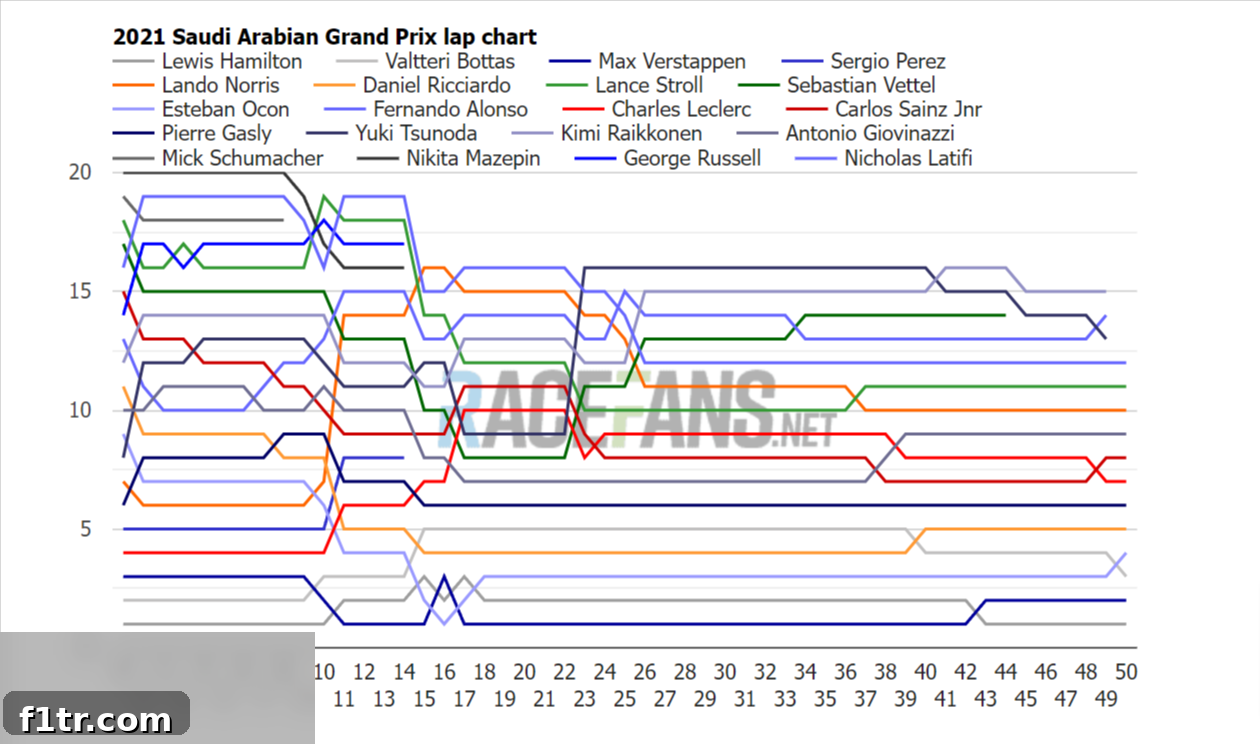
Even after the race was finally underway for its third and final restart, interruptions continued to plague the running. A remarkable four Virtual Safety Car (VSC) periods followed, primarily triggered by debris scattering across the circuit. These frequent VSCs made the lap time charts resemble those of a four- or five-stop race, as drivers were forced to adhere to strict speed limits, disrupting their rhythm and further complicating tyre management strategies. The unpredictable nature of these interruptions ensured that no driver could settle into a consistent pace, adding another layer of challenge to an already demanding race.
Given the sheer number of times green flag racing was brought to a halt, the attrition rate was surprisingly low, although significant for those involved. Five drivers were ultimately unclassified: Mick Schumacher, Sergio Perez, Nikita Mazepin, George Russell, and Sebastian Vettel. Their departures from the lap charts underscore the brutal demands of the Jeddah circuit. Perhaps the most notable of these was Sebastian Vettel, whose heavily damaged car became a significant contributor to the numerous Virtual Safety Car periods. Running with compromised aerodynamics, his car shed debris, not only dropping him further down the order but also necessitating clean-up operations that repeatedly neutralized the race. This incident further amplified the chaotic narrative of the Grand Prix, illustrating the unforgiving nature of the circuit and the consequences of even minor contact.
Towards the dramatic climax of the race, Max Verstappen reported significant difficulties with his rear tyres. This issue may have been exacerbated by potential damage sustained during a contentious incident with Hamilton on lap 37. This bizarre encounter saw Verstappen attempt to slow down and let Hamilton pass, a directive from his team after concluding he had gained a position by running off-track. However, Hamilton, unwilling to pass before the DRS detection point to maximize his strategic advantage, also slowed down further. The result was a peculiar stalemate that saw both drivers inexplicably give away approximately four seconds to the chasing pack, a critical loss in such a tightly contested race. This moment epitomized the intensity of their championship duel, where every decision, even a seemingly simple one, was scrutinized and laden with consequence.
Once Hamilton finally managed to get ahead of Verstappen, the Red Bull driver’s lap times visibly plummeted. His gamble on medium tyres for the final restart ultimately did not pay off, leaving him to limp home as his pace dramatically faded. The comparison of their lap times clearly illustrates this decline, marking a crucial turning point in the race and the championship battle.
2021 Saudi Arabian Grand Prix Lap-by-Lap Positions
This section typically illustrates the dynamic changes in each driver’s position throughout every lap of the race. It provides a visual representation of overtakes, strategic gains, and losses, offering insights into the evolving race narrative. Spectators can track individual driver progress, highlighting moments of ascent or decline.
2021 Saudi Arabian Grand Prix Race Gaps
Here, the gaps between each driver relative to the leader’s average lap time are presented, providing a comprehensive overview of the race’s ebb and flow. Very large gaps are often omitted for clarity, focusing on the competitive clusters and showing how effectively drivers maintained pace or lost ground to the front-runners. It’s a key tool for understanding race rhythm and strategic effectiveness.
Position Change Analysis
The following table provides a detailed breakdown of each driver’s starting position, their change in position on the opening lap, and their overall position change by the end of the race. This data offers crucial insights into a driver’s ability to gain or lose ground at the start, as well as their general performance and progression throughout the chaotic Saudi Arabian Grand Prix.
| Driver | Start position | Lap one position change | Race position change |
|---|---|---|---|
| Lewis Hamilton | 1 | 0 | 0 |
| Valtteri Bottas | 2 | 0 | -1 |
| Max Verstappen | 3 | 0 | 1 |
| Sergio Perez | 5 | 0 | |
| Lando Norris | 7 | 1 | -3 |
| Daniel Ricciardo | 11 | 2 | 6 |
| Lance Stroll | 18 | 2 | 7 |
| Sebastian Vettel | 17 | 2 | |
| Esteban Ocon | 9 | 2 | 5 |
| Fernando Alonso | 13 | 2 | -1 |
| Charles Leclerc | 4 | 0 | -3 |
| Carlos Sainz Jnr | 15 | 2 | 7 |
| Pierre Gasly | 6 | -2 | 0 |
| Yuki Tsunoda | 8 | -4 | -5 |
| Kimi Raikkonen | 12 | -2 | -3 |
| Antonio Giovinazzi | 10 | 0 | 1 |
| Mick Schumacher | 19 | 1 | |
| Nikita Mazepin | 20 | 0 | |
| George Russell | 14 | -3 | |
| Nicholas Latifi | 16 | -3 | 4 |
2021 Saudi Arabian Grand Prix Lap Times Overview
This section presents all recorded lap times for the drivers during the Grand Prix, with extremely slow laps typically excluded to maintain focus on competitive performance. This data allows for an in-depth analysis of driver consistency, pace management, and how their performance fluctuated throughout the race, particularly in response to the numerous interruptions and incidents.
2021 Saudi Arabian Grand Prix Fastest Laps
The table below details each driver’s fastest lap recorded during the 2021 Saudi Arabian Grand Prix, alongside their respective gaps to the fastest overall lap and the lap number on which their quickest time was achieved. This metric is crucial for understanding outright pace and potential, even if overall race strategy or incidents prevented a higher finishing position.
| Rank | Driver | Car | Fastest lap | Gap | On lap |
|---|---|---|---|---|---|
| 1 | Lewis Hamilton | Mercedes | 1’30.734 | 47 | |
| 2 | Valtteri Bottas | Mercedes | 1’31.408 | 0.674 | 47 |
| 3 | Max Verstappen | Red Bull-Honda | 1’31.488 | 0.754 | 35 |
| 4 | Charles Leclerc | Ferrari | 1’31.601 | 0.867 | 46 |
| 5 | Fernando Alonso | Alpine-Renault | 1’31.633 | 0.899 | 46 |
| 6 | Esteban Ocon | Alpine-Renault | 1’31.797 | 1.063 | 47 |
| 7 | Carlos Sainz Jnr | Ferrari | 1’31.851 | 1.117 | 37 |
| 8 | Lando Norris | McLaren-Mercedes | 1’31.914 | 1.180 | 49 |
| 9 | Pierre Gasly | AlphaTauri-Honda | 1’32.297 | 1.563 | 46 |
| 10 | Yuki Tsunoda | AlphaTauri-Honda | 1’32.506 | 1.772 | 44 |
| 11 | Daniel Ricciardo | McLaren-Mercedes | 1’32.716 | 1.982 | 43 |
| 12 | Nicholas Latifi | Williams-Mercedes | 1’32.751 | 2.017 | 49 |
| 13 | Kimi Raikkonen | Alfa Romeo-Ferrari | 1’32.778 | 2.044 | 45 |
| 14 | Lance Stroll | Aston Martin-Mercedes | 1’32.804 | 2.070 | 45 |
| 15 | Antonio Giovinazzi | Alfa Romeo-Ferrari | 1’32.865 | 2.131 | 37 |
| 16 | Sebastian Vettel | Aston Martin-Mercedes | 1’34.030 | 3.296 | 41 |
| 17 | Sergio Perez | Red Bull-Honda | 1’34.138 | 3.404 | 9 |
| 18 | Mick Schumacher | Haas-Ferrari | 1’36.043 | 5.309 | 8 |
| 19 | George Russell | Williams-Mercedes | 1’36.130 | 5.396 | 7 |
| 20 | Nikita Mazepin | Haas-Ferrari | 1’37.043 | 6.309 | 7 |
2021 Saudi Arabian Grand Prix Tyre Strategies
Understanding the tyre strategies deployed by each driver is paramount in analyzing the race outcome, especially in a Grand Prix fraught with multiple safety car and red flag periods. This table outlines the tyre compounds used in each stint and the number of laps completed on them, providing insight into how teams adapted to the rapidly changing conditions and interruptions at the Jeddah Corniche Circuit.
| Stint 1 | Stint 2 | Stint 3 | Stint 4 | |
|---|---|---|---|---|
| Lewis Hamilton | C3 (10) | C2 (40) | ||
| Max Verstappen | C3 (13) | C2 (2) | C3 (35) | |
| Valtteri Bottas | C3 (10) | C2 (5) | C3 (35) | |
| Esteban Ocon | C3 (0) | C2 (50) | ||
| Daniel Ricciardo | C2 (13) | C3 (37) | ||
| Pierre Gasly | C3 (13) | C2 (37) | ||
| Charles Leclerc | C3 (10) | C2 (40) | ||
| Carlos Sainz Jnr | C2 (13) | C3 (37) | ||
| Antonio Giovinazzi | C3 (0) | C2 (50) | ||
| Lando Norris | C4 (10) | C2 (40) | ||
| Lance Stroll | C3 (9) | C2 (6) | C3 (35) | |
| Nicholas Latifi | C3 (10) | C2 (3) | C3 (2) | C2 (35) |
| Fernando Alonso | C3 (10) | C2 (5) | C4 (29) | |
| Yuki Tsunoda | C3 (0) | C2 (15) | C3 (8) | C2 (26) |
| Kimi Raikkonen | C3 (0) | C2 (26) | C3 (23) | |
| Sebastian Vettel | C2 (0) | C3 (15) | C3 (29) | |
| Sergio Perez | C3 (10) | C2 (-10) | C3 (14) | |
| Nikita Mazepin | C3 (13) | C2 (1) | ||
| George Russell | C3 (9) | C2 (5) | ||
| Mick Schumacher | C3 (8) |
2021 Saudi Arabian Grand Prix Pit Stop Times
The efficiency of pit stops can be a decisive factor in Formula 1 races, and in a chaotic event like the Saudi Arabian Grand Prix, quick service is even more critical. This table presents the duration of each driver’s pit stops, including the overall time spent in the pit lane, the gap to the fastest stop, and the lap on which the stop occurred. Notably, this data specifically excludes tyre changes made under red flag conditions, as these are not standard racing pit stops.
| Driver | Team | Pit stop time | Gap | On lap | |
| 1 | Fernando Alonso | Alpine | 20.405 | 10 | |
| 2 | George Russell | Williams | 20.519 | 0.114 | 9 |
| 3 | Charles Leclerc | Ferrari | 20.531 | 0.126 | 10 |
| 4 | Lewis Hamilton | Mercedes | 20.580 | 0.175 | 10 |
| 5 | Sergio Perez | Red Bull | 20.710 | 0.305 | 10 |
| 6 | Lando Norris | McLaren | 20.973 | 0.568 | 10 |
| 7 | Fernando Alonso | Alpine | 21.097 | 0.692 | 44 |
| 8 | Valtteri Bottas | Mercedes | 21.668 | 1.263 | 10 |
| 9 | Nicholas Latifi | Williams | 24.220 | 3.815 | 10 |
| 10 | Lance Stroll | Aston Martin | 27.165 | 6.760 | 9 |
| 11 | Yuki Tsunoda | AlphaTauri | 27.874 | 7.469 | 23 |
| 12 | Kimi Raikkonen | Alfa Romeo | 34.489 | 14.084 | 26 |
NB. Excludes tyre changes under red flag.
Related Articles: 2021 Saudi Arabian Grand Prix
- Mercedes Seal Record Eighth Consecutive Constructors Title as Hamilton Misses Driver’s Crown
- Analysis: Is Jeddah Circuit’s Layout Fit for F1 or a “Recipe for Disaster”?
- Hamilton Closes on Another Schumacher Record with First ‘Hat-Trick’ of 2021
- How Hamilton and Verstappen’s Roughest Scrap Yet Played Out on the Radio
- Brawn Defends Masi Following Criticism of Saudi Arabian GP Decisions
Browse all 2021 Saudi Arabian Grand Prix articles