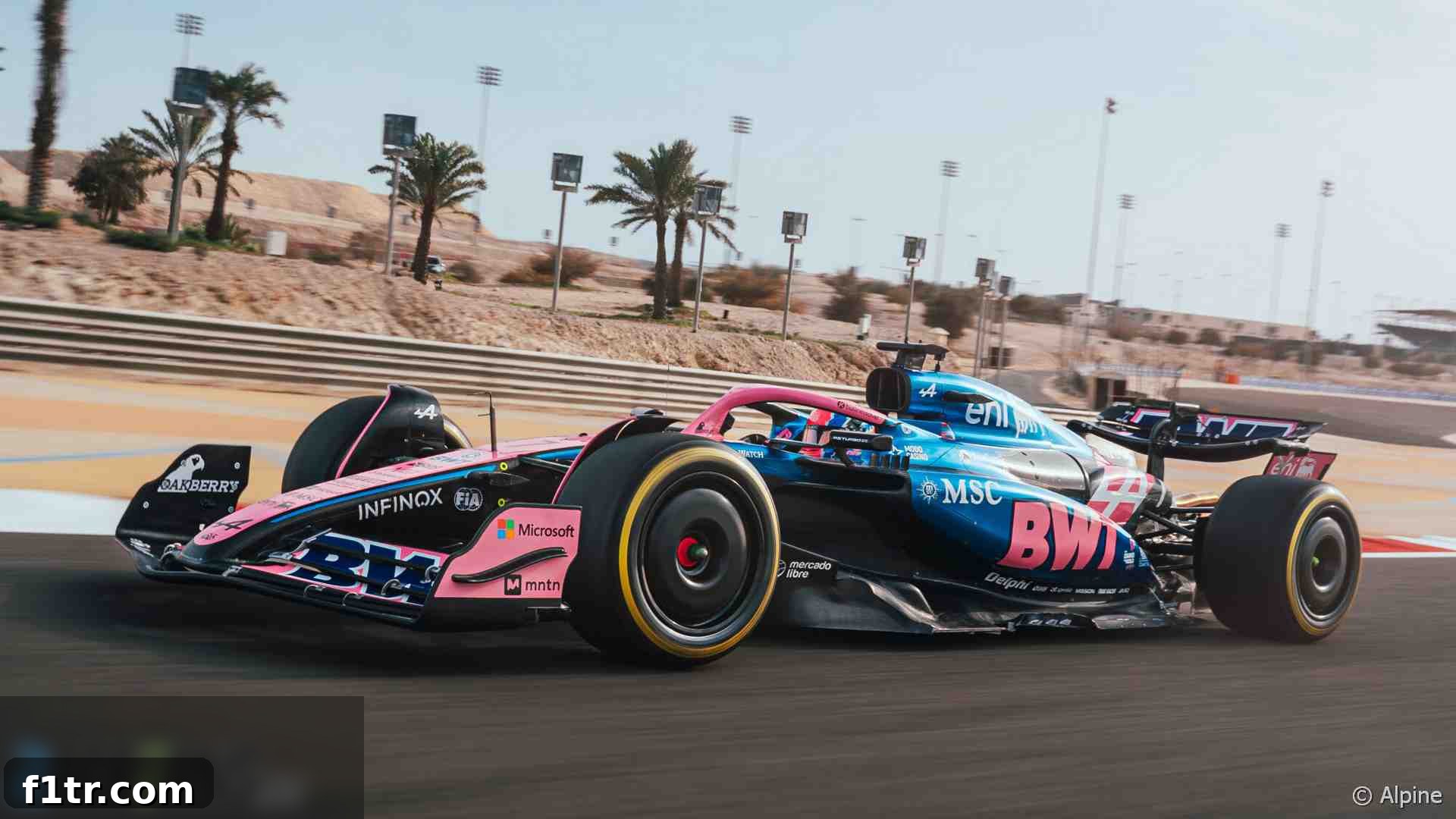
Alpine A525 Makes Impressive Track Debut Ahead of Critical 2025 F1 Season
The highly anticipated Alpine A525 Formula 1 car has officially hit the track for the very first time, completing its initial shakedown at the Bahrain International Circuit. This pivotal moment marks the beginning of Alpine’s comprehensive preparations for what promises to be a challenging yet crucial 2025 F1 season. The debut run signifies a significant milestone in the development cycle of the Enstone-based squad’s latest challenger, setting the stage for intensive testing in the days to come.
Advert | Become a Supporter & go ad-free
Guiding the A525 through its maiden laps were experienced F1 stalwart Pierre Gasly and his new team partner for 2025, Jack Doohan. The pair shared the driving duties during a designated filming day, collectively completing the maximum permissible mileage of 200 kilometres as stipulated by Formula 1’s strict regulations. These filming days are invaluable for teams, providing an opportunity to conduct preliminary system checks, gather foundational data on the new car, and capture essential promotional material for media and marketing campaigns, all within a tightly controlled environment.
The limited but critical running in Bahrain allows Alpine to validate fundamental aspects of the A525’s design and assembly, ensuring all systems function as intended before embarking on more rigorous performance-focused testing. Following this successful shakedown, both Gasly and Doohan are now poised to participate in the upcoming three-day official pre-season test session, which commences on Wednesday at the very same circuit. This will be the team’s first real opportunity to push the A525 to its limits, collecting a wealth of data vital for its development throughout the year.
Team Principal Oliver Oakes Reflects on A525’s Maiden Run
Alpine Team Principal Oliver Oakes conveyed his satisfaction with the smooth execution of the A525’s first track outing. Despite the challenging meteorological conditions, which included overcast skies and strong gusts of wind across the Bahrain International Circuit, the team successfully met its objectives for the day. “It was a good day’s running in Bahrain, with the full 200km completed and split evenly between Pierre and Jack,” Oakes commented, underscoring the efficiency of the operation.
Oakes further elaborated on the strategic importance of allocating track time to both drivers during this initial phase. “It’s paramount to give them each an initial taste and allow both to get a first feeling at the wheel ahead of what will be a very busy and demanding three days of testing later this week,” he added. This early exposure helps the drivers begin to understand the car’s ergonomics, basic handling characteristics, and overall balance. Their immediate feedback, even if rudimentary, is essential for the engineering teams at Enstone and Viry-Chatillon, providing crucial insights that will inform the intensive setup and development work during the official tests.
Driver Perspectives: Gasly and Doohan’s Initial Impressions
For Jack Doohan, this shakedown represented a significant personal milestone. Set to embark on his first full season as a Grand Prix driver in 2025, having made his F1 debut in the closing round of the previous year, getting his hands on the A525 so early is an invaluable opportunity. Doohan conveyed a strong sense of optimism after his initial run. “We’ve had a really good first day on-track here in Bahrain,” he stated, praising the car’s initial feel. “The car felt positive, and I extend my sincere thanks to everyone at Enstone and Viry-Chatillon for their incredible time and unwavering dedication in preparing the A525 for its 2025 campaign.”
Doohan’s positive affirmation, even from a limited run, provides an early confidence boost for the entire Alpine team. It suggests that the fundamental design and construction of the A525 are sound, laying a stable foundation upon which performance can be built. For a rookie preparing for a full F1 season, early seat time and positive initial feedback are instrumental in building confidence and accelerating their integration into the team’s operational rhythm and development efforts.
Seasoned F1 racer Pierre Gasly, bringing a wealth of experience to the table, offered a more cautious yet equally encouraging assessment of the A525’s debut. “It’s crucial to remember that this was purely a shakedown, meaning very limited running,” Gasly clarified. “We were certainly not driving the car at its full potential or exploring its absolute limits.” Despite these constraints, his initial impressions were distinctly positive. “The initial feeling felt very smooth and responsive,” he confirmed, indicating good inherent balance and predictability.
Gasly’s anticipation for the upcoming official tests was palpable. “I’m just looking forward to getting proper running done and truly getting going later this week for official pre-season testing,” he expressed. His feedback is vital for the team; a “smooth” initial feeling is often a good indicator of a car that possesses a strong underlying platform, capable of being fine-tuned for performance. The shakedown serves not to set blistering lap times, but to ensure basic functionality, validate systems, and provide drivers with that crucial first connection to their new machine, paving the way for detailed analysis and performance extraction during the comprehensive testing program.
A Strategic Shift: Alpine’s Power Unit Transition for 2026
The 2025 Formula 1 season holds particular significance for Alpine beyond just the performance of the A525. It will mark the final year in which the team races with Renault power units, engines that have been meticulously designed and built at the company’s historic Viry-Chatillon facility. This long-standing relationship between the chassis (from Enstone) and the engine (from Viry-Chatillon) is set to conclude as Alpine prepares for a monumental strategic shift, transitioning to Mercedes power units from the 2026 season onwards.
The decision to change power unit suppliers is arguably one of the most profound and far-reaching strategic moves an F1 constructor can undertake. It reflects a comprehensive re-evaluation of Alpine’s long-term competitive strategy and its ambitions within Formula 1’s evolving landscape. While Renault power units have been a cornerstone of the team’s identity through various eras, the move to Mercedes – a manufacturer boasting an unparalleled track record of success in the hybrid engine era – signals a clear intent to elevate performance benchmarks, enhance reliability, and potentially unlock new levels of competitiveness.
Integrating a completely new power unit into an F1 chassis is an engineering undertaking of immense complexity. It extends far beyond a simple engine swap; every aspect of the car’s design must be meticulously adapted. This includes the intricate cooling systems, the aerodynamic packaging around the engine, the weight distribution, the intricate electrical architecture, and the crucial software integration. Such a process demands extensive lead time and an exceptionally close, collaborative relationship between the chassis design team at Enstone and the new power unit supplier. Therefore, the 2025 season will not only be about optimising the A525 but also about diligently laying the groundwork for the radical integration challenges posed by the 2026 regulations and the new Mercedes power unit.
The new partnership with Mercedes holds the promise of significant benefits, including potential gains in outright power delivery, improved fuel efficiency, and access to highly sophisticated ancillary systems that contribute substantially to overall car performance and drivability. However, it also introduces a transitional period of adjustment and learning. The Alpine team will dedicate substantial resources throughout 2025 to thoroughly understand the characteristics of the Mercedes engine, ensure its seamless integration, and meticulously optimise the A526 chassis – which will be designed specifically around the Mercedes unit – to hit the ground running when the new regulations come into effect. This bold strategic pivot underscores Alpine’s commitment to forging a path towards sustained success and becoming a front-running contender in the next generation of Formula 1.
Looking Ahead: The Crucial Three-Day Pre-Season Testing
With the successful completion of the filming day, all focus now shifts to the official three-day pre-season testing session. This event is the definitive initial test for any new Formula 1 car, where teams can begin to unlock its true potential and gather a vast amount of critical performance data. Unlike the restricted shakedown, this comprehensive testing period allows for extensive running and deep dives into a wide array of vital parameters, including:
- Aerodynamic Validation: Teams will meticulously confirm that the car’s on-track aerodynamic behaviour precisely matches their extensive wind tunnel and Computational Fluid Dynamics (CFD) simulations. This involves using advanced tools like flow-vis paint and intricate aero rakes for detailed data analysis.
- Tyre Understanding: A crucial objective is to thoroughly understand how the Pirelli tyres interact with the new car across various compounds, fuel loads, and track conditions. Mastering tyre management is an absolute prerequisite for success in modern F1.
- Reliability Runs: The car will be pushed over extended distances, simulating race conditions, to rigorously identify any latent weaknesses, potential failure points, or areas requiring further reinforcement before the demanding race season commences.
- Setup Optimisation: Engineers and drivers will experiment with a myriad of mechanical and aerodynamic setups, including wing angles, suspension settings, and ride height, to meticulously find the A525’s optimal performance window.
- Driver Feedback Integration: Gasly and Doohan will provide exhaustive and detailed feedback on every aspect of the car’s handling, balance, and performance. This invaluable input will be directly translated into engineering adjustments and will crucially guide the car’s ongoing development trajectory throughout the season.
The Bahrain International Circuit, renowned for its challenging layout, diverse corner types, and varying track conditions throughout the day, offers an ideal proving ground for comprehensive pre-season testing. The enormous volume of data collected here will be absolutely instrumental in finalising the A525’s specification for the opening races of the 2025 season and providing a clear, informed direction for its subsequent development throughout the entire championship year. For Alpine, a successful and insightful test period translates not merely into impressive lap times, but into a profound understanding of their new machine and a robust, well-defined strategy for continuous progress.
Gallery: First Glimpses of the 2025 Alpine A525 on Track
Feast your eyes on the thrilling debut of the Alpine A525 as it gracefully takes to the asphalt of the Bahrain International Circuit for its inaugural run. These exclusive images capture the sleek, purposeful design and the underlying engineering prowess of Alpine’s latest Formula 1 contender, offering fans a first look at the car that will represent the team in the 2025 season.
Advert | Become a RaceFans supporter andgo ad-free
Explore More Formula 1 Content
- F1 returning to India soon after 2027 sounds like wishful thinking
- Verstappen loathes F1’s new generation of cars – but what do his rivals reckon?
- The ‘throwback weekend’ is back in fashion. But it’s a flawed concept – especially for F1
- Is Formula 1’s double race cancellation a blessing in disguise?
- Todt admits Schumacher crashed on purpose – but did it really cost him two titles?
Browse all Formula 1 articles