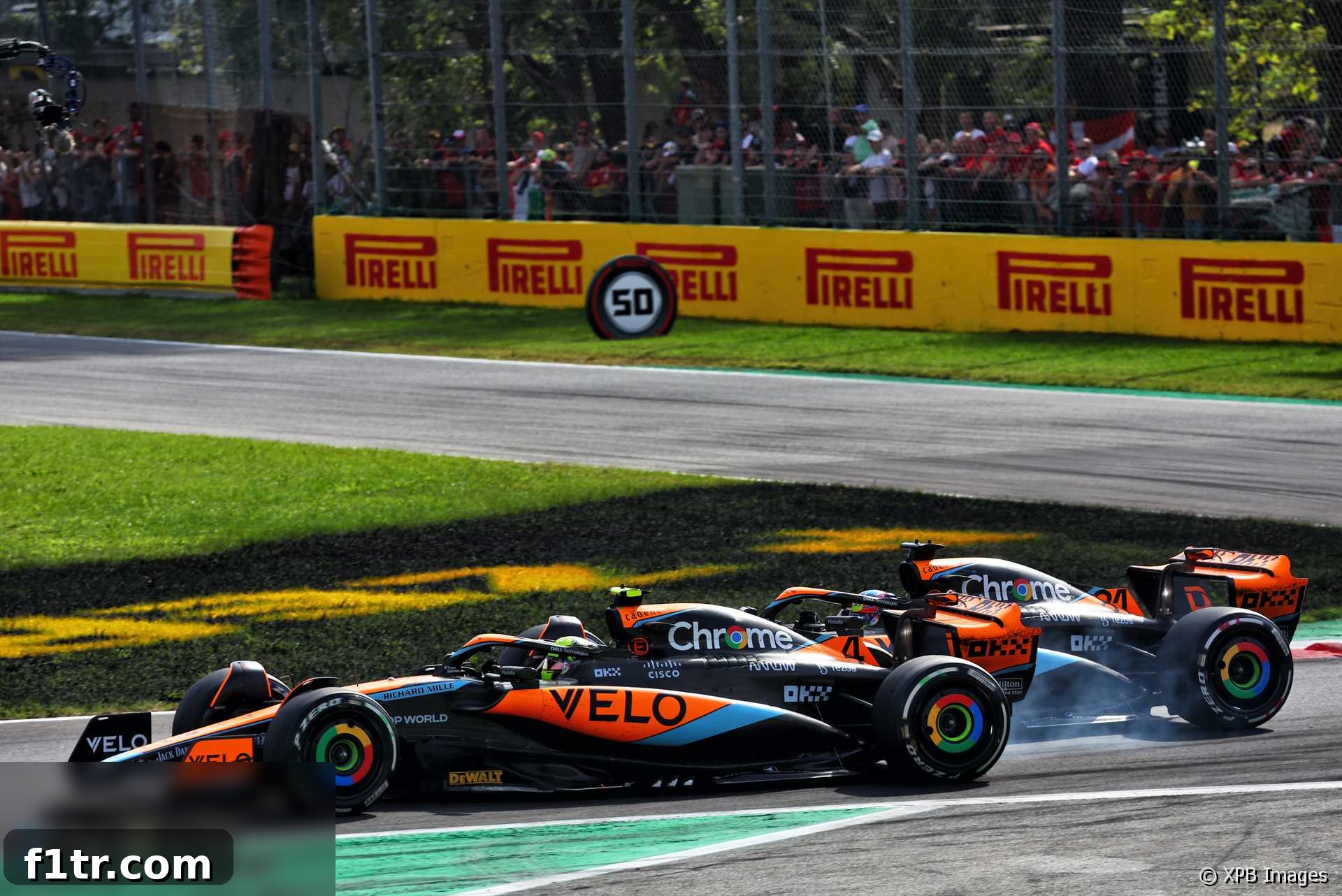
A recent high-tension moment at the Italian Grand Prix has prompted McLaren to issue a firm reminder to its drivers, Lando Norris and Oscar Piastri: on-track contact between teammates is unequivocally unacceptable. The incident, which saw the two McLaren cars briefly touch during the Monza race, has triggered an internal review by Team Principal Andrea Stella, who stressed the paramount importance of team cohesion and discipline.
The Monza Mayhem: A Lap of High Stakes and Cold Tyres
The contact occurred shortly after Oscar Piastri exited the pits, having just swapped to hard compound tyres. Rejoining the circuit, Piastri found himself navigating the notorious first corner complex, a crucial and often challenging section of the legendary Monza track. As he attempted to position his car, his front touched the rear of his teammate Lando Norris’s MCL60. This brief but significant brush immediately raised eyebrows and served as a stark reminder of the fine margins in Formula 1 racing, especially when battling your own teammate.
“It’s obviously not ideal,” Piastri reflected on the incident. “Fortunately, we both were fine after. Of course, the intention is never to get that close.” The young Australian racer had just lost a position to Norris, who had pitted earlier and was already benefiting from warmer, fresher tyres. This dynamic, where one driver has superior grip while the other is grappling with cold rubber, often leads to precarious situations. Piastri clarified his actions, stating, “I braked where I braked, and I couldn’t really slow down much more than that. I was at the limit of locking up, and it was tight. In the end, nothing happened, so I’m sure we’ll talk about it.”
Drivers’ Perspectives: A Tight Squeeze and Cold Rubber
Lando Norris, from his vantage point, believed he had afforded his teammate ample space to avoid any potential contact. “I left enough of a gap, I think, but it’s impossible to see, it was very difficult to see in the mirror. I left a big gap,” Norris explained. He attributed Piastri’s reduced stopping power to the lack of heat in his tyres. “I guess he was just on cold tyres or something, so he had a bit of understeer. But it’s just hard and cold tyres is not a nice combination, and I guess he just ran into my rear tyre, but nothing else.”
The statements from both drivers highlight the inherent challenges of close-quarters racing immediately after a pit stop. Cold hard tyres offer significantly less grip than warmed-up ones, making braking and steering more unpredictable. This factor, combined with the intense pressure of maintaining track position against a teammate, creates a high-stakes scenario where misjudgments can easily occur. While neither driver intended contact, the competitive instinct and the physics of cold rubber converged to create the incident.
Andrea Stella’s Unwavering Principle: No Contact Between Teammates
McLaren Team Principal Andrea Stella wasted no time in making the team’s position unequivocally clear: such incidents are simply not acceptable. “There should never, ever be a contact between two McLaren cars,” Stella declared with a resolute tone. “There was a contact, which doesn’t fit the way we go racing at McLaren.” This statement underscores a core principle within the Woking-based outfit, emphasizing that while fierce competition is encouraged, it must never compromise the integrity of the team or its machinery.
Stella’s philosophy stems from a deep understanding of Formula 1’s collaborative nature. Despite individual driver ambitions, the team’s collective success is paramount. Any incident, especially between teammates, risks significant damage to both cars, loss of championship points, and ultimately, a detrimental impact on McLaren’s overall objectives. The Italian team principal stressed that this rule is not based on emotion but on logical, operational parameters. “What is important is to have a clear parameter as to what you deem acceptable and what you deem not acceptable. It’s not an emotional thing, it’s just like you deal with other things, you deal with racing in a similar way. And this is very clear that for any driver, there’s something bigger than them. It’s the team.” This reinforces the message that individual glory should never overshadow the collective good.
The Post-Race Review: A Calm, Objective Assessment
In the aftermath, the team will engage in a thorough and calm discussion with both Lando Norris and Oscar Piastri. Stella indicated that the review process would be approached with the same objectivity applied to any technical or operational matter. “It’s okay, you just review things like you do with anything that is technical, operational or racing,” he explained. This measured approach aims to extract maximum learning from the incident without apportioning blame hastily.
The review will involve a detailed analysis of telemetry data, onboard footage, and driver feedback to reconstruct the events leading up to the contact. Stella stated that he would personally take another look at the incident before drawing any definitive conclusions about whether either driver could have done more to avert the collision. “I need to review,” he said. “Like all things, we’ll do it calmly; there’s nothing that we need to do urgently. So we will review; we take the adjustments that we need to take.” This careful methodology ensures that any future adjustments to driver guidelines or team procedures are well-informed and constructive.
Beyond the team’s official review, Stella expects his drivers to engage in self-reflection and recalibration of their approach to similar scenarios in the future. “I’m sure even the drivers will calibrate themselves for a similar situation,” he commented. This self-assessment is crucial for professional athletes operating at the pinnacle of motorsport, constantly learning and refining their craft under immense pressure. The team principal acknowledged the inherent difficulty of racing in such conditions, particularly with cold tyres after a pit stop, recognizing that minor misjudgments can occur. “This could be slightly more difficult than he might have anticipated. So we could absolutely conclude that this is just a little misjudgement. Therefore, it means there’s no problem at all.” He concluded by reiterating that while execution errors are part of the challenge, they become highly visible for drivers performing under intense scrutiny.
Pit Strategy Under Scrutiny: The Undercut and Its Impact
Beyond the immediate driver contact, McLaren is also taking a deeper look into its pit stop strategy at Monza and whether it inadvertently contributed to the pressure that led to the incident. Specifically, the decision to pit Lando Norris before Oscar Piastri will be a focal point of their internal investigation. “If the contact is due to the fact that there was pressure because of the undercut and so on, then we have something to review. Because it means drivers put the team at risk because of affirming themselves; this is not acceptable,” Stella asserted.
The “undercut” is a common strategic manoeuvre in Formula 1, where a driver pits earlier than a competitor to gain lap time on fresh tyres, hoping to emerge ahead when the rival eventually pits. Stella explained the rationale behind pitting Norris first: “We pitted Lando before Oscar because Lando was the car that was most under pressure when Alonso pitted.” McLaren’s primary concern at that moment was to protect their track position against Fernando Alonso, who was a significant threat. “It wasn’t clear as soon as Alonso would have cleared the AlphaTauri, how fast he would have been. So we wanted to make sure that we had two McLarens ahead of Alonso. So that’s why you go this kind of sequence.” This strategic decision, while tactically sound, may have intensified the internal race between Norris and Piastri, creating a high-pressure environment for Piastri as he exited the pits on cold tyres, trying to hold his position.
McLaren’s Path Forward: Upholding Standards and Team Unity
The incident at Monza, while minor in its physical impact, serves as an important learning curve for McLaren. Andrea Stella’s decisive reaction underscores the team’s unwavering commitment to its core values: professionalism, discipline, and, above all, the supremacy of the team. By conducting a calm, objective review and reiterating the absolute rule against teammate contact, McLaren aims to reinforce a culture where drivers understand their responsibilities extend beyond individual performance to the collective success of the entire operation. This approach is vital for any team aspiring to compete at the very top of Formula 1, where unity and strategic execution are as critical as raw pace.
As the Formula 1 season progresses, all eyes will be on McLaren to see how these lessons are integrated and how the dynamic between Lando Norris and Oscar Piastri evolves. The team’s ability to navigate such internal challenges, maintain harmony, and ensure drivers race hard but fairly will be key to unlocking their full potential and continuing their upward trajectory in the Constructors’ Championship.
Bringing the F1 news from the source
RaceFans strives to bring its readers news directly from the key players in Formula 1. We are able to do this thanks in part to the generous backing of our RaceFans Supporters.
By contributing £1 per month or £12 per year (or the equivalent in other currencies) you can help cover the costs involved in producing original journalism: Travelling, writing, creating, hosting, contacting and developing.
We have been proudly supported by our readers for over 10 years. If you enjoy our independent coverage, please consider becoming a RaceFans Supporter today. As a bonus, all our Supporters can also browse the site ad-free. Sign up or find out more via the links below:
- Become a RaceFans Supporter
- RaceFans Supporter FAQ
2023 Italian Grand Prix Related Articles
- Despite close battles at Monza, F1 drivers want more powerful DRS
- Monza “frustrating” for Alonso but Aston Martin expect better form in coming races
- F1 changed rules to stop Mercedes in 2021 but we won’t ‘cry foul’ now – Wolff
- McLaren will bring ‘follow-up to Austria upgrade’ before focusing on 2024 car
- Magnussen explains why his driving style rarely works with the Haas VF-23
Browse all 2023 Italian Grand Prix articles