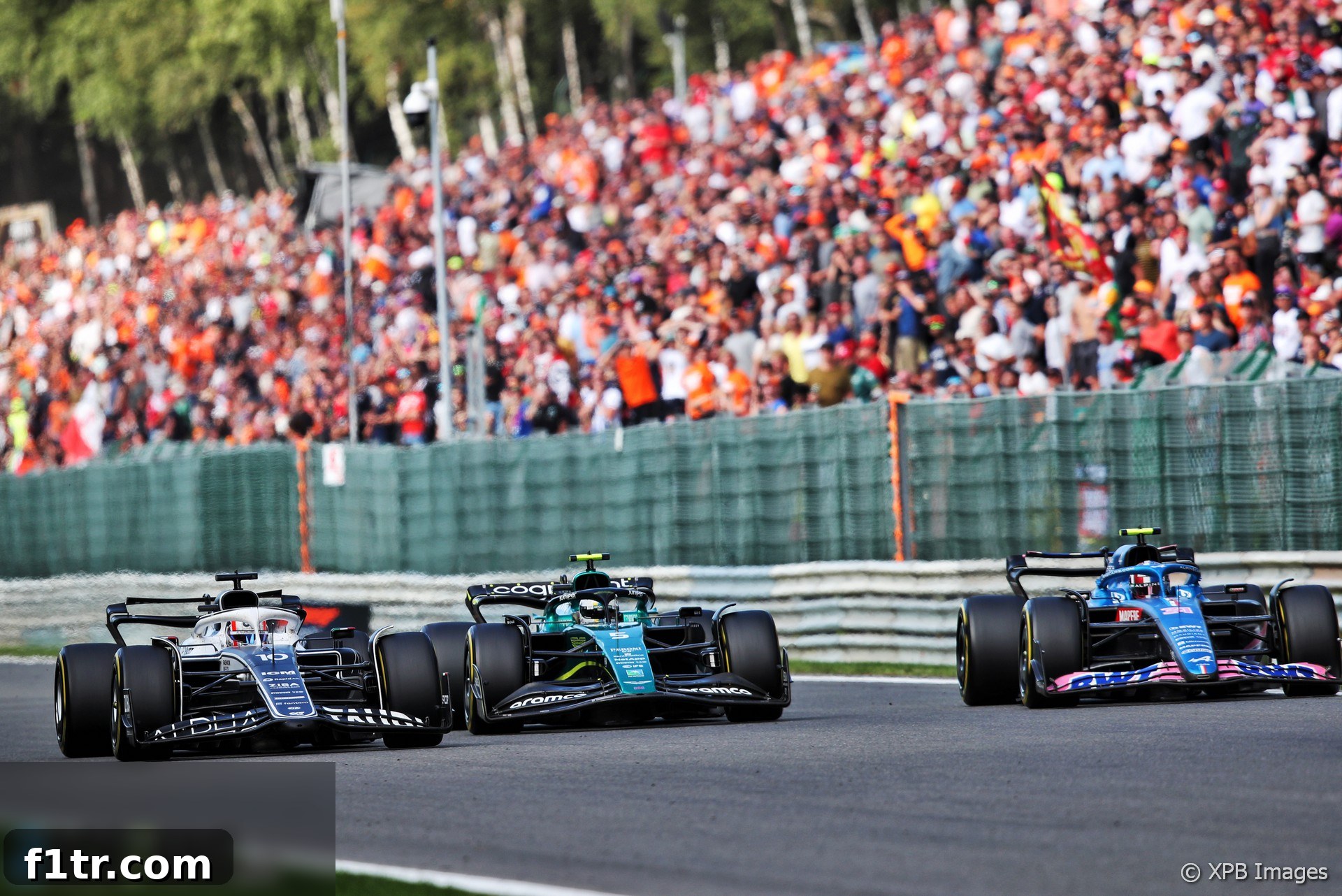
The exhilarating world of Formula 1 consistently delivers moments of high-octane drama, and the 2022 Belgian Grand Prix at the iconic Spa-Francorchamps circuit was no exception. Amidst a fiercely contested mid-field battle, a particularly captivating three-way tussle unfolded, involving Esteban Ocon of Alpine, Sebastian Vettel of Aston Martin, and Pierre Gasly of AlphaTauri. This intense on-track showdown not only provided thrilling entertainment but also highlighted the razor-thin margins and intricate tactical decisions that define top-tier motorsport. Post-race, Ocon candidly revealed that he had pointed out a crucial tactical misstep to Sebastian Vettel, a decision that ultimately influenced the outcome of their spectacular encounter.
Advert | Become a Supporter & go ad-free
The pivotal moment occurred as the trio hurtled towards Les Combes, one of Spa’s most renowned overtaking spots, battling fiercely for seventh position. In a breathtaking display of precision and raw speed, the three cars ran abreast, wheels mere inches apart, each driver pushing the limits of their machinery and skill. When the dust settled, it was Esteban Ocon who emerged victorious from the skirmish, pulling ahead of both his rivals. Pierre Gasly followed, securing his position, while Sebastian Vettel, caught in the middle of this high-speed sandwich, found himself passed on both sides, a testament to the unpredictable nature of F1 racing and the critical timing of strategic maneuvers.
This remarkable overtaking sequence was meticulously set up a lap earlier. On lap 34, Sebastian Vettel, having just completed his pit stop, rejoined the race track directly behind Pierre Gasly. Recognizing an immediate opportunity, Vettel wasted no time, executing a decisive pass on the AlphaTauri driver at the very beginning of the subsequent lap. With Gasly now behind him and Ocon rapidly closing in, Vettel led the charge down the legendary Eau Rouge and up through the breathtaking Raidillon. However, as they burst onto the long Kemmel Straight, a prime DRS (Drag Reduction System) zone, the dynamic of the battle shifted dramatically, turning the advantage towards the cars behind him.
As the cars crested Raidillon and accelerated onto the Kemmel Straight, both Pierre Gasly and Esteban Ocon had the crucial advantage of DRS activation. This system, which reduces aerodynamic drag by opening a flap on the rear wing, provides a significant speed boost, especially on long straights. Ocon, with a car known for its formidable straight-line speed, masterfully exploited this advantage. In an incredible display of strategic timing and driving prowess, he not only used DRS to pass Vettel but executed a double overtake, sweeping past both Vettel and Gasly in a single, audacious move. This was a feat Ocon had already accomplished once before during the very same Grand Prix, underscoring his exceptional skill and the Alpine car’s potent performance on the Spa circuit.
Reflecting on the thrilling encounter, Ocon couldn’t hide his enthusiasm. “It was definitely good fun,” he recounted, a wide smile likely gracing his face. “I’ve enjoyed the racing today, the car was extremely fast in a straight line, so I was managing the timing right about when to overtake.” His comments highlighted not just the raw speed of his Alpine, but also his astute understanding of race craft and the optimal moments to deploy his car’s strengths. From a starting position of 16th or 17th on the grid, the team had initially hoped for a single point. To finish the race having secured six points was a significant achievement, prompting Ocon to declare it “definitely a good result for us.” This strong performance in a highly competitive mid-field underscored the importance of every strategic decision and the relentless pursuit of opportunities during a race.
The post-race debrief brought forth the conversation between Ocon and Vettel, where the Alpine driver shared his tactical assessment. Ocon explained that he had informed Vettel about a critical error in timing. According to Ocon, Vettel had passed Pierre Gasly “too early” on the preceding lap. The crux of the issue lay with the DRS detection zone. If a driver passes another before entering the detection zone, they are unlikely to be eligible for DRS themselves on the subsequent straight, while the car they just passed might be. This nuanced understanding of the rules and track layout is what separates good drivers from great strategists. Ocon, understanding this intricate detail, deliberately “lifted the throttle a bit,” creating a small gap to ensure he would be within the DRS detection window behind Gasly, thereby enabling him to utilize his car’s superior straight-line speed to its maximum potential. The “surprise,” which quickly became a confirmation, was that Pierre Gasly indeed had DRS available, giving Ocon the perfect tow to execute his double overtake.
Advert | Become a RaceFans supporter andgo ad-free
Ocon’s strategic brilliance was complemented by Sebastian Vettel’s commendable sportsmanship. “So I was able to go on the left side,” Ocon explained. “Seb was very fair, honestly, he could have closed a bit on the left which he didn’t do, and I managed to get down on the outside of five.” This acknowledgement from Ocon highlights the mutual respect among drivers, even in the heat of battle. Vettel’s decision to leave enough space speaks volumes about his character and his commitment to clean, fair racing, even when it meant conceding positions. The intricate dance of overtaking, especially at high speed and with multiple cars involved, requires not just aggression but also a degree of mutual understanding and respect to prevent dangerous collisions, and this instance perfectly showcased that balance.
While Sebastian Vettel expressed satisfaction with his overall finish in the Grand Prix, he couldn’t help but acknowledge the missed opportunity that cost him at least one extra position. He admitted that “it could have been a position more” after being outmaneuvered by Ocon in that crucial moment. “That was a bit of a shame with Esteban, he was a bit too lucky to pick me up there,” Vettel commented, a hint of wry amusement perhaps in his tone, but also an honest assessment of the situation. He recognized that Ocon had capitalized perfectly on the circumstances, even if those circumstances arose partly from Vettel’s own tactical oversight.
Vettel elaborated on his predicament, stating he felt “a bit stuck” when Ocon and Gasly caught him on the Kemmel straight. The root of his helplessness lay in the absence of DRS and, critically, running low on energy recovery system (ERS) deployment. In modern Formula 1, managing ERS is as crucial as managing tire degradation. Without the boost from DRS or sufficient ERS to defend, Vettel knew he was at a significant disadvantage. “I didn’t have DRS and I was running out of energy,” he explained. “So I just watched in the mirrors and at some point just tried to keep it in the middle to not be distracting because I knew I’d get eaten up.” This candid admission paints a clear picture of a driver who, despite his vast experience, found himself in an unavoidable situation, forced to concede due to a confluence of tactical and energy management issues. His decision to stay central was a pragmatic move to ensure safety, allowing the faster cars to pass cleanly rather than attempting a futile and potentially dangerous defense.
Reflecting further on the sequence of events, Vettel also pointed to a prior missed opportunity stemming from his pit stop. “It was a bit unfortunate. I just missed to get a run on Pierre coming out of the pits,” he pondered. “I don’t know, with a better in-lap or better pit stop, that half a second we could have picked him up straight away and then it’s a different story. So that was a bit of a shame.” This illustrates the microscopic margins that define success and failure in Formula 1. Even fractions of a second gained or lost during a pit stop or on an in-lap can dramatically alter track position and, consequently, a driver’s strategic options for the laps that follow. A slightly different pit sequence could have put him in a position where he wasn’t susceptible to Ocon and Gasly’s DRS advantage on the Kemmel Straight, potentially allowing him to consolidate a higher position.
Ultimately, Vettel unequivocally accepted responsibility for the tactical error that led to him being overtaken. He admitted, “I picked it [the DRS] up too early” after passing Gasly, directly confirming Ocon’s assessment. “So that was not great on my side and obviously then I was dead meat.” The phrase “dead meat” perfectly encapsulates the feeling of being utterly defenseless against an attack in Formula 1 when you lack the essential tools like DRS or ERS to counter. It’s a stark reminder that even four-time world champions can make small errors in judgment, and in the cut-throat environment of F1, these errors are often immediately capitalized upon by their rivals. The incident serves as a perfect case study in the intricate interplay of track position, DRS strategy, and energy management that defines modern Grand Prix racing, especially at a circuit like Spa-Francorchamps, where the long straights amplify the effects of these tactical decisions.
Advert | Become a RaceFans supporter andgo ad-free
2022 Belgian Grand Prix
- How many victory chances did Hamilton have in his first winless F1 season?
- Sainz doesn’t believe Red Bull’s huge Spa advantage is here to stay
- Alonso: Hamilton’s nationality explains “huge” media reaction to radio comment
- “Big question marks” remain over policing of Formula 1’s budget cap – Ferrari
- Williams: Points-scoring Belgian GP pace not just due to straight line speed
Browse all 2022 Belgian Grand Prix articles