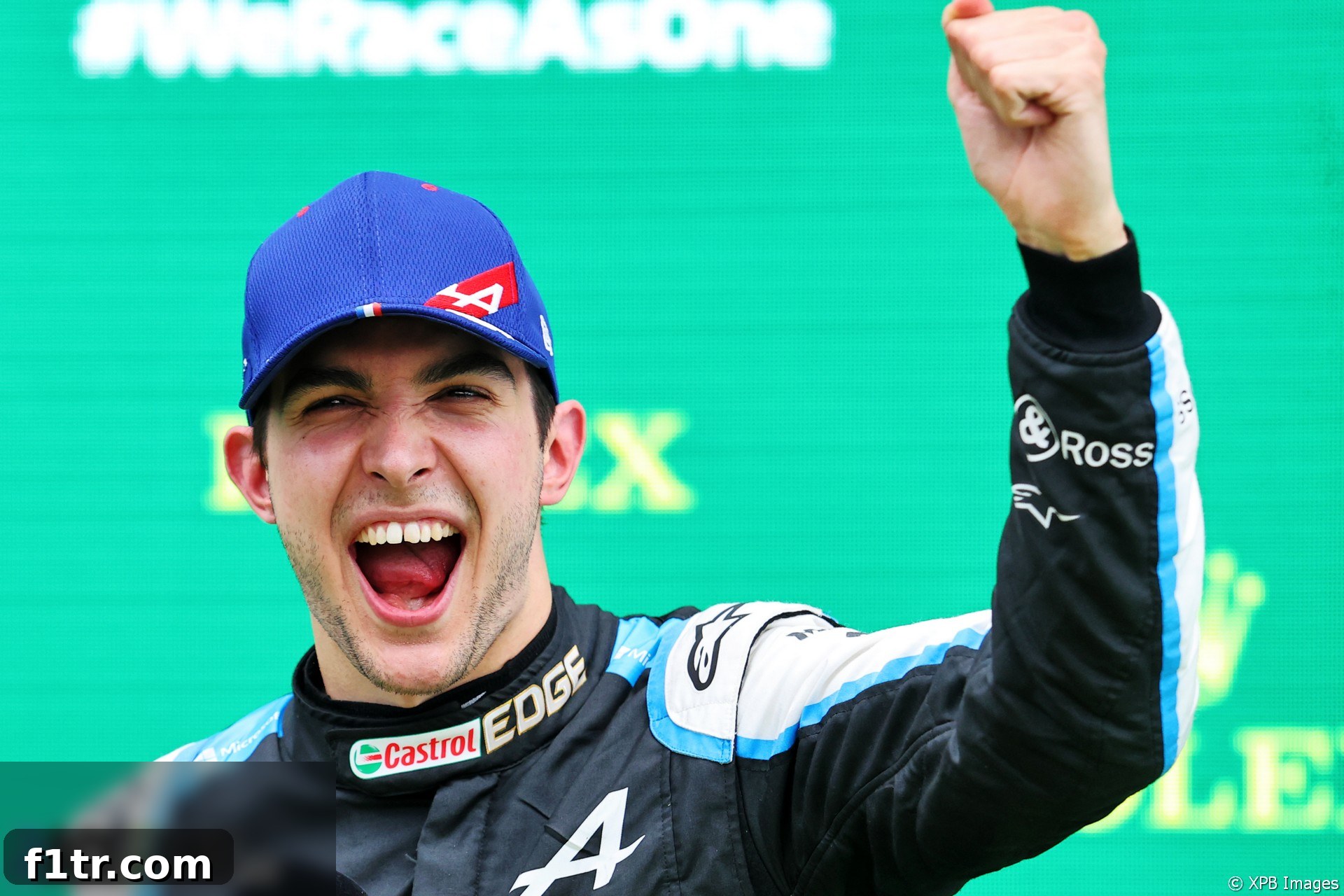
The thrilling conclusion to the Hungarian Grand Prix witnessed a remarkable moment in Formula 1 history as Esteban Ocon clinched his maiden victory, becoming the sport’s latest new winner. This triumph was not just a personal milestone for Ocon, but a significant event that underscored a fascinating trend emerging within the pinnacle of motorsport. His victory at the Hungaroring was a testament to his perseverance, the strategic brilliance of his Alpine team, and the unpredictable nature of modern Formula 1.
Indeed, the last 12 months have ushered in an exciting era for Formula 1, marked by a refreshing influx of new faces standing atop the podium. Ocon’s breakthrough win follows similar celebrated maiden victories by Sergio Perez and Pierre Gasly within this relatively short span. To have three different drivers achieve their first Grand Prix wins in just 21 races highlights a shift in competitive dynamics. This recent surge contrasts sharply with previous seasons, where the same number of new winners emerged over a much longer period of 85 races. Such a concentrated period of fresh victories suggests a more open and less predictable championship, captivating fans and offering a broader spectrum of narratives beyond the traditional front-runners.
Esteban Ocon’s name now joins an illustrious list as the 111th driver to win a race counting towards the Formula 1 World Championship. For France, his victory is particularly poignant, making him the 14th French driver to taste Grand Prix success. Among his countrymen, five others, including Pierre Gasly, the charismatic Jean Alesi, the strategic Olivier Panis, and the early pioneers Jean-Pierre Beltoise and François Cevert, stand as one-time winners. Ocon’s achievement not only elevates his own status but also reinforces France’s rich legacy in Formula 1, adding another chapter to a storied history of talent and passion from the nation.
Alpine, the team behind Ocon’s success, also etched its name into the record books as the 37th different constructor to win a Formula 1 race. However, the intricacies of Formula 1 team identities often complicate these statistics. Alpine is the latest iteration of a lineage that includes previous race winners such as Renault (though not the original 1970s outfit), Lotus (distinct from the classic Team Lotus), and Benetton. This makes their “first win” a nuanced achievement, building on a rich heritage of engineering excellence and competitive spirit. The BWT Alpine F1 Team, under its current guise, now proudly carries forward the winning tradition of its predecessors, demonstrating the cyclical nature of team evolution and identity in Formula 1.
In a similar vein, Alpine marks the third different constructor to claim its first win in the recent 21-race period. Just like Alpine, the other two recent first-time winning constructors, Racing Point and AlphaTauri, have histories steeped in prior successes under different names. Racing Point, for instance, can trace its roots back to the legendary Jordan Grand Prix team, known for its vibrant character and breakthrough performances in the 1990s. AlphaTauri, the sister team to Red Bull Racing, carries on the legacy of Toro Rosso, a team renowned for nurturing young talent. These shifting identities highlight the dynamic landscape of Formula 1, where teams evolve, rebrand, and continue to chase glory, often building upon the foundations laid by their historical antecedents.
Ocon’s victory at the Hungaroring was not merely his first win in Formula 1, but also the first time he had ever led a Grand Prix. This momentous occasion marked his return to the top step of a podium for the first time since the opening race of the 2015 GP3 championship at the Circuit de Catalunya. That particular GP3 season saw Ocon clinch the title after an extraordinary and highly unusual run of nine consecutive second-place finishes. This remarkable consistency in his junior career foreshadowed the grit and determination he would bring to Formula 1, illustrating a driver who knows how to deliver under pressure and extract maximum performance, even if outright wins were initially elusive. His journey from junior categories, marked by fierce competition and unwavering focus, culminated in this defining moment on the world stage.
The strategic play within Alpine was evident when Ocon pitted from the lead, allowing his veteran teammate, Fernando Alonso, to take the provisional lead for two laps. This brief moment saw Alonso head the field for the first time since the very same race seven years prior, a testament to his enduring skill and the team’s tactical acumen. Alonso’s role in Ocon’s victory cannot be understated; his masterful defense against the charging Lewis Hamilton was crucial, buying Ocon the necessary time to consolidate his lead and manage his tires. This display of teamwork and strategic depth from Alpine added another layer to the Hungarian Grand Prix’s compelling narrative.
The race also generated significant discussion off-track, notably concerning Sebastian Vettel’s disqualification. Initially, the FIA’s final classification listed Vettel in second place, despite his exclusion, a departure from standard practice that caused some confusion. A “corrected” classification was subsequently issued, elevating Lewis Hamilton to second and shuffling everyone behind him up one position. Assuming Aston Martin’s intention to appeal does not alter the outcome, this would mark Vettel’s first disqualification in his extensive 268-race career, a remarkable statistic for a four-time world champion. The controversy surrounding his disqualification due to insufficient fuel in his car added a dramatic post-race twist, highlighting the strict technical regulations that govern Formula 1 and the often razor-thin margins between success and penalty.
Carlos Sainz Jnr therefore inherited the fourth top-three finish of his career under these unusual circumstances. This was not the first time Sainz found himself on the podium without participating in the official ceremony; his first career podium in Brazil 2019 also involved a delayed confirmation. So far, Sainz has only physically stood on the rostrum twice, even when including his informal celebrations. These peculiar occurrences underscore his consistent performance and ability to capitalize on opportunities, even if the public recognition sometimes comes retrospectively. Sainz’s steady progress and mature driving style have consistently placed him in contention for strong results, further solidifying his reputation as a formidable competitor in the midfield and beyond.
Further down the field, the Williams drivers, George Russell and Nicholas Latifi, also moved up in the corrected standings, securing seventh and eighth place respectively. For Williams Racing, this was an emotional and long-awaited triumph. The team had endured its longest-ever pointless streak, spanning more than two years since their last top-10 finish. Their combined points haul in Hungary, even before the corrected classification, surpassed their total from the previous three seasons combined. This momentous achievement signals a potential turning point for the iconic British team, bringing renewed hope and momentum after years of struggle at the back of the grid. The collective sigh of relief and celebration within the team was palpable, marking an end to a challenging chapter and the beginning of a potentially brighter future.
While George Russell is known for his exceptional qualifying performances, often outperforming his teammates, it was Nicholas Latifi who scored his first career points with a fantastic seventh-place finish. Russell, not to be outdone, secured his best finish to date with eighth, surpassing his impressive one-off drive for Mercedes last year. This remarkable outcome for Williams showcased the team’s progress and the drivers’ ability to seize rare opportunities in a chaotic race. The performance of both drivers, particularly Latifi’s breakthrough, provided a massive boost for team morale and demonstrated the potential that has been brewing within the Grove-based outfit.
Yuki Tsunoda, the spirited Japanese rookie, also claimed the best finish of his nascent career, crossing the line in an impressive sixth position. His AlphaTauri teammate, Pierre Gasly, further underlined the team’s strong performance by bagging the fastest lap for the third time in his career. Gasly’s three fastest laps now place him alongside esteemed champions such as Keke Rosberg and Jochen Rindt, as well as accomplished drivers like Bill Vukovich, Tony Brooks, Bruce McLaren, Richie Ginther, Chris Amon, and Jean-Pierre Jarier, highlighting his raw speed and ability to push the car to its limits.
The first-lap crash at the start of the Hungarian Grand Prix proved to be a pivotal moment, raining down bad luck on several drivers. Most notably, Lando Norris, who had enjoyed a phenomenal season, saw his impressive 15-race streak of consecutive points finishes come to an unfortunate end. The incident also triggered yet another disruption to the race, resulting in a red flag – the fourth of the season, already one more than the entirety of the previous season, with more than half of the current championship still left to run. This increasing frequency of red flags underscores the heightened intensity and unpredictability of modern Formula 1, where every race can be a high-stakes, dramatic affair from the very first lap.
The 2021 Hungarian Grand Prix will undoubtedly be remembered as a race of unexpected outcomes, breakthrough performances, and significant statistical milestones. From Esteban Ocon’s emotional maiden victory to Williams’ long-awaited return to points, and the dramatic first-lap chaos, it offered a compelling spectacle that epitomizes the excitement and unpredictability of Formula 1.
2021 Hungarian Grand Prix
- Ocon congratulated by past French F1 aces after breakthrough win
- Alpine doubt first win signals a performance breakthrough
- Vettel disqualification hearing to take place on Monday
- Why no one received a Grosjean-style race ban for the Hungarian GP pile-up
- Ocon’s “beautiful” late-stint pace was other key to Alpine’s breakthrough win
Browse all 2021 Hungarian Grand Prix articles