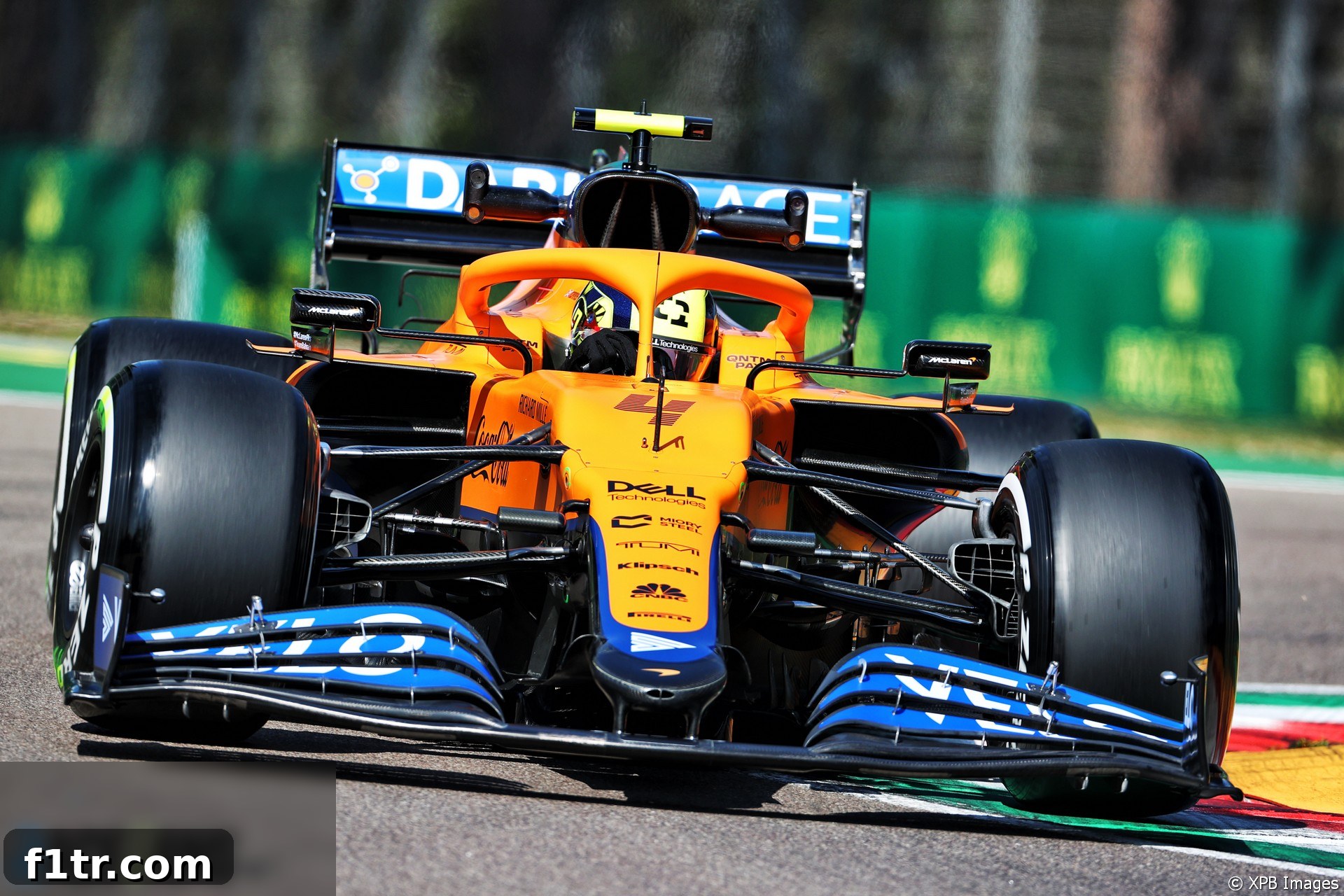
Lando Norris’s Imola Heartbreak: The Centimetres That Cost a Podium Start
The 2021 Emilia-Romagna Grand Prix qualifying session at Imola was a rollercoaster of emotions for Lando Norris. The young McLaren driver delivered a sensational performance, only to have his hopes of a front-row or even third-place start dashed by a hairline track limits infringement. This incident, a stark reminder of the unforgiving nature of Formula 1, saw Norris lose a truly exceptional lap time, relegating him down the grid and sparking discussions about the sport’s stringent regulations.
In the thrilling final moments of Q3, Norris unleashed a blistering lap, clocking a 1’14.454. This incredible effort, just four hundredths of a second shy of Lewis Hamilton’s pole-winning time, provisionally placed him second on the grid. For a brief, electrifying moment, it seemed Norris had secured the best starting position of his burgeoning career, igniting cheers from fans and pundits alike. However, the elation was short-lived as Sergio Perez soon edged past his time, placing Norris in a provisional third position – still an outstanding result for the young Briton.
The Lap That Vanished: A Fine Line at Piratella
Tragically, Norris’s spectacular lap time did not stand. Race control, through meticulous scrutiny, observed that he had exceeded track limits at the critical exit of Piratella, a high-speed left-hand kink. The loss of this fastest lap was a severe blow, plummeting Norris from a potential third place to a seventh-place grid start, placing him behind his new team mate, Daniel Ricciardo. This incident underscored the razor-thin margins that define success and failure in Formula 1 qualifying.
Reflecting on the painful decision, Norris expressed his surprise, stating that he didn’t perceive his final flying lap to be significantly different from his previous, compliant attempts. “I didn’t think it was too different to the laps I did previously,” Norris explained. “I think I was always close to the limit. I didn’t think of it when I was doing my lap or anything. So it was a bit of a surprise.” He elaborated on the fine distinction, attributing the penalty to a matter of mere “centimetres” that were almost imperceptible from inside the cockpit at full speed.
“But I think the reason is because all my other laps were very close and were very similar, obviously just a few centimetres further left,” Norris added. “But when you’re driving the car, you don’t really feel those couple of centimetres all the time. So that’s why it didn’t feel too different.” His comments highlight the extreme precision and often instinctive nature of driving at the absolute limit, where minor deviations can have significant consequences.
The Unforgiving Nature of Imola’s Track Limits
Norris, however, was not alone in his predicament. The challenging nature of Imola’s circuit, particularly at the Piratella corner, caught out several other prominent drivers. Mick Schumacher, Antonio Giovinazzi, Lance Stroll, Pierre Gasly, and Sergio Perez all had lap times deleted for running too wide at the exit of this very same high-speed kink. This collective struggle underlined that the issue was not isolated but rather a characteristic challenge of the track’s design and the precise enforcement of regulations.
Norris further detailed the specific difficulties presented by Piratella. “I think the faster corner, the trickier it is to guess,” he commented. “It’s quite a narrow track. You’re committing to your turn-in. It’s not like you can start to edge in and have a few attempts at it.” The corner demands full commitment and a precise line, leaving little room for error or adjustment once the driver has initiated the turn-in.
“It’s quite a big inside kerb, so I didn’t have much room to kind of play with the inside kerb,” Norris continued, painting a vivid picture of the constraints drivers face. “You’re on a very particular line and you just go that little bit quicker, then you can end up a couple of centimetres wider. The thing that’s hard to judge is that it happens so quickly – it’s not easy to get to an apex and then go ‘okay, I know I’m going to be ending up three centimetres further right’. So it’s a very difficult corner. I think in terms of this track, it’s probably one of the hardest to judge exactly where you’re going to end up.”
His description emphasizes that while observers might perceive these infringements as straightforward mistakes, the reality from inside a Formula 1 car travelling at immense speeds is far more complex. “It probably looks easy when you’re watching. I think we make it look easier than it is. But judging centimetres and inches and stuff like that, it’s much trickier than it looks.”
The Broader Debate: F1 Track Limits and Fair Play
The incident involving Norris and other drivers at Imola reignited the perennial debate surrounding track limits in Formula 1. On one hand, strict enforcement is crucial for maintaining fairness and preventing drivers from gaining an unfair advantage by running wide. The white lines, technically part of the circuit, are the definitive boundary. On the other hand, drivers often argue that the lack of a natural deterrent, such as gravel traps or grass, encourages them to push the absolute limits, leading to scenarios where fractions of an inch can invalidate a perfect lap.
The FIA’s role in consistent application of track limits remains a hot topic. While the rules are clear, the sheer volume of data and angles reviewed means that even the most minute infringements are now detectable. This level of scrutiny, while ensuring fairness, can at times feel draconian to drivers who are pushing their vehicles to the absolute edge of performance. The Imola qualifying session served as a perfect illustration of this tension between precision, performance, and regulation.
A Season of Promise: McLaren and Lando Norris’s Resilience
Despite the disappointment, Norris’s performance at Imola was a clear indicator of his growing maturity and McLaren’s significant progress in the 2021 season. Starting from seventh, Norris showed remarkable resilience and talent in the race itself, ultimately securing a brilliant third-place finish and a podium. This ability to bounce back from adversity and deliver strong results under pressure further solidified his reputation as one of F1’s most exciting young talents. The incident, while frustrating, did not detract from the overall trajectory of his impressive season.
The 2021 Emilia-Romagna Grand Prix qualifying session will forever be etched in memory as a testament to the fine margins that define Formula 1. For Lando Norris, it was a moment of profound frustration, a podium start snatched away by a few crucial centimetres. Yet, it also highlighted his incredible speed, his relentless pursuit of perfection, and his capacity to deliver extraordinary laps. This event serves as a potent reminder that in the world of F1, every millimetre counts, and the line between triumph and penalty is often imperceptibly thin.
The lessons learned from Imola regarding track limits undoubtedly continued to shape driver approaches and FIA interpretations throughout the season, emphasizing the continuous evolution of the sport’s regulations in pursuit of fair and exhilarating competition.
Further Reading: 2021 Emilia-Romagna Grand Prix
- Poor Imola pace was “100% tyres”, says Bottas
- Bottas says Imola crash is “history” after reading Russell’s apology
- ‘Lewis and Valtteri are team mates to me as Nicholas is’ says Russell after ‘private’ Wolff talks
- ‘Hamilton didn’t break the rules by reversing’ shouldn’t be a story
- 2021 Emilia-Romagna Grand Prix Star Performers
Browse all 2021 Emilia-Romagna Grand Prix articles