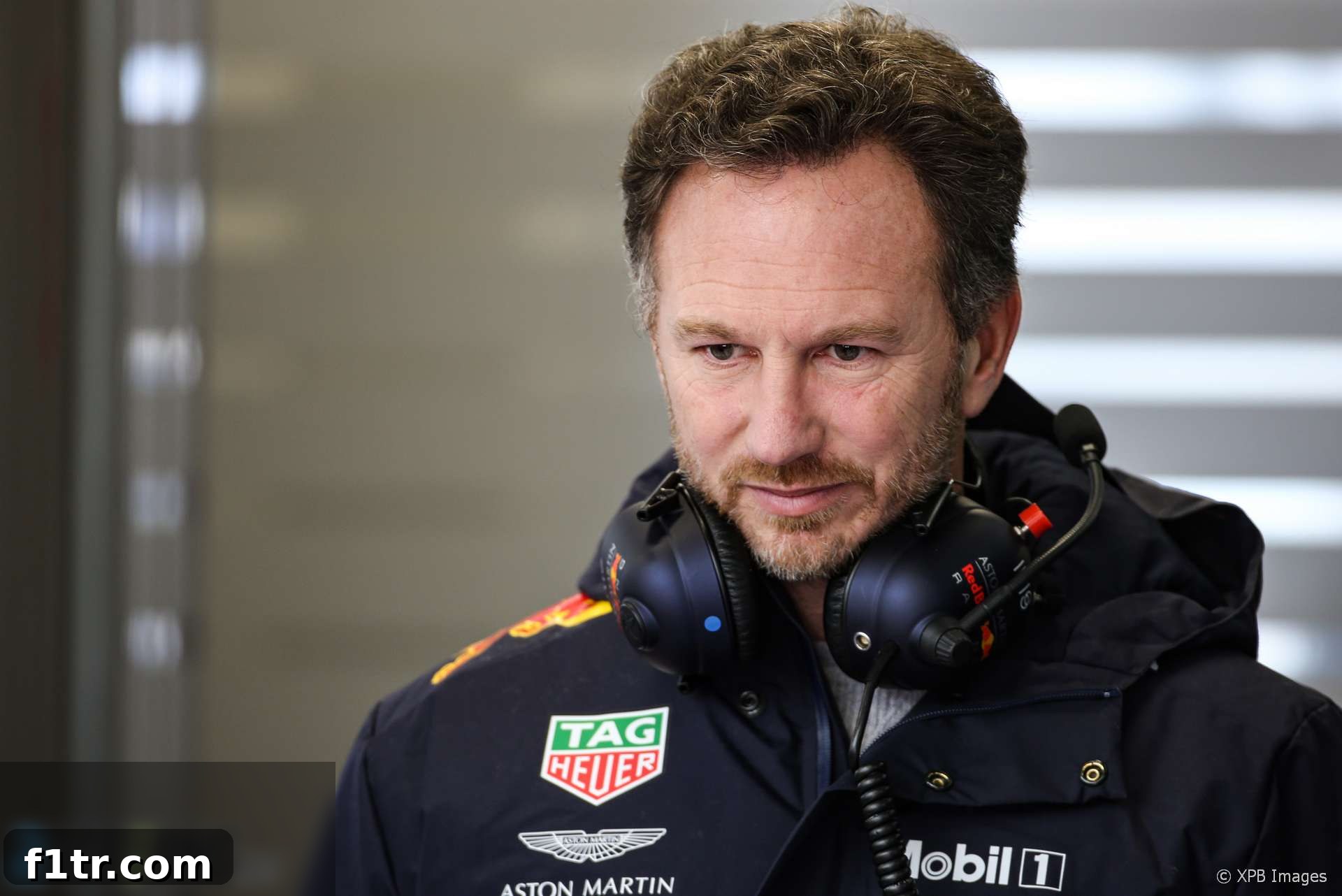
In the dynamic and often contentious world of Formula 1, discussions around cost-saving measures frequently spark debate among team principals and governing bodies. One such recent proposal by Formula 1 managing director Ross Brawn, suggesting that teams cease using their elaborate motorhomes at European race weekends to cut expenses, was met with swift dismissal by Red Bull team principal Christian Horner. This contentious point highlights the broader tension between F1’s drive for financial sustainability and the deeply ingrained culture and operational necessities of its elite teams.
Christian Horner Rejects Motorhome Ban for Cost-Saving
Speaking from the impressive ‘Holzhaus’ motorhome, a fixture at European Grands Prix and emblematic of Red Bull’s distinctive brand, Christian Horner articulated a firm stance against Brawn’s proposition. Horner underscored the vital role these hospitality units play, not merely as logistical bases but as integral components of a team’s identity and operational infrastructure during the European leg of the F1 calendar. He expressed a strong disinclination for teams to be relegated to “sub-standard facilities,” arguing that such a move would undermine the sport’s professional image and operational efficiency.
“Ross needs to have a look in his own Concorde Agreement because it doesn’t make any reference to that in their drafts. So I’m not quite sure what he was referring to there,” Horner stated, challenging the premise of Brawn’s suggestion by referencing the sport’s foundational governance document.
He continued, passionately defending the current setup: “But you know, this is very sustainable. It’s all out of wood. I think for the European races teams’ hospitality is their face, their home for those European races, it makes sense.” Horner’s defense emphasizes that these state-of-the-art motorhomes are not just lavish expenses but carefully constructed, environmentally conscious facilities that serve as a team’s crucial base of operations, media hub, and client entertainment space. They are, in essence, a tangible representation of their brand and professionalism.
Expanding on the broader cost implications for the sport, Horner elaborated on the need for clearer regulations and support concerning facilities, particularly at overseas events. “Obviously for the flyaway races we all survive. But I think what’s vital is that moving forward, we get charged a fortune for a tent and chairs and whatever else, that those costs are provided for by the promoter, so that when you turn up, you get a set amount of facilities, that we don’t end up buying tents at every grand prix wherever we go around the world.” This statement highlights a significant, often overlooked, financial burden faced by teams: the unpredictable and often exorbitant costs associated with securing basic infrastructure at non-European venues. Horner advocates for a standardized, promoter-provided solution to ensure a baseline level of facilities globally, which he argues would genuinely address cost inefficiencies more effectively than dismantling the well-established European motorhome system.
Quotes: Dieter Rencken
Horner’s comments illuminate a critical aspect of Formula 1 economics: the distinction between perceived luxury and operational necessity. While motorhomes may appear opulent, they represent significant, albeit mobile, investments that teams rely on for their extensive personnel, logistical needs, and corporate hospitality. The ‘Holzhaus’ itself, a multi-story, timber-constructed marvel, exemplifies a commitment to both functionality and brand identity. Red Bull and other major teams invest heavily in these structures because they offer unparalleled control over their operational environment, a level of comfort and privacy crucial for team members, and a professional setting for crucial meetings and media engagements. Dismantling this system for European races, without a viable, cost-effective alternative, could paradoxically lead to increased logistical challenges and unforeseen expenses, as teams would still require robust infrastructure for their extensive operations.
Furthermore, the argument extends beyond mere cost. The motorhomes are a fundamental part of the Formula 1 paddock experience, offering unique spaces for fan interaction, media interviews, and sponsor events. They are part of the spectacle, contributing to the sport’s premium image. The suggestion to eliminate them raises questions about the long-term vision for F1’s paddock culture and whether cost-saving measures might inadvertently dilute the sport’s appeal and operational efficiency in Europe. The core of Horner’s argument is that effective cost control should target genuine inefficiencies, such as the variable and often inflated costs of temporary facilities at flyaway races, rather than dismantling established, functional, and brand-defining assets.
Advert | Become a RaceFans supporter andgo ad-free
Formula 1’s Soaring Digital Presence on Social Media
The modern era of Formula 1 is not just defined by roaring engines and on-track battles; it’s increasingly shaped by its vibrant and expansive presence across various social media platforms. Engaging millions of fans worldwide, F1 has become a dominant force in the digital sphere, masterfully leveraging platforms like Twitter and Instagram to connect with its global audience. This strategic digital outreach provides fans with unprecedented access to the sport, from behind-the-scenes glimpses to real-time updates and exclusive content.
A testament to F1’s aggressive and successful digital strategy is its remarkable growth in Instagram followers. Data from early 2020 revealed a significant milestone for the sport:
Number of @instagram followers (19/03/2017)
3.81 million – @MotoGP
2.26 million – @F1Number of @instagram followers (23/02/2020)
8.83 million – @MotoGP
8.85 million – @F1 @F1 is now officially the most followed motor racing series on @Instagram.— Dave Nelson (@f1broadcasting) February 23, 2020
As highlighted by these figures, F1’s Instagram following surged from 2.26 million in March 2017 to an impressive 8.85 million by February 2020, surpassing even MotoGP to become the most followed motor racing series on the platform. This explosive growth underscores F1’s successful pivot towards a more digitally native and fan-centric content strategy, attracting a younger and more diverse audience globally.
Beyond statistics, social media serves as a dynamic channel for F1 to showcase its rich history, present thrilling race moments, and highlight the personalities of its drivers and teams. Fans engage with content ranging from historical highlights to current race drama, as illustrated by other notable posts from RaceFans:
…and incredibly, the very next day he lost another win due to a puncture while leading, which decided the title in Alders’ favour! pic.twitter.com/UU0EOvvCeR
— RaceFans (@racefansdotnet) February 23, 2020
Such posts exemplify how social media narratives can capture the drama and excitement inherent in motorsport, connecting fans with pivotal moments and discussions. The ability to instantly share news, analysis, and historical context makes platforms like Twitter invaluable for both official F1 channels and dedicated fan communities.
For enthusiasts eager to deepen their engagement, resources such as the F1 Twitter Directory provide a curated list of official F1 accounts, drivers, teams, and journalists to follow. This directory acts as a gateway for fans to immerse themselves further in the F1 ecosystem, ensuring they stay abreast of all developments and engage directly with the sport’s key figures. The continuous expansion and sophisticated use of social media demonstrate F1’s commitment to accessibility and fan interaction, solidifying its position as a global sporting phenomenon not just on track, but across all digital frontiers.
- Find more official F1 accounts to follow in the F1 Twitter Directory
Essential Motorsport News and Developments
Beyond the Formula 1 paddock, the world of motorsport continues to churn with significant news and developments across various racing series. Keeping abreast of these stories offers a broader perspective on the global racing landscape, from driver dynamics to championship battles and technological advancements. Here’s a brief roundup of other compelling motorsport links of interest:
Wary Ricciardo ready for combative Renault team mate (The Age)
This report delves into the intricate dynamics of intra-team rivalry, a perpetual talking point in competitive motorsport. Daniel Ricciardo, a driver known for his engaging personality but also his fierce on-track competitiveness, discussed the impending challenge of a new teammate at Renault. His reflections highlight the critical balance between individual ambition and collective team success, especially for a midfield team aiming to climb the constructors’ standings. Ricciardo’s past experiences with highly combative teammates like Sergio Perez and Max Verstappen have clearly shaped his perspective, emphasizing that for Renault, internal strife would be detrimental. “He’s had problems with Perez, problems with Max (Verstappen)… we, him and I, need to understand that we’re not fighting for wins yet, so for us to be tearing each other’s heads off is not the way we need to go about our business,” he reportedly noted. This sentiment underscores the strategic necessity for teammates to collaborate and push the team forward, rather than allowing their rivalry to derail progress.
Line-up for Marrakesh rookie test confirmed (FIA)
The confirmation of the line-up for the Marrakesh rookie test in Formula E represents an important step for the future of electric motorsport and the careers of aspiring drivers. Rookie tests are vital platforms for young talent to demonstrate their capabilities in cutting-edge machinery, attracting the attention of established teams. These events are not just about raw speed but also about understanding complex energy management systems unique to Formula E. The schedule for the test, following the 2020 Marrakesh EPrix on Sunday, March 1st, allows for intensive morning and afternoon sessions (10:00 to 13:00 and 14:00 to 17:00 respectively). For drivers hoping to secure a full-time seat in the innovative electric racing series, this test offers an invaluable opportunity to impress team principals and engineers, potentially paving their way into a rapidly evolving sector of motorsport.
Joey Alders crowned 2020 F3 Asian Champion in dramatic season finale (Asian F3)
The crowning of Joey Alders as the 2020 F3 Asian Champion after a dramatic season finale at the Buriram International Circuit in Thailand spotlights the crucial role of regional Formula 3 championships as stepping stones to higher echelons of motorsport, including Formula 1. These series are fiercely competitive proving grounds where young drivers hone their skills against international talent. The report highlights the “dramatic” nature of Alders’ victory, suggesting a hard-fought championship that went down to the wire. Such thrilling finales captivate audiences and are pivotal moments in a young driver’s career, often attracting the attention of scout programs and junior teams associated with Formula 1. Alders’ triumph not only secures him a prestigious title but also significantly elevates his profile, marking him as a talent to watch for future opportunities in open-wheel racing.
We always endeavour to credit original sources. If you have a tip for a link to feature in the next RaceFans round-up please send it in via the contact form.
Advert | Become a RaceFans supporter andgo ad-free
Fan Insights: The Russell-Latifi Dynamic at Williams
The Formula 1 community thrives on passionate discussion and informed opinions, and today’s featured comment from reader Adam offers a pertinent insight into the anticipated driver dynamic at Williams with George Russell and Nicholas Latifi. Fan observations often capture the nuances of intra-team battles and driver expectations, reflecting the complex psychology that underpins competitive motorsport.
“Being honest, I’ll be shocked if Latifi out-qualifies or beats Russell at any race. Latifi’s arguably got more to gain by beating Russell than Russell has of beating Latifi – everyone expects there to be little contest.” This initial assessment by Adam (@Rocketpanda) sets a clear benchmark for the rookie, Nicholas Latifi, suggesting that the established talent of George Russell will be a formidable challenge.
“So Russell ‘hyping’ Latifi up a little isn’t surprising. It’ll be interesting to see if Williams can close up to the field and fight other cars, rather than just each other.” Adam’s concluding thought touches upon the strategic and psychological aspects of team dynamics. When an experienced driver like Russell, who has already demonstrated immense potential despite challenging machinery, publicly ‘hyped’ his rookie teammate, it can be interpreted in several ways. It could be genuine encouragement, a way to build team morale, or perhaps a subtle tactic to manage external expectations. By setting a high bar for Latifi, Russell might be subtly reinforcing his own perceived superiority while also motivating his teammate to perform at his absolute best. For Williams, a team that has faced significant struggles in recent seasons, the focus should ideally shift from internal rivalries to competing effectively against other teams on the grid. The success of the team, and indeed both drivers, hinges on their ability to work collaboratively, extracting every ounce of performance from their car and leveraging their combined talent to climb out of the backmarker positions. The internal battle between Russell and Latifi will undoubtedly be a fascinating subplot, but the greater objective remains Williams’ resurgence as a competitive force in Formula 1.
Celebrating Milestones in the F1 Community
The vibrant Formula 1 community extends beyond the track, celebrating key moments and connections among its members. Today, we send our warmest wishes to Georgedaviesf1 on their birthday!
These personal touches foster a sense of belonging and camaraderie among F1 enthusiasts worldwide. If you’d like to receive a birthday shout-out and be part of this growing community, you can easily tell us when yours is via the contact form or by adding to the list here. It’s a small but meaningful way to acknowledge and celebrate the diverse global fanbase that makes Formula 1 so special.
On This Day in F1 History: Alain Prost’s Legacy
- Born today in 1955: Future four-times world champion Alain Prost
Today marks the birthday of one of Formula 1’s most iconic figures, Alain Prost. Born on this day in 1955, Prost would go on to carve out an indelible legacy as a four-time Formula 1 World Champion. Nicknamed “The Professor” for his cerebral approach to racing, strategic acumen, and smooth driving style, Prost was a master tactician who often prioritized preserving his car and tires, calculating his moves with precision.
His illustrious career spanned from 1980 to 1993, during which he competed for top teams like Renault, McLaren, Ferrari, and Williams. Prost’s rivalry with Ayrton Senna is legendary, widely considered one of the most intense and captivating in the history of sport. Their battles, both on and off the track, pushed the boundaries of competition and captivated millions worldwide. With 51 Grand Prix victories and four world titles (1985, 1986, 1989, 1993), Prost remains one of the most successful drivers in Formula 1 history. His influence extends beyond his racing achievements, shaping the sport with his analytical mind and dedication to perfection. His birthday serves as a moment to reflect on the enduring impact of a true Formula 1 legend.