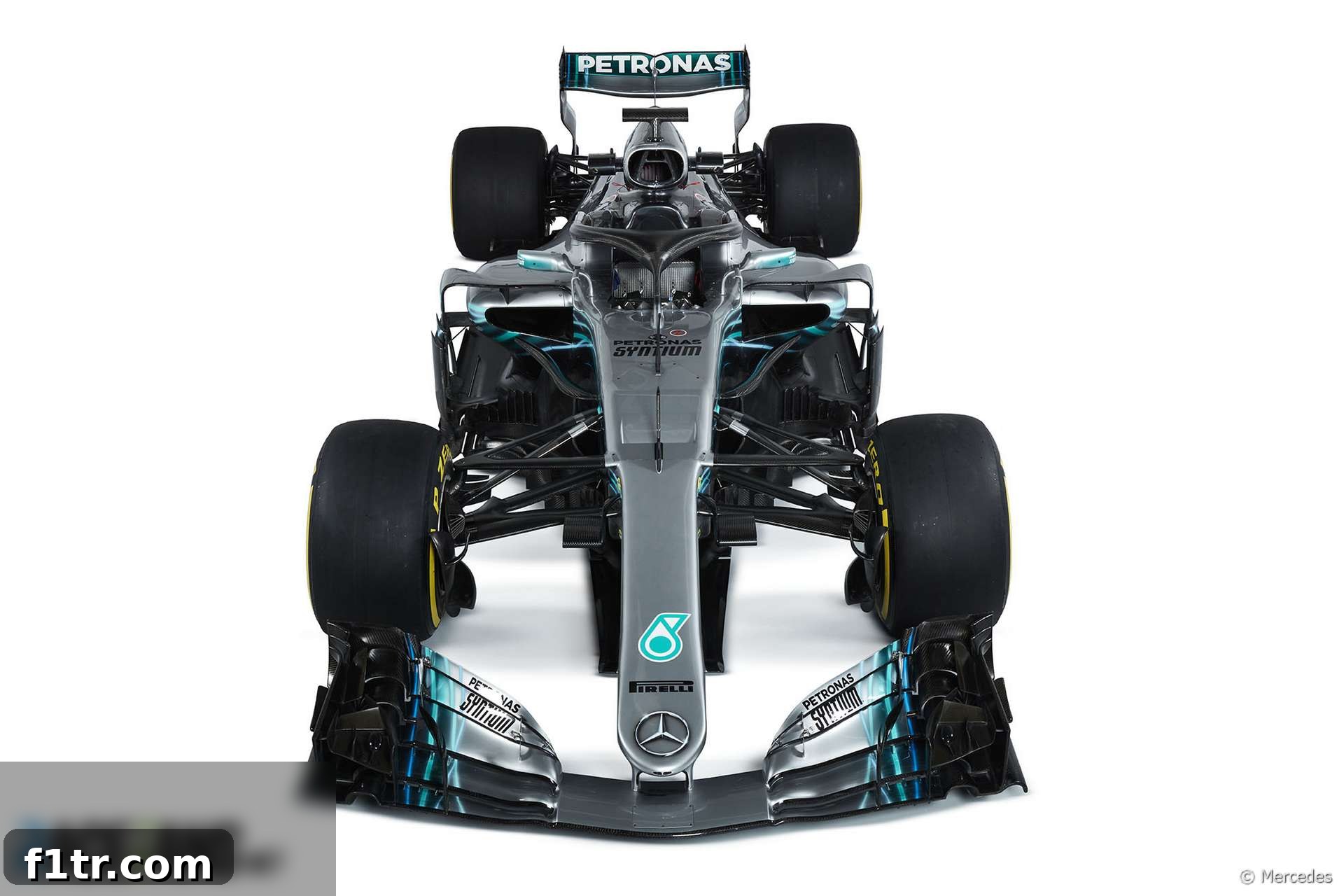
In the relentlessly competitive world of Formula 1, the adage “if it ain’t broke, don’t fix it” rarely applies, even to the most dominant teams. While such a philosophy might seem sensible for reigning champions, the reality of top-tier motorsport dictates a continuous pursuit of perfection. For Mercedes-AMG Petronas Motorsport, fresh off a triumphant 2017 season that saw them clinch both the Constructors’ and Drivers’ Championships, the challenge was clear: how do you evolve a winning formula without disrupting its core strengths? The answer lies in meticulous refinement rather than radical overhaul.
The 2017 season, though successful, presented Mercedes with a unique set of challenges compared to their unprecedented domination between 2014 and 2016. While securing an impressive 11 race victories and wrapping up both coveted championships with several weeks to spare, the W08 often proved to be a demanding and sometimes temperamental machine. Its “diva” characteristics, as famously described by the team, meant that extracting its full potential required a delicate balance, especially on certain circuit types. Therefore, the Mercedes-AMG Petronas Motorsport F1 W09 EQ Power+ – which for obvious reasons will simply be referred to as the Mercedes W09 – is clearly an evolution of its predecessor, designed to iron out those kinks and build upon a remarkably strong foundation.
The development philosophy behind the Mercedes W09 centers on optimizing every aspect of the W08, enhancing its strengths while mitigating its weaknesses. This iterative approach is crucial in Formula 1, where marginal gains accumulate to create significant performance advantages. The team, spearheaded by technical director James Allison, aimed to deliver a car that was not only faster but also more consistent and predictable for its drivers, Lewis Hamilton and Valtteri Bottas. Every component, from the front wing to the rear diffuser, has been meticulously reviewed and refined, demonstrating Mercedes’ unwavering commitment to innovation within the confines of the stringent FIA technical regulations.
Up front, one of the most visible areas of refinement on the Mercedes W09 is the nose cone and its surrounding aerodynamic furniture. Mercedes have further honed their distinctive “caped nose” concept, a design innovation first introduced with great success in Spain during the previous year’s championship battle. This unique approach replaces the more conventional hanging turning vanes that are commonly employed by most other teams on the grid. The cape serves a critical aerodynamic purpose: it helps to manage the turbulent airflow generated by the front wheels and channel it efficiently underneath the car and towards the intricate bargeboard area. By guiding this airflow effectively, the cape contributes significantly to overall downforce generation and stability.
While the aerodynamic benefits of the caped nose are substantial, it naturally adds a certain amount of structural weight. To counteract this, Mercedes engineers have skillfully tapered the nose section more aggressively towards the front bulkhead. This intelligent design choice reduces the volume of material required, thereby minimizing the weight penalty associated with the cape’s structure without compromising its integrity or aerodynamic function. Furthermore, the transition between the nose and the main bulkhead of the chassis has been meticulously softened. This has been achieved by extruding the suspension clevises in a fashion reminiscent of designs seen on rival cars, notably those from Red Bull Racing. This subtle modification not only contributes to a cleaner aerodynamic profile but also enhances the structural integration of the front suspension components, ensuring optimal performance and reliability under extreme loads.
Continuing the theme of evolutionary refinement, the team has wisely retained its signature high upper wishbone suspension configuration at the front, a design concept that proved so effective on the W08. This innovative setup, which positions the upper wishbone higher than is traditionally seen, provides distinct advantages in managing tire contact patch and optimizing aerodynamic flow around the front suspension elements. Its success has not gone unnoticed by competitors, with this configuration being widely copied by various other teams across the grid in the intervening period, underscoring Mercedes’ role as an F1 design trendsetter. Recognizing its benefits, Mercedes has now applied this same advanced thinking to the rear suspension of the W09. The upper wishbone at the rear features a notably higher pickup point at the upright compared to its predecessor. This specific adjustment is also part of a broader trend observed elsewhere in the Formula 1 field, as teams strive to fine-tune the kinematic properties of their suspension systems for improved performance.
Advert | Become a RaceFans supporter andgo ad-free
Initial glimpses of the W09, particularly the engine fire-up video released by Mercedes, offered intriguing clues about the car’s internal architecture. It indicated that the central exhaust exit had been ingeniously bridged to accommodate some underlying component. We can now confirm that this modification was specifically made to clear the higher inboard mounting point for the upper wishbone at the rear. On first impression, one might assume the primary reason for such a complex structural change would be purely aerodynamic, a common driver for F1 design. However, a deeper analysis suggests that while aerodynamics are always a consideration, this may not be the sole, or even primary, motivator for this particular alteration.
It is well-documented that the W08, despite its championship-winning prowess, was sometimes challenging to optimize, particularly on low-grip circuits such as street tracks or venues with low surface roughness. These specific conditions often exacerbated its “diva” tendencies, making it harder for the drivers to consistently extract peak performance from the tires. According to James Allison, Mercedes’ Technical Director, the wheelbase on the W09 remains exactly the same as its predecessor. This decision was deliberately made because, across the entire 2017 season, the W08’s longer wheelbase proved advantageous from an aerodynamic perspective, allowing for a more stable platform for airflow management and downforce generation, despite its handling quirks. This consistency in wheelbase length indicates a strategic focus on resolving handling issues through other means rather than redesigning the fundamental dimensions of the car.
Given the wheelbase remains unchanged, it is highly reasonable to assume that the significant alteration to the rear suspension geometry, specifically the repositioning of the upper wishbone, is primarily designed to address the W08’s known handling problems. The lower wishbone appears to maintain a similar geometry and stature to that on last year’s car. Consequently, the strategic raising of the upper wishbone’s pickup point effectively raises the rear roll center of the car. The roll center is a critical kinematic point that dictates how the car rolls in response to cornering forces. By elevating the rear roll center, the W09 is engineered to exhibit less body roll at the rear during cornering. This reduction in roll creates a more stable platform, which in turn allows for greater and more consistent energy transfer through the tires into the track surface. The ultimate aim of this sophisticated suspension tuning is to help the Pirelli tires remain within their optimal operating window more effectively than before, particularly in challenging, low-grip conditions. Maintaining tires in their ideal temperature and performance range is paramount in modern Formula 1, directly impacting grip, longevity, and ultimately, lap time.
Moving along the mid-section of the car, the bargeboards on the W09 represent a striking aesthetic and functional improvement. Towards the end of the 2017 season, the W08’s bargeboard area had evolved into a complex, almost patchwork arrangement of carbon fiber elements, reflecting the frantic pace of aerodynamic development throughout the year. For the W09, this area has been reimagined into a much tidier, more integrated version. Indeed, it is arguably this specific region of the car that showcases the most intricate and beautifully finished aerodynamic work. Mercedes engineers have not only refined their core design principles, including the distinctive “horns” that attach to the main chassis tub, but they have also subtly introduced a few clever ideas gleaned from other successful cars on the grid. A notable example is the incorporation of a “fluted footplate,” a design element that aids in managing airflow more effectively around the lower edge of the bargeboards, enhancing their overall performance in conditioning the airflow for the underfloor and diffuser.
The sidepod inlets on the Mercedes W09 are noticeably narrower than those on its predecessor. This reduction in size suggests improved cooling efficiency or a more compact internal component layout, allowing for a tighter overall bodywork package. These narrower inlets form the basis of the trailing bodywork, which now hugs the car significantly more tightly and elegantly than last year’s somewhat more hunched design. This sleeker, more sculpted bodywork serves a critical aerodynamic function: it helps to guide the turbulent airflow generated further upstream, channeling it smoothly over the floor below, through various other intricate aero devices strategically placed along the car’s flanks, and ultimately onto the top surface of the diffuser at the very back of the car. This precise management of airflow is vital for maximizing the efficiency of the diffuser, which is responsible for generating a substantial portion of the car’s overall downforce.
At the back of the Mercedes W09, a few subtle yet significant changes have been implemented to comply with evolving regulations and optimize performance. The single rear wing support, which on the W08 controversially breached the central exhaust pipe, has been redesigned. The team has reverted to an inverted Y-shaped pillar. This clever design now wraps neatly around the exhaust exit, attaching securely to the rear crash structure without obstructing the exhaust flow or incurring any regulatory penalties. This change reflects Mercedes’ commitment to clean design and adherence to technical directives. Furthermore, over the winter break, the FIA clamped down on the use of complex “monkey seat” winglets, which were previously used by teams to exploit exhaust gases for additional downforce. In response to these revised regulations, the W09 features a minimalist, single-element monkey seat design, perched delicately on the rear wing support. Its primary function is now limited to subtly influencing the exhaust plume, ensuring it integrates harmoniously with the wider aerodynamic structures without generating direct downforce from the exhaust itself.
The Mercedes W09 represents a masterful execution of evolutionary design in Formula 1. It embodies the lessons learned from a challenging yet victorious 2017 campaign, addressing the W08’s temperamental nature while building on its inherent speed. With key refinements in nose aerodynamics, sophisticated suspension geometry, optimized airflow management around the mid-section, and intelligent adaptation to regulatory changes at the rear, the W09 is poised to be another formidable contender. It’s a testament to Mercedes-AMG Petronas Motorsport’s continuous drive for innovation, ensuring they stay at the forefront of Formula 1 technology and maintain their championship-winning form.
Go ad-free for just £1 per month>> Find out more and sign up
F1 technology
- McLaren, Red Bull and Ferrari bring rear corner updates to Imola
- Ferrari, McLaren and Red Bull bring upgrades again for Saudi Arabian Grand Prix
- McLaren introduce major floor upgrade for Norris’ car at Mexican Grand Prix
- McLaren, Mercedes and Red Bull detail upgrade packages for United States GP
- Red Bull remove engine cover ‘cannons’ in major RB20 update – but they may return
Browse all F1 technology articles