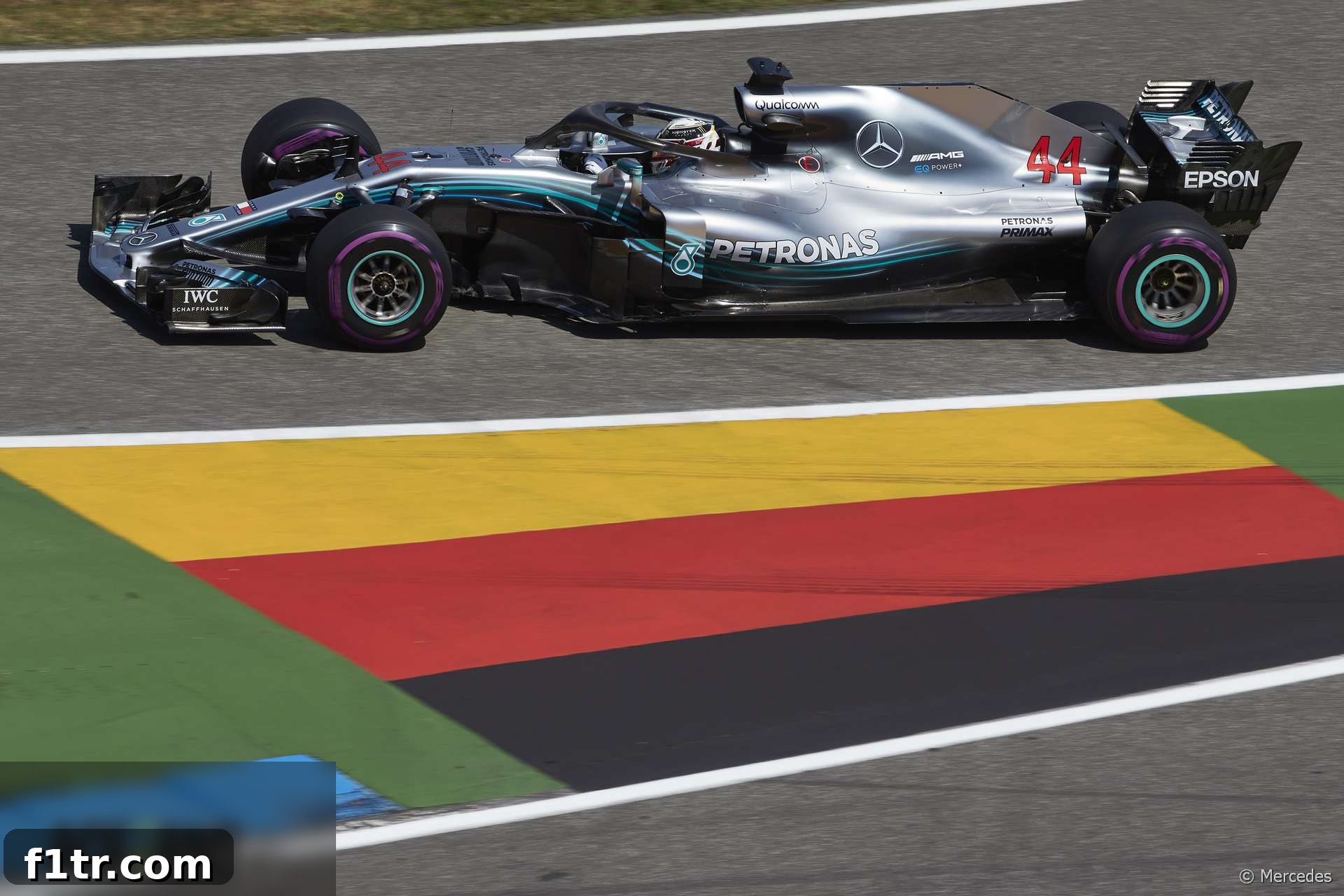
Lewis Hamilton’s Pit Lane Reprimand: A Controversial Victory at the 2018 German Grand Prix
The 2018 Formula 1 German Grand Prix provided an exhilarating race, but it was a specific incident involving Lewis Hamilton that sparked considerable debate. A crucial decision made under Safety Car conditions led to a pit lane entry violation, prompting questions about the fairness of F1 stewarding and the interpretation of regulations. Despite committing a clear breach of the rules, the Mercedes driver ultimately received only a reprimand – the most lenient penalty available – allowing him to maintain his hard-fought victory. This outcome ignited discussions among fellow drivers, pundits, and fans, highlighting the complexities of applying strict rules in the high-stakes, split-second environment of Formula 1 racing.
Advert | Become a Supporter & go ad-free
The Incident: Aborting a Pit Stop Under Pressure
The pivotal moment occurred when the Safety Car was deployed during the German Grand Prix. Race leader Lewis Hamilton, advised by his team, initially committed to entering the pit lane for a tire change. However, in a matter of milliseconds, he made a snap decision to abort the pit stop, swerving across the pit lane entry line and rejoining the main track. This maneuver, while preventing a potentially problematic pit stop, was a clear transgression of the FIA Sporting Regulations which mandate strict adherence to pit lane entry procedures. The rules are designed to ensure driver safety and prevent any unfair advantage. Had the stewards imposed a more severe penalty, such as a five-second time penalty typically given for such infractions, Hamilton would have been relegated to second place or lower, losing a victory that was crucial for his championship campaign that year.
Rival Perspectives: Sympathy, Precedent, and Fairness
Daniel Ricciardo: Acknowledging the Breach, Defending the Win
Red Bull Racing driver Daniel Ricciardo, who unfortunately retired from the race, offered a balanced perspective on Hamilton’s penalty. While acknowledging the technical breach, he believed that stripping Hamilton of his victory for the error would have been “harsh.” Ricciardo differentiated between deliberate breaches and momentary indecision under extreme pressure. He noted that strict rules are in place for entering the pit lane after a certain bollard, implying that a direct, strategic breach is often a “black or white” matter. However, Hamilton’s action of avoiding the pit entry, in Ricciardo’s view, did not significantly compromise safety or fundamentally alter the competitive landscape in a way that warranted such a drastic consequence. He praised Hamilton’s exceptional drive to recover from his starting position, suggesting that the overall sporting merit of the win should be considered. Ricciardo stated, “The way I see it, he did a good race to come from where he did. It should be black or white so I’m not saying the circumstance should’ve affected the decision. But it seemed fine, he still deserved the win. If they would have taken the win from him for that maybe that’s a bit harsh.” His comments underscored the ongoing debate between rigid rule enforcement and the spirit of fair competition.
Sergio Perez: Supporting the Stewards’ Decision
Force India’s Sergio Perez concurred with the decision to issue a reprimand, deeming it “correct.” Perez emphasized several mitigating factors that likely influenced the stewards’ judgment. He highlighted that the incident occurred under Safety Car conditions, meaning speeds were reduced, thereby minimizing the immediate danger. Crucially, Perez noted that Hamilton “rejoined safely,” indicating that the maneuver did not create an unsafe situation for other competitors. His perspective sheds light on the nuanced approach stewards often take, considering not just the letter of the law but also the context, intent, and immediate impact of a driver’s actions. The stewards’ role involves a delicate balance of maintaining discipline, ensuring safety, and preserving the integrity of the race without unduly punishing minor infringements that do not result in a significant competitive advantage or endanger others. Perez concluded, “I think the stewards looked at it carefully and decided to give a reprimand which I’m not against. I think the stewards took the decision right.”
Max Verstappen: A Call for Consistency and Precedent
Max Verstappen, Ricciardo’s teammate at Red Bull, acknowledged the “very confusing” nature of the situation from Hamilton’s perspective. While not explicitly criticizing the reprimand, Verstappen’s primary concern revolved around the importance of setting a clear and consistent precedent for future incidents. He noted that while the rules clearly prohibit such actions, the decision to issue a reprimand in this instance could influence how similar situations are judged moving forward. Verstappen stressed the need for stewards to apply the rules strictly and uniformly across all teams and drivers to ensure fairness. “In the rules it says it’s not allowed, this time they gave him a reprimand. I guess for the future for every team it makes it a bit more clear maybe you get a reprimand if it’s such a confusing thing. I hope they just are very strict on it for other teams as well,” Verstappen remarked. His comments underscore a persistent frustration within the F1 paddock regarding perceived inconsistencies in stewarding decisions, which can lead to confusion and dissatisfaction among competitors.
Lewis Hamilton’s Perspective: Learning from Split-Second Decisions
Lewis Hamilton himself candidly reflected on the incident, seeing it as a valuable learning experience despite the victory. He admitted to an internal struggle and indecision regarding the pit stop, explaining that his initial instinct was to remain on track, but was swayed by team communication. This moment of hesitation, he explained, was the direct cause of the pit lane violation. Hamilton emphasized the immense pressure involved in making critical, split-second decisions during a Safety Car period and the need for enhanced communication and clearer protocols within the Mercedes team to avoid similar scenarios in the future. “If I could go back I would have stuck to what I felt, which was to stay out, so I wouldn’t have been in that scenario,” Hamilton stated. “So that’s an area that we need to work on because we’re always dealing with split-second decisions. There wasn’t a long time for the team to make a decision. But if we had time to discuss, we would have come to the conclusion that I would have stayed out because that’s what I felt was right at the time. My tyres felt good.” His honest assessment provides a rare glimpse into the mental fortitude required of F1 drivers and the intricate interplay between driver instinct and team strategy during crucial race moments.
F1 Regulations and Stewarding: The Delicate Balance
The incident at the German Grand Prix highlights the complex challenges faced by F1 stewards in interpreting and applying the sport’s regulations. The FIA Sporting Regulations are exhaustive, with specific rules governing every aspect of a race, including pit lane entries. Rule 28.3, for example, typically states that “Drivers must use the pit entry and pit exit at all times and must not cross the white lines delimiting the entry and exit,” making Hamilton’s action a clear technical breach. However, stewards are not merely robotic enforcers of the rulebook. They are empowered to consider the specific context, including factors such as the safety implications, the intent of the driver, and any competitive advantage gained. A reprimand, while the most lenient penalty, is still a formal disciplinary action that contributes to a driver’s penalty points, with accumulating three reprimands potentially leading to a grid penalty. In Hamilton’s case, the absence of immediate danger, the chaotic nature of the aborted pit stop under Safety Car conditions, and the lack of a clear, deliberate competitive advantage likely swayed the stewards towards a less punitive outcome, prioritizing the race result in the absence of a severe safety breach.
Advert | Become a RaceFans supporter andgo ad-free
Broader Implications: Consistency, Fairness, and the Championship Battle
The German Grand Prix pit lane controversy ultimately became a significant talking point in the 2018 Formula 1 season. While many acknowledged the technical breach, the decision to issue a reprimand rather than a time penalty was largely seen as a pragmatic approach by the stewards, who likely considered the overall context and the minimal impact on safety. However, such decisions inevitably fuel the ongoing debate about consistency in F1 stewarding and whether star drivers might sometimes receive more favorable treatment. Verstappen’s call for strict and uniform application of rules across the board encapsulates a genuine concern within the paddock. For a sport that prides itself on precision and strict adherence to regulations, perceived inconsistencies can undermine confidence in the officiating process. In the end, Hamilton retained a crucial victory that significantly bolstered his championship campaign, but the incident served as a potent reminder of the fine line between technical infringements and actions deemed worthy of race-altering penalties. It highlighted that while the rulebook aims for “black or white” clarity, its application often operates within a nuanced grey area, shaped by the subjective judgment of the stewards and the unique, high-pressure context of each race weekend.
2018 F1 season
The 2018 Formula 1 season was a memorable one, filled with intense battles and strategic plays. Relive more moments and insights from that exciting year:
- F1 feared “death knell” for Drive to Survive after Ferrari and Mercedes snub
- McLaren staff told us we were “totally crazy” to take Honda engines in 2018 – Tost
- ‘It doesn’t matter if we start last’: How Red Bull’s junior team aided Honda’s leap forward
- Honda’s jet division helped F1 engineers solve power unit problem
- McLaren Racing losses rise after Honda split
Browse all 2018 F1 season articles