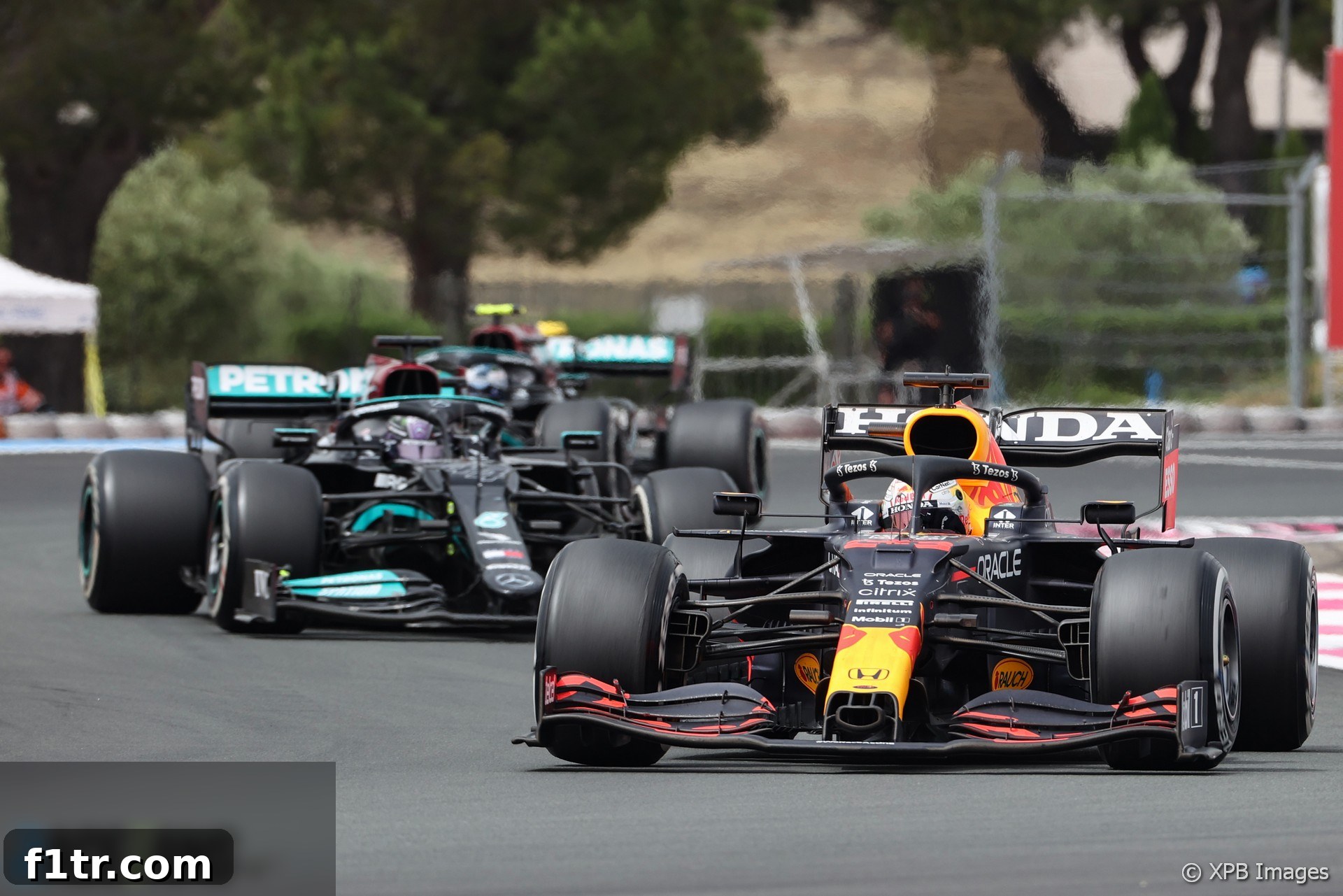
Red Bull Racing’s formidable straight-line speed proved to be a decisive factor, propelling Max Verstappen to his third victory of the season at the French Grand Prix. This performance has set the stage for a thrilling challenge as the Austrian-owned team aims for a triumphant double-header on their home turf, commencing this weekend at the Red Bull Ring. As Formula 1 prepares for two consecutive races in Austria, starting with the Styrian Grand Prix, several key narratives are unfolding that promise intense competition and strategic battles.
The Red Bull Ring Showdown: Mercedes vs. Red Bull
Following three consecutive victories for Red Bull in Monaco, Azerbaijan, and most recently, the French Grand Prix, it is no longer mere Brackley hyperbole to assert that the RB16B is the car to beat in Formula 1. Mercedes’ latest defeat left them visibly stunned, highlighting a significant shortcoming: a noticeable straight-line speed deficit compared to the Honda-powered Red Bull machine. This became particularly evident after the implementation of stringent new tests designed to curb the ‘flexi-wings’ that had garnered attention in previous rounds.
In response to these regulations, Red Bull strategically opted for a trimmed-out setup in France, maximizing their top-end speed. The Red Bull Ring, with its three distinct long straights, presents an ideal opportunity for them to replicate and even amplify this advantage. Mercedes, which had chosen not to sacrifice downforce in the previous race, may find themselves with no alternative but to adopt a similar low-drag configuration this weekend. The tactical decisions made by both teams regarding car setup will be paramount, as they grapple with balancing outright speed against aerodynamic stability and tyre wear on a circuit that demands both. The championship battle is heating up, and every strategic nuance could be the difference between victory and defeat in this high-stakes contest.
Ferrari’s Midfield Ambition: Reclaiming Supremacy
Ferrari’s impressive pace at Monaco and Baku, while securing back-to-back pole positions, did not necessarily reflect their true position in the pecking order, as the team itself was keen to emphasize at the time. The expectation was that their street circuit prowess would not translate seamlessly to conventional tracks. However, the dramatic slump at Paul Ricard, where both Charles Leclerc and Carlos Sainz Jnr finished outside the points, underscored the volatility of their performance this season. It highlighted the challenges they face in maintaining consistent competitiveness across diverse circuit types.
In stark contrast, McLaren, who had appeared to struggle significantly during Friday’s practice sessions and even in qualifying at the French Grand Prix, executed a remarkable recovery to confidently claim the title of ‘best of the rest’ in the race, securing fifth and sixth place finishes. This exceptional turnaround from McLaren bewildered many within the paddock, including Guillaume Dezoteux, AlphaTauri’s head of vehicle performance.
Dezoteux admitted his surprise at Ferrari’s performance drop-off: “Ferrari looked strong on Friday, especially on the long-run pace. They also looked pretty strong in quali – OK, Carlos was faster than us, but Leclerc was slower. So we felt in the short run we were a very similar pace. But in the long run we thought they would go faster than that.” He continued, drawing a direct comparison to their rivals: “And the McLaren is the opposite. Actually, we were slightly faster than them in the short run and we were expecting a bit less from them in the long run. I think what we’ve seen is a ranking of how good people have been at managing the tyres and how severe the cars are on the tyres, because obviously you have limited possibilities in adapting just for the race, your tyre management strategies. So McLaren have done a better job, as simple as that.”
The crucial question remains: will we witness a similar scenario unfold this weekend at the Red Bull Ring? Prior to the French Grand Prix, Ferrari harbored hopes that cooler temperatures would favor their car. However, this expectation did not materialize, which unfortunately bodes poorly for their prospects in Austria. The Styrian Grand Prix is predicted to be overcast, and Pirelli is supplying the exact same tyre selection as at Paul Ricard, notably without the softest C5 compound that Ferrari had previously leveraged to their advantage on other tracks. This combination of factors could once again put immense pressure on Ferrari’s tyre management strategies and overall race performance, making their quest for midfield leadership all the more challenging.
Navigating the Aggressive Kerbs of the Red Bull Ring
The issue of track limits and the impact of kerbs gained prominence at the French Grand Prix. Following Friday’s practice sessions, both Mercedes and Red Bull raised significant concerns regarding the severity and potential damage caused by the kerbs situated beyond the white lines at Turn 2. Despite these concerns being voiced by leading teams, Race Director Michael Masi, after a thorough examination, decided to keep the kerbs in place, citing consistency and the need for physical track limits.
Masi elaborated on his decision after the grand prix, emphasizing that the kerbs had remained unchanged since F1 last raced at Paul Ricard in 2019. “They were over two metres from the edge of the track,” Masi explained, “so you had to be completely off the track to actually come in contact with them. And probably most importantly, yes, they were reviewed on Friday night, so following the discussion at the drivers meeting, I could physically go down to Turn 2 and have a look at everything, and I did satisfy myself that everything was quite correct.”
Masi remained steadfast in his conviction regarding the necessity of imposing physical track limits at the circuit’s boundaries. He highlighted a consistent demand from both team principals and drivers throughout the season: “As we’ve heard on a number of occasions, particularly this year, both from team principals and drivers, they want physical limits and there was very clearly a physical limit.” The Red Bull Ring is renowned for its even more aggressive kerbing than Paul Ricard, which could re-ignite teams’ ongoing love-hate relationship with hard track limits. Drivers often push the boundaries, using every inch of the track, but harsh kerbs can inflict significant damage to cars, impacting race performance and reliability. However, based on Masi’s previous stance and his observation that “there were no issues at all” during Sunday’s race in France, it is unlikely that race control will compromise on this aspect, challenging drivers to maintain precision within the defined track limits.
Williams’ Resurgence: A Step Forward
The French Grand Prix marked a significant turning point for Williams, delivering what George Russell enthusiastically described as “our best race we’ve ever had together.” Finishing an impressive 12th, ahead of a Ferrari, an Alpine, and an AlphaTauri, demonstrated a tangible step forward for the Grove-based outfit. The team’s protracted struggle over several challenging seasons has been well-documented, and they continue their arduous quest for their first championship point since 2019. However, Russell was quick to emphasize that their stellar performance at Paul Ricard was not a stroke of luck or fortuitous circumstance.
“We were there on merit,” he asserted, “the car was good, we made that strategy work, really well managed.” This statement highlights the team’s growing confidence in their car’s capabilities and their strategic execution. Russell’s 12th place finish was particularly significant, as it allowed Williams to reclaim ninth position in the constructors’ championship from Haas. While Haas had technically finished ahead in a few earlier races due to attrition, the French Grand Prix showcased Williams’ genuine on-track progress. If the Styrian Grand Prix proves to be another complex race characterized by challenging tyre management, similar to the French Grand Prix, Williams may finally seize a golden opportunity to break their prolonged points drought. The team is clearly on an upward trajectory, and securing a championship point would be a massive morale booster and a testament to their relentless efforts.
Intra-Team Battles: Navigating Team Mate Dynamics
Team mate dynamics, often a source of both collaboration and fierce rivalry, frequently add an extra layer of intrigue to Formula 1 races. Last year’s season-opening race in Austria saw an unfortunate collision between then-Ferrari team mates Charles Leclerc and Sebastian Vettel, a stark reminder of how close battles can turn sour. This season, several other teams have experienced their share of near-misses and tense moments between their drivers, underscoring the relentless pressure of competition.
At McLaren, Lando Norris and Daniel Ricciardo have, for the most part, maintained a respectful and cooperative relationship since becoming team mates. This was exemplified when Ricciardo graciously allowed Norris to pass him at Imola earlier in the season. However, the cordiality appeared to be tested at the French Grand Prix when Ricciardo controversially forced Norris wide during an overtaking maneuver. The younger driver was visibly unimpressed by his team mate’s aggressive tactic, signaling that even the most harmonious partnerships can face moments of friction when battling for track position and points.
Much more dramatically, the team mate situation between Haas drivers Nikita Mazepin and Mick Schumacher appears to be steadily deteriorating. Following an alarming near-miss incident between the pair at Baku, they once again found themselves embroiled in a contentious on-track battle at the French Grand Prix. Schumacher made it clear he was no more complimentary about his team mate’s actions than he had been after the previous round, publicly expressing his frustration.
Haas team principal Günther Steiner, renowned for his straightforward approach, indicated that his patience with such antics is rapidly wearing thin. He addressed the situation with a pointed warning: “At the moment, where we are as a team, with the car we have got, the only opponent they can fight with is their team mate.” He then laid down a clear “rule of engagement”: “Don’t do this stuff. There is no other rule.” This stern admonition underscores the team’s current position and the imperative for drivers to prioritize team cohesion and avoid unnecessary incidents, especially when competing at the back of the grid. These internal battles, while captivating for spectators, can have significant repercussions for team morale and championship aspirations.
Engage with the Styrian Grand Prix
If you’re making the journey to Austria for this thrilling weekend of racing, we genuinely want to hear from you. Share your experiences, expectations, and insights:
- Forum: Going to the Styrian Grand Prix at Red Bull Ring
Who do you believe will emerge as the dominant force in the Styrian Grand Prix? Cast your vote and share your predictions below.
And remember to submit your predictions for this weekend’s race in the official championship. You have the flexibility to edit your predictions right up until the start of qualifying:
- RaceFans Predictions Championship
2021 Styrian Grand Prix
- Sainz praises Ferrari “teamwork” with Mercedes after unlapping himself from Hamilton
- W Series boss says it will not become a “billionaire girls’ club”
- Mercedes has more than just aerodynamic upgrades coming for 2021 car
- Alonso: F1 rule to ‘improve the show’ helps the big teams
- Is stamping out ‘burn-out’ celebrations a killjoy over-reaction?
Browse all 2021 Styrian Grand Prix articles