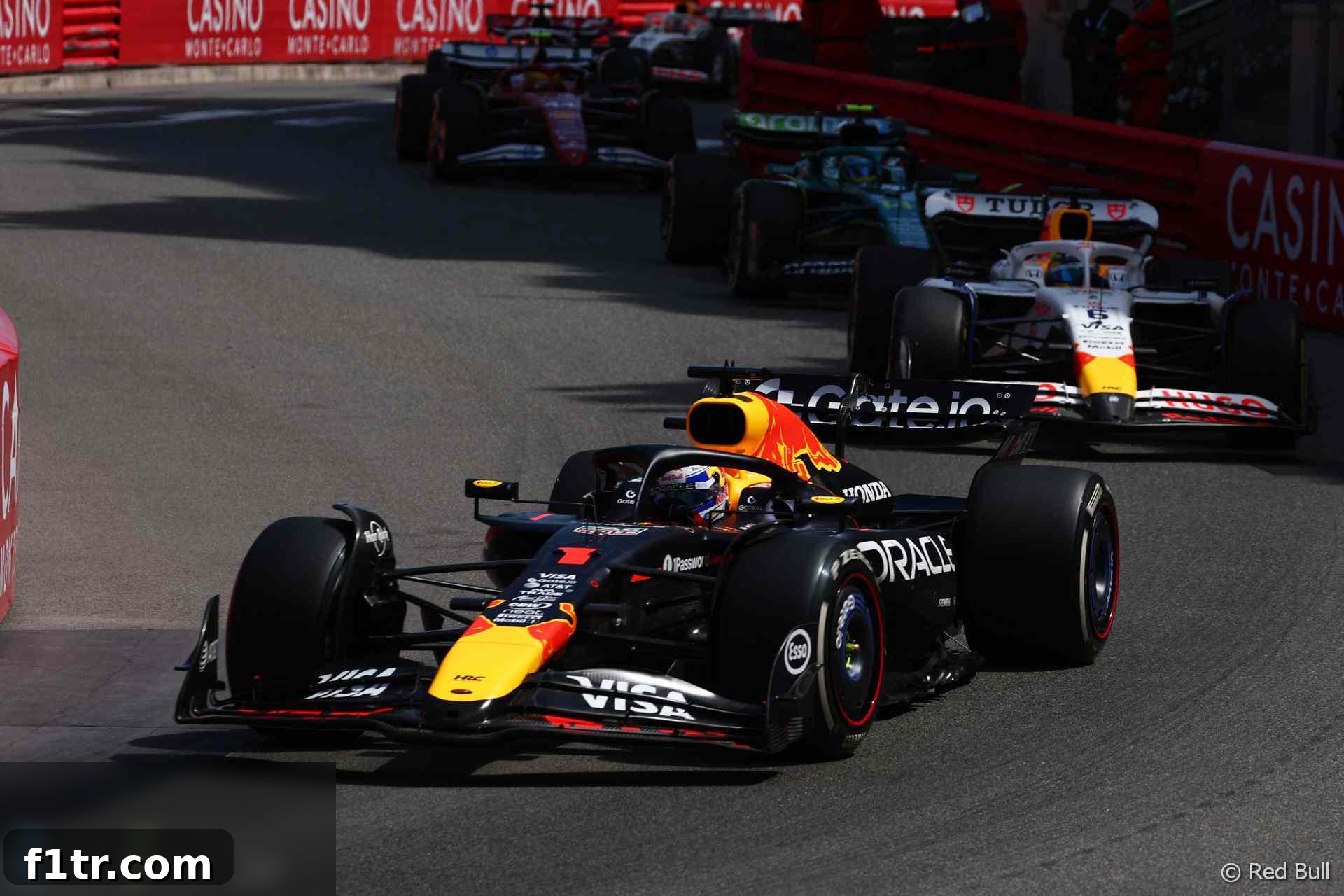
Monaco Grand Prix: Verstappen’s ‘Four-Stop’ Theory Unveils Strategic Frustrations Amidst Calls for Radical Change
The iconic streets of Monte Carlo once again hosted the Monaco Grand Prix, an event long celebrated for its unparalleled glamour, rich history, and the formidable challenge it presents to the world’s elite racing drivers. However, this year’s race ignited a fervent debate among drivers and motorsport enthusiasts alike, not just for its unique demands but for its seemingly stagnant strategic landscape. The tactical limitations were so pronounced that reigning world champion Max Verstappen candidly remarked that he could have pitted twice more during the race and still finished in the exact same position – a potent indictment of the competitive nature, or lack thereof, on the legendary circuit.
In an effort to inject more strategic variance and excitement into a race often criticized for becoming a high-speed procession, Formula 1’s governing body had introduced a new regulation for the Monaco Grand Prix, mandating drivers to execute a minimum of two tyre changes. While this rule aimed to foster dynamic tactical decisions, Verstappen’s experience highlighted an unintended consequence, or perhaps merely reinforced, the track’s inherent resistance to genuine on-track battles and significant strategic shifts.
The Bold Gamble: Verstappen’s Late Pit Stop Strategy and its Implications
Verstappen’s race strategy was a testament to the unique pressures and speculative possibilities that only Monaco can present. He embarked on a high-stakes gamble, controversially delaying his second compulsory pit stop until the very last possible moment, specifically at the close of the penultimate lap. This audacious tactical move was conceived to exploit a specific, albeit unlikely, loophole within the race regulations: had a red flag been deployed during the final stages of the race, Verstappen could have, in theory, completed his mandatory final tyre change without incurring the typical time penalty of a physical pit stop, potentially securing an improbable victory.
While this speculative scenario ultimately did not materialize, his delayed pit stop still saw him drop to fourth place. Yet, even with this strategic deferral, the Red Bull driver crossed the finish line a significant half-minute ahead of Lewis Hamilton, who finished fifth. This considerable gap between positions underscored a peculiar paradox of Monaco: while a typical pit stop on the narrow, winding circuit costs approximately 19 seconds, the almost insurmountable difficulty for rivals to make meaningful overtakes meant that time lost in the pits could often be easily maintained or, more accurately, not genuinely threatened by direct on-track competition.
Reflecting on the race, Verstappen articulated his frustrations with characteristic bluntness and honesty. He even ventured an even more extreme hypothetical, suggesting that he could have theoretically embraced a four-stop strategy and still concluded the race in the same fourth position. “It was quite boring,” Verstappen told Viaplay, summarizing the sentiment of many. “I mean, I could have done four stops, I would have still finished in the same position. So that’s probably not what you want around here. But it’s, of course, also not nothing new.” This pervasive sentiment deeply resonates with numerous F1 observers and highlights the fundamental struggle the sport faces in making the Monaco Grand Prix a consistently compelling race day spectacle, despite its immense prestige.
The Overtaking Conundrum: A Processional Affair on the Streets of Monte Carlo
Verstappen’s prolonged second stint saw him being progressively caught by the chasing pack, which included fierce competitors such as Lando Norris, Charles Leclerc, and Oscar Piastri. However, despite their closing proximity, the Red Bull ace harbored no genuine concern about being overtaken. The notorious difficulty of executing a pass on the tight and unforgiving streets of Monaco is legendary, effectively rendering even significant pace advantages largely irrelevant. Drivers inherently understand that once track position is established, it becomes almost impossible to dislodge a rival unless they commit a costly error or suffer a debilitating mechanical failure.
“At the end of the day, you saw even with my pace, they couldn’t pass me,” Verstappen further elaborated, his words echoing the widespread frustrations felt across the grid. To emphasize the severity of the challenge, he went on to draw a striking comparison: “So you need to be, like, 10 seconds off. An F1 car can maybe pass an F2 car around here, that’s how bad it is.” This powerful comparison vividly illustrates the unique, and often exasperating, characteristics of the Monaco circuit when confronted with the immense size and aerodynamic complexity of contemporary Formula 1 machinery. The physical constraints of the track, combined with the capabilities of modern cars, leave virtually no room for audacious strategic maneuvers or brave, wheel-to-wheel overtaking attempts.
George Russell’s Radical Call: A “Qualifying Race” Proposal for Monaco’s Future
The criticisms leveled against F1’s new rules for the Monaco Grand Prix were widespread and emphatic, with several drivers across the paddock mirroring Verstappen’s sentiments after the race. The prevailing consensus was that, despite the best intentions, the rule changes did little to genuinely address the fundamental issue of uninspiring racing. Among the most outspoken and thought-provoking voices was that of George Russell, who went as far as to suggest a drastic, wholesale reimagining of the Monaco event altogether. Russell argued that the inherent difficulty of engaging in competitive racing around the Monte Carlo circuit is so severe that Formula 1 should seriously consider a radical alternative: transforming the Grand Prix into a series of thrilling qualifying sessions rather than attempting to force a traditional, often processional, race format.
“I don’t know what the solution is,” Russell admitted, articulating the profound and complex challenge confronting F1 management. “I honestly think we should not have a race and we have a qualifying race.” His innovative proposal outlined a fascinating format designed to maximize the circuit’s strengths: “Do qualifying on Saturday, the pole man gets a trophy and some points, you do another qualifying on Sunday and the pole man gets the points.” This bold and unconventional idea stems from the deep-seated belief that “the race is not a race, it is a boring game of chess and you’re driving around in circles for 77 laps.” Russell’s imaginative suggestion aims to fully capitalize on Monaco’s undeniable strength – its thrilling and nail-biting qualifying sessions – while realistically acknowledging the current limitations and frustrations associated with its traditional race format.
The “game of chess” analogy perfectly encapsulates the strategic deadlock and cautious approach that frequently characterizes the Monaco Grand Prix. Drivers are often less preoccupied with outright pace or aggressive wheel-to-wheel battles and more intensely focused on meticulous tyre management, hitting apexes with absolute precision, and rigorously maintaining their track position. This inherently cautious approach, while demanding immense skill, unwavering discipline, and extreme concentration from the drivers, frequently translates into a spectacle that regrettably lacks the dynamic excitement and unpredictable action that fans have come to expect from a premier-tier motorsport event.
The Wet Weather Anomaly: When Monaco Truly Comes Alive with Unpredictability
Russell, in his commentary, also highlighted a crucial and often-cited exception to Monaco’s often-criticized race format: challenging wet weather conditions. “We were lucky in ’22 and ’23 when it was wet,” he noted with emphasis. Indeed, rain has historically served as the great equalizer and enhancer of the Monaco Grand Prix, consistently transforming it from a predictable strategic procession into a chaotic, utterly unpredictable, and intensely thrilling spectacle. The significantly reduced grip levels, dangerously unpredictable braking zones, and increased margin for error inherent in wet conditions compel drivers to push the limits of car control in a way that dry conditions rarely allow, frequently leading to dramatic overtakes, unexpected spins, and momentous shifts in fortunes throughout the race.
The 2022 and 2023 races, both marked by challenging wet conditions at various stages, are frequently cited as prime examples of Monaco at its most exhilarating and competitive. These events unequivocally showcased that when the elements intervene, the circuit’s inherent difficulty, rather than being a hindrance, becomes its greatest asset, demanding exceptional car control, supreme bravery, and opening up genuine opportunities for drivers to make a decisive difference through sheer skill and adaptability. This stark and undeniable contrast between dry and wet races only further intensifies the ongoing debate about how to consistently deliver excitement and genuine competition in Monaco, prompting critical questions about whether artificial rule changes or even significant track modifications could ever truly replicate the natural, raw drama of rain-soaked racing.
Reimagining Monaco: Balancing Cherished Tradition with Modern F1 Dynamics
The Monaco Grand Prix unquestionably holds an undeniable and revered prestige within the world of Formula 1. Its deep history, captivating glamour, and established status as the “jewel in the crown” of motorsport are irrefutable. However, as Formula 1 continues its relentless evolution, constantly pushing the boundaries of technology, speed, and competitive spectacle, the circuit’s fundamental suitability for truly competitive racing becomes an increasingly pressing and complex concern. Drivers are no longer content to simply manage 77 laps around the principality; they yearn for authentic opportunities to race, to battle, and to showcase their extraordinary skills in dynamic, high-stakes, wheel-to-wheel encounters.
The profound discussions sparked by Max Verstappen’s candid observations and George Russell’s radical proposals highlight a critical juncture for both F1 as a sport and the Monaco Grand Prix as an event. While the very thought of modifying such a historic and revered track often encounters fierce resistance from traditionalists and fans alike, incremental changes, or indeed, more fundamental alterations to the race weekend format, might prove necessary to safeguard its place on the calendar as a truly compelling and exciting event. Suggestions like those previously put forth by former F1 driver Alex Wurz regarding potential track adjustments, though often initially met with skepticism, underscore the ongoing, earnest search for viable solutions that could genuinely enhance racing without irrevocably sacrificing Monaco’s unique and cherished character. The ultimate challenge lies in finding a delicate and sustainable balance: meticulously preserving the unparalleled heritage and enduring allure of Monaco while simultaneously adapting it to the contemporary demands of modern Formula 1, thereby ensuring it remains not just a breathtaking spectacle of speed and luxury, but also a vibrant stage for thrilling, unpredictable, and truly memorable racing action for generations to come.
2025 Monaco Grand Prix Further Reading
- Norris predicts his Monaco pole record should stand “for a very long time”
- Bearman is right: Formula 1 should let Monaco be Monaco
- Wurz’s proposed Monaco track changes would make ‘1 to 5%’ difference – Sainz
- Bortoleto claims his “put him in the wall” radio message was taken out of context
- I deserved penalty, deliberate rule breaking ‘should never be allowed’ – Russell
Browse all 2025 Monaco Grand Prix articles