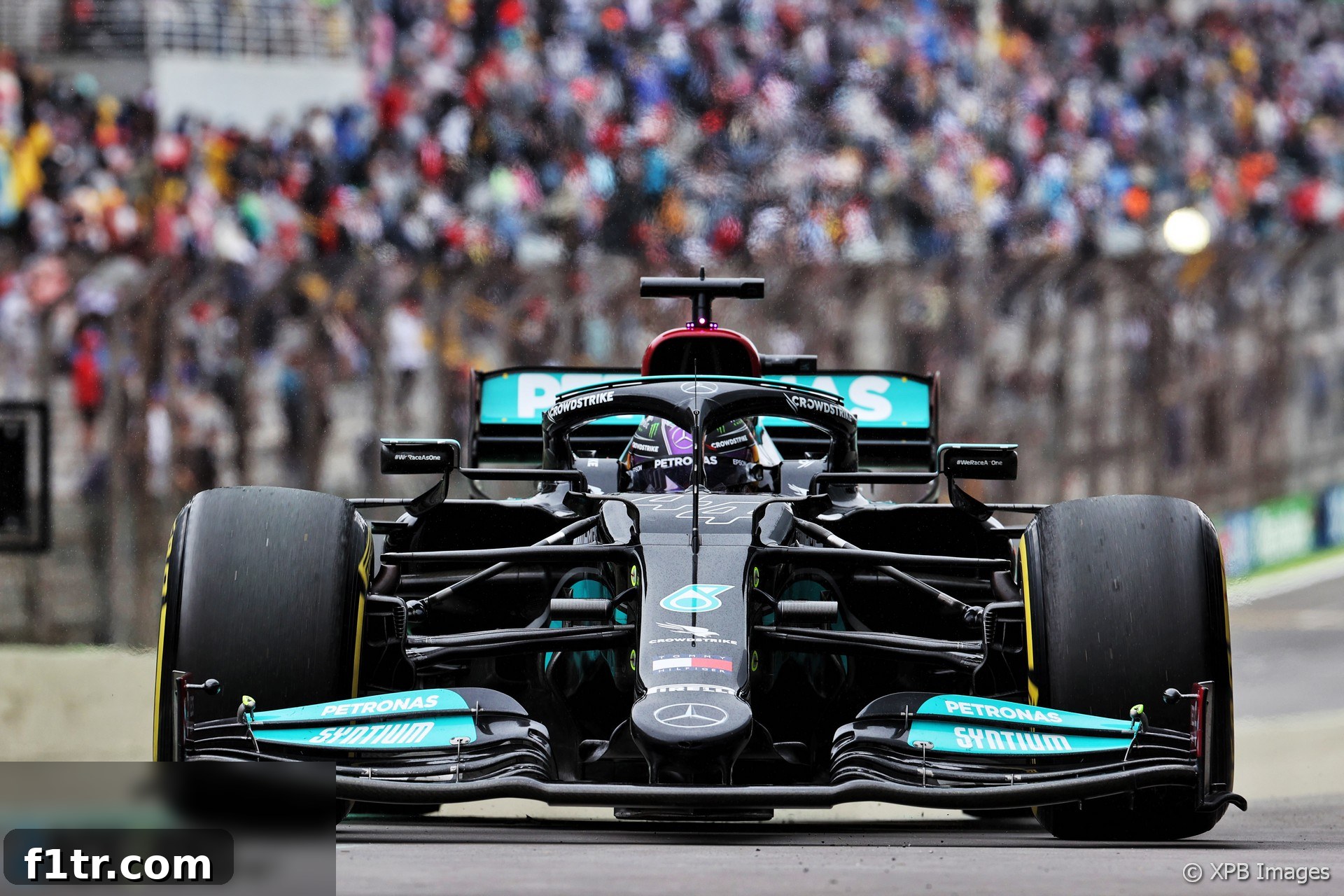
Lewis Hamilton’s Strategic Engine Change: Mercedes Battles Unforeseen Degradation in Tight F1 Title Race
In a pivotal moment for the intensely contested Formula 1 World Championship, Mercedes-AMG Petronas F1 Team made the critical decision to replace Lewis Hamilton’s internal combustion engine ahead of the Sao Paulo Grand Prix. This significant move was necessitated by a higher-than-expected degradation in the performance of his previous power unit, a factor that has become a growing concern for the German constructor.
Team Principal Toto Wolff confirmed the engine change, highlighting the strategic timing of the decision. Speaking to Sky Sports, Wolff explained that the Interlagos circuit, hosting a sprint qualifying race, presented a unique opportunity to absorb the mandatory five-place grid penalty without severely compromising Hamilton’s starting position for Sunday’s main event. This carefully calculated risk underscores Mercedes’ determination to provide Hamilton with the best possible equipment for the crucial final races of the season.
The Persistent Challenge: Unprecedented Engine Degradation
The core of Mercedes’ conundrum lies in an unusual and persistent issue of engine degradation. As Wolff elaborated, “We have deg on the engine that until the end of the season is just going to continue to decrease in power. And we haven’t yet realised why that is but we’re just seeing it creep down.” This acknowledgment reveals a deeper, unresolved technical challenge for a team renowned for its engineering prowess and reliability throughout the V6 turbo-hybrid era.
Unlike previous seasons where engine performance decay followed a predictable curve, Mercedes is experiencing a more accelerated and pronounced decline. Wolff emphasized that while every engine naturally degrades over its operational lifespan, typically losing a certain amount of kilowatts over a thousand kilometers, Mercedes’ current power units are “degrading much more than the average of the past few years.” This increased rate of degradation means that if the team were to persist with older engines, their competitiveness would be severely compromised in the decisive races in Saudi Arabia and Abu Dhabi.
The impact of this power loss is not merely theoretical; it directly translates into lap time deficits, a disadvantage Mercedes cannot afford in its fierce championship battle against Red Bull Racing and Max Verstappen. The decision to introduce a new engine, therefore, was not taken lightly but as a necessary measure to ensure Hamilton retained the power and performance required to challenge at the front of the grid.
Strategic Calculation: Why Sao Paulo?
The choice of the Sao Paulo Grand Prix for the engine change and subsequent grid penalty was a masterstroke of strategic planning by Mercedes. Formula 1 regulations stipulate a five-place grid drop for any additional internal combustion engine used beyond the season’s allocation of three. Typically, such a penalty would put a driver at a significant disadvantage for the main race.
However, the 2021 season introduced the sprint qualifying format at selected events, including Interlagos. This format sees a short sprint race on Saturday determine the grid for Sunday’s Grand Prix. By taking the penalty for the sprint qualifying race, Lewis Hamilton had the opportunity to mitigate the grid drop by making up positions during Saturday’s sprint. This unique scenario allowed Mercedes to introduce a fresh, powerful engine while offering Hamilton a chance to recover a strong starting position for the Grand Prix itself.
Wolff confirmed that this “opportunity” presented by the sprint race was the driving force behind the timing. While Saudi Arabia was also considered, simulations indicated that the engine would have lost even more power by then, making Sao Paulo the optimal location to introduce the new power unit. The team’s data-driven approach highlighted that the benefits of a fresh engine, combined with the sprint race’s recovery potential, far outweighed the immediate penalty.
Exceeding the Limits: Engine Allocation and Penalties
The engine change for Lewis Hamilton marks his fifth internal combustion engine of the season, a clear indication of the challenges Mercedes has faced with the reliability and longevity of their power units. Both Mercedes drivers have now exceeded the maximum allocation of three ICEs for the season. Valtteri Bottas, Hamilton’s teammate, has already taken his sixth internal combustion engine, underscoring that this is not an isolated incident but a systemic concern for the team.
This situation contrasts sharply with Mercedes’ historical reputation for producing incredibly robust and powerful engines. The need for so many power unit changes suggests that either Mercedes has been pushing their engines harder in pursuit of performance in the face of strong competition, or there is an underlying issue impacting the durability of their components. Each additional engine beyond the permitted allocation incurs a grid penalty, making strategic timing paramount.
Toto Wolff’s Insight: A Candid Assessment
Toto Wolff’s public statements provided a transparent look into the complex decisions being made behind the scenes. His frank admission that the team hadn’t “realised why that is” regarding the unusual degradation signifies the depth of the technical mystery Mercedes is grappling with. Despite their vast resources and expertise, the precise cause of the accelerated power unit decay remains elusive, adding another layer of complexity to their championship aspirations.
Wolff’s explanation that “if we keep the engine, we are going to be, for sure, not competitive in Saudi and Abu Dhabi” paints a stark picture of the predicament. It illustrates the high stakes involved and the imperative to act decisively. The team is caught between the need for outright performance and the inherent reliability challenges, a balance that is proving particularly tricky in the high-pressure environment of a title fight. His confidence that “I think this is the final one that we need to take” indicates a hope that this move will stabilize their engine situation for the remainder of the season.
The Road Ahead: Championship Implications
This strategic engine change has significant ramifications for the Formula 1 World Championship, which is heading for a thrilling conclusion. By introducing a new engine, Mercedes aims to equip Lewis Hamilton with maximum power for the critical final races, where every horsepower and every millisecond will count. While taking a grid penalty is never ideal, the team believes it is a necessary evil to ensure Hamilton has the tools to fight Max Verstappen on equal terms.
The decision reflects Mercedes’ belief that a fresh, performing engine is more valuable than avoiding a grid penalty in Sao Paulo. It’s a calculated gamble on Hamilton’s ability to recover positions and on the superior performance of the new power unit over the remaining rounds. The reliability of this new engine, combined with the one previously introduced at the Turkish Grand Prix, will be under intense scrutiny as the championship reaches its climax.
Wolff confirmed that Hamilton now has this new engine, alongside his fourth internal combustion engine (fitted at the Turkish Grand Prix), in the pool for the remaining races. His three prior engines have been deemed unusable for further competitive running, underscoring the severity of the degradation issue. This management of the engine pool becomes crucial, as Mercedes must carefully decide which unit to deploy at which Grand Prix to optimize performance and reliability.
Conclusion: A Defining Moment for Mercedes’ Title Bid
The engine change for Lewis Hamilton at the Sao Paulo Grand Prix is more than just a technical adjustment; it’s a defining strategic moment in Mercedes’ bid for the 2021 Formula 1 World Championship. Faced with an unforeseen and persistent engine degradation issue, the team made a brave decision to incur a penalty for the sake of sustained performance in the crucial final races. This move, carefully timed to leverage the sprint race format, highlights the intricate balance between technical challenges, strategic planning, and the relentless pursuit of championship glory. As the season hurtles towards its thrilling conclusion, the performance and reliability of these new power units will undoubtedly play a decisive role in determining who ultimately lifts the coveted F1 title.
2021 Sao Paulo Grand Prix – Related Articles
- Red Bull and Mercedes summoned to FIA hearing on review of Sao Paulo incident
- McLaren must “get back to scoring the results that are on the table” – Seidl
- Hamilton makes his second-biggest climb to victory from 10th on the grid
- F1 releases missing video footage from Verstappen’s car of Hamilton incident
- How Alonso and Ocon “pushed team tactics to the ultimate limit” to delay Gasly
Browse all 2021 Sao Paulo Grand Prix articles