F1 Teams Unleash Aerodynamic Innovation for the High-Speed Challenge of Monza
The Italian Grand Prix, held just one week after Formula 1’s summer break, traditionally presents a unique challenge for teams. While major performance-altering updates are rare in such a tight turnaround, the specific demands of Monza – the fastest circuit on the calendar – compel most teams to bring specialized aerodynamic adjustments. This year, all but one team arrived at the historic “Temple of Speed” with bespoke modifications aimed at mastering its relentless straights and high-speed corners.
Monza, with its long straights and fast chicanes, necessitates an ultra-low downforce setup to maximize straight-line speed. This means teams must reduce drag as much as possible, often by trimming their front and rear wings. While this is a common theme, some teams have gone to extraordinary lengths, showcasing significant engineering effort to gain even marginal advantages on a track where every kilometer per hour counts.
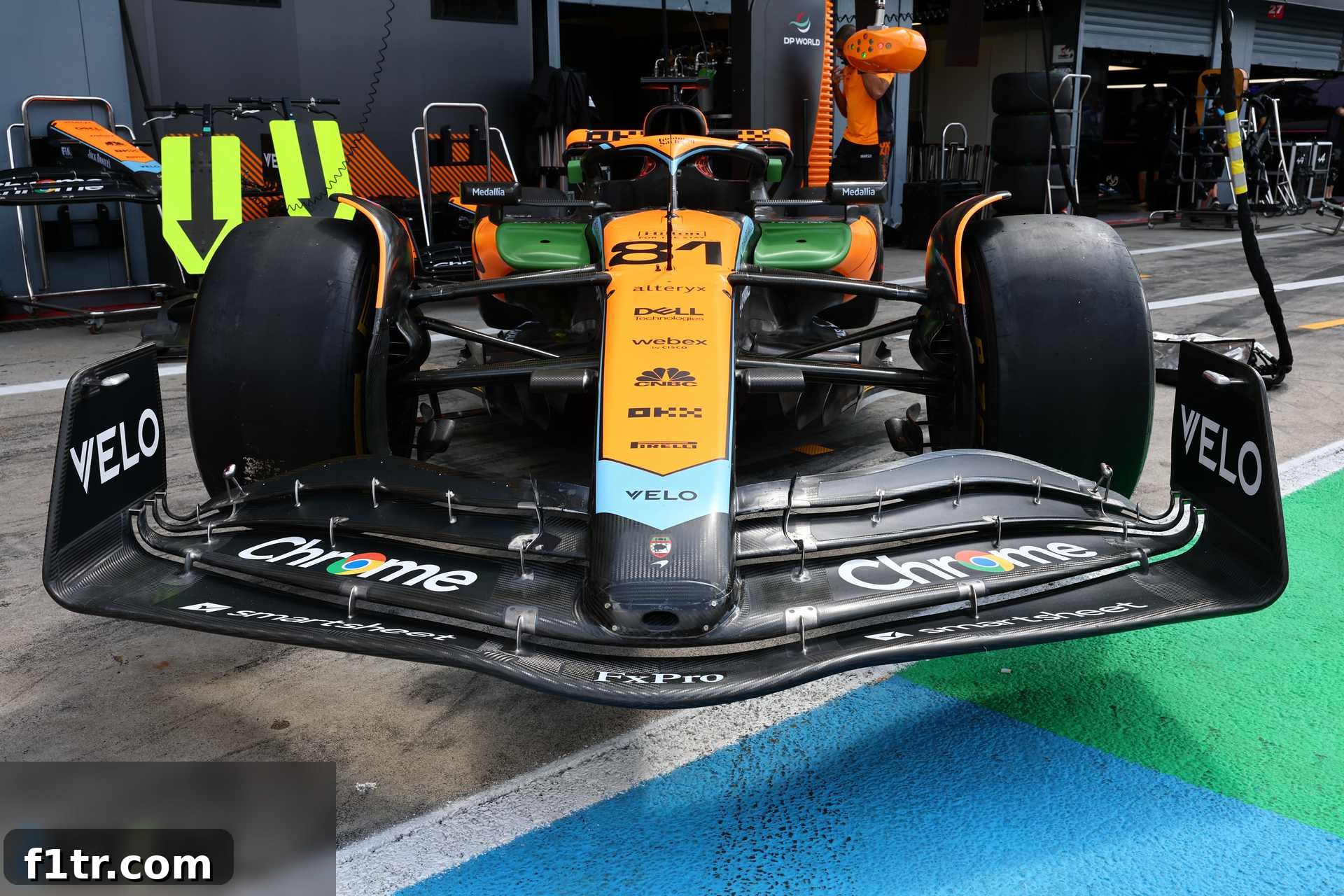
One team that stands out for its comprehensive approach to drag reduction is McLaren. The Woking-based outfit had a particularly challenging experience at the last high-speed venue, Spa-Francorchamps in Belgium, just before the summer break. Their MCL60 was notably vulnerable on the straights, a weakness brutally exposed during the Grand Prix where Lando Norris found himself overtaken by two cars simultaneously on the Kemmel straight. This highlighted a critical need for improved aerodynamic efficiency, a task McLaren tackled with urgency.
McLaren’s Aggressive Pursuit of Low Drag Efficiency
Following their struggles at Spa, McLaren’s team principal Andrea Stella was candid about the car’s shortcomings. He openly admitted that addressing the MCL60’s low-downforce efficiency was high on their “to-do list” from the start of the season. “We had no time to address that for Spa,” Stella explained, emphasizing the rapid corrective work required to prepare for Monza. The team deployed a comprehensive package of six distinct changes for the Italian Grand Prix, signaling a concerted effort to rectify their aerodynamic inefficiencies.
Beyond the standard front and rear wing tweaks, McLaren introduced alterations to their rear wing endplates, revised brake ducts, and other integral parts of the MCL60. Stella expressed satisfaction with the initial data collected, noting that the observed performance matched their expectations. The team’s strategy involved splitting these new solutions across their cars during practice sessions to gather optimal data, aiming to select the most effective configuration for the race. Their goal was clear: deliver a significantly improved performance in dry conditions compared to their Spa showing, by efficiently reducing both downforce and drag across multiple components.
This aggressive development push highlights McLaren’s commitment to continuous improvement and their determination to compete at the front of the grid. Their updates for Monza were not just circuit-specific; they represented a crucial step in improving the fundamental aerodynamic efficiency of the car, a foundational aspect that will benefit them in future high-speed challenges.
Team-by-Team Aerodynamic Updates for Monza
While McLaren’s efforts were particularly extensive, almost every team brought specialized updates to tackle Monza’s unique characteristics. These modifications primarily focused on reducing aerodynamic load and drag, ensuring maximum speed on the circuit’s iconic straights.
Red Bull Racing
Front Wing
Reason for change: Circuit specific – balance range
Red Bull applied a trim to the front wing flap’s trailing edge. This shortening of the chord reduces the aerodynamic load on the front of the car, crucial for achieving the desired balance with the expected low-drag rear wing setup at Monza, all while adhering to strict geometric requirements.
Rear Wing
Reason for change: Circuit specific – drag range
Similar to the front, the rear wing flap’s trailing edge received a trim, shortening its chord. This modification serves to reduce the wing’s relative load and consequently its drag at high speeds, perfectly suiting Monza’s demand for minimal air resistance.
Scuderia Ferrari
Rear Wing
Reason for change: Performance – drag reduction
For their home race, Ferrari introduced lower downforce top and lower rear wing designs. These “depowered” profiles are specifically adapted to Monza’s unique layout and the critical need for aerodynamic efficiency, ensuring the SF-23 can cut through the air with minimal resistance.
Front Wing
Reason for change: Circuit specific – balance range
A lower downforce front wing flap design was also brought by Ferrari. This provides the necessary aerodynamic balance range to complement the optimized downforce level anticipated for Monza, allowing the drivers to attack the high-speed sections with confidence.
Mercedes-AMG Petronas Formula One Team
Rear Wing (Upper)
Reason for change: Performance – drag reduction
Mercedes opted for a small chord upper rear wing. This reduced downforce upper element is tailored for low-drag circuits like Monza, contributing to higher straight-line speeds.
Rear Wing (Beam)
Reason for change: Performance – drag reduction
Complementing the upper rear wing, Mercedes also introduced a small chord beam wing. This component further reduces downforce and drag, forming a cohesive low-drag package for their W14 at Monza.
BWT Alpine F1 Team
Beam Wing
Reason for change: Circuit specific – drag range
Alpine fitted a packer to its beam wing, resulting in a revised profile for the element. This adjustment specifically reduces drag and downforce to match Monza’s low downforce configuration, optimizing the car’s performance for the high-speed track.
McLaren Formula 1 Team
Front Wing
Reason for change: Circuit specific – balance range
McLaren introduced a low balance front wing flap with an altered shape. This design efficiently reduces front wing loading to precisely balance the low downforce rear wing options available for this track, crucial for stable handling at extreme speeds.
Front Corner
Reason for change: Performance – flow conditioning
A new front brake duct scoop geometry was implemented. This revision improves airflow conditioning around the front corner, leading to an efficient increase in aerodynamic load while maintaining sufficient brake cooling performance – a testament to clever multi-functional design.
Rear Wing (Flap)
Reason for change: Circuit specific – drag range
A new, low drag flap assembly with two trim options was introduced. This reduces flap loading and the resultant downforce and drag of the entire rear wing assembly, contributing significantly to straight-line speed.
Rear Wing Endplate
Reason for change: Circuit specific – drag range
McLaren designed a modified rear wing endplate featuring a different sideview shape. This subtle change reduces the main plane loading of the rear wing, efficiently decreasing both aerodynamic drag and overall load.
Rear Wing (Assembly)
Reason for change: Circuit specific – drag range
A completely new lower drag rear wing assembly was deployed, featuring an offloaded mainplane and flap. The goal here is a highly efficient reduction in both downforce and drag, optimized for Monza’s unique requirements.
Rear Corner
Reason for change: Circuit specific – drag range
A revised rear corner winglet arrangement was introduced. This new configuration specifically reduces aerodynamic load and drag, making it ideally suited for the high-speed characteristics of the circuit.
Stake F1 Team Kick Sauber (Alfa Romeo)
Rear Wing
Reason for change: Circuit specific – drag range
Alfa Romeo introduced a new profile for their rear wing in its entirety, encompassing different main plane and endplate designs. The aim was to minimize drag and respond directly to Monza’s unique high-speed characteristics, seeking to enhance their competitive edge.
Front Corner
Reason for change: Performance – local load
In a notable change, Alfa Romeo brought a new geometry for their front suspension shrouds. These redesigned shrouds work to improve the aerodynamic efficiency of the car, integrating seamlessly with the rest of the car’s airflow to boost overall performance. Unfortunately, their initial evaluation in first practice was hampered by technical problems, underscoring the challenges of introducing significant changes mid-season.
Aston Martin Aramco Cognizant Formula One Team
Rear Wing
Reason for change: Circuit specific – drag range
Aston Martin introduced a new rear wing flap with a reduced chord on their low-drag rear wing. This modification specifically targets reduced wing loading and, consequently, reduced drag to suit the circuit’s characteristics. Its deployment depends on the chosen setup for optimal performance.
Scuderia AlphaTauri
Front Wing
Reason for change: Circuit specific – balance range
AlphaTauri reduced the chord and camber of their front wing flap elements compared to their baseline geometry. This reduction in flap loading is essential for achieving the desired aerodynamic balance when paired with the low downforce/drag rear wing assembly, which is optimal for lap time at Monza.
Beam Wing
Reason for change: Circuit specific – drag range
Compared to other beam wing designs, this new assembly reduces the camber and chord of the beam wing elements. Notably, there’s just one element local to the diffuser trailing edge, with a second beam wing element positioned further forward and above. This configuration further reduces drag compared to previous, higher downforce designs, specifically for Monza’s low drag requirement.
Rear Corner
Reason for change: Performance – drag reduction
AlphaTauri removed several of the upper, rear brake drum elements compared to their baseline assembly. These wing elements are standard at high and medium downforce circuits, but at Monza, lap time is significantly improved by their removal due to the circuit’s extremely high aerodynamic efficiency demands.
Other – Rear View Mirrors
Reason for change: Performance – drag reduction
In a subtle yet impactful change, AlphaTauri removed three turning vanes from the outboard mirror stem. Similar to the brake drum elements, these mirror vanes are typically used at higher downforce circuits. Their removal at Monza reduces drag, contributing to lap time gains on a circuit where aerodynamic efficiency is paramount.
Williams Racing
Front Wing
Reason for change: Circuit specific – balance range
Williams implemented a trim to the trailing edge of their front wing flap element. This efficiently reduces the load on the front wing to match the low downforce provided by their low-drag rear wing. The team noted they would deploy this trim only if required, indicating a flexible setup strategy.
The Haas Anomaly: No Updates for the VF23
In contrast to the extensive modifications seen across the paddock, Haas was the sole team to arrive at Monza without any specific circuit-tailored updates for their VF23. This decision may reflect a strategic choice to focus resources elsewhere or could simply indicate the inherent limitations of their current development cycle. However, on a circuit where aerodynamic efficiency is king, a lack of specialized low-drag components could put them at a distinct disadvantage against their updated rivals.
Implications for the Race Weekend and Beyond
The array of aerodynamic updates brought by Formula 1 teams to Monza underscores the circuit’s unique position on the calendar. Each modification, from a simple wing trim to a comprehensive overhaul like McLaren’s, represents a calculated gamble aimed at unlocking precious milliseconds on track. These changes will undoubtedly influence the pecking order in qualifying, where straight-line speed is a significant factor, and will play a crucial role in race strategy, particularly concerning DRS effectiveness and tire degradation due to varying aerodynamic loads.
Beyond the immediate Italian Grand Prix, these updates provide valuable data for teams, guiding their future development trajectories. The intense focus on aerodynamic efficiency at Monza serves as a high-stakes test bed, pushing the boundaries of engineering innovation in pursuit of ultimate speed.
The “Temple of Speed” once again challenges every team to optimize their machinery for sheer velocity. With detailed adjustments made across the grid, the 2023 Italian Grand Prix promised to be a thrilling showcase of aerodynamic prowess and engineering precision, as teams battled not just each other, but also the demanding physics of Monza.
2023 Italian Grand Prix
- Despite close battles at Monza, F1 drivers want more powerful DRS
- Monza “frustrating” for Alonso but Aston Martin expect better form in coming races
- F1 changed rules to stop Mercedes in 2021 but we won’t ‘cry foul’ now – Wolff
- McLaren will bring ‘follow-up to Austria upgrade’ before focusing on 2024 car
- Magnussen explains why his driving style rarely works with the Haas VF-23
Browse all 2023 Italian Grand Prix articles