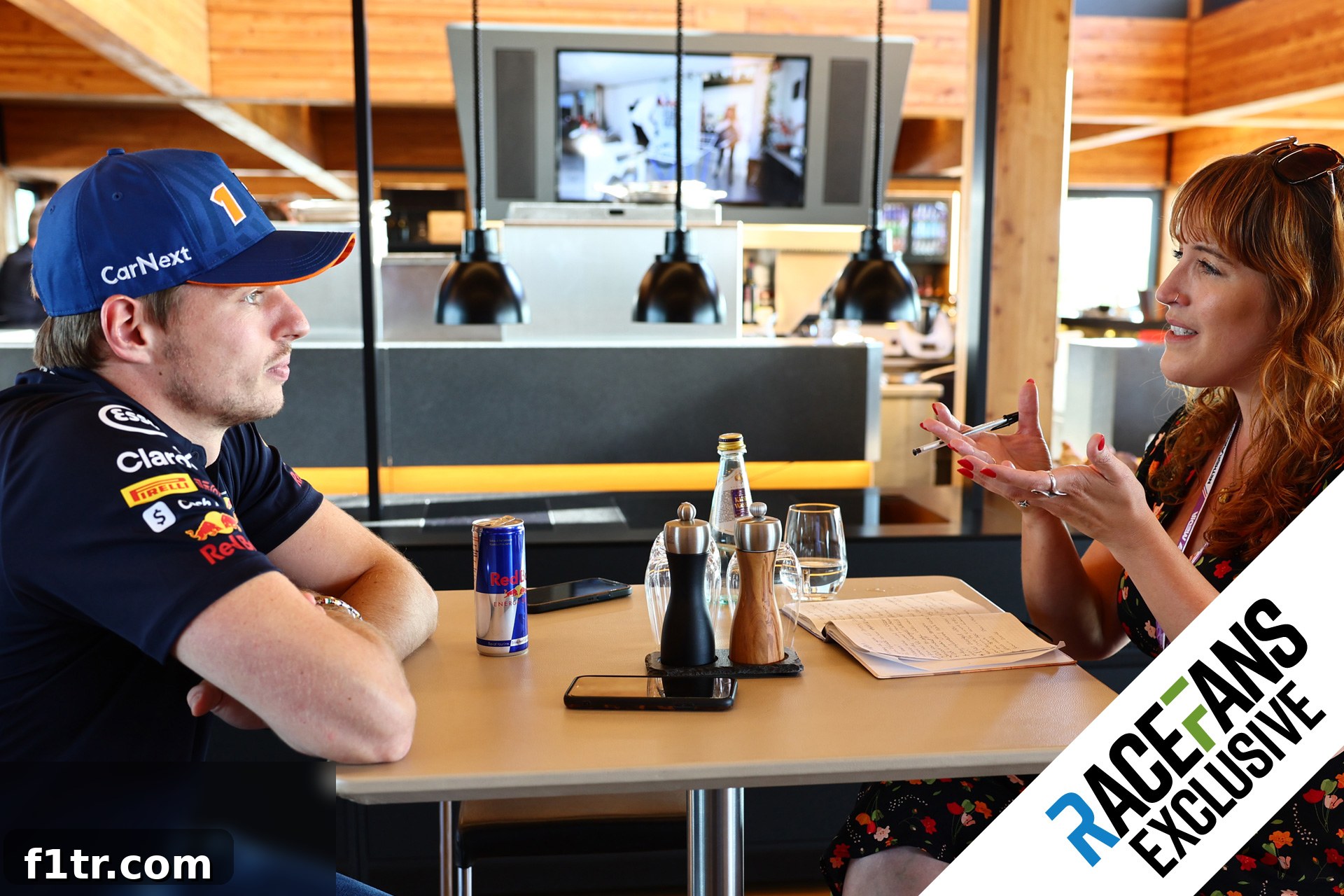
Max Verstappen, Formula 1’s reigning champion, could hardly have envisioned a more spectacular prelude to his highly anticipated home Grand Prix at Zandvoort. Fresh off a summer break, the Dutch driver returned with an almost unstoppable momentum, showcasing a level of dominance that left rivals trailing in his wake.
Advert | Become a Supporter & go ad-free
His impressive string of performances began with a remarkable victory from tenth on the grid at the Hungarian Grand Prix before the summer recess. This set the stage for a truly commanding display at Spa-Francorchamps in Belgium, where he delivered arguably his most dominant performance of the season, cementing his status as the man to beat.
Verstappen’s Unassailable Dominance in the 2022 Season
The sheer speed and unflappable performance of Verstappen’s RB18 at Spa sent a clear message to the paddock. Even with a grid penalty relegating him to the middle of the field, few doubted his capacity to clinch victory. Indeed, the pre-race predictions proved accurate as Verstappen swiftly carved through the grid, seizing the lead by half-distance and ultimately storming to not only his most emphatic victory of the season but also one of Red Bull Racing’s most comprehensive wins in recent history.
Team Principal Christian Horner drew parallels between this performance and the team’s glory years from 2010-13, a period when Sebastian Vettel secured four consecutive championships. This comparison underscored the magnitude of Verstappen’s achievement and Red Bull’s resurgence to the pinnacle of Formula 1.
Such overwhelming dominance, especially after the nail-biting conclusion to the previous year’s world championship, was perhaps not the narrative Formula 1’s organisers, Liberty Media, had envisioned for the 2022 season. New technical regulations, featuring drastically overhauled aerodynamics, were introduced with the specific aim of closing up the field and encouraging closer wheel-to-wheel racing. While these efforts to reduce the impact of powerful surface aerodynamics and allow cars to follow more closely have been largely applauded, the championship battle itself has seen one driver rise head and shoulders above the rest.
Balancing Tradition and Commercialism: Verstappen’s Views on F1’s Evolution
However, not all changes implemented by Liberty Media, now in its fifth year at the helm of F1, have been met with universal acclaim. Max Verstappen, ever the outspoken competitor, has not shied away from voicing his concerns regarding some of their strategic decisions. These include deviations from the traditional Grand Prix weekend format and the gradual shift away from some of the sport’s most cherished, historic circuits in favour of new, often glitzy, venues.
“It’s very commercial,” Verstappen acknowledges candidly. “I mean, everyone wants to make money, right? I understand what it’s all built around nowadays because it’s more like F1 plus a festival, I understand.” This statement encapsulates the modern dilemma facing Formula 1: how to grow its global appeal and financial viability without alienating its core fanbase or compromising the sporting integrity that defines it.
While Verstappen appreciates the necessity for Formula 1 to explore new markets and engage fresh audiences, he staunchly believes that the sport’s traditions must be preserved. Central to this belief is the sanctity of the conventional race weekend format, a structure that has evolved over decades and holds deep significance for purists.
Advert | Become a RaceFans supporter andgo ad-free
The Sprint Race Debate: “Not F1”
Verstappen has been particularly vocal about his disdain for Liberty Media’s controversial sprint race experiment. Introduced last year amidst considerable hype, these Saturday qualifying races have generated, at best, a mixed reception from fans and drivers alike. For Verstappen, sprint races are more than just a minor adjustment; he considers them a “gimmick” that fundamentally misaligns with the spirit of Formula 1. He openly questions whether they genuinely provide the additional entertainment and spectacle that was promised.
“As long as the core stays the same, I think that is very important,” he stresses. “I’m not a fan of sprint races because I don’t think that’s F1, and I’ve said it many times.” His argument extends beyond personal preference, delving into the tactical implications for drivers. “Not only that, I think if you look at them, not many things have changed a lot because everyone is scared to crash and because the big points are on Sunday so you don’t want to risk it to the limit.” This highlights a fundamental flaw in the concept: if drivers are incentivized to play it safe to avoid compromising their main race, the sprint loses its intended competitive edge and becomes a glorified parade.
Calendar Expansion and the Rise of Street Circuits
Another significant concern for Verstappen is the relentless expansion of the Grand Prix schedule. The 2023 F1 calendar is projected to feature 24 rounds, pushing the limits of the maximum permitted under Liberty Media’s current agreement with the teams. This ever-growing calendar has intensified competition for coveted spots, leading to heritage European road courses increasingly being squeezed out in favour of flashy street circuits in glamorous, often urban, locations. The prospect of swapping legendary venues like Spa-Francorchamps for new city tracks such as Las Vegas doesn’t sit well with the world champion.
“We are going to new tracks and some tracks are dropping out. Some I don’t mind, some I do. That is something I think at the moment we have to find a balance [on].” Verstappen acknowledges the need for evolution but pleads for a measured approach. “Of course, F1 is becoming more and more popular and you have to make a few changes. But you need to keep some proper tracks and not go to all these street circuits and just build up the hype and stuff.”
Advert | Become a RaceFans supporter andgo ad-free
He elaborates on the practicalities: “It’s nice, a few street circuits, but at the end of the day you have to remember that F1 cars are not designed to drive on the streets.” Modern Formula 1 cars are precision-engineered machines, designed to perform optimally on purpose-built racing circuits with smooth surfaces, high-speed corners, and challenging elevation changes. Street circuits, often bumpy and confined, present a different set of challenges that can compromise the driving experience and the spectacle of pure speed.
Ironically, his Red Bull car has proven remarkably adept on these urban layouts. The team has secured victories on all four street circuits F1 has visited so far this year, with Verstappen conquering Jeddah, Miami, and Baku, while his teammate Sergio Perez triumphed in Monaco.
“Luckily our car’s a bit more comfortable than some others,” Verstappen adds, taking a subtle jab at arch-rivals Mercedes, whose W13 chassis notoriously delivered a particularly punishing ride to Lewis Hamilton over the unforgiving bumps of Baku. Yet, despite his car’s success, his sentiment remains unchanged: “But in general, a street circuit is very bumpy and it’s something I don’t really like because I don’t really feel the same emotion as when you do a lap here in Zandvoort, like an old-school track.” This preference for the raw, visceral challenge of traditional circuits speaks volumes about his racing philosophy.
Beyond F1: Verstappen’s Limitless Racing Appetite and Future Ambitions
Despite the ever-expanding F1 calendar, Verstappen’s appetite for racing remains seemingly boundless. Between Grand Prix events, he can frequently be found honing his skills, whether by tackling tracks in GT cars or meticulously refining his technique on his advanced simulator. This dedication underscores a profound passion for motorsport that transcends the confines of Formula 1.
Following his maiden world championship title last year, Verstappen committed his long-term future to Red Bull Racing, signing a deal that will keep him with the team until the 2028 season. This contract, by far the longest of any driver on the current grid, signifies his deep loyalty and belief in the team. However, his ambitions extend beyond Formula 1, with aspirations to explore other disciplines within motorsport.
Advert | Become a RaceFans supporter andgo ad-free
“I want to try different kinds of discipline,” he states, expressing a desire to broaden his racing horizons. “So probably a bit more endurance.” This inclination towards endurance racing reflects a different kind of challenge, one that tests not only raw speed but also consistency, strategy, and teamwork over extended periods.
Interestingly, for American fans who dream of seeing F1 stars conquer the iconic oval, Verstappen confirms he is not among the drivers interested in tackling the unique demands and dangers of the Indianapolis 500. “No ovals,” he stresses emphatically. “Just 24-hour races. Because I like to drive different kind of cars as well. Like I already do it now, like whatever GT3 cars and stuff.” His preference for multi-class, multi-driver endurance events underscores a desire for diverse driving experiences and learning opportunities.
Even with F1 threatening to monopolise nearly half of next year’s weekends, Verstappen remains hopeful of pursuing additional racing endeavors during his active career in the series. “I really enjoy testing myself in different kinds of machinery because I think you can learn from it and become an even better driver,” he explains. “So that’s what I want to do in the future. Maybe even during my F1 career. But that’s [if] the schedule would allow that as well. At the moment that’s a bit hard to combine when we also go to more and more races.” This highlights the practical constraints imposed by an increasingly demanding F1 calendar on a driver’s ability to explore other racing passions.
Advert | Become a Supporter & go ad-free
The Philosophy of Enjoyment: A Key to Unlocking Potential
Verstappen has consistently maintained that winning his first world championship was his ultimate career goal, viewing any subsequent successes as bonuses. This perspective appears to be a crucial element in allowing him to access the very peak of his potential, a point Christian Horner himself alluded to following Verstappen’s dominant Spa victory. The emphasis on enjoyment and satisfaction seems to liberate him from undue pressure, fostering an environment where peak performance can flourish.
“What I think is very important as well is that you’re enjoying the moment,” says Verstappen. “Because these years they go by so quickly and everyone always thinks about the performance side. But are you even happy with what you’re doing? I think it’s sometimes what you have to question as well. I am very happy with what I’m doing right now and I’ll keep questioning myself.”
Advert | Become a RaceFans supporter andgo ad-free
“As long as I’m happy doing what I’m doing, I want to continue. But at one point, if it’s all becoming a bit of a problem and you don’t really enjoy it, then you have to try and maybe find something else.” This introspective approach to his career, prioritising personal happiness and fulfillment, offers valuable insight into the mindset of a champion.
The 2022 Championship Battle: Red Bull’s Flawless Execution vs. Ferrari’s Missteps
His commanding victory in Belgium delivered yet another significant blow to the rapidly fading championship hopes of rival Charles Leclerc and his Ferrari team. This performance has propelled Verstappen into a points lead that, barring an unforeseen catastrophe, now appears virtually unassailable. The prospect of another victory from pole position at his home race in Zandvoort would only further solidify this commanding advantage.
Given his challenging start to the season, which saw two retirements in the opening three races, and the initially close competition Red Bull faced from Ferrari, Verstappen admits he is much further ahead than he had anticipated. “It’s a bit surprising because initially we had our little issues. We retired, that was not great. We were massively behind and now we are massively in front.”
“I do think a lot of races we had a really good car, but I wouldn’t say the dominating car. But I think as a team we really maximised most of our race results and that gave us this lead. I would say the only race I actually felt like we were really dominating was last weekend in Spa.” This nuanced perspective underscores Red Bull’s ability to extract maximum performance and results even when not possessing the outright fastest car, a testament to their operational excellence.
In contrast to Red Bull’s relentless and efficient campaign, their 2022 opponents, Ferrari, have experienced a full spectrum of setbacks: driver errors, strategic blunders, and crippling reliability failures. Verstappen admits that “in a way” he does wish the fight had been closer. “And in another way, not, because of course it’s nice to have a big lead instead of being equal on points or whatever. But I also look at myself and the team – yes, it’s good to look at other teams, but at the end of the day, we can only control what we do ourselves.” This pragmatic focus on internal performance rather than external competition has been a hallmark of his championship-winning approach.
Max Verstappen’s 2022 season has thus far served as a masterclass in resilience and consistent performance, demonstrating how to overcome early setbacks and convert potential into tangible success. Barring an unforeseen catastrophe, his astute driving and Red Bull’s unwavering execution are set to deliver him a well-deserved second world title.
“It’s all about trying not to make mistakes because at the end of the day it’s all about collecting points all the time,” reflects F1’s newest world champion. “That’s how, at the end of the day, you win championships.” This simple yet profound philosophy encapsulates the essence of his dominant campaign.
Don’t miss anything new from RaceFans
Follow RaceFans on social media:
- Join RaceFans on Facebook
- Follow RaceFans on Twitter
- Get daily email updates from RaceFans
Advert | Become a RaceFans supporter andgo ad-free
Read RaceFans’ full exclusive interview with Max Verstappen
Become a RaceFans Supporter
RaceFans is run thanks in part to the generous support of its readers. By contributing £1 per month or £12 per year (or the same in whichever currency you use) you can help cover the costs of creating, hosting and developing RaceFans today and in the future.
Become a RaceFans Supporter today and browse the site ad-free. Sign up or find out more via the links below:
- Become a RaceFans Supporter
- RaceFans Supporter FAQ
2022 Dutch Grand Prix
- Ferrari’s season of missed chances led to “difficult” criticism for Binotto
- How many victory chances did Hamilton have in his first winless F1 season?
- Why F2’s role as F1’s sustainable fuel guinea pig ‘isn’t going to be a reliability issue’
- Straight-line speed deficit will continue to “bite” Mercedes in qualifying – Wolff
- Verstappen achieves his longest winning streak with second home victory
Browse all 2022 Dutch Grand Prix articles