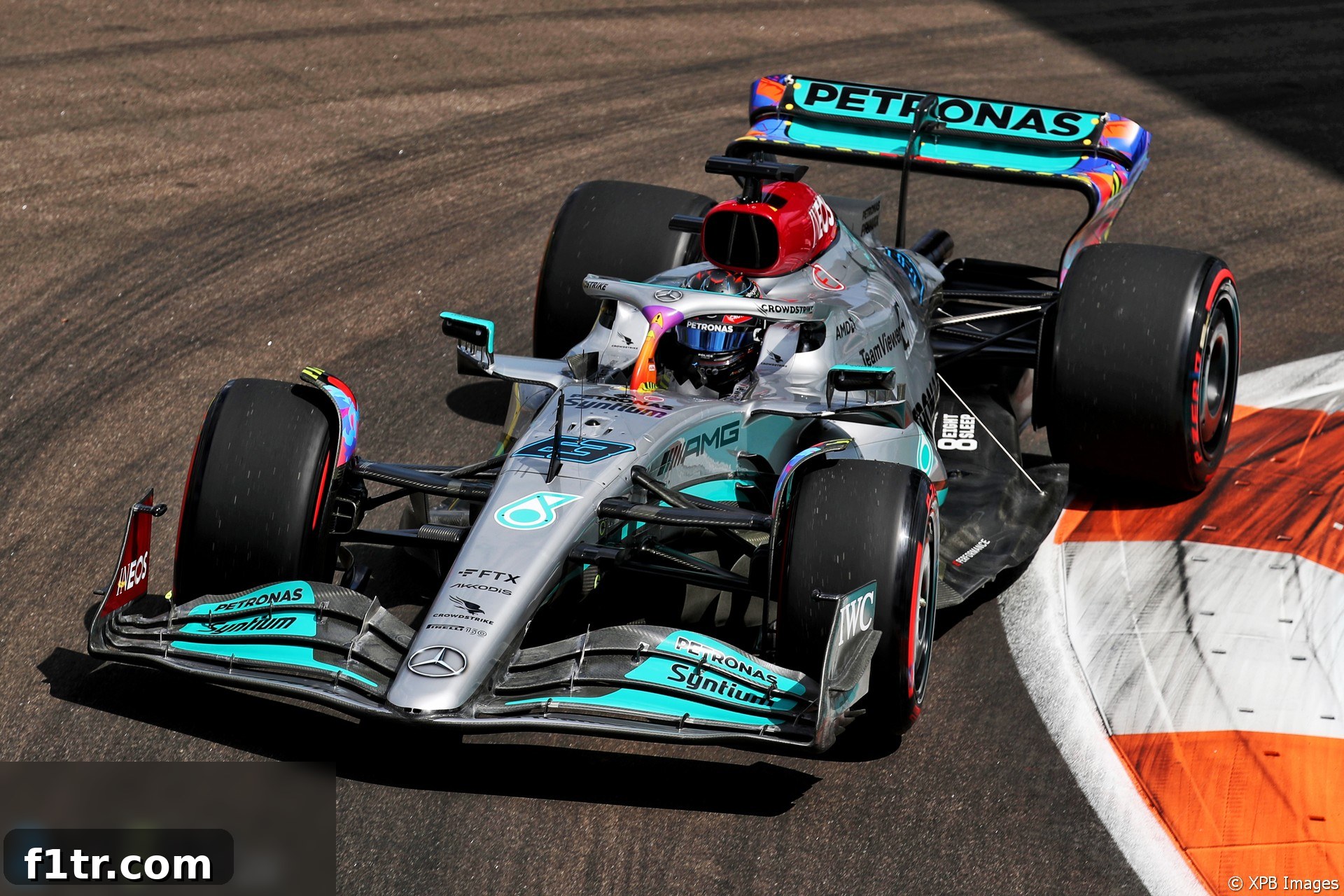
In an unexpected turn of events at the inaugural Miami Grand Prix, Mercedes driver George Russell showcased remarkable pace during Friday’s practice sessions, leading many to believe the Silver Arrows might finally be turning a corner in their challenging 2022 Formula 1 season. Russell topped the timesheets in the second practice session (FP2) after securing the second-quickest time in the opening session (FP1), just seven-hundredths of a second shy of Charles Leclerc’s Ferrari.
While Mercedes introduced a package of upgrades to their W13 car this weekend, Russell suggests that the unique characteristics of the Miami International Autodrome, combined with the prevailing conditions, played an equally significant role in their improved performance. The combination of slower corners and high ambient temperatures at the new circuit appears to have provided a timely advantage for the Brackley-based squad.
Mercedes Finds Form in Miami: Russell Tops Practice
George Russell’s impressive display on Friday immediately injected a much-needed dose of optimism into the Mercedes garage. After a challenging start to the 2022 season, marked by significant performance issues, seeing one of their drivers at the very top of the leaderboard was a welcome sight. In FP1, Russell swiftly adapted to the unfamiliar Miami circuit, posting a time that put him firmly in contention, just behind Ferrari’s title contender, Charles Leclerc. This strong showing was not a fluke, as Russell then went on to outpace the entire field in FP2, demonstrating consistent speed and control.
This early weekend dominance from Russell stood in stark contrast to Mercedes’ struggles in previous races, where they often found themselves battling in the midfield rather than at the front. The team has been grappling with a complex array of issues, primarily the severe porpoising of their car and difficulties in generating sufficient tire temperature. However, Miami seemed to offer a different narrative, with the W13 appearing more stable and competitive, allowing Russell to extract performance that had been elusive in earlier rounds.
The Miami Circuit: A Timely Advantage for Mercedes?
According to George Russell, the competitive start was not solely down to the car’s upgrades, but also significantly influenced by the track and environmental factors. “We always knew ahead of this weekend that the conditions should suit us better,” Russell stated, highlighting the team’s pre-race analysis. He pointed to Mercedes’ ongoing struggles with tyre warm-up, a problem exacerbated on colder or rougher tracks like Bahrain earlier in the season. Miami, however, presented a different scenario, being “the first real hot race of the season.”
The high ambient temperatures and the track’s slow-speed corners are believed to have played directly into Mercedes’ hands. Warmer conditions naturally aid in bringing tyres up to their optimal operating temperature, a consistent challenge for the W13. Furthermore, circuits with a greater proportion of slow-speed corners tend to place less emphasis on outright aerodynamic efficiency at high speeds, where Mercedes has often found itself at a disadvantage due to its porpoising issues. Instead, mechanical grip and traction become more critical, areas where the Mercedes chassis, when operating correctly, can still excel.
Track Characteristics and Temperature Play Key Role
The Miami International Autodrome features a unique layout, with a mix of high-speed straights and a particularly twisty, technical section. It’s the latter, characterized by tight turns and chicanes, that Russell believes is benefiting Mercedes. In these slower sections, the impact of aerodynamic instability, such as porpoising, is inherently less pronounced compared to fast corners where downforce is paramount. This allows the drivers to push harder without being as severely affected by the car’s vertical oscillations. The surface of the new track, while initially reported to be quite slippery, also seemed to offer a different grip characteristic that might be more sympathetic to the W13’s current setup window.
The combination of these factors suggests that while the upgrades are important, the circuit itself provided a more forgiving environment for the W13, allowing its underlying performance to shine through more readily. This “track effect” phenomenon is not uncommon in Formula 1, where certain car designs naturally perform better on specific types of circuits due to their inherent strengths and weaknesses. For Mercedes, Miami might just be the opportune venue to recalibrate and understand their car better in a competitive setting.
Unpacking the W13 Upgrades: A Step in the Right Direction
Mercedes arrived in Miami with a highly anticipated package of upgrades for the W13, hoping to address some of the fundamental issues plaguing their car. While the team remains cautious, acknowledging that conditions played a part, they do believe the updated components have contributed to the improved performance. The nature of these upgrades typically involves refining aerodynamic surfaces, particularly the floor and sidepods, to better manage airflow and mitigate the porpoising effect. Such changes are designed to unlock more consistent downforce and improve overall stability.
The initial feedback from both Russell and the team engineers suggests that these modifications are indeed working as intended, albeit perhaps not in isolation. Russell’s comments imply a synergy between the new parts and the favourable track conditions. Had the team brought these upgrades to a less suitable circuit, their impact might have been less dramatic. This highlights the complex challenge Mercedes faces: not only developing effective upgrades but also finding a setup window where the car can consistently perform across diverse track environments.
Incremental Improvements or a Game-Changer?
While the pace in Miami was encouraging, the team is careful not to get carried away. Russell himself stated, “The car is working well but it’s only Friday, I’m not getting too carried away.” This cautious optimism is typical for Mercedes, who understand that strong practice performance doesn’t always translate into qualifying and race success, especially in a tightly contested championship. The true test of the upgrades will come when they are evaluated on different circuits and under varying conditions. However, the initial signs are positive, suggesting that Mercedes is making incremental, rather than revolutionary, steps forward in understanding and developing the W13.
The engineering challenge for Mercedes is immense. They are not merely seeking to make the car faster but to make it *predictably* faster, eliminating the performance lottery that has characterized their season thus far. The Miami weekend offers a critical opportunity to gather extensive data on the updated car in real-world racing conditions, which will be invaluable for their ongoing development efforts throughout the year. This data will inform future design choices and help the team move closer to consistently challenging at the front.
Taming the Porpoising Phenomenon: A Glimmer of Hope
One of the most significant and persistent challenges for Mercedes this season has been the violent “porpoising” of the W13 – an aerodynamic phenomenon where the car bounces rapidly at high speeds due to fluctuating downforce. This issue has not only compromised performance by forcing the team to run higher ride heights, but it has also caused considerable discomfort for the drivers. In Miami, however, there appeared to be a noticeable, albeit not complete, improvement.
Russell admitted the porpoising problem had improved, saying, “We know that it will always be there, but maybe it’s working at a lower range compared to where we were previously.” This insight suggests that while the car still exhibits some degree of bouncing, its amplitude or frequency might have been reduced, or perhaps it manifests at a different speed range, making it less detrimental to overall performance. The ability to run the car slightly lower to the ground, even with residual porpoising, is crucial for generating more downforce and improving cornering speeds.
Managing the Bouncing Beast
Despite the improvement, Russell acknowledged that the porpoising was still present, especially during longer high-fuel runs. “For sure in that high-fuel run I was feeling it and it didn’t seem to be any better,” he explained. This indicates that the problem is deeply ingrained in the W13’s aerodynamic design and cannot be fully eradicated by a single package of upgrades or favorable track conditions. However, the key for Mercedes lies in managing it: if they can control the porpoising to a level where they can run the car closer to its optimal ride height, the performance gains could be substantial.
The struggle with porpoising has been a delicate balancing act for Mercedes. Lowering the car increases downforce but risks intensifying the bouncing, potentially leading to instability and reduced driver confidence. The hope in Miami is that the combination of upgrades and track conditions has allowed them to find a more effective compromise, enabling them to exploit more of the W13’s potential without suffering debilitating porpoising. The goal is to consistently reduce the porpoising to a ‘lower range’ where its impact on lap time is minimized, and driver comfort is enhanced.
A Productive Friday Amidst Rivals’ Woes
Beyond Mercedes’ own improvements, the team also benefited from a remarkably smooth and productive Friday, a stark contrast to the challenges faced by their main rivals, Red Bull and Ferrari. Both championship-leading teams experienced significant disruptions to their practice sessions due to a combination of technical problems and crashes. This disparity in track time and data collection could prove to be a crucial factor as the weekend progresses.
Red Bull’s Sergio Perez suffered from a gearbox issue, while Max Verstappen encountered a hydraulics problem that severely limited his running, especially in FP2. Meanwhile, Ferrari’s Carlos Sainz crashed out early in FP2, sustaining damage that cost him valuable track time. These incidents meant that both Red Bull and Ferrari had fewer laps to gather data on the new Miami circuit, assess their car setups, and understand tire behavior. In a sport where every minute of track time is precious, particularly at a new venue, such setbacks can have a ripple effect on qualifying and race performance.
Maximizing Data Collection While Competitors Struggle
For Mercedes, a clean and productive Friday allowed them to execute their entire practice program, methodically testing their upgrades and fine-tuning the W13. Russell noted, “It’s definitely been a really productive day for us, probably the most productive Friday we’ve had.” This extensive data collection is invaluable, as it provides engineers with a deeper understanding of how the car responds to different setups and track conditions. With a solid foundation of data, Mercedes can approach qualifying with greater confidence in their setup choices, potentially gaining a strategic advantage over their less prepared rivals.
The contrast between Mercedes’ seamless operations and their competitors’ troubles underscores the importance of reliability and execution, even in practice sessions. While the Silver Arrows might not yet be outright challengers for race wins, maximizing their track time in Miami has positioned them well to capitalize on any further missteps from Red Bull and Ferrari. This strategic advantage gained on Friday could translate into better grid positions and a stronger race strategy, offering Mercedes a prime opportunity to score significant points.
Looking Ahead: Qualifying and Race Prospects
While the Friday performance has undoubtedly lifted spirits within the Mercedes camp, the true challenge lies in translating that practice pace into strong qualifying and race results. Formula 1 is a sport of fine margins, and the field is incredibly competitive. George Russell’s cautious optimism reflects this reality, understanding that Saturday and Sunday present different dynamics and pressures.
Qualifying will be the first major test, determining whether Mercedes can consistently challenge Red Bull and Ferrari over a single lap. The long run pace, typically assessed in FP2, also looked promising for Mercedes, suggesting they might be able to manage their tires effectively during the Grand Prix. However, the newness of the track and the possibility of varying conditions mean that nothing is guaranteed.
Can Mercedes Maintain Momentum Through the Weekend?
The Miami Grand Prix offers a crucial opportunity for Mercedes to not only validate their upgrades but also to gain confidence and momentum for the remainder of the 2022 season. While Russell led the charge, his teammate Lewis Hamilton also showed signs of improvement, albeit not reaching the same heights as Russell on Friday. If both drivers can extract consistent performance from the W13, Mercedes could emerge as a stronger force in the coming races.
Ultimately, the Miami weekend will serve as a significant data point in Mercedes’ quest to understand and tame their challenging W13. The blend of favorable track characteristics, effective upgrades, and a clean run through practice has created a rare moment of optimism. The team will be working tirelessly to maintain this newfound competitiveness, hoping to turn promising Friday pace into tangible results and continue their ascent back to the front of the Formula 1 grid.
As Russell succinctly put it, “you generally have races that sort of go in your favour, some races that go against you. I think Imola obviously wasn’t a strong circuit for us, but so far from what we see, the car is working well around Miami.” The challenge now is to ensure that Miami is not just an anomaly but a genuine step forward for the Silver Arrows.
2022 Miami Grand Prix
- Why TecPro barriers weren’t used at Miami chicane where Sainz and Ocon crashed
- Miami’s track surface is ‘a safety issue and does not offer good racing’ – Russell
- Miami Grand Prix draws F1’s largest live US television audience
- Alpine complain they had no say over penalty which cost Alonso points
- Red Bull wary of Ferrari’s high-speed cornering strength in Barcelona
Browse all 2022 Miami Grand Prix articles