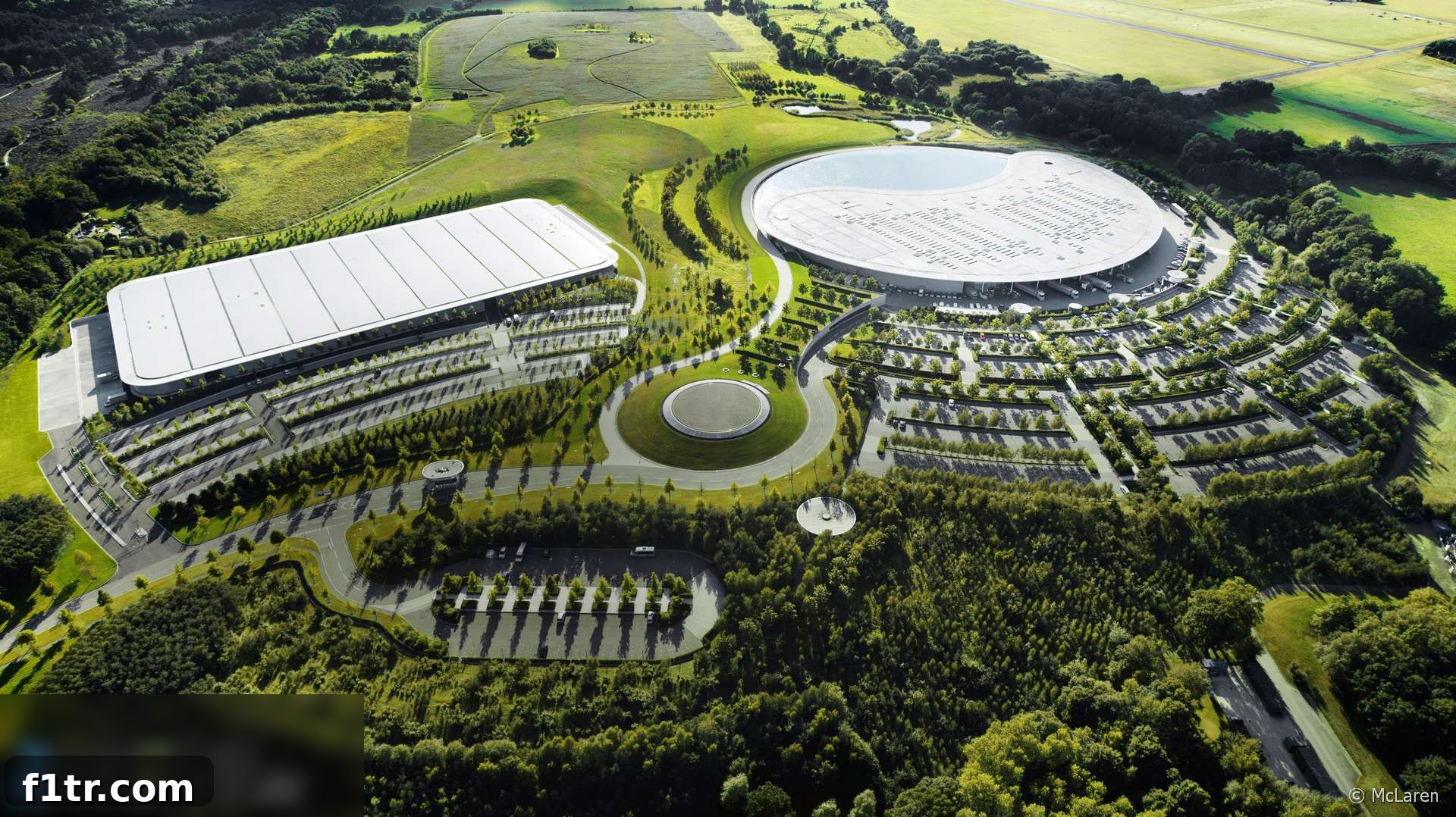
McLaren, one of Formula 1’s most iconic and successful teams, is embarking on a significant strategic investment to bolster its technical capabilities and reclaim its position at the pinnacle of motorsport. The Woking-based outfit has announced plans to construct a brand-new, state-of-the-art wind tunnel at its McLaren Technology Centre (MTC), a move aimed at addressing what has been identified as one of the team’s most critical “big deficits.” This ambitious project signals McLaren’s unwavering commitment to long-term success and technical excellence in the intensely competitive world of Formula 1.
For nearly two decades, since the opening of the impressive MTC in 2004, McLaren’s Formula 1 team has largely relied on an external facility – specifically, Toyota’s larger wind tunnel in Cologne, Germany – for the crucial aerodynamic development of its cars. This arrangement, while functional, presented inherent challenges in terms of logistics, efficiency, and the seamless integration of design and testing processes. The decision to build an in-house wind tunnel marks a pivotal shift, bringing a core technical function back under McLaren’s direct control and supervision.
This substantial two-year project has received unequivocal backing from McLaren’s leadership. McLaren Racing CEO Zak Brown, alongside the team’s dedicated shareholders, Sheikh Mohammed bin Essa Al Khalifa and Mansour Ojjeh, have championed this investment, underscoring their shared vision for McLaren’s future. Their support highlights a broader strategic commitment to provide the team with every necessary resource to compete at the very highest level, echoing McLaren’s rich heritage of innovation and racing success.
Andreas Seidl, the team principal, has been a driving force behind identifying and articulating the need for this crucial infrastructure upgrade. Seidl, tasked with a clear mandate from Zak Brown and the shareholders, explicitly pointed out the absence of a proprietary wind tunnel at Woking as a significant weakness. “One of the big deficits we have at the moment is clearly not running our own wind tunnel in Woking,” Seidl stated, openly acknowledging the challenge. His candid assessment and strategic clarity have been instrumental in pushing forward with this vital investment, aligning with his engineering-focused approach to team reconstruction.
The announcement has been met with widespread enthusiasm within the team, serving as a powerful morale booster. Seidl emphasized the positive impact: “I’m very happy that recently the decision has been made that we install a new wind tunnel in Woking which is obviously a great message for everyone inside the team because it also shows how serious Zak and the shareholders are regarding our way back to the front.” This investment is perceived as a tangible demonstration of leadership’s dedication to returning McLaren to its winning ways, fostering a renewed sense of purpose and belief among engineers, designers, and operational staff.
Seidl firmly believes that aerodynamic development is the single most critical area currently holding McLaren back from challenging the front-running teams. He attributes a substantial portion of the performance gap – estimated at 1.5 seconds or more, depending on the circuit – directly to “aero load.” In Formula 1, aerodynamic efficiency and the generation of downforce are paramount. Every millisecond gained through improved airflow, reduced drag, and optimized grip translates directly into faster lap times. The new wind tunnel will provide McLaren’s aerodynamics department with an unparalleled tool to iterate designs more rapidly, conduct more precise testing, and gain a deeper understanding of their car’s interaction with the air, ensuring that every component is optimized for performance.
The relentless pursuit of aerodynamic excellence is a constant in Formula 1. Teams invest hundreds of millions in research and development, and the wind tunnel remains a cornerstone of this process, even with advancements in Computational Fluid Dynamics (CFD) and simulation software. A modern F1 wind tunnel allows engineers to physically test scaled models of their cars under controlled conditions, collecting vast amounts of data on downforce, drag, and airflow behavior. Having this facility on-site will drastically reduce the logistical complexities and time delays associated with using an external facility, enabling McLaren to accelerate its development cycle and respond more swiftly to performance issues or design opportunities.
Furthermore, the Formula 1 landscape is continuously evolving, with stricter limits on wind tunnel usage expected to come into force from 2021. These impending regulations place an even greater emphasis on efficiency and precision in testing. By investing in a brand-new, cutting-edge facility, McLaren is proactively preparing for these future challenges, ensuring they have the most efficient and effective tools available to maximize their allocated testing time. This forward-thinking approach is crucial for maintaining a competitive edge in an environment where resources are increasingly constrained.
The new wind tunnel is not conceived solely for the Formula 1 team. McLaren’s vision for this significant asset is multifaceted, making it a strategic investment that extends across its various ventures. Seidl confirmed the resource will be shared, stating, “We can share the resource of the wind tunnel with Automotive.” This integration means that McLaren Automotive, the company’s high-performance road car division, will also benefit from the advanced testing capabilities, driving innovation in its future vehicle designs. Beyond its internal divisions, McLaren Racing is actively exploring other motorsport projects, which could potentially leverage the tunnel. “We can share the potential future other motorsport projects at McLaren, Zak is working on that,” Seidl added, hinting at diversification.
Moreover, the facility is designed with commercial viability in mind. McLaren intends to rent out its new wind tunnel to external customers, offering a lucrative revenue stream and maximizing the return on investment. This approach underscores the pragmatic and business-savvy decision-making behind such a large-scale project, transforming a core technical asset into a financially sustainable, multi-purpose hub for advanced aerodynamic testing and development. This strategic move ensures the new wind tunnel will serve as a cornerstone of McLaren’s engineering prowess for decades to come, benefiting not only its F1 ambitions but also its broader corporate objectives.
The two-year timeline for the construction of the wind tunnel means that its full impact on the F1 team’s performance will not be immediate. However, it represents a foundational step towards long-term, sustainable success. This strategic infrastructure project is a clear declaration of intent from McLaren: a commitment to provide its engineers with the best possible tools, foster a culture of technical excellence, and systematically address its weaknesses to forge a path back to championship contention. As McLaren continues its journey to regain its former glory, this new wind tunnel will undoubtedly be a crucial component in realizing those ambitious goals, solidifying its place as a formidable competitor in the world of Formula 1.
2019 F1 season
- Crying in the Melbourne car park at 2019 grand prix was my career low – Ocon
- McLaren Racing reports reduced £71 million loss in 2019
- Kvyat: Hockenheim podium last year was “my biggest achievement” so far
- How the FIA’s new encrypted fuel flow meter targets Ferrari’s suspected ‘aliasing’ trick
- “He smashed my office door”: 23 must-see moments from ‘Drive to Survive’ season two
Browse all 2019 F1 season articles