Suzuka Showdown: Unpacking Team and Driver Performance at the Japanese Grand Prix
The legendary Suzuka International Racing Course once again delivered a captivating spectacle, revealing intriguing shifts in the Formula 1 pecking order. While Mercedes continues to assert its formidable presence as a team to reckon with, this year’s Japanese Grand Prix introduced a compelling new narrative: for the first time in recent memory, a key rival demonstrated a year-on-year performance improvement that surpassed even the reigning champions. This development signals a tightening of competition and promises an exhilarating season ahead, particularly as teams grapple with evolving car regulations and track characteristics. The iconic circuit, known for its high-speed corners and demanding layout, served as a crucial benchmark for evaluating car development and driver skill, setting the stage for an intense weekend of racing.
Team Performance Dynamics: A Closer Look at the Suzuka Grid
The battle for supremacy at the Japanese Grand Prix saw the competitive landscape solidify for the top contenders, largely mirroring the outright one-lap pace observed in China. The front-running quintet of teams showcased remarkable consistency, indicating a clear hierarchy at the sharp end of the grid. However, beneath this stable veneer, significant fluctuations emerged, particularly impacting teams vying for points in the competitive midfield.
Shifts in the Midfield Battle
One of the most notable downturns in performance was observed at Haas. After a comparatively strong showing in Shanghai, the American outfit found itself significantly less competitive at Suzuka, plummeting to eighth-fastest team. This stark contrast highlights the challenges of car adaptability across different circuits and potentially underlying issues with their package on tracks demanding high aerodynamic efficiency and sustained cornering speeds like Suzuka. Such variability can be a critical factor in a team’s championship aspirations, as consistent performance across diverse tracks is paramount.
The unforgiving nature of Suzuka further amplified the performance disparities across the grid. The gap between the best and worst cars widened considerably, underscoring the demanding technical requirements of the circuit. Teams like Cadillac and Aston Martin found themselves struggling, trailing the ninth-fastest team, Williams, by well over a second per lap. This substantial deficit is a cause for concern, indicating fundamental challenges with their current car designs or setup philosophies for this type of circuit. It’s important to note that this wasn’t merely an artifact of track evolution favoring a single driver, such as Carlos Sainz Jnr progressing from Q1 with a later, faster lap; his best Q2 time, for instance, was demonstrably slower, confirming a genuine performance shortfall for these teams.
Audi’s Ascent and Missed Opportunities
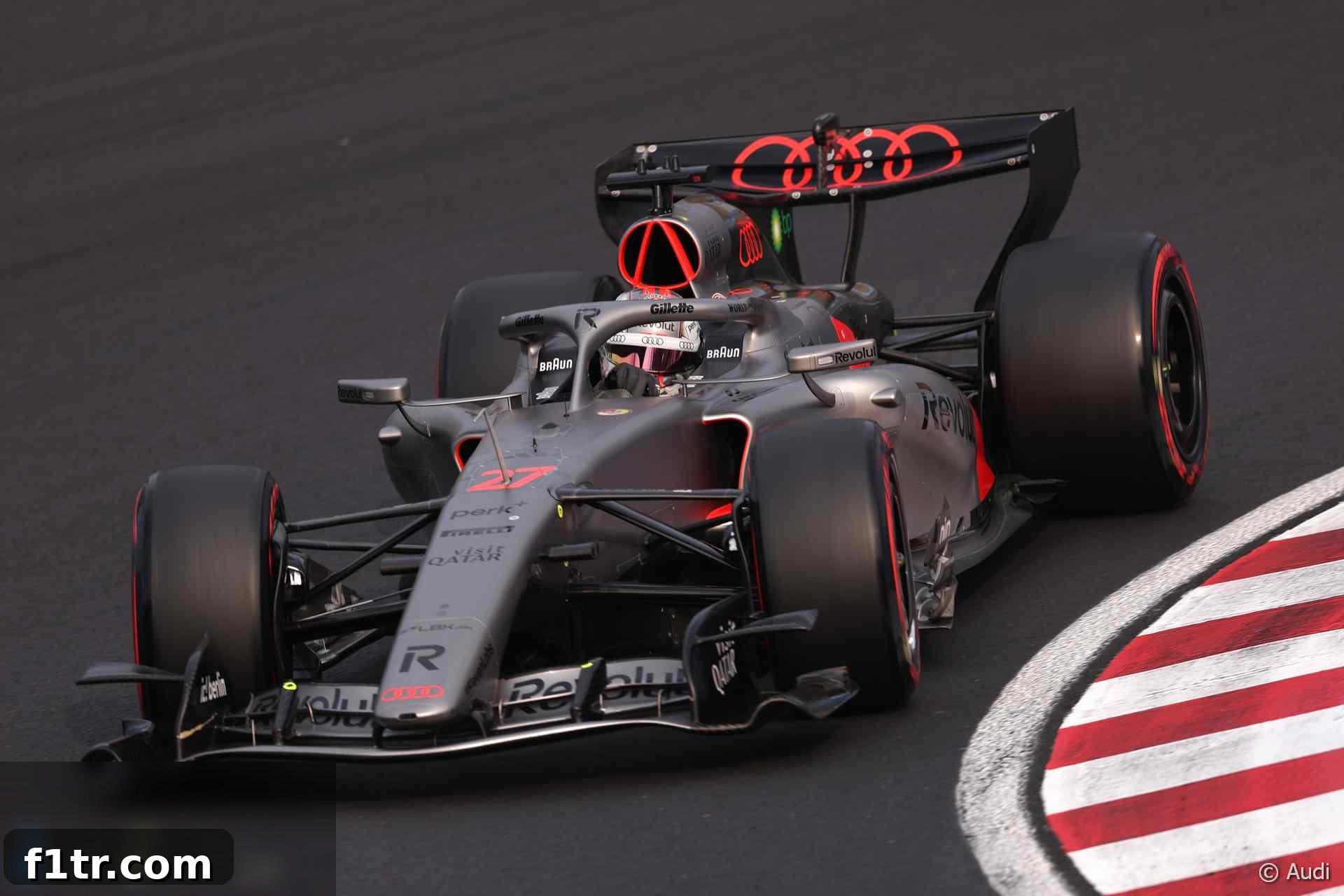
In contrast to the struggles of some, Audi emerged as a standout performer, enjoying a surprisingly strong weekend. The team showcased impressive pace, hinting at significant progress in their car development. A particularly intriguing aspect of their qualifying session was the potential for both cars to secure a top-ten starting position. Had Max Verstappen and Franco Colapinto, two highly capable drivers, not failed to make the cut for Q3, Audi could have easily capitalized on their momentum. This near-miss underscores Audi’s burgeoning competitiveness and their capability to challenge established midfield runners.
Despite the team’s overall strong performance, driver Nico Hulkenberg expressed frustration, stating he failed to produce a truly clean lap in Q2. He actually recorded a slower lap time than he had in the previous qualifying round, suggesting that the car had even more untapped potential. This minor stumble for Hulkenberg, combined with the unexpected exits of other front-runners, paints a picture of Audi on the cusp of a major breakthrough, eagerly awaiting the opportunity to demonstrate their full pace.
Notably, Audi, competing under their previous guise as Sauber, managed to get closest to their best lap time recorded at Suzuka last year. This remarkable consistency, or even improvement, suggests effective car development and a deeper understanding of their package. Mercedes achieved a similar feat in the first two rounds of the season, maintaining their high performance benchmark. This comparison highlights which teams are successfully optimizing their cars and adapting to the evolving technical regulations and track conditions year-on-year, a crucial metric for long-term success in Formula 1.
Support independent motorsport journalism. Your readership keeps us going.
Driver & Sector Analysis: Precision on the Edge
Suzuka’s challenging layout, with its iconic Esses and high-speed turns, demands absolute precision and maximum commitment from drivers. A detailed look at sector times reveals the granular aspects of individual driver performance and where precious tenths can be won or lost. The concept of a “theoretical ideal time” is particularly illustrative here – it represents the fastest possible lap a driver could achieve by combining their best individual sector times from across all their laps. Any significant deficit between a driver’s actual fastest lap and their theoretical ideal time often points to a lack of consistency, small errors that prevent linking perfect sectors, or a struggle to maximize the car’s potential throughout a single, flawless lap.
In this regard, only one driver exhibited a larger disparity between his theoretical ideal time and his actual best lap than Nico Hulkenberg: the formidable Lewis Hamilton. Despite his P5 final qualifying position, Hamilton’s theoretical best lap indicated he had the raw pace to challenge for a second-row start. This suggests that while the Mercedes W15 clearly possessed the speed, Hamilton was unable to string together a completely clean lap, perhaps pushing the limits a little too far or encountering minor imperfections that cost him critical fractions of a second. Such a scenario is common on a demanding circuit like Suzuka, where even the slightest misjudgment can unravel a perfect lap.
Qualifying Sector Times: A Deep Dive into Driver Performance
The table below offers a comprehensive breakdown of qualifying sector times, illuminating individual strengths and areas where drivers might have left time on the table. Each sector at Suzuka presents unique challenges, from the technical first sector to the high-speed and flowing final sections.
| P. | # | Driver | S1 | S2 | S3 | Ultimate lap (deficit) |
|---|---|---|---|---|---|---|
| 1 | 12 | Andrea Kimi Antonelli | 31.827 (4) | 39.398 (1) | 17.464 (1) | 1’28.689 (+0.089) |
| 2 | 63 | George Russell | 31.782 (3) | 39.607 (3) | 17.616 (12) | 1’29.005 (+0.071) |
| 3 | 81 | Oscar Piastri | 31.954 (5) | 39.557 (2) | 17.577 (9) | 1’29.088 (+0.044) |
| 4 | 16 | Charles Leclerc | 31.655 (1) | 39.855 (5) | 17.668 (15) | 1’29.178 (+0.125) |
| 5 | 44 | Lewis Hamilton | 31.762 (2) | 39.933 (6) | 17.625 (13) | 1’29.320 (+0.247) |
| 6 | 1 | Lando Norris | 32.049 (6) | 39.716 (4) | 17.627 (14) | 1’29.392 (+0.017) |
| 7 | 10 | Pierre Gasly | 32.143 (7) | 40.029 (7) | 17.519 (4) | 1’29.691 |
| 8 | 6 | Isack Hadjar | 32.164 (8) | 40.094 (10) | 17.608 (10) | 1’29.866 (+0.112) |
| 9 | 5 | Gabriel Bortoleto | 32.288 (9) | 40.149 (11) | 17.492 (2) | 1’29.929 (+0.061) |
| 10 | 41 | Arvid Lindblad | 32.548 (14) | 40.043 (8) | 17.501 (3) | 1’30.092 (+0.017) |
| 11 | 3 | Max Verstappen | 32.369 (10) | 40.196 (14) | 17.565 (7) | 1’30.130 (+0.132) |
| 12 | 27 | Nico Hulkenberg | 32.400 (11) | 40.181 (13) | 17.564 (6) | 1’30.145 (+0.213) |
| 13 | 31 | Esteban Ocon | 32.481 (13) | 40.048 (9) | 17.700 (16) | 1’30.229 (+0.080) |
| 14 | 30 | Liam Lawson | 32.791 (15) | 40.175 (12) | 17.529 (5) | 1’30.495 |
| 15 | 43 | Franco Colapinto | 32.463 (12) | 40.433 (16) | 17.610 (11) | 1’30.506 (+0.121) |
| 16 | 55 | Carlos Sainz Jnr | 32.844 (17) | 40.434 (17) | 17.576 (8) | 1’30.854 (+0.073) |
| 17 | 23 | Alexander Albon | 32.858 (18) | 40.489 (18) | 17.741 (17) | 1’31.088 |
| 18 | 87 | Oliver Bearman | 32.824 (16) | 40.421 (15) | 17.845 (18) | 1’31.090 |
| 19 | 11 | Sergio Perez | 33.512 (20) | 40.667 (19) | 18.027 (22) | 1’32.206 |
| 20 | 77 | Valtteri Bottas | 33.362 (19) | 40.961 (20) | 17.947 (20) | 1’32.270 (+0.060) |
| 21 | 14 | Fernando Alonso | 33.536 (21) | 41.206 (21) | 17.904 (19) | 1’32.646 |
| 22 | 18 | Lance Stroll | 33.595 (22) | 41.341 (22) | 17.948 (21) | 1’32.884 (+0.036) |
From the data, Andrea Kimi Antonelli’s performance stands out, not only clinching the fastest times in both Sector 2 and Sector 3 but also demonstrating remarkable consistency to achieve a competitive ultimate lap. Charles Leclerc showcased blistering speed in Sector 1, highlighting the Ferrari’s prowess in high-speed, flowing corners, but perhaps struggled to maintain that edge through the more technical later sections. Oscar Piastri’s strong Sector 2 time underlines McLaren’s efficiency through the circuit’s complex middle section. Conversely, drivers like Sergio Perez and Valtteri Bottas faced significant challenges across all sectors, illustrating the profound performance gap for their respective teams.
Your ongoing support helps us deliver in-depth F1 analysis.
Field Performance & Track Dynamics: The Suzuka Resurfacing Enigma
The 2024 Japanese Grand Prix presented a fascinating paradox concerning overall field performance. Despite ongoing advancements in automotive technology, the current generation of Formula 1 cars demonstrated a noticeable decrease in speed compared to their predecessors. On average, the new cars were almost two seconds per lap slower around Suzuka than they were last year. This significant drop in pace places them roughly on par with the performance levels seen approximately three years ago. Several factors could contribute to this trend, including evolving aerodynamic regulations designed to promote closer racing, changes in tire compounds, or a general shift in car design philosophies focused on reliability and race pace over outright single-lap speed.
Adding another layer of complexity to this analysis is the recent resurfacing of the Suzuka circuit. Over the past two seasons, significant portions of the track have been re-laid. A major section was completed last year, with the remaining parts finished just before this year’s race. Typically, a freshly resurfaced track offers improved grip levels due to a smoother, more consistent surface and often a higher coefficient of friction. This usually translates to faster lap times, as cars can carry more speed through corners and benefit from better traction.
However, the observed slower lap times this year, despite the resurfacing, create an interesting conundrum. This discrepancy suggests that while grip levels might have indeed improved, other factors are having a more dominant influence on overall car performance. It could indicate that the current cars are less suited to fully exploit the enhanced grip, perhaps due to their inherent aerodynamic characteristics, suspension setups, or the specific tire compounds chosen for this event. Alternatively, the new surface might be more abrasive or have different thermal properties, impacting tire degradation in ways that compel teams to run more conservative setups. Understanding this interplay between car design, tire performance, and track evolution is key to deciphering the true performance landscape of modern Formula 1.
Support independent motorsport journalism. Your readership keeps us going.
Stay Connected with All the Latest from the World of F1
Receive our daily email newsletter featuring all the latest stories, exclusive analyses, and breaking news – with no marketing or ads. Sign up here to never miss a moment:
Experience Ad-Free Browsing and Exclusive Content
>> Support our work and enjoy an uninterrupted experience.
More from the 2026 Japanese Grand Prix
- Alpine denies “sabotaging” Colapinto and criticises social media “hate” posts
- Verstappen starts season with lowest score over three rounds since his debut in F1
- Poor starts a ‘very high priority’ for Mercedes as drivers lose 21 places in four races
- “Two balls of steel!” How Leclerc won his battery battle with Hamilton and Russell
- Was Bearman right to question Colapinto’s role in his huge Suzuka crash?
Browse all 2026 Japanese Grand Prix articles