Vijay Mallya and the Fight for Force India’s Future in Formula 1
At the midway point of the 2018 Formula 1 season, the Force India team found itself at a crucial juncture. Having consistently finished an impressive fourth in the constructors’ championship for two consecutive years, they had slipped to sixth. This on-track performance dip coincided with significant legal challenges faced by the team’s flamboyant co-owner and principal, Vijay Mallya, who had recently stepped down as managing director. Despite the swirling uncertainties, Mallya, in an exclusive interview, conveyed a message of resilience and hope, affirming his belief in “light at the end of the tunnel” for Force India.
The Maverick Owner: Vijay Mallya’s Enduring Passion for Motorsport
Vijay Mallya’s life has been defined by two great sporting passions: cricket and motor racing. Born into considerable wealth, primarily amassed through liquor trading, he possessed the means to pursue these interests both as a competitor and, later, as a team owner. His personal racing journey included competing in Indian Formula Libre, even utilizing Ensign F1 chassis, showcasing his deep-seated connection to the sport from an early age.
Mallya’s foray into Formula 1 as a sponsor began in 1996, with his Kingfisher lager brand adorning the Benetton cars during their post-Michael Schumacher era. Over a decade later, in 2007, his “Fly Kingfisher” messages were prominently displayed on Toyota’s TF107, a deal reportedly facilitated by the then-F1 supremo, Bernie Ecclestone, who had prior dealings with Mallya, having acquired one of the rare surviving Vanwall cars from him. Beyond commercial interests, Mallya also represented India on the prestigious FIA World Motorsport Council, a position he relinquished in July 2017 as his mounting legal issues confined him to London, where his passports had been seized.
Advert | Become a Supporter & go ad-free
Despite his personal predicaments, Mallya’s credentials as a serious F1 stakeholder were undeniable when he acquired the struggling Spyker team in late 2007. This acquisition marked the beginning of what would become Force India. The team, with a storied past tracing back through Midland and Jordan, was in dire need of investment and direction. Mallya initially secured a 70% stake, with the Dutch Mol family, previous Spyker shareholders, holding the remaining 30%. Through a debt-for-equity swap and subsequent transactions, this ownership structure evolved. By 2011, Mallya had sold half of his stake to Subrata Roy’s Sahara Group, leading to an 85/15 split in favor of the combined Mallya/Sahara entities.
Force India’s Ascent: A David Among Goliaths
Entering Formula 1 as an independent team in the late 2000s was a daunting proposition, fraught with considerable financial and competitive risks. The sport’s grid was heavily populated by powerful manufacturer teams such as BMW Sauber, Toyota, Honda, and Renault, while Ferrari enjoyed overt backing from Fiat, and McLaren maintained a strong equity relationship with Mercedes. The independent faction was comparatively small, comprising Williams, two Red Bull-owned outfits, the ambitious but short-lived Super Aguri, and Spyker – the team Mallya had just purchased, which was languishing at the back of the field.
Indeed, in the 2007 constructors’ standings, Spyker officially placed 10th. However, this position was skewed by McLaren’s disqualification from the points due to the infamous “Spygate” scandal. In practical terms, the team Mallya had acquired concluded its previous campaign in 11th place, effectively at the very bottom of the competitive pecking order.
The dawn of the Force India era in 2008 brought continued struggles, with the team enduring a painful streak of 29 races without scoring a single point. However, their fortunes dramatically changed in 2009. The Belgian Grand Prix that year proved to be a double jackpot. Giancarlo Fisichella, against all odds, secured pole position and went on to finish a stunning second, narrowly losing the lead to eventual winner Kimi Räikkönen. This incredible performance was followed by another strong showing in Italy, where Adrian Sutil secured a remarkable fourth place. These breakthrough results propelled Force India to a respectable tenth place in the overall classification, finishing ahead of Super Aguri.
This marked the beginning of Force India’s remarkable ascent up the Formula 1 rankings. The team secured ninth place in 2010, ahead of Toro Rosso, and continued its steady climb: seventh in 2010 and sixth in 2011. This consistent performance was maintained in 2012 and 2013, followed by another sixth-place finish in 2014. The subsequent three years saw Force India achieve an extraordinary fifth place, a feat that drew both admiration and chagrin from the more established, factory-backed teams. As the top-placed ‘outsider’ team, Force India earned a coveted seat on the influential Strategy Group, granting them a voice in the sport’s future direction. This was followed by two highly impressive fourth-place finishes, cementing their reputation as fierce competitors operating on a significantly smaller budget. By the midway point of 2018, as this interview took place, they were positioned sixth, a testament to their enduring competitiveness.
Navigating Legal Storms: Vijay Mallya’s Personal Battles
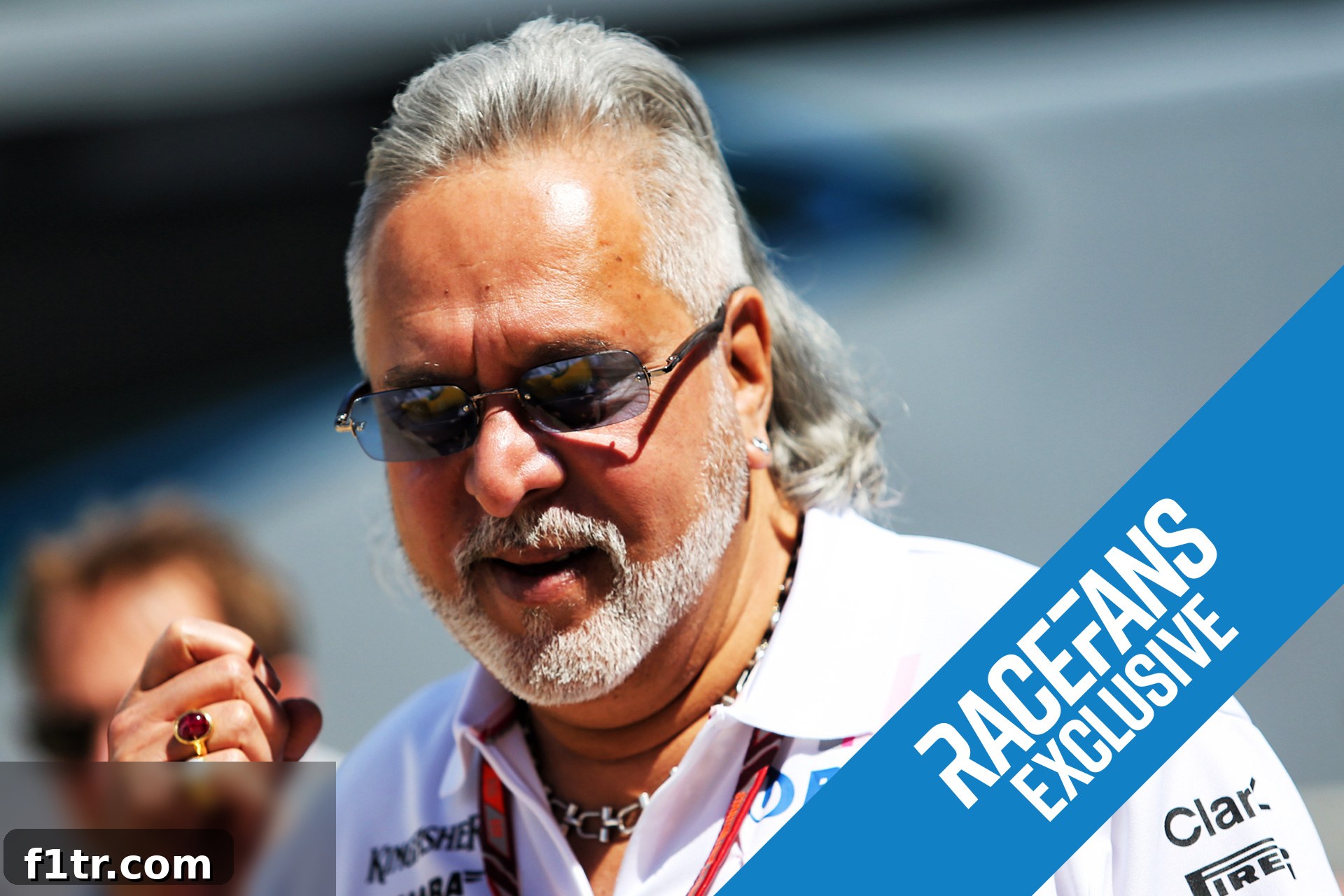
The history of Force India’s journey, particularly its consistent overachievement, provides crucial context to the questions posed to Vijay Mallya during our interview. Held in Force India’s distinctive ‘Pink Palace’ – a nickname given in honor of sponsor BWT – shortly before the British Grand Prix, this meeting marked Mallya’s first grand prix attendance in 12 months, a direct consequence of his ongoing extradition proceedings in London, which restrict his ability to travel internationally.
Despite facing severe fraud allegations, which he vociferously denies, Mallya appeared remarkably relaxed throughout the interview. He spoke slowly and deliberately, pausing occasionally for emphasis, never to backtrack or retract a statement. The core of the charges against him revolves around the collapse of Kingfisher Airlines. Launched in 2005, the airline rapidly expanded to become India’s second-largest carrier. However, it subsequently encountered severe difficulties as the global economic crisis took hold, contributing to the failure of numerous airlines worldwide.
Mallya maintains that he is largely a victim of complex economic circumstances compounded by Indian politicking, having served as an MP both as an independent member and a party representative. Regardless of the legal and political intricacies, which he insists have no bearing on his Formula 1 interests, he has been relentlessly pursued both within and outside India. He recently issued a lengthy explanation on social media, asserting that he had offered assets equivalent to $2 billion as security in settlement. This claim was corroborated by a Reuters reporter based in India, who, however, added the important caveat that “some of the security is in the form of attached assets,” while confirming that these assets indeed belonged to Mallya or his associated companies. As the matter continues to rumble on, a critical question emerges: Are Force India’s assets included in this $2 billion offer?
“Absolutely not,” Mallya states unequivocally. “These are Indian assets only. The matter concerns Indian banks, Indian loans, Indian borrower, Kingfisher Airlines Limited, backed by assets in India. Why shift the problem overseas?” This clarification underscores his position that his personal legal battles are distinct from the team’s financial standing.
To further complicate matters for Force India, Mallya’s co-owner, Subrata Roy of the Sahara Group, was also facing significant legal challenges. These included allegations of failing to return funds to investors, leading to his incarceration after failing to appear in court. Although he was out on parole at the time, Roy was clearly not in a position to contribute financially or operationally to Force India. Despite these intertwined difficulties, Mallya, who had recently stepped down as managing director, remained the primary driving force behind the team. Given the potential for his personal fate to impact the team, I asked if he had secured Force India’s future irrespective of his own legal outcome.
A momentary pause made it clear that Mallya had grown weary of this frequently asked question. Then, with renewed resolve, he responded: “Absolutely, that’s always been the case. I mean, the problems that Sahara and I are confronted with are not new; they’ve been going on for over three years. And, within this period, we finished fourth in the world championship two years in a row. So, that in itself is pretty obvious that our troubles are not affecting the team.”
Financial Resilience: Securing Force India’s Operations
While Mallya’s confidence was evident, the lingering question remained: was he feeling the financial pinch, and was he still in a position to underwrite Force India’s activities, whether through direct loans or sponsorship from associated companies? “No, that’s not true,” he shot back emphatically. “Two weeks ago, I put two billion dollars’ worth of assets in front of the High Court. I asked them to be sold under judicial supervision to pay off everybody, all the claimants, and to return the balance.”
“Bottom line is I have the assets, which I’ve offered before the court – the list is there for the world to see. On the other hand, as far as the team is concerned, we have much bigger external sponsors, other than internal sponsors, than we’ve had before. So, you see the economics, how they work.” Indeed, a visual assessment of the team’s cars and branding revealed virtually no visible Mallya- or Sahara-related funding. Force India was by then relying predominantly on external sponsors, notably BWT, and driver-linked support, particularly attracted by the consistent performance of Sergio Perez. It’s important to note the significant distinction between ‘pay-drivers’ who bring funding regardless of performance, and high-performing drivers whose talent attracts sponsors eager to associate with their success – a category that includes talents like Fernando Alonso, Valtteri Bottas, and Perez.
“At the end of the day, the backing is mostly external now, which has changed over the last two or three years. Of course, prior to three years ago, it was the other way around,” Mallya explained. “The management team’s objective is to make the team self-sustaining and not to rely every year on shareholder support. I mean, why are the shareholders owners of a Formula One team? Not to keep dipping into their pockets to have two cars run around. So ultimately, the objective is that the performance should justify sponsorship, which in turn will justify the economics.”
When pressed about the team’s alleged debts, Mallya’s response was swift and unequivocal: “There is no debt. There is no external borrowing at all. Zero. Obviously, we have creditors; any running business owes money to creditors.” He reiterated, “Any running business owes money to creditors.” While conceding that some accounts “are more overdue than others,” he quickly added, “there’s nothing that has showed up in 2018.”
To put Mallya’s statements into perspective, let’s examine the numbers. In the preceding year, Force India’s budget amounted to approximately £97 million. Of this, £55 million was derived from Formula 1 revenues, leaving the team to secure a substantial £42 million from other sources. Sponsor income, primarily from BWT and various smaller streams, contributed an estimated £35 million. This left a shortfall of approximately £7 million, which was typically funded partly by third-party income (such as test drivers or miscellaneous earnings) and, if necessary, by the shareholders. While Mallya’s point about creditors being a normal part of business is valid, it’s crucial to acknowledge that over the past decade, since he and other shareholders invested in the team, F1’s economic and political landscapes had undergone a radical transformation. The sport was characterized by excessive bonuses – some of which exceeded Force India’s entire annual budget – paid to major teams, often by virtue of their historical presence and their seats on the powerful Strategy Group, creating an inherently unequal playing field.
The Future of F1 and Force India’s Strategic Position
Given this skewed financial environment, a pressing question was whether Force India could survive until sanity prevailed at Formula One Management (FOM) from 2021 onwards. From that year, revenues were expected to be disbursed on a more performance-based model, rather than on increasingly nebulous concepts of “heritage.” Mallya acknowledged the current disparity, stating, “As I basically said during one of our internal discussions, there’s two more years of pain with this grossly unfair imbalance in the income distribution.”
However, his outlook beyond 2020 was optimistic. “And from 2021, as discussed in Bahrain [where FOM presented its proposed post-2020 structures], when things get smoothed out, yes. We have a lot to look forward to in terms of the redistribution of the prize fund.” This prospect of a more equitable revenue distribution from FOM after 2020 provided a tangible “light at the end of the tunnel.”
Could this long-term vision be the underlying reason for Mallya’s consistent refusal to entertain genuine and speculative offers to purchase the team – offers, of which at least one of each type were known to exist? The belief was that the team’s intrinsic value would significantly rise once FOM implemented its more equitable revenue distribution. Mallya agreed with this assessment: “There is light at the end of the tunnel; any prospective buyer I think will have also seen that. With far more income, obviously the value of the team goes up, and until then, we are used to, culturally, working off a tight budget and extracting the maximum performance out of that tight budget.”
There was certainly no arguing with that assertion. Over the preceding three years, Force India had consistently been recognized as the best team in Formula 1 in terms of ‘bang for buck,’ delivering exceptional performance relative to their budget. Based on their current trajectory and underlying capabilities, they were poised to continue this remarkable trend in 2018.
Leadership in Absentia: Mallya’s Role and the Team’s Management Structure
Mallya’s resignation as managing director had, naturally, sparked a fresh wave of speculation regarding the team’s future and the extent of his ongoing involvement. However, he downplayed the significance of this move. “Yes… as a director, I’m not on the board. But you know, at the end of the day, if you walk up and down this paddock, how many members of the board of directors of anyone of these companies do you see? At the end of the day, in this sport and on matters relevant to the sport, such as the F1 Strategy Group, the F1 Commission et cetera, it is a team principal format and I am team principal. Simple.”
While his statement highlighted the importance of the Team Principal role, his specific case was undeniably different due to his inability to travel. This meant he could not attend races, or crucial FIA or F1 Commission meetings unless they were held within the United Kingdom. This raised the critical question of who then carried the responsibility and authority in his absence. “Otmar goes; Bob goes,” he clarified, referring to Chief Operating Officer Otmar Szafnauer and Deputy Team Principal Robert Fernley, respectively. Fernley, in particular, was a long-time friend and confidante of over 30 years, whom Mallya had met during his Ensign racing days. A former F2 racer, Fernley had previously sold used racing cars before establishing his own IndyCar team.
The next logical question was whether Szafnauer and Fernley possessed full authority to act independently, or if they were required to report back to Mallya first. “On issues, on sporting regulations, on technical regulations, we have protocols,” he explained. “If the matter concerns technical regulations, then obviously (technical director) Andrew Green is consulted, his inputs are taken. Otmar, Bob and me discuss, and then we put forth Force India’s point of view. When it comes to sporting regulations, Andy Stevenson is obviously consulted and involved; we collectively decide and put forth Force India’s point of view.” This detailed explanation showcased a well-defined and functional decision-making structure designed to operate effectively even with Mallya’s travel limitations. The team’s continued strong on-track performance and solid political standing within F1 served as clear evidence that these protocols were indeed working.
So, why then did he resign from the managing director position? “It was a question of in India you have to declare all your directorships. If you’re a director of an Indian company, you have to fill up forms that disclose your global directorships, all the time. Globally, you have to. So, I’ve quit most of the boards because there’s no point wasting time in just filling up one form after another. It’s impractical.” Mallya further insisted that he remained very much in control, emphasizing that his shareholders trusted him implicitly and denying any link between his resignation and negative perceptions surrounding his association with the team. “I’m not going to analyze it or comment on it,” he responded when invited to address such speculation. He added, “I don’t know who gave that reason, but here I am, sitting as team principal, and to me, the sport and our participation in this sport is what matters.” He further highlighted, “Let’s add another dimension to your questions. If you are suggesting that my ownership in this team is potentially under threat or at risk, it’s only 42.5%. The other two have 57.5% majority control.”
The Path Forward: Hope for Resolution
Ultimately, the realism of any threat to his position at Force India hinges on the resolution of his legal challenges. “It’s all a legal process now. That’s going to be decided by courts going forward. As long as the judicial process takes. I’ve tried to put an offer together by offering two billion dollars’ [equivalent] of assets in front of the High Court in India, and hopefully the judges will look at it positively, and if everybody is paid and everybody is happy, hopefully these problems should go away.”
If this offer were to be accepted, would it simply be business as usual for him? “Hopefully, yes,” he responded. The crucial factor, however, remains the timeframe. “I don’t know. It’s in the hands of the judiciary.”
With that, Vijay Mallya prepared to head to the pit wall, a familiar sight he hadn’t experienced in 12 months. His life, currently embroiled in complex legal battles, was certainly a far cry from the straightforward game of cricket he once loved.