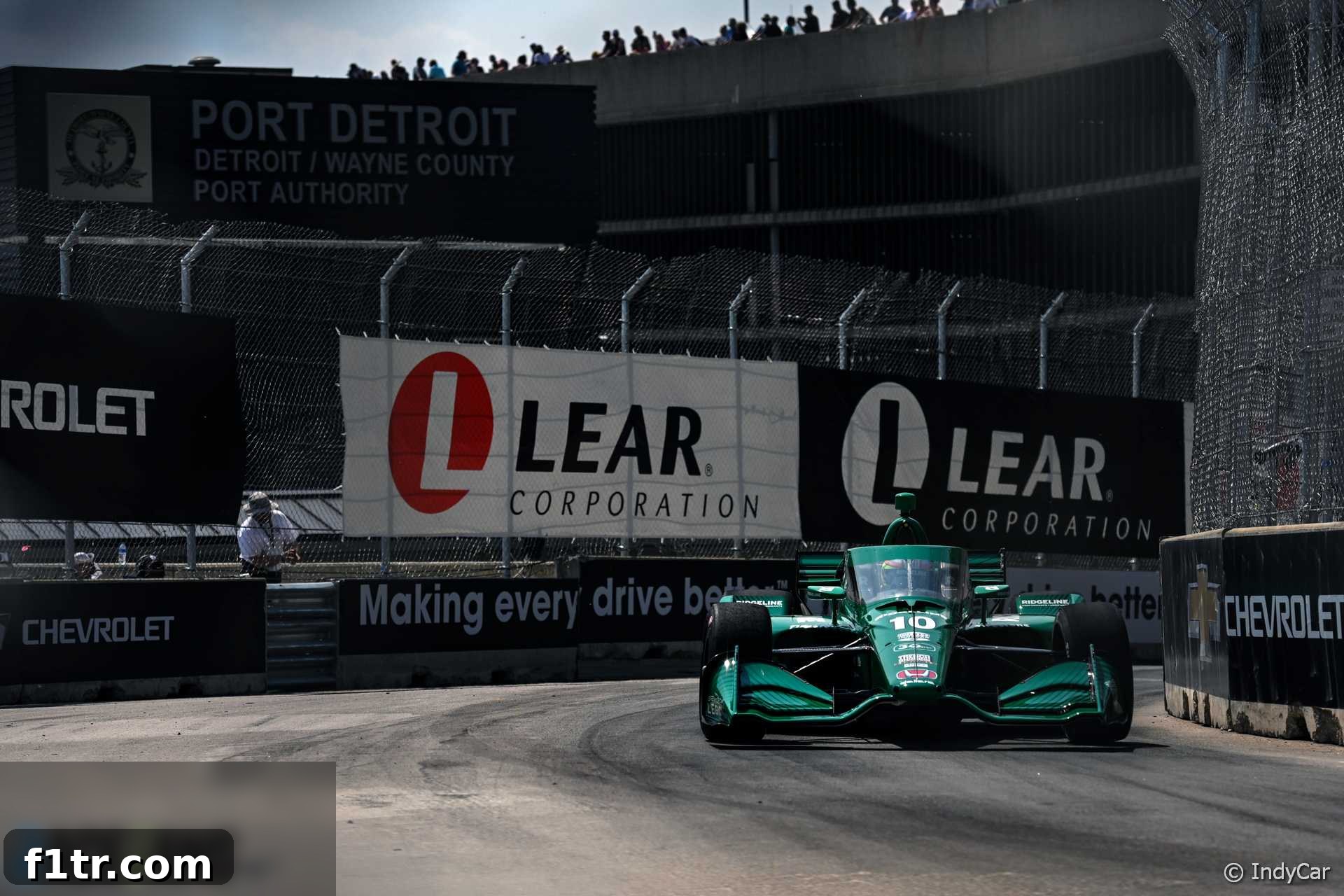
Alex Palou Claims Pole Position, Yet Slams New Detroit IndyCar Street Circuit Design
Spanish racing ace Alex Palou clinched a commanding pole position at the much-anticipated Detroit Grand Prix, marking the first time the NTT IndyCar Series has graced its brand-new downtown street circuit. However, his on-track triumph was quickly followed by a candid and pointed critique of the circuit’s design and its suitability for the demands of modern open-wheel racing. Palou’s remarks shed light on the inherent challenges of integrating high-speed motorsport into a bustling urban environment.
The 2.64-kilometer (1.64-mile) downtown circuit, inaugurated this year as the successor to the Belle Isle course, has been a focal point of intense discussion and considerable driver criticism since its debut yesterday. Palou, fresh off his qualifying success, articulated his concerns clearly, stating that the track’s current configuration simply does not measure up to the high standards expected for an IndyCar Series venue.
Palou’s Scathing Critique: “Too Tight, Too Short, Too Bumpy, Too Much Traffic”
In a direct and unequivocal assessment, Alex Palou laid bare the fundamental issues he perceived with the new Detroit street circuit. “It’s too tight for IndyCars,” he declared, highlighting the restrictive nature of the track’s width. He continued, “It’s too short for IndyCars. There’s too much traffic. It’s too bumpy.” This comprehensive list of grievances from the pole-sitter paints a clear picture of a circuit struggling to accommodate the high-speed, demanding characteristics of NTT IndyCar Series machinery and the close-quarters racing it aims to deliver.
The concerns regarding the circuit’s brevity and narrowness resonated throughout the IndyCar paddock, with many drivers echoing Palou’s sentiments. With 27 powerful IndyCars competing on a track that spans just 2.64 kilometers, the average track distance allocated per car is less than 100 meters. Palou emphasized the logistical nightmare this creates, particularly during crucial practice and qualifying sessions when drivers are pushing for clear air and optimal lap times.
“I think if we’re doing 62-second [laps] and there’s 27 cars, it’s like 2.4 seconds for each car, when everybody wants a five-second gap,” he explained. “Then you end up having traffic every lap like we saw in practice two.” This relentless congestion significantly impedes drivers’ ability to achieve clean, uninterrupted laps, hindering their setup validation and ultimately compromising both safety and performance optimization. The constant interruptions due to yellow and red flags disrupt momentum and prolong sessions, adding to driver frustration.
Palou offered constructive suggestions for improvement, indicating that a more substantial lap length would dramatically alleviate the current issues. “I don’t know what the perfect distance is, but I would say adding 30 seconds to the track or 20 seconds would help a lot,” he proposed. The current grid size, while a positive indicator of the series’ strength and popularity, becomes a significant drawback on such a compact circuit. “We have a lot of cars. It’s crazy. It’s good, it’s really good for the series, for the racing. But when it comes to practice, we have 10 red flags, 25 yellows, traffic all the time.” This conundrum highlights the need for circuits capable of safely and efficiently managing a large field, especially during the critical developmental stages of a race weekend.
Navigating the Design Flaws: 90-Degree Corners and Pit Lane Entry
Beyond the overall length and tightness, specific architectural elements of the new Detroit street circuit have attracted considerable criticism. A dominant feature of the track’s ten turns is their abrupt, 90-degree nature. This characteristic, common in many temporary street circuits, often restricts natural overtaking opportunities and fosters a stop-and-go racing rhythm rather than the high-speed, flowing sections that IndyCar machines excel on. Many drivers have openly expressed their dissatisfaction with this repetitive corner profile, suggesting it leads to a less engaging and more physically demanding driving experience.
A particularly contentious design point centered around the pit lane exit, which is unusually situated directly adjacent to the entrance of Turn 1. This proximity created a significant safety hazard, raising the potential for high-speed collisions between cars rejoining the track from the pits and those on a hot lap. Following extensive feedback from drivers and teams after the initial day of practice, race control swiftly intervened. The pit lane exit line was promptly redrawn in an effort to mitigate the immediate risk of incidents and to provide a clearer, safer racing line through the demanding opening corner.
Prioritizing Safety and Flow at Turn 1
Palou shared his perspective on the emergency adjustments and the inherent complexities of Turn 1. “I think you have to kind of give a little bit of advantage or priority to the guy that is on track,” he stated, reinforcing the conventional racing etiquette that dictates prioritizing cars already up to speed and committed to their racing line. “I think that’s fair. There was not much more margin to do anything differently because it’s, I don’t know, 400 feet to the first corner.” He did, however, express some appreciation for the re-drawn line, acknowledging its positive impact: “I honestly like that because otherwise I think the issue was that we couldn’t go enough to the right, so Turn 1 was even tighter.” This minor modification, while not a holistic solution, demonstrated a responsive effort to address critical safety concerns on a track that many felt was fundamentally compromised in its initial design.
The Allure and Inherent Challenges of Urban Street Racing
The strategic decision to relocate the Detroit Grand Prix from its long-standing home on Belle Isle back to the vibrant downtown streets was primarily driven by a desire to immerse the thrilling spectacle of IndyCar racing directly within the city’s core, making it more accessible to residents and visitors. Urban street circuits, by their very nature, offer a unique and compelling visual, juxtaposing high-performance motorsport against iconic cityscapes. However, this urban integration often comes with inherent trade-offs in track design and functionality. Unlike purpose-built road courses or dedicated ovals, street circuits are constrained by existing infrastructure, public roads, and the rigidities of urban planning. This frequently results in layouts that are tighter, bumpier, and feature more repetitive corner profiles. The new Detroit circuit exemplifies these challenges, underscoring the delicate balance required between urban accessibility and the creation of an optimal racing environment.
In contrast, the previous Belle Isle circuit, while also a temporary facility, offered a distinct character. Its wider layout and more flowing, tree-lined sections were generally more accommodating for IndyCar’s powerful machines, enabling higher average speeds and a greater variety of racing lines. The transition to the downtown core, though ambitious in its vision, appears to have introduced a new set of compromises that elite drivers like Alex Palou are acutely experiencing and vocalizing. The pursuit of bringing racing closer to the people must always be balanced with the fundamental requirements for safe, competitive, and spectacular motorsport.
Pole Position’s Mixed Blessings and the Race Day Outlook
Despite his trenchant criticisms of the circuit, Alex Palou remained keenly aware of the significant achievement of securing pole position. “I think I’m the happiest driver at the moment starting on pole, so I cannot complain too much,” he admitted, a testament to the fiercely competitive spirit that drives these athletes. Starting from the very front of a densely packed field on such a challenging street circuit offers a distinct strategic advantage, potentially allowing him to navigate the initial chaos and tight corners more safely and control the pace.
Nevertheless, the pervasive potential for incidents loomed large, a concern vividly underscored by events in the support categories. Palou recalled a harrowing moment from the Indy NXT race, which served as a cautionary tale: “I was watching Indy Nxt, the guy starting on pole ended up on the fence on the braking zone,” he shared, referring to Louis Foster’s unfortunate and abrupt exit at Turn 3 shortly after the start. This incident served as a stark reminder of the unforgiving nature of the new Detroit layout, where even starting from the most advantageous position offers no absolute guarantee against the unpredictable challenges inherent in urban street racing.
Looking ahead to the main event, Palou acknowledged the demanding nature of the race ahead. “It’s going to be really important, but at the same time it’s a hundred laps. It’s going to be a long day.” His pole position provides a crucial initial advantage, but the race itself will be an arduous test of endurance, strategic acumen, and precise driving on a circuit that has already proven to be a formidable adversary for even the most skilled competitors. The criticisms voiced by Palou and his peers will undoubtedly ignite further discussions about the long-term viability and potential necessary refinements for the Detroit Grand Prix’s new downtown home, with the aim of ensuring future iterations achieve a better balance between urban spectacle and world-class motorsport.
More IndyCar News and Features
- IndyCar driver McLaughlin cleared of injury after crashing through barrier at Barber
- Schumacher says his IndyCar feels like ‘an F2 car, just with better tyres’
- IndyCar “way faster than Formula 1” in some corners, says Grosjean
- FIA to award more F1 superlicence points to IndyCar drivers from 2026
- Schumacher to race full-time in IndyCar with RLL in 2026
Browse all IndyCar articles