Ferrari’s ‘Luxury Problem’: Navigating the Intense Vettel-Leclerc Rivalry
Advert | Become a Supporter & go ad-free
Ferrari team principal Mattia Binotto found himself in an unenviable yet highly sought-after position: managing a fierce internal driver rivalry that culminated in a disastrous on-track collision. While the sight of two scarlet SF90s eliminating each other from contention was a public humiliation, it was, as McLaren’s Andreas Seidl observed, a “luxury problem” – a challenge only faced by teams with two drivers capable of fighting at the very front.
Seidl, whose team was not yet in a position to contend for victories, acknowledged the inherent difficulties. “It’s obviously a challenge to handle two drivers who are at the same level, especially when it’s about fighting for podiums and wins,” he remarked after Sebastian Vettel and Charles Leclerc collided. He added, “At the same time, I’m looking forward to having this luxury problem at some point in the future, having two drivers fighting for podiums or wins and then having the challenge to deal with this as a team.”
Binotto’s Perspective: A Costly Learning Opportunity
Despite the crushing disappointment of seeing both cars out of the race due to a mere tap, Binotto attempted to frame the incident as a learning curve. “I think overall it’s still a luxury,” he stated. “The fact that what happened, I would say even [it’s] lucky it happened this season because at least there will be opportunities to clarify with them in the view of next year, I mean [for it] not to happen. So I’m happy to take the opportunity of what happened at least to clarify with them for the future.”
This “clarification” was a recurring theme throughout the season, as Ferrari grappled with the age-old Formula 1 conundrum: how to unleash the maximum potential from two incredibly talented drivers without them ultimately becoming each other’s biggest rivals, or worse, their own undoing. For decades, F1 team principals have struggled to ensure their star drivers push the car to its limits without pushing each other off the track.
A History of Hierarchy: Ferrari’s Approach to Driver Management
Historically, Ferrari has often leaned on a de facto number one driver policy to manage internal competition. This unacknowledged but often practiced strategy ensured team stability and a clear championship focus, even if it sometimes meant controversial team orders. Instances like Michael Schumacher’s era, where Rubens Barrichello was famously asked to “let Michael past for the championship,” or the Fernando Alonso years, with the infamous “Felipe, Fernando is faster than you” radio message to Felipe Massa, underscored this approach.
Even during the pairing of two world champions, Sebastian Vettel and Kimi Raikkonen, Vettel often enjoyed preferential status. Raikkonen, known for his calm demeanor, was a more acquiescent teammate, rarely challenging the established pecking order. This system, while sometimes criticized, provided clarity and minimized internal conflict, allowing the team to focus its resources on a single championship bid.
The Leclerc Effect: A New Dynamic
The arrival of Charles Leclerc to replace Raikkonen marked a significant shift. While many viewed it as a natural progression, bringing in the next generation of talent, it also signaled a potential challenge to Vettel’s established role. Vettel’s championship battles with Lewis Hamilton in 2017 and 2018 had provided Ferrari with too many reasons to doubt his ability to consistently deliver, paving the way for Leclerc’s promotion.
Despite this, Ferrari initially made it clear that Vettel was expected to lead their championship charge. Binotto affirmed that in any 50-50 strategic decisions, the more experienced, four-time world champion would be favored. However, from their very first race together as teammates, it became evident that things would not be so straightforward. Leclerc’s raw pace and ambition were undeniable, immediately disrupting Ferrari’s carefully laid plans for a clear hierarchy.
Early Season Tensions: Challenging the Status Quo
The 2019 season quickly became a saga of escalating tensions and tactical missteps in managing the burgeoning rivalry. In the final laps of the Australian Grand Prix, when Leclerc closed in on Vettel, he explicitly asked the pit wall if he was permitted to fight his teammate. The answer was a firm “no,” and despite a car advantage that could have easily seen him pass, Leclerc complied, staying behind.
This compliance, however, was short-lived. At the very next race in Bahrain, Leclerc, demonstrating superior pace, was told to hold behind Vettel for two laps. He didn’t. Instead, he boldly passed Vettel and charged towards what should have been his maiden F1 victory, only for misfortune to intervene with a late engine issue. This incident was a clear indicator that Ferrari’s initial attempts to impose order were proving ineffective.
The situation didn’t improve in China. Leclerc was again ordered to let Vettel through. He complied, but Vettel failed to make any significant ground on their rivals, while the time Leclerc lost allowed Max Verstappen to jump him. These early incidents highlighted Ferrari’s struggle to enforce team orders effectively, often leaving one driver feeling disadvantaged and the other failing to capitalize.
Advert | Become a RaceFans supporter andgo ad-free
Post-Summer Resurgence and Heightened Drama
As the season progressed, the inherent shortcomings of the SF90 became a more pressing concern than the internal driver relations, temporarily quieting the flashes of tension. However, after the summer break, Ferrari hit its stride, rediscovering winning form and consistently challenging for victories. With newfound competitiveness, the driver rivalry intensified dramatically.
At Spa, Leclerc convincingly outpaced Vettel. But it was in Ferrari’s own backyard at Monza, arguably the most important race for the Scuderia, that the tensions reached a fever pitch during qualifying. The team orchestrated a strategy for Q3, intending to give each driver the benefit of a slipstream (tow) from the other for one lap. Leclerc received Vettel’s tow on the first run, and the plan was for this to be reversed on the second run.
What unfolded was a chaotic sequence of events that left many questioning Leclerc’s intentions. While the Ferrari drivers left the pits in the correct order, Vettel passed Leclerc early on the out-lap. The final runs were further complicated by drivers from rival teams deliberately driving slowly to avoid leading the queue and giving away a tow. Although Leclerc should have led Vettel on the out-lap as per the plan, Vettel changed the running order. Leclerc’s opportunity to regain position was severely limited by the lack of time and the intervention of other cars, notably Carlos Sainz Jnr passing both Ferraris.
Despite these mitigating factors, Ferrari’s dissatisfaction with Leclerc was evident. Binotto’s radio message to Leclerc after the race – “today you are forgiven” – was telling. Binotto later commented on the situation in Brazil: “It’s true that in Monza it has not been an easy situation to manage. They had to clarify, they spoke together face to face, openly.”
Strategic Maneuvers and Defiance
Vettel endured a particularly challenging race at Monza, spinning out, colliding with another car, and failing to score. Perhaps in an attempt to rebuild his confidence, the team’s strategy in Singapore appeared to favor him. Leclerc again led the way, but Ferrari’s efforts to get Vettel ahead of Hamilton inadvertently put him ahead of Leclerc too. The team could have easily reversed the running order to restore Leclerc’s lead, but that would have meant issuing an unwelcome instruction to Vettel, a call they seemed hesitant to make.
Binotto might have already suspected that Vettel would defy such an order anyway. The subsequent race in Sochi, Russia, proved this suspicion utterly correct. The team radio messages and post-race comments revealed Ferrari’s pre-race strategy: Leclerc, starting on pole, was to give Vettel, starting third, a slipstream to help him pass Hamilton. Crucially, if this maneuver also allowed Vettel to pass Leclerc, Vettel was then expected to cede the lead back to his teammate.
This ambitious attempt at stage-managing the start spectacularly backfired. Vettel did pass Leclerc but then repeatedly ignored direct team orders to move over. While his car was ultimately doomed to retire, rendering the incident academic, the defiance was stark. By then, the team had already switched the running order of its drivers through strategic pit stops, a decision Binotto denied was intentional to manage the drivers, but which many observers questioned. The precise intentions behind Ferrari’s strategy calls in Russia and whether a “hold position” order was imminent for Vettel to ensure Leclerc’s victory remain subjects of speculation.
Following the Sochi episode, the drivers were summoned to another post-race summit to “clarify” the situation. Their next significant on-track interaction, however, would not occur until the Brazilian Grand Prix, and it would be by far the most destructive yet.
Advert | Become a RaceFans supporter andgo ad-free
The Brazil Collision: Desperation and Disaster
Ferrari’s season-opening justification for their “50-50” policy, favoring Vettel, was his perceived stronger chance at the championship. Yet, upon arriving at Interlagos for the Brazilian Grand Prix, Charles Leclerc held a significant 19-point lead over Vettel in the drivers’ standings, signaling a clear shift in momentum and the internal pecking order.
Vettel had a golden opportunity to close that gap in Brazil, as Leclerc faced a 10-place grid penalty for a power unit change. Although Leclerc swiftly carved his way through the midfield, he had little prospect of catching his teammate, who was running a different strategy to the front-runners, Max Verstappen and Lewis Hamilton, and eyeing a shot at the lead.
However, the race dynamics dramatically shifted with the deployment of the Safety Car. Leclerc, having qualified on medium tires due to his penalty, had a fresh set of soft tires readily available. Vettel did not. This meant Leclerc could make a low-cost pit stop for fresh, grippy softs and attack the leaders, while Vettel was denied this strategic advantage, leaving him vulnerable to those behind. His frustration was palpable during the radio exchange:
| Vettel: | Turn six Do we have a gap for a pit stop? |
| To Vettel: | Turn eight We are staying out. |
| Vettel: | Turn 11 How many places do we lose if we box? |
| To Vettel: | We don’t have good tyres, we don’t have good tyres available. |
| Vettel: | Turn 12 But we have from quali, one lap. |
| To Vettel: | Turn 13 No, negative because we had damage. Stay positive [on lap time delta]. |
| Vettel: | Turn 14 That’s only one tyre. I stay out? |
| To Vettel: | Pit entry Stay out, stay out. |
| Vettel: | OK, too late. |
Vettel had gone from an outside chance of attacking the leaders to being firmly on the defensive. When the race restarted, he was immediately passed by Alexander Albon. Crucially, as soon as he dropped out of the Red Bull’s DRS range, Leclerc launched his decisive attack into Turn One.
At that critical moment, Vettel recognized the immense pressure. Failing to re-pass Leclerc would mean a significant swing in championship points towards his teammate, almost guaranteeing he would finish the season as the second Ferrari driver. In his desperate attempt to regain the lost position, he overstepped the mark, leading to the fateful collision.
Echoes of the Past: Vettel vs. Webber, Istanbul 2010
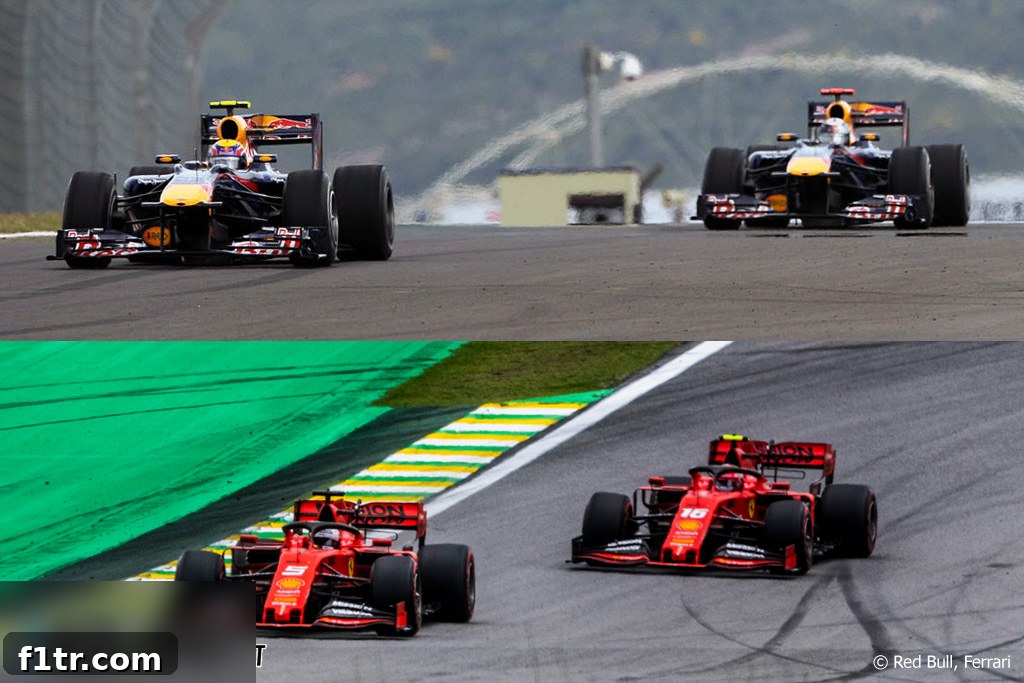
The similarities between the Brazil collision and Vettel’s notorious incident with former Red Bull teammate Mark Webber at Istanbul in 2010 are striking. In both cases, Vettel was in the process of overtaking or re-passing his teammate and squeezed them aggressively, seemingly trying to force them to concede the next corner. In Brazil, with Leclerc on fresher, softer tires, Vettel desperately needed to intimidate his teammate into backing out of a re-pass attempt in the braking zone.
Go ad-free for just £1 per month>> Find out more and sign up
The deeper parallels extend beyond the mere mechanics of the crash. Heading into the 2010 Turkish Grand Prix, Webber had won the two preceding races and was leading the championship, 15 points and four places ahead of Vettel. Then, as in Brazil, Vettel was feeling the intense pressure from a formidable teammate who was performing strongly and reacted with uncharacteristic aggression. In both scenarios, the internal team dynamic and the championship implications played a significant role in the ill-judged maneuvers.
Ferrari’s Critical Crossroads: Handling the Future
The crucial question now facing Ferrari, and especially Mattia Binotto, is how to effectively manage this escalating rivalry. Nine years prior, Red Bull Racing’s Helmut Marko staunchly advocated for Vettel over Webber, leading to accusations that the team was unfairly biased. Today’s Ferrari could face similar accusations if it continues to treat its drivers inconsistently.
Leclerc was publicly rebuked for the Monza incident and his radio messages in Singapore. Yet, Vettel’s blatant insubordination in Russia, where he ignored clear team orders, did not elicit a similar public condemnation or disciplinary response. However, the rashness displayed in Brazil – a direct collision with a teammate – is an incident of a different magnitude, one that cannot be allowed to go unchecked without severe consequences for team morale and future performance.
Furthermore, the context of the rivalry has shifted significantly. In 2010, Sebastian Vettel represented Red Bull’s bright, ascendant future. Today, at Ferrari, that position is unequivocally occupied by Charles Leclerc. His youth, raw speed, and championship potential make him the clear star around whom Ferrari’s long-term aspirations are built. This generational shift may prove to be the vital difference in how Ferrari chooses to handle what otherwise appear to be remarkably similar internal conflicts, potentially signaling a new era of driver management at Maranello.
Quotes: Dieter Rencken
2019 F1 season
- Crying in the Melbourne car park at 2019 grand prix was my career low – Ocon
- McLaren Racing reports reduced £71 million loss in 2019
- Kvyat: Hockenheim podium last year was “my biggest achievement” so far
- How the FIA’s new encrypted fuel flow meter targets Ferrari’s suspected ‘aliasing’ trick
- “He smashed my office door”: 23 must-see moments from ‘Drive to Survive’ season two
Browse all 2019 F1 season articles