For a titan of motorsport accustomed to relentless success, anything short of victory can feel like a profound failure. This sentiment weighed heavily on Lewis Hamilton as he navigated a challenging period in his illustrious Formula 1 career. Arriving at Mercedes’ Brackley factory in January 2013, Hamilton was already a decorated world champion, widely recognized as one of the sport’s most exceptional talents. He seamlessly stepped into the formidable shoes left by the legendary Michael Schumacher, inheriting a legacy of excellence that Mercedes aimed to uphold.
Advert | Become a Supporter & go ad-free
It was a natural progression for Mercedes to pair their new star with Schumacher’s seasoned race engineer, the then 37-year-old Peter Bonnington, affectionately known as “Bono.” Despite a few tantalizing near-misses, this burgeoning partnership wasted no time in delivering results, securing their inaugural win together just ten races into the season at the Hungarian Grand Prix. “Get in there, Lewis,” Bonnington’s voice crackled over the radio as Hamilton crossed the finish line, marking his first triumph as a Mercedes driver and, simultaneously, Bonnington’s maiden Grand Prix victory as a race engineer.
What followed was an unprecedented era of dominance. Over the subsequent eight years and 168 Grands Prix, the Hamilton-Bonnington pairing ascended to become the most successful driver-engineer duo in Formula 1 history. Their shared journey yielded six world championship titles, an astounding 77 pole positions, and 82 Grand Prix victories. The last of these came during a fiercely contested Saudi Arabian Grand Prix in 2021, at the zenith of a bitter championship rivalry with Red Bull and their formidable driver, Max Verstappen.
However, what few could have predicted was the abrupt end to this glorious run. When Hamilton was controversially denied an unprecedented eighth world title just one week later, it heralded the beginning of a stark and barren spell for both Mercedes and their star driver, extending over the following two challenging seasons. As Hamilton and Bonnington approached Silverstone for what would be their twelfth and final British Grand Prix together, they did so having endured a winless streak spanning almost 60 races. They were now spectators to Verstappen and his engineer, Gianpiero Lambiase, rapidly building their own challenge to the record books, threatening to eclipse Hamilton and Bonnington’s legacy as the sport’s premier partnership.
Yet, an unusual sense of optimism permeated the Mercedes garage on Sunday morning at Silverstone. Both Hamilton and Bonnington arrived at the circuit sensing a different energy, a unique dynamic to this race compared to the many frustrating encounters they had endured over the preceding two years. For the first time since that last victory in Jeddah back in 2021, Mercedes had locked out the front row in qualifying. The only distinction this time was that Hamilton had been edged out for pole position by his talented teammate, George Russell.
While Mercedes had clinched a rare victory just a week prior in Austria – a result largely influenced by Verstappen and Lando Norris colliding and handing Russell the win – the team harbored no illusions about the formidable threats awaiting them at Silverstone. Not only did they face strong competition from Norris, Verstappen, and even Oscar Piastri behind them on the grid, but the ominous skies above also promised rain, a near-certain factor that would introduce further unpredictability into the race proceedings.
The paddock buzzed with the collective understanding that the circuit would inevitably get wet. The pivotal question was precisely when. With various weather radars offering subtly differing projections for the arrival and intensity of the rain, teams were compelled to maintain maximum flexibility. Their strategy was to run as deep into the race as possible, pushing for blistering pace while preserving their tires. Consequently, it came as no surprise when the top 13 starters opted for medium compound tires as they left the grid for the formation lap, ready to tackle the initial stages of the race.
A touch of Hollywood glamour graced the start line as two fictional ‘APXGP’ cars lined up at the back, allowing a film crew to capture spectacular shots before these cinematic props were dutifully pushed into the pit lane. They were soon joined by Sergio Perez, who commenced his race from the pit lane following earlier issues. Further drama unfolded at the end of the formation lap when Pierre Gasly’s Alpine also retired to the pits, a debilitating gearbox problem ending his race before it had even truly begun.
Advert | Become a RaceFans supporter andgo ad-free
With 18 cars poised on the grid, the two Mercedes W15s prepared to spearhead the charge towards Abbey. Hamilton, on the inside, had the advantage of the racing line beside Russell. As the lights extinguished, Russell launched superbly from pole position, with Hamilton tucking in behind his teammate well before the turn-in point for Abbey. Behind them, Verstappen initially managed to split the two McLarens. However, Norris’s ambitious attempt to overtake Hamilton on the outside into Village was firmly rebuffed, allowing the seasoned world champion to sweep cleanly around Norris on the outside into The Loop, seizing a crucial third place.
Exiting Chapel onto the iconic Hangar Straight for the first time, Hamilton was within half a second of Russell, while Verstappen lagged a further six-tenths back in third. With DRS activation looming at the end of the lap, Hamilton remained acutely aware of the Red Bull behind him, knowing Verstappen would be eager to make a move before his medium tires passed their optimal window. Fortunately for Mercedes, a subpar exit from The Loop on lap two saw Verstappen drop beyond a second behind Hamilton, affording the Silver Arrows a critical window to pull away before the inevitable rain arrived.
“Rain potentially in 25 minutes,” Bonnington calmly informed his driver as Hamilton exited Luffield for the second time, setting the strategic tone for the unfolding race.
Hamilton deliberately dropped out of DRS range of his teammate on the subsequent lap, a strategic decision that caused him no concern. All teams now anticipated rain striking before lap 20, making the meticulous preservation of their medium tires in optimal condition paramount. By the close of lap ten, the leading six drivers – Russell, Hamilton, Verstappen, Norris, Piastri, and Carlos Sainz Jnr – remained remarkably tightly bunched, all covered by less than ten seconds, a clear testament to their measured and disciplined pacing.
Two distinct showers were converging on the circuit. A light sprinkling was expected first, a mere precursor to a significantly heavier band of rain forecast to follow approximately ten minutes later. Bonnington warned Hamilton that rain was “imminent” midway through the 13th lap, yet there were no immediate considerations for preparing intermediate tires for this lighter initial cell.
Behind Hamilton, Verstappen found himself falling prey to Norris. Despite a week of simmering tension following their Austrian clash and widespread speculation about their next on-track encounter, Norris encountered surprisingly little resistance from the Red Bull driver. With the aid of DRS, Norris effortlessly swept past Verstappen down the Hangar Straight on lap 15, reclaiming a top-three position.
As the Silverstone crowd erupted in cheers, celebrating Norris’s promotion, many seized the opportunity to don their raincoats and ponchos, protecting themselves from the first scattered drops now falling. The rain initially hit the southern section of the circuit, complicating Piastri’s subsequent pass on Verstappen for fourth. The corner, which had offered ample grip moments earlier, now presented a treacherous, slick surface. Soon, the leading Mercedes cars were visibly struggling. As lap times plummeted by three, then five seconds, Hamilton began to swarm over the rear of his race-leading teammate. With DRS still active as they entered the Hangar Straight, Hamilton executed an excellent run on Russell.
“Just caution with the wet,” Bonnington advised, his voice measured. Undeterred, Hamilton successfully navigated the corner, completing the pass for the lead into Stowe. However, moments later at Abbey, both Mercedes drivers suffered slides on the increasingly greasy track, allowing Norris to close right up to Russell and snatch second place into The Loop. Over the remainder of the lap, Norris rapidly gained on Hamilton, and when he challenged for the lead along the pit straight—aptly named in the Mercedes driver’s honor—Hamilton offered minimal resistance, ceding the lead to the McLaren driver for the first time.
Advert | Become a RaceFans supporter andgo ad-free
McLaren’s demonstrable superiority on the now-damp track, astonishingly still running slick tires, was further underscored when Piastri immediately charged onto Hamilton’s tail. “Lewis, we think it’s time to jump to the inters,” Bonnington suggested, his tone probing.
“Nope,” came Hamilton’s unequivocal and decisive response. “It’s dry in a lot of places.”
Ahead, Norris briefly slid off at Becketts. Soon after, Hamilton found Piastri filling his mirrors before ultimately losing second place to the McLaren down the Hangar Straight. However, losing track position was secondary to making the correct tire call for the capricious conditions. While some drivers, notably Perez and Charles Leclerc, gambled on an early switch to intermediates—a decision that would prove detrimental—the leading pack wisely remained out on slick tires for several more critical laps.
Red Bull was the first of the front-runners to blink, pitting Verstappen for intermediates at the end of lap 26. When informed of this, Hamilton concurred, telling Bonnington, “in at the end of this lap.” He emerged behind a Red Bull, but fortunately, it was the car of Perez, now a lapped 17th after his premature switch to intermediates. Norris also pitted on the same lap as Hamilton, managing to regain the lead. Piastri’s decision to stay out an extra lap on slicks proved immensely costly, dropping him to sixth. Hamilton now sat just three seconds behind the leading McLaren, with Verstappen a further four seconds back in third, having gained a position over Russell through his earlier pit stop.
The track conditions were exquisitely marginal – too wet for slicks to be truly effective, yet not wet enough for intermediates to operate in their ideal temperature window. Drivers grappled with near-instant degradation from their freshly fitted tires. Slowly but surely, Hamilton began to close the gap to the leading McLaren, the Mercedes once again proving to be the fastest car on track as the surface gradually dried. But just as momentum seemed to swing in Mercedes’ favor, they suffered a significant setback. Russell was unexpectedly called into the pits, forced to retire with a suspected water system problem. Bonnington relayed the disheartening news to his driver, who now carried the sole hopes of the team.
Miss nothing from RaceFans
Get a daily email with all our latest stories – and nothing else. No marketing, no ads. Sign up here:
Despite the rain continuing to fall lightly, the sun defiantly emerged from behind the clouds, casting its warmth over the southern side of the circuit. Saturday’s qualifying session had provided a stark demonstration of just how rapidly the track could dry, and with no further rain anticipated until the checkered flag, teams now faced the daunting prospect of making a critical decision: when to switch back to slicks, potentially much sooner than initially expected.
Hamilton capitalized on a slight slide from the McLaren at the exit of Club, narrowing the gap to the leader to within two seconds. Mercedes strategists now intensely focused on how a timely switch to slick tires could provide their driver with a definitive chance of seizing the lead. “Okay, Lewis, from your times, it looks like it’s getting close to the cross[over],” Bonnington conveyed as Hamilton entered the Wellington Straight, with just 15 laps remaining. “Let us know what you think.”
“It’s very close, mate,” came Hamilton’s immediate, precise reply. “It could be this lap.”
Advert | Become a RaceFans supporter andgo ad-free
And so it proved. Hamilton was called into the pits as he entered Stowe, joining Daniel Ricciardo and Kevin Magnussen, who had been brought in moments earlier for their own tire changes. Verstappen also pitted on the same lap, opting for hard tires. Crucially, Norris stayed out an extra lap, benefiting from a fresh set of mediums—a distinct advantage over Hamilton, who was fitted with soft tires, and Verstappen on hards. Norris eventually pitted at the end of the subsequent lap, but he, too, opted for soft tires for the thrilling final 14 laps.
Norris pulled in slightly long into his pit box, and a 4.5-second hold further compounded his woes. However, Hamilton’s middle sector on the new slicks had been more than a second faster than Norris’s on used intermediates, enabling the Mercedes driver to leapfrog the McLaren as Norris exited the pit lane. With just 13 laps remaining and no further rain predicted, the British Grand Prix had distilled into an electrifying three-way battle for victory: Hamilton and Norris on softs, separated by a mere two-and-a-half seconds, with Verstappen a further four seconds back on hard tires. Bonnington attempted to outline the precarious situation to his driver, but Hamilton, fully immersed in the moment, was not interested in distractions.
“Yeah, leave me to it, mate,” he asserted, his focus unwavering.
Remarkably, Hamilton had not found himself in the position of leading a Grand Prix on merit in its final stages throughout the ground effect era. Nearly three years had passed since he last commanded a race from the front, yet here he and Bonnington were, returning to their natural habitat. This was precisely the scenario that had been their bread and butter for so many years, and as the laps relentlessly wound down, it felt as if the clocks had indeed been turned back, a nostalgic echo of their dominant past.
Initially, Norris demonstrated superior pace to Hamilton, but the Mercedes driver swiftly responded, incrementally extending his lead over the McLaren. Meanwhile, Verstappen, on his hard tires, began to show astonishing speed, rapidly closing in on the pair ahead. When DRS was re-enabled on lap 41, it provided a significant boost to Verstappen, who was now unequivocally closing on Norris.
Advert | Become a Supporter & go ad-free
With just six laps remaining, Verstappen’s gap to Hamilton dipped below four seconds. The reigning world champion, Hamilton’s fierce rival, was now undeniably the biggest threat to what would be a truly stunning end to his prolonged win drought. Five laps from the finish, Verstappen was comfortably within the slipstream of the McLaren ahead. Norris offered a valiant defense, diligently protecting the inside line as Verstappen stalked him down the Hangar Straight. However, his efforts were ultimately futile, as the Red Bull surged past on the left, effortlessly claiming second place.
Now with four laps remaining, Verstappen faced a three-second deficit to Hamilton. Could he break the hearts of a hundred thousand spectators and snatch victory? On the first of these final laps, Verstappen gained only a tenth of a second. Lapped traffic further complicated the second lap for Hamilton, who pleaded for “blue flags” over the radio, but even then, Verstappen could only shave off a mere four-tenths. Entering the final lap, Hamilton remained comfortably out of DRS range, the victory now tantalizingly within grasp. It was increasingly evident that Verstappen had simply run out of time.
Almost 1,000 days since his last victory, and just weeks after confirming his seismic move from Mercedes to Ferrari at the end of the year—a decision that had fueled doubts and questions about whether the Scuderia was downgrading by dropping Sainz for a driver amidst his career’s longest losing streak—Hamilton was emphatically proving his enduring capabilities. This win was not just a victory; it was a powerful statement.
Advert | Become a RaceFans supporter andgo ad-free
Bonnington continued to provide Hamilton with updates on Verstappen’s diminishing gap, but with under six kilometers remaining, Hamilton gently, yet firmly, told his engineer and close friend, “leave me to it,” one last time. Hamilton had taken the checkered flag first at his home Grand Prix on eight previous occasions. Yet, after such an extended period of losing, and knowing this would be his final home race shared with Mercedes and Bonnington, Hamilton could no longer contain his raw emotions as he crossed the finish line. And neither, it seemed, could his race engineer.
“Get in there, Lewis!” Bonnington roared, his voice thick with emotion, viscerally releasing over two years of pent-up frustration and disappointment. “Oh, I’ve been waiting for this… jeez.” Hamilton’s 104th Grand Prix victory resonated with as much significance and emotion as any of his previous triumphs. “Thank you so much, guys…” he uttered, his voice quivering with profound emotion as he saluted the adoring Silverstone crowd. “It means a lot to get this one.”
Verstappen, finishing just 1.4 seconds behind the winner, received the understandable commiserations of his own race engineer, Gianpiero Lambiase. “Oh, hard luck, Max,” offered Lambiase. “Not a bad chase, that. Well done.”
“Well, we weren’t the quickest, but we did everything right today,” Verstappen replied, ever the pragmatist.
Norris, predictably, was less than thrilled, having again been at the very forefront of the field only to miss out on victory. The joint decision not to fit his fresh mediums at the final pit stop was immediately identified as the primary cause of his latest defeat. “We threw it away in the final stop,” Norris later admitted, reflecting on the crucial moment. “I think even if I boxed on the perfect lap, our decision to go on to the softs was the wrong one.”
However, Norris was not the only McLaren driver to depart Silverstone with a sense of disappointment. Piastri was left rueing his team’s controversial call not to pit him alongside his teammate for intermediates, even if it meant a frustrating double-stack. His extra lap on slicks cost him approximately 18 seconds, ultimately seeing him finish within 13 seconds of Hamilton at the flag, a testament to what might have been.
Advert | Become a RaceFans supporter andgo ad-free
Elsewhere on the grid, Sainz finished a respectable fifth, having snatched the fastest lap with a late switch to softs. Nico Hulkenberg delivered a brilliant performance, validating Haas’s latest upgrades with a superb sixth place, just ahead of Lance Stroll. Fernando Alonso brought home the second Aston Martin in eighth. Alexander Albon impressively claimed two points for Williams in ninth, with Yuki Tsunoda securing the final point in tenth. Those who gambled on intermediates too early, namely Charles Leclerc and Sergio Perez, finished well outside the points in 14th and 17th, respectively, highlighting the strategic complexities of the mixed conditions.
But ultimately, the day belonged unequivocally to Hamilton. As he pulled into the pit lane, parking triumphantly in front of the coveted number one board once again, George Russell, despite his own earlier misfortune, walked over to offer his heartfelt congratulations to his teammate. After Russell’s victory the previous weekend in Austria had been somewhat fortuitous, Hamilton’s win at Silverstone, achieved without a single Safety Car intervention or the retirement of a rival team, was, as Team Principal Toto Wolff later characterized it, an ‘honest’ and well-deserved triumph for the entire Mercedes squad.
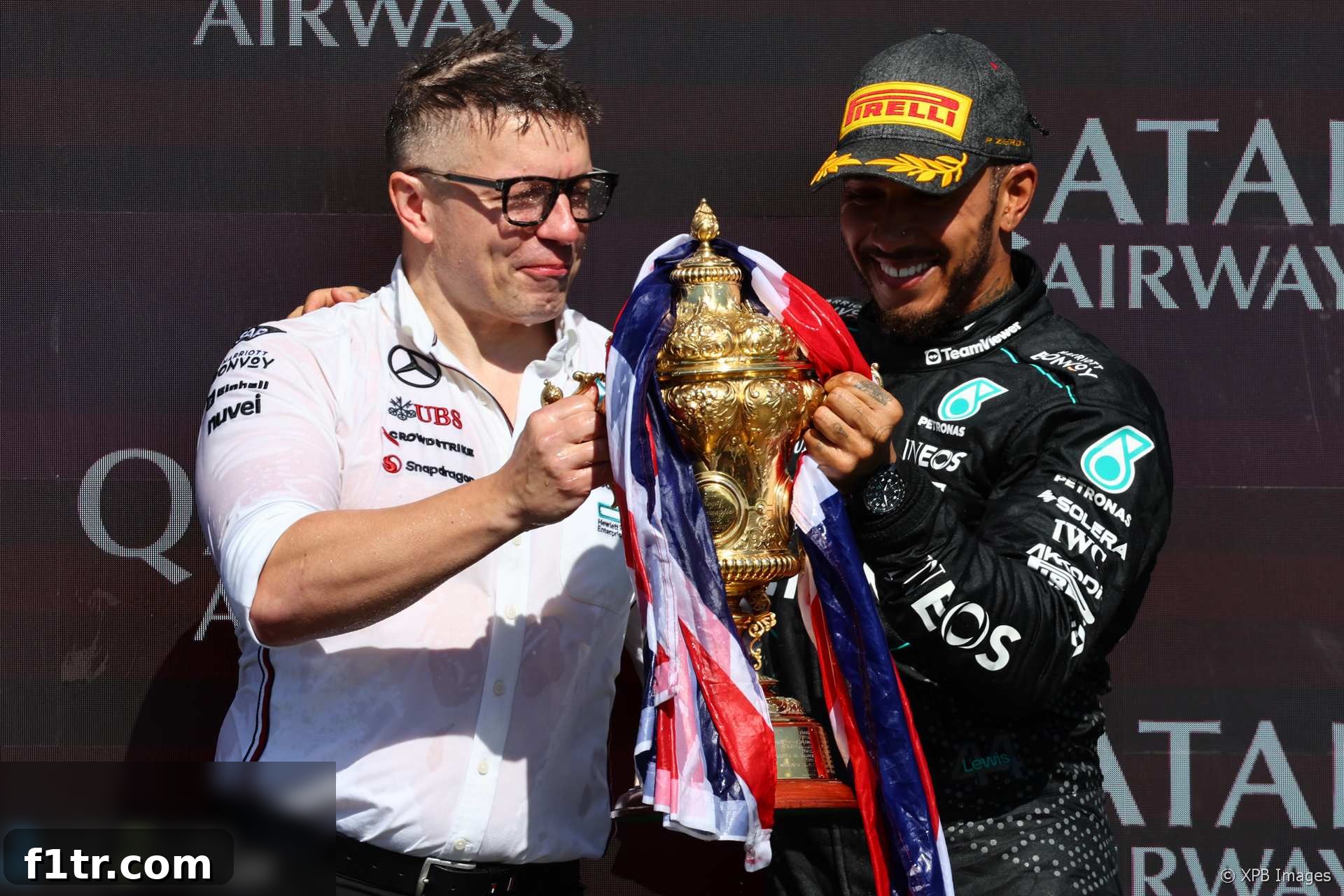
For what would be the final time as a Mercedes driver, Lewis Hamilton ascended the iconic Silverstone podium, gazing out at the adoring crowd, savoring the profound feeling of victory once more. By his side stood Peter Bonnington, the most fitting member of the team to share this poignant moment – the 83rd win of their historic partnership. And perhaps, out of all their shared triumphs, this one, breaking a drought of 945 days, would forever be etched in memory as the most emotional.
“That’s the longest stint that I’ve not had a win, 945 days,” Hamilton reflected, his voice still heavy with the magnitude of the achievement. “And the emotion that’s accumulated over that time. So this one could be one of the most special ones for me, I think, if not the most special one.” This British Grand Prix victory was more than just a win; it was a testament to resilience, an emotional crescendo, and a powerful reaffirmation of a legend’s enduring skill.
Become a RaceFans Supporter
RaceFans is run thanks in part to the generous support of its readers. By contributing £1 per month or £12 per year (or the same in whichever currency you use) you can help cover the costs of creating, hosting and developing RaceFans today and in the future.
Become a RaceFans Supporter today and browse the site ad-free. Sign up or find out more via the links below:
- Become a RaceFans Supporter
- RaceFans Supporter FAQ
2024 British Grand Prix Related Articles
- The ‘good and bad’ reason Piastri is sure he can win after three near-misses
- Gasly solved mystery handling problem by using Ocon’s settings
- Mercedes “will be in an even stronger position” after next upgrade – Hamilton
- Verstappen “refuses to believe” Red Bull are reaching limit of RB20’s potential
- Why “under construction” McLaren still celebrate third place after missing a win
Browse all 2024 British Grand Prix articles
More F1 Race Reviews
- Antonelli lucks in for second win and becomes youngest F1 championship leader
- Emotional Antonelli grabs first Formula 1 victory in Chinese Grand Prix
- Russell sees off Ferrari threat to lead Mercedes one-two in Melbourne
- Norris clinches F1 title by two points as Verstappen wins finale at Yas Marina
- McLaren strategy blunder in Losail hands Verstappen crucial win and shot at title
Read all F1 race reviews