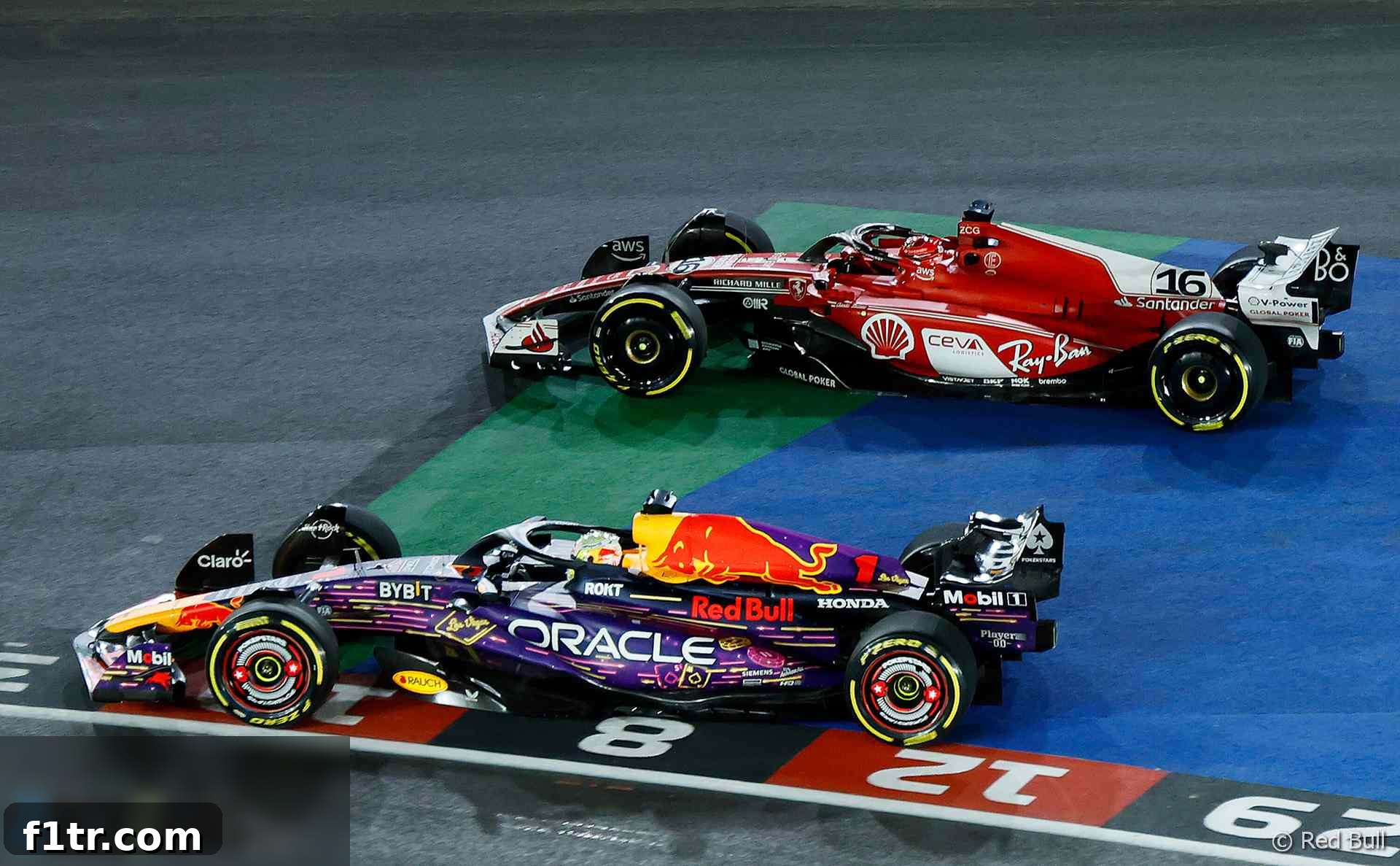
Leclerc Demands FIA Intervention After Verstappen’s Controversial Las Vegas Maneuver
Charles Leclerc has voiced his strong opinion that the FIA should have instructed Max Verstappen to relinquish his position after the Red Bull driver pushed him off the track during the chaotic opening lap of the Las Vegas Grand Prix. The incident, which occurred at the very first corner of the highly anticipated race, ignited immediate debate regarding racing standards and the effectiveness of current penalty systems in Formula 1.
The highly anticipated Las Vegas Grand Prix, a spectacle billed as a new era for Formula 1 in the United States, began with immediate drama and controversy. Ferrari’s Charles Leclerc, starting from a hard-earned pole position, found himself battling fierce competition from the onset. Alongside him on the front row was reigning world champion Max Verstappen of Red Bull Racing. As the lights went out and the field surged towards Turn 1, the notoriously low-grip conditions of the street circuit quickly became apparent, setting the stage for an incident that would define the early moments of the race.
Advert | Become a Supporter & go ad-free
Verstappen, known for his aggressive racing style, made a decisive move down the inside heading into the first corner. However, in doing so, he failed to maintain a clean line, running wide and effectively squeezing Leclerc off the racing surface. This maneuver forced the Ferrari driver to take evasive action, costing him valuable track position and disrupting his early race rhythm. While Red Bull swiftly communicated to their driver to hold the gained position, Leclerc’s frustration was palpable over the team radio, describing the lack of an immediate “give back the place” order as a “joke.” The stewards, after reviewing the footage, eventually intervened, handing Verstappen a five-second time penalty for the infraction.
Despite his initial frustration, Leclerc later offered a degree of understanding regarding the challenge Verstappen faced in controlling his car under the treacherous low-grip conditions. “Max already came to me and explained the situation,” the Ferrari ace acknowledged, highlighting the sportsmanship between the rivals off-track. However, he remained firm in his belief that a penalty was warranted. “Obviously it was on the limit, over the limit and I think the five seconds penalty is deserved,” Leclerc stated, reflecting on the fine line between aggressive racing and an illegal move.
The incident underscored the difficulties drivers faced on the brand-new Las Vegas street circuit, particularly during the initial laps when tyre temperatures were low and track grip was minimal. Leclerc elaborated on his own struggle during the incident: “It was tight. I still tried to push off the track – but it was so low grip – to try and keep that position.” This detail illustrates the inherent challenges of the circuit and the split-second decisions drivers must make at over 200 mph. Ultimately, while accepting the fairness of the five-second penalty, Leclerc’s primary contention was not with the outcome of the penalty itself, but rather with the method of its application.
The “Give Back the Place” Debate: A Call for Direct Intervention
Leclerc’s more significant point of contention revolved around the FIA’s handling of such situations. He firmly believes that in instances where a driver clearly gains an unfair advantage by forcing a competitor off track, the correct procedure should be for the race director to instruct the offending driver to immediately cede the position. “I just think that in those kind of situations it would be better for the FIA to ask to give the place back because I think there’s quite a bit of an advantage to take care of tyres when you have free air,” Leclerc argued. This argument highlights a critical aspect of modern Formula 1: tire management.
Advert | Become a RaceFans supporter andgo ad-free
By staying ahead, even with a time penalty looming, Verstappen was able to run in “free air,” avoiding the turbulent wake of other cars. This uninterrupted flow of air over his car allowed him to maintain optimal tire temperatures and minimize degradation, thereby preserving the performance of his Pirelli tires. Conversely, Leclerc, forced to battle back through the field and contend with dirty air, would have undoubtedly experienced greater tire wear and a reduction in his car’s aerodynamic efficiency. This subtle yet significant advantage, Leclerc suggests, is not fully mitigated by a simple time penalty applied later in the race, especially when the damage to the other driver’s race strategy is immediate and profound.
The “give back the place” rule is not unprecedented in motorsport. It is often employed in various categories to swiftly neutralize an unfair advantage and restore the original racing order without compromising the flow of the race or the strategic integrity of competitors. Leclerc’s call for this direct intervention reflects a desire for more immediate and impactful justice on track, ensuring that drivers are less incentivized to commit borderline infractions for a temporary gain.
Verstappen’s Perspective: Low Grip and Adrenaline
Max Verstappen, for his part, accepted the penalty, offering his version of events and insights into the challenging conditions. “The start was good but we both braked quite late to defend the position, but I was a bit on the inside on the dirt, I guess,” Verstappen explained. His account painted a picture of a driver pushing the limits on a tricky surface. “As soon as you’re a bit off-line here it’s super-low grip and that’s what happened. I braked and there was no grip. I didn’t mean to push Charles off the track, but I couldn’t slow down, I just kept sliding on four wheels, wide. So that’s why we had to go wide.”
This explanation from the Dutchman underscores the unique characteristics of the Las Vegas circuit, a temporary street track where the asphalt was fresh and not fully rubbered-in, leading to exceptionally low grip levels, particularly off the racing line. Verstappen’s admission of sliding “on four wheels” provides a vivid illustration of the lack of control he experienced at that critical moment. While he acknowledged the stewards’ decision, his initial reaction, fueled by the adrenaline of the opening lap, was one of disagreement. “At the time you’re also full of adrenaline and I was not happy with the decision but looking back at it, it was probably the right call,” he conceded, showing a degree of reflection and maturity.
The five-second penalty certainly complicated Verstappen’s race strategy. Having to build a gap to the cars behind to negate the penalty meant pushing harder and potentially compromising tire life. “After that, of course, with that five seconds, it was definitely a bit harder to come back to the front,” he stated. Despite this, Verstappen ultimately demonstrated his phenomenal race craft, carving his way back through the field to secure a remarkable victory, showcasing his ability to overcome adversity.
The Stewards’ Verdict and Licence Points
The FIA stewards’ decision was clear and unambiguous. They ruled that Verstappen “appeared to miss the apex of turn one, did not follow the racing line and consequently forced car 16 [Leclerc] off the track.” This precise articulation of the infraction left little room for doubt regarding the responsibility for the incident. The penalty comprised a five-second time addition to his race time, coupled with two penalty points on his Super Licence. Significantly, these were the first penalty points accumulated by Verstappen within the current 12-month period, a rare occurrence for the typically disciplined world champion.
The allocation of penalty points serves as an additional deterrent, as accumulating 12 points within a year automatically results in a one-race ban. While two points are a minor fraction of this threshold, it underscores the FIA’s commitment to maintaining driving standards and penalizing transgressions, regardless of the driver’s stature. The stewards’ swift and decisive action aimed to uphold fair play and ensure that drivers adhere to the established rules of engagement on track.
Strategic Penalty or Position Relinquishment?
An interesting revelation came from Verstappen himself, who confirmed that his Red Bull team had the option to let Leclerc past immediately but chose not to. “We opted to just stay ahead at that point,” he said, indicating a tactical decision rather than an oversight. “So then you take the five second penalty.” This choice highlights a strategic dilemma teams often face: whether to immediately surrender a position and avoid a penalty, or to accept a time penalty later while maintaining track position, betting on the ability to build a sufficient gap.
Advert | Become a RaceFans supporter andgo ad-free
Verstappen pondered the efficacy of their decision: “I don’t know what’s better at the end. I mean, I paid the penalty, right? So it doesn’t matter in a way, you know, like if you go back behind, you probably also end up losing whatever, five seconds. So it’s pretty similar, I guess at the end.” While he suggests the net loss might be similar, Leclerc’s argument about the crucial “free air” advantage suggests otherwise. The ability to control the race from the front, manage tires optimally, and dictate pace can be far more beneficial than a simple five-second time penalty might imply, especially in a closely contested race. This incident will undoubtedly fuel further discussions among teams, drivers, and the FIA about the most equitable and effective ways to penalize on-track infringements.