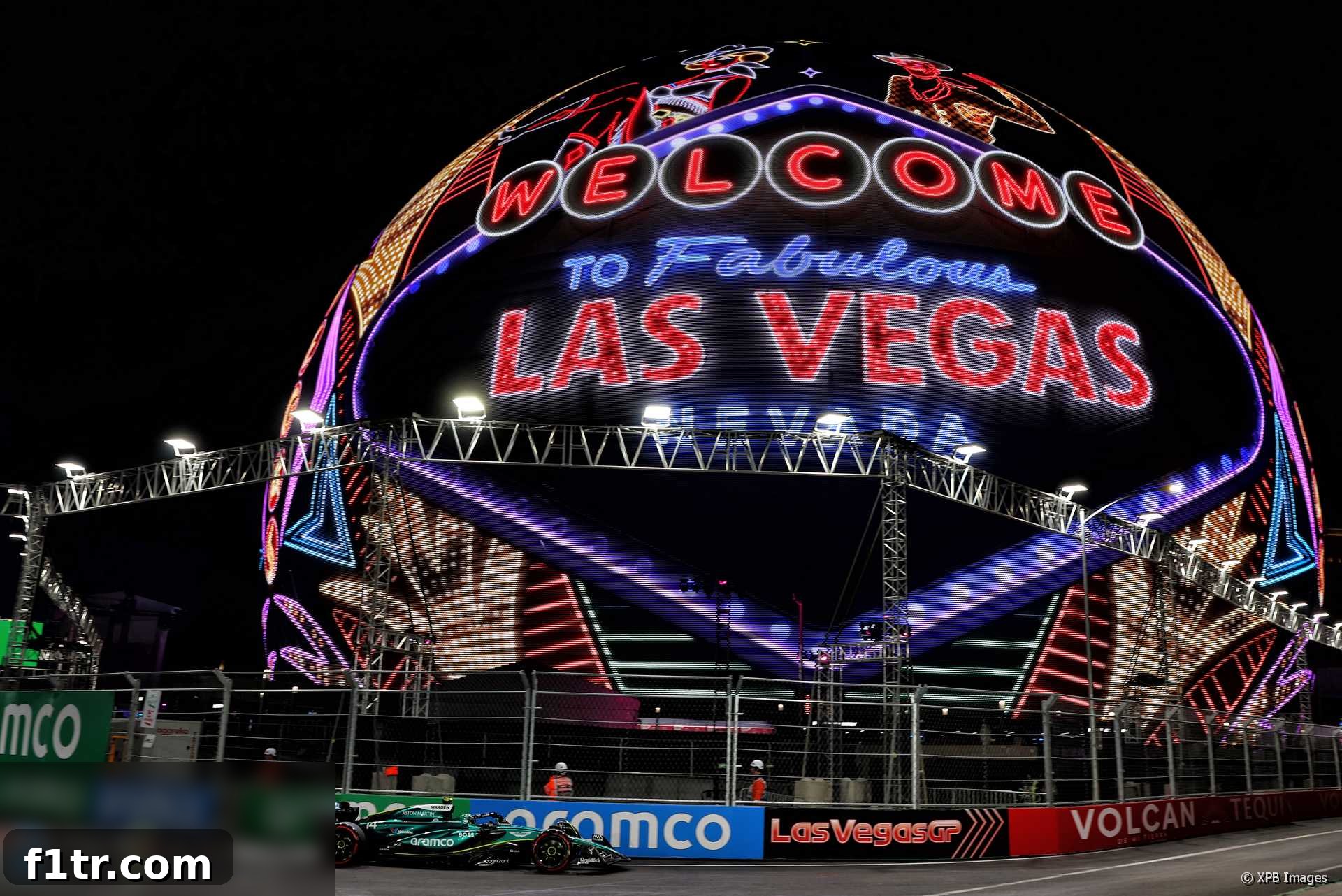
In a significant development for the world of Formula 1, the Las Vegas Convention and Visitors Authority (LVCVA) has openly expressed its willingness to extend its highly successful partnership with Formula 1 beyond the initial three-year agreement. This indicates a strong mutual interest in solidifying the future of the Las Vegas Grand Prix, a race that has quickly become a pivotal event on the F1 calendar and a cornerstone of the sport’s burgeoning presence in the United States.
Formula 1 News Digest: Key Updates from Around the Paddock
Las Vegas Grand Prix Set for Long-Term Commitment Amidst Contract Extension Talks
The exhilarating Formula 1 Las Vegas Grand Prix, a spectacle held on the iconic Las Vegas Strip Circuit, is currently operating under a three-year agreement that is slated to conclude after the 2025 race. However, signs are strongly pointing towards a much longer commitment. Formula 1, uniquely acting as both the series organizer and the promoter for this particular round, has already secured the necessary long-term permission to host races on the city’s roads for a decade, laying the groundwork for a sustained presence.
Following the successful second running of the event last weekend, which saw improvements in organization and fan experience, the Las Vegas Convention and Visitors Authority (LVCVA) has publicly indicated its enthusiasm for the race to continue well beyond its current contractual obligations. Steve Hill, President and CEO of the LVCVA, conveyed this positive sentiment to the Las Vegas Review-Journal, stating, “We’ll look to have something a little more permanent in place.” This statement underscores a strategic vision to embed the Grand Prix as a lasting fixture in the city’s events portfolio.
Further elaborating on the timeline, Hill added, “We’ll probably start that conversation shortly after the first of the year and probably look to have something in place prior to the race happening next year.” This proactive approach suggests a shared desire between F1 and Las Vegas to secure the event’s future swiftly, ensuring stability and allowing for long-term planning. The Las Vegas Grand Prix represents a significant investment for both parties, and a permanent extension would solidify its status as a premier global sporting event, continuing to draw international attention and tourism to the entertainment capital of the world. The initial races have demonstrated a massive economic impact and a unique blend of high-octane motorsport with the vibrant energy of the Strip, making a continued partnership highly desirable for all stakeholders involved.
Yuki Tsunoda Explores IndyCar Prowess in Landmark Test Drive
In an intriguing cross-discipline development, Formula 1 driver Yuki Tsunoda recently had his first taste of an IndyCar, getting behind the wheel of one of the formidable open-wheel machines ahead of the past weekend’s grand prix. This test marks a significant moment, offering the Japanese driver an invaluable opportunity to experience a different facet of elite motorsport and perhaps consider future career avenues.
Tsunoda, known for his aggressive driving style and spirited performances in Formula 1 with the RB team (formerly AlphaTauri), has consistently shown his potential. His venture into IndyCar testing could be seen as an exploratory move, either to broaden his racing skillset, evaluate alternative pathways in top-tier motorsport, or simply to satisfy a driver’s natural curiosity about different machinery. IndyCar, with its unique chassis, oval racing, and distinct aerodynamic characteristics, presents a stark contrast to the sophisticated hybrid power units and complex aero of Formula 1 cars. The experience would have provided Tsunoda with fresh perspectives on vehicle dynamics and handling at high speeds, enriching his overall understanding of elite single-seater racing. Such tests often generate considerable buzz among fans, speculating on potential future transitions or guest appearances, further linking the two prestigious racing series.
Williams Racing’s Rising Star Oleksandr Bondarev Joins Prema in Italian F4
Williams Racing has announced a strategic placement for one of its promising junior drivers, 15-year-old Oleksandr Bondarev, who is set to compete with the esteemed Prema Racing team in Italian Formula 4 next year. This move is a crucial step in the young Ukrainian driver’s development, positioning him within one of motorsport’s most successful junior teams known for nurturing future champions.
Bondarev made his debut in the highly competitive Italian F4 series earlier this year, participating in the final two rounds to gain initial experience and familiarity with the championship’s dynamics. His progression into a full season with Prema is a testament to his talent and Williams’ commitment to his growth. Italian F4 is widely regarded as one of the toughest and most respected entry-level single-seater championships globally, attracting top talent from around the world. Prema Racing, with its unparalleled track record in junior formulae, including numerous titles in F4, F3, and F2, offers an ideal environment for Bondarev to hone his skills, learn from experienced engineers, and compete against a strong field. This opportunity will be instrumental in his journey through the motorsport ladder, with the ultimate goal of reaching Formula 1 as part of the Williams driver development program.
Further Reading: Insights from the Motorsport World
Delve deeper into some of the most compelling stories and discussions from the broader motorsport and entertainment landscape with our curated selection of external articles. These pieces offer unique perspectives on the sport’s cultural impact, ongoing challenges, and the broader narratives shaping its future.
Kaya Scodelario on Skins, scares and sex scenes: ‘I was called an English rose – it really pissed me off’ (The Guardian)
While primarily an interview about her acting career, this Guardian piece offers a poignant reflection on the enduring legacy of Ayrton Senna through the eyes of actress Kaya Scodelario. She recalls her powerful experience watching Asif Kapadia’s documentary, “Senna,” emphasizing the emotional depth of the film and its profound impact on Brazilian audiences. Scodelario’s account highlights how Senna transcended sport to become a cultural icon, demonstrating the incredible power of Formula 1 figures to inspire and move millions even decades after their passing. The collective emotional response she witnessed underscores the deep connection fans forge with legendary drivers, a bond that remains vibrant across generations and cultures.
Brundle on Las Vegas GP (Sky Sports)
Renowned F1 commentator and former driver Martin Brundle shares his candid thoughts on the recent Las Vegas Grand Prix in this Sky Sports column. Brundle, known for his insightful and often humorous analysis, delves into the logistical and experiential challenges faced by attendees and participants alike, particularly the unconventional late-night schedule. His personal anecdote about struggling with the timings offers a relatable perspective on the demands placed on everyone involved in the event. Beyond Las Vegas, Brundle also touches upon Max Verstappen’s remarkable fourth world title and George Russell’s impressive race win, providing a comprehensive overview of recent F1 highlights and controversies from an expert’s viewpoint, shedding light on the human element behind the glamorous façade of Formula 1.
F1 says 306K attended Las Vegas race; police report lower number: here’s why (8 News Now)
This investigative report from 8 News Now highlights a discrepancy in attendance figures for the Las Vegas Grand Prix, contrasting the 306,000 figure reported by F1 with a significantly lower number suggested by police reports, totaling around 139,000 across the three race days. The article delves into the potential reasons for this disparity, often related to how “attendance” is calculated—whether it counts unique ticket holders, cumulative entries over multiple days, or total gate clicks. Such discrepancies are not uncommon for large-scale events and often spark debate about transparency and the true success metrics of major sporting spectacles. Understanding these nuances is crucial for both event organizers and the public to accurately gauge the scale and impact of the Grand Prix on the city and its economy.
F1 in push to broaden trackside appeal as racing returns to Vegas (Financial Times)
The Financial Times explores Formula 1’s ongoing efforts to diversify and broaden its trackside appeal, particularly in the context of the Las Vegas Grand Prix. The article touches upon the sport’s past reliance on high-end hospitality, which, while lucrative, inadvertently limited access for a wider range of fans, including newer and potentially younger demographics. F1’s current strategy aims to strike a better balance, ensuring that the sport remains accessible and engaging for a broader audience without diluting its premium appeal. This shift is vital for long-term growth and fan engagement, especially in new markets like the US. By creating more diverse ticketing options and experiences, F1 hopes to cultivate a more inclusive environment that welcomes both traditional enthusiasts and those new to the excitement of Grand Prix racing.
We always endeavour to credit original sources. Got a tip for a link relating to single-seater motorsport? Please send it to us via the contact form.
Advert | Become a RaceFans supporter andgo ad-free
Social Media Highlights: Voices from the Motorsport Community
Explore some notable discussions and insights from prominent figures and outlets across various social media platforms, offering glimpses into current sentiments and future aspirations within the world of racing:
I feel very lucky that I’ve been able to stick around for this long and do what I love for so long. And the idea that the Cadillac F1 Team wants me around….I’ll help where I can, a non-executive role with the team, not involved in day-to-day operations (because I don’t want a…
— Mario Andretti (@MarioAndretti) November 25, 2024
Legendary motorsport figure Mario Andretti expressed his gratitude and excitement regarding his potential involvement with the proposed Cadillac F1 Team. In a heartfelt post, Andretti conveyed his appreciation for a long and illustrious career in motorsport and his eagerness to contribute to a new American F1 venture. His prospective role, described as a non-executive position, would allow him to offer strategic guidance and lend his invaluable experience without being embroiled in the daily operational grind—a preference he clearly stated. This potential partnership signifies a powerful endorsement for the Cadillac F1 bid and highlights the enduring appeal of the Andretti name in global motorsport. His involvement could bring significant gravitas and a wealth of knowledge to a new team looking to establish itself on the world stage of Formula 1, further galvanizing American interest in the sport.
Formula E CEO Jeff Dodds will be particularly pleased Lando Norris didn’t manage to beat Max Verstappen to the championship:
https://buff.ly/3V7Tk5b
#F1 #FE
[image or embed]
— RaceFans (@racefansdotnet.bsky.social) 25 November 2024 at 15:34
A post from RaceFans on Bluesky, referencing Formula E CEO Jeff Dodds, humorously speculated on Dodds’ potential satisfaction that Lando Norris did not manage to secure the Formula 1 championship title over Max Verstappen. This comment subtly hints at the dynamic rivalry and competitive spirit that exists between different top-tier motorsport series, especially Formula 1 and Formula E. While both offer distinct racing experiences, there is an underlying competition for talent, headlines, and fan engagement. Dodds’ hypothetical pleasure could stem from the idea that a dominant F1 narrative might overshadow other series, or perhaps it touches upon specific competitive nuances or past comments between the two championships. This playful observation highlights the interconnectedness of the racing world and the constant jockeying for position, not just on track but also in the broader sporting consciousness.
Advert | Become a RaceFans supporter andgo ad-free
- Find more official F1 accounts to follow in the F1 Twitter Directory
Comment of the Day: McLaren’s Strategic Decisions Under Scrutiny
Today’s featured comment dives deep into the strategic choices of the McLaren F1 team, particularly questioning their approach during critical phases of the championship fight. The discussion centers around whether Lando Norris’s self-admitted errors were the sole factor in lost points, or if McLaren’s overarching strategy played a more significant, perhaps too passive, role in their championship aspirations.
I also think that in general McLaren were far too conservative when they had a competitive car, often playing reactive strategy and following the opposition rather than trying anything to improve their result.
For example, in Spa when Norris was out of position after a poor start and overtaking was clearly challenging, they had little to lose by attempting a one-stop, but didn’t, and inevitably got stuck in a DRS train. Also in Monza, where they looked to have control of the race with Piastri in the lead, but instead of at least splitting strategies they allowed themselves to be countered by an alternate strategy.
To me, they always looked like a team that was happy to just collect ‘decent’ points every race rather than fighting for championships.
Keith Campbell (@Keithedin)
Keith Campbell’s insightful critique highlights a perceived conservatism within McLaren’s strategic department. He argues that even with a highly competitive car, the team often defaulted to a reactive posture, mirroring competitor strategies rather than taking calculated risks to maximize their potential outcomes. The examples provided—Spa and Monza—illustrate this point vividly. In Spa, with Norris facing an uphill battle after a poor start, a bold one-stop strategy could have been a high-reward, low-risk gamble, yet it wasn’t pursued, leading to a frustrating period stuck in a DRS train. Similarly, at Monza, when Oscar Piastri appeared to control the race, the failure to diversify strategies by splitting approaches between their two cars left them vulnerable to rivals employing alternative tactics.
This perspective suggests that McLaren, despite their clear pace improvements, may have lacked the aggressive, championship-winning mindset often seen in top-tier teams. The focus, as Campbell observes, seemed to be on accumulating “decent” points consistently rather than pushing the boundaries to convert potential victories into actual ones, or to challenge for the ultimate title. In Formula 1, where fine margins dictate success, such strategic hesitancy can be the difference between a strong season and a truly memorable championship bid. This analysis prompts a wider discussion on whether modern F1 teams, with their advanced simulations and data, sometimes become overly cautious, overlooking the potential gains from bold, unconventional strategic plays that can define champions.
Happy Birthday! Celebrating Motorsport Personalities
A very happy birthday goes out to several notable individuals within and around the motorsport community today: Carlos Santos, Nick, and Andy Alexander! We wish them all a fantastic day filled with joy and celebration. These personal acknowledgments highlight the diverse community that supports and contributes to the world of racing, from fans and enthusiasts to those working behind the scenes.
On This Day in Motorsport History: The Ferrari 312T5’s Challenging Debut
- Exactly 45 years ago today, Ferrari unveiled its 312T5, a car that would unfortunately go down in history as one of the team’s least successful Formula 1 challengers. Launched in late 1979 for the upcoming 1980 season, the 312T5 was intended to defend the constructors’ and drivers’ championships that Ferrari had triumphantly won in 1979 with Jody Scheckter.
However, the 312T5 proved to be a significant step backward for the Maranello squad. The car, an evolution of the highly successful 312T series, failed to adapt to the ground effect aerodynamics that were rapidly dominating Formula 1 at the turn of the decade. Its flat-12 engine, while powerful, was wide and hindered the creation of effective underbody tunnels, a critical component for generating aerodynamic downforce in the ground effect era. This fundamental design flaw meant the 312T5 lacked grip and was notoriously difficult to drive, severely hampering the performance of both defending champion Jody Scheckter and his teammate Gilles Villeneuve.
The 1980 season saw Ferrari plummet to an uncharacteristic 10th place in the Constructors’ Championship, a stark contrast to their previous year’s dominance and their worst performance in four decades. Jody Scheckter, disillusioned by the car’s poor performance and the lack of competitive edge, scored only two points throughout the season and ultimately retired from Formula 1 at its conclusion, making the 312T5 his final Grand Prix machine. Gilles Villeneuve, despite his immense talent and bravery, could only manage a handful of points finishes himself. The 312T5 remains a poignant reminder of how quickly fortunes can change in Formula 1 and the critical importance of adapting to evolving technical regulations and design philosophies to stay at the pinnacle of motorsport.